

Quick Answer: What Should You Know Before Visiting China?
For a first mainland China trip, choose a few places that match your interests and leave enough time between them. Beijing, Xi’an and Shanghai make a useful starting route for around 10–12 days, with additions depending on your pace.
- Destinations: Combine complementary places rather than collecting distant cities.
- Time: Seven days suits one region; 10–14 days gives more room for contrasting stops.
- Season: Match the weather to your actual destinations and check holiday crowds.
- Entry: Confirm your passport’s visa or visa-free conditions before buying inflexible tickets.
- Practical setup: Prepare payments, mobile data, navigation and offline booking details.
Nature, Silk Road and high-altitude trips can also work for a first visit, but need a route built around their distances and conditions. Choose the trip first; prepare the tools around it.
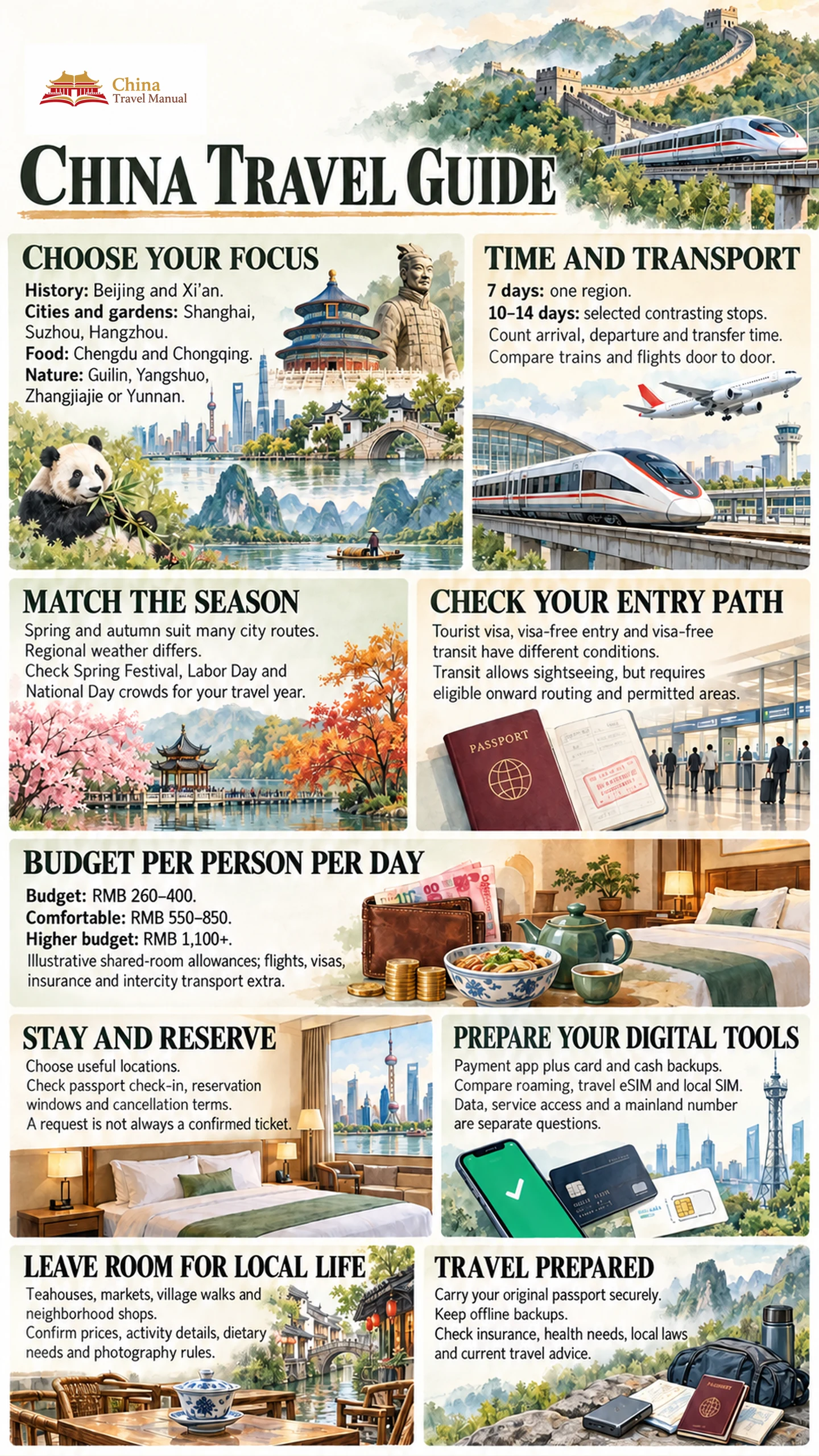
Your first China trip becomes easier once you decide what matters most: imperial history, modern cities, dramatic scenery or everyday local life. That choice shapes your route, travel days and budget. This China travel guide focuses on mainland China. Hong Kong, Macau and Taiwan have separate entry and practical arrangements. Start with a manageable route, then use the linked guides to work through the details.
Where to Go in China: Match Destinations to Your Interests
Choose destinations by what you want to experience, then check whether they fit together. A first trip does not need Beijing, pandas, rice terraces and a mountain park to feel worthwhile. Two places explored well can offer more than five rushed stops. Use the China destinations guide to compare a wider range once you know your priorities.
| Destination or region | Best fit | Representative highlights | Main planning trade-off |
|---|---|---|---|
| Beijing | Imperial history, architecture and museums | The Forbidden City, Temple of Heaven and hutongs | Major sights spread across a large city. Give a Great Wall excursion its own day; check each attraction’s reservation rules. |
| Xi’an | Archaeology, ancient capitals and food | The Terracotta Warriors, city wall and historic neighborhoods | The central area is manageable, but the warriors are outside it. Museum availability can shape your schedule; do not assume every attraction is downtown. |
| Shanghai, Suzhou and Hangzhou | Modern skylines, gardens, canals and tea landscapes | The Bund, classical gardens and West Lake | These cities form a practical regional combination. Station transfers still take time, and summer heat or prolonged rain can change outdoor plans. |
| Chengdu and Chongqing | Food, pandas, teahouses and dramatic urban scenery | Chengdu Panda Base and parks; Chongqing’s riverfront and hillside streets | A convenient pairing with different personalities. Chongqing’s slopes and levels make walking more demanding than a map suggests. |
| Guilin and Yangshuo | Karst scenery, rivers and a slower outdoor stay | The Li River, Yulong River and countryside | Guilin city and Yangshuo are separate bases. Choose accommodation around your activities and allow for transfers to dispersed rural sights. |
| Zhangjiajie | Sandstone peaks, walking and photography | Zhangjiajie National Forest Park and Tianmen Mountain | They are separate scenic areas. Allow several days and choose a base near your intended entrances; sleeping inside the mountains is not essential. |
| Yunnan, especially Dali and Lijiang | Lakes, old towns, regional cultures and mountain scenery | Erhai Lake, village visits and snow-mountain landscapes | A good first-trip focus if those interests lead. Build a regional itinerary rather than adding it to an already full cross-country route; elevations differ substantially. |
| Gansu’s Silk Road or high-altitude regions | Grotto art, desert landscapes or plateau journeys | Dunhuang and Jiayuguan; a separate plateau-focused route | These are different trip types. Long distances, elevation and access conditions deserve dedicated planning rather than a last-minute extension. |
Tibet travel requires additional arrangements for foreign visitors, including permits and organized travel. Check current access rules before committing to transport.[1]
How Many Days Do You Need, and Which Routes Make Sense?
Count your total trip in calendar days, including arrival and departure. Then mark the full sightseeing days that remain. A three-hour train is not a three-hour hotel-to-hotel move: packing, station travel, security and check-in all consume time. A transfer may leave an afternoon free, but it should not be treated as an untouched sightseeing day.
| Total trip length | A workable starting route | Pace and trade-off |
|---|---|---|
| 7 days | Beijing with excursions, or Shanghai with one or two Jiangnan stops | Keep to one region. Adding Suzhou and Hangzhou is possible, but fewer hotel changes creates more time to explore. |
| 10 days | Beijing and Xi’an, or Beijing, Xi’an and Shanghai at a quicker pace | Two bases allow deeper visits. Three cities trade some flexibility for a broader introduction; use suitable international flight endpoints. |
| 14 days | Beijing, Xi’an and Shanghai, with Suzhou or Hangzhou | Enough scope for history and modern city life. Choose additions selectively rather than treating every nearby city as compulsory. |
| 18 days or more | Extend a classic route with Chengdu and Chongqing, or Guilin and Yangshuo | Add a coherent cluster and retain buffer days. Trying to include both extensions, Yunnan and the Silk Road defeats the extra breathing space. |
As starting allowances, give Beijing three full sightseeing days and Xi’an two. Suzhou or Hangzhou can each support a focused full day, though staying longer changes the experience. These are planning recommendations, not minimum admission requirements.
For example, a ten-day trip with arrival on day one, departure on day ten and one day reserved for an intercity move leaves seven full sightseeing days. You might still use part of those travel days, but avoid assigning them an entire museum-and-excursion schedule.
For a slower first visit, remove a stop before cutting every city to one night. The first-time China itinerary and travel-distance planning guide help test that balance. Once the route works, follow how to plan a trip to China for the preparation sequence.
When to Visit China: Weather, Seasons and Holiday Crowds
For many Beijing–Xi’an–Shanghai trips, spring and autumn are useful starting seasons, particularly April–May and September–October. They are not a nationwide promise of mild, dry weather. Northern spring can be windy, southern spring can be wet, and early October brings a major holiday. Use the best time to visit China guide against your actual route.
Regional exceptions matter. Jiangnan’s early-summer rainy period can affect garden and canal visits; southern summers are often hot and humid. Harbin is a winter destination for ice and snow, while some northern and highland areas suit summer trips. Plateau routes need elevation-specific planning: summer may offer easier access, but rain and mountain conditions still affect travel.
Crowds follow a different calendar from good weather. Spring Festival, Labor Day and National Day can tighten transport and accommodation availability. In 2026, the official breaks were February 15–23, May 1–5 and October 1–7. These are that year’s arrangements, not permanent holiday lengths.[2]
If your dates are flexible and crowds are a concern, compare weeks outside the main breaks. If festivals are the point of the trip, reserve more carefully and allow for closures and family travel. Check China’s public holidays for your departure year and the weather and seasons guide for regional differences.
Visas and Entry: Check Your Eligibility Before Booking
Your passport, purpose, route and intended stay determine which entry path may apply. Check rules again before departure; the policy information here was reviewed on October 25, 2026.
- Tourist visa: A China tourist visa is the usual route when your tourism trip does not qualify for a relevant exemption. Check the authorized application channel for where you live.
- Visa-free entry: Eligibility can come from unilateral policies, bilateral agreements or specific arrangements. The current unilateral policy allows eligible ordinary-passport holders stays of up to 30 days for permitted purposes, including tourism, business and family visits. It is not limited to holidays.[3]
- Visa-free transit: Eligible travelers may use 240-hour visa-free transit when continuing to a third country or region through approved ports and within permitted areas. Sightseeing is allowed during an eligible transit stay; an ordinary return trip does not become transit simply because it lasts fewer than ten days.[4]
The visa-free entry versus transit comparison explains the distinction. Confirm the actual passport category, onward booking and permitted stay rather than relying on a headline country list. If combining the mainland with Hong Kong or Macau, check entry and re-entry arrangements separately, including your right to return to the mainland.
How Much Does a Trip to China Cost?
Use the following as illustrative planning allowances for a conventional city trip, not quoted rates or national averages. Figures are RMB per person per day, assuming two adults share a twin or double room. They exclude international flights, visas, insurance and intercity transport. Prices depend on dates, location and what you book.
| Travel style | Shared-room assumption | Daily allowance per person | What the allowance is intended to cover |
|---|---|---|---|
| Budget | A modest chain hotel outside the most expensive locations | RMB 260–400 | Accommodation share, simple meals, public transport and a modest average allowance for admission fees. |
| Comfortable | A well-located midrange or business hotel | RMB 550–850 | Accommodation share, varied meals, some ride-hailing and ordinary sightseeing. |
| Higher budget | An upscale hotel or individually priced boutique stay | RMB 1,100 or more | Higher accommodation and dining costs; guides, private cars and special access require separate quotes. |
At the comfortable level, ten days suggests roughly RMB 5,500–8,500 before the excluded items. Replace the assumptions with actual room rates and transport quotes rather than treating that multiplication as a complete trip price.
Solo travelers cannot simply halve a room bill. Holiday stays, major-city hotels and frequent flights can push costs upward. Scenic-area shuttles, cableways, guides and agency booking fees also add up. Prioritize a useful hotel location before upgrading every room, and pay for explanations where they improve a complex site visit. The China travel cost guide helps build a fuller budget.
Getting to China and Traveling Between Destinations
Choose international airports around your first and last destinations. Beijing Capital, Beijing Daxing, Shanghai Pudong and Guangzhou Baiyun are options to compare, not a mandatory shortlist for every traveler. A suitable flight into Chengdu or Xi’an can avoid a needless domestic connection. An open-jaw ticket, arriving in one city and leaving another, may reduce backtracking even if its fare is higher.
For intercity travel, compare the whole journey. High-speed rail is often attractive when the train ride is around one to four hours. Flights become more competitive as rail journeys lengthen, but there is no universal distance at which flying wins. Include hotel-to-terminal travel, security, baggage and the final transfer when comparing trains and flights.
Check the full station or airport name before paying. Shanghai Hongqiao Airport and Shanghai Hongqiao Railway Station are different facilities, even though they connect within one hub. A ticket to the wrong station can undo an otherwise sensible plan.
Rail travel uses real-name tickets. Enter the passenger’s identity details accurately and carry the original valid document used for booking; a booking screenshot does not replace it.[5] Start with train travel in China and the 12306 guide for foreign visitors.
Within cities, metro systems and licensed taxis or Didi rides are useful options. Independent travel can be combined with a single guided museum visit or rural transfer. You do not have to choose between organizing everything yourself and joining a full tour. The China transportation guide connects these choices.
Where to Stay and What to Book Ahead
Choose a useful base before comparing room upgrades. A hotel near your main sightseeing area or a convenient metro line may save more than a cheaper room far outside town. Check the walking route to the station, not just the property’s straight-line distance. Large junctions, hills and the wrong exit can make a supposedly convenient location awkward.
An airport hotel can help after a very late arrival or before an early flight. It is not automatically best if a direct transfer to your city hotel remains practical. Avoid an extra hotel change that saves little time.
Hotels and booking platforms should not exclude foreign guests on the grounds of supposed qualification requirements. Hotels also have accommodation-registration duties.[6][7] Confirm passport check-in arrangements when a property’s listing is unclear, and retain its reply. This is an operational check, not proof that foreigners must use a special hotel class.
Book around genuine constraints: holiday accommodation, a must-see attraction’s reservation release, and the transport that makes the route work. Train and attraction sales windows differ, so there is no universal hotel–ticket–train order. Review where to stay in China, hotel booking for foreign visitors and attraction reservations before making connected purchases nonrefundable. Read cancellation deadlines in the destination time zone, and keep a workable alternative if the attraction that anchors your visit is unavailable. A reservation request is not always a confirmed ticket.
Payments, Internet and Essential Travel Apps
Paying with Apps, Cards and Cash
Prepare more than one payment method. Linking an international card to Alipay or WeChat Pay is different from using that card directly at a shop’s terminal. Both payment apps support eligible international cards, while direct card acceptance depends on the merchant and card network. Cash remains another payment option.[8]
Set up and verify your chosen apps before departure where possible, then test them on arrival. Keep another card and some small-denomination RMB available. A mobile-payment failure does not mean your card will work in every POS terminal; try a different supported method or cash. The amount of backup cash should reflect your route and access to ATMs, not one fixed emergency figure.
Use the visitor payment guide for the overall setup, or the dedicated Alipay and WeChat Pay guides for details. Check fees and verification prompts in the service you actually use; do not rely on old screenshots or assume two banks behave identically.
Getting Online, Navigating and Staying Reachable
Compare international roaming, a travel eSIM and a local SIM. Hotel or airport Wi-Fi is useful backup, but does not cover a street pickup or navigation between stops. Local SIM registration requires an accepted identity document, such as a passport.[7]
Separate three questions: does the plan provide data, can it reach the services you need, and does it include a mainland number? Some overseas services are restricted on mainland internet connections. A data-only eSIM does not supply a mainland number, and access can depend on the plan and routing.[9]
Prepare a map app, translation tool, ride-hailing option and necessary booking tools. Save Chinese hotel addresses, station names and orders offline. Check roaming versus SIM and eSIM and whether you need a Chinese number: some local verification flows require one, but it is not a universal condition for sightseeing. Use the essential travel apps guide to choose by task rather than install everything.
Food, Cultural Experiences and Everyday Discoveries
Leave room between major sights for everyday places. Breakfast stalls, neighborhood markets, public parks and teahouses can change your understanding of a city without requiring another intercity journey. Choose a few experiences that fit your base, rather than adding a separate destination for every interest.
- Chengdu teahouses: A People’s Park tea stop offers a place to sit and watch daily life. Check the menu and what your seat or order costs; do not assume a commercial teahouse has no spending requirement.
- Xi’an food neighborhoods: Explore local markets and small restaurants beyond a single famous street. Ask before photographing people, especially at close range, and keep walkways clear.
- Hangzhou tea landscapes: Longjing tea experiences can combine village walking with a tasting. Picking activities depend on the season and operator, so confirm what is actually included.
- Shanghai neighborhood walks: Mix a major landmark with ordinary shops, cafés and residential streets. Respect private entrances and residents’ daily routines.
For meals, learn how to order food in China and communicate dietary needs clearly. A translated allergy card helps, but does not guarantee a kitchen can prevent cross-contact. Seek specific advice for serious food allergies.
For souvenirs, choose items you can transport and legally import at home. Before buying tea, food or fragile crafts, check packing and destination customs rules. The shopping guide and cultural experiences guide provide practical next steps.
Health, Safety and Practical Advice
Review travel insurance for the actual trip, including treatment, medical evacuation and any planned activities. If you have a medical condition or take prescription drugs, check healthcare access and medicine-entry rules before departure. High-altitude destinations need specific health preparation.[10]
Carry your original passport securely for identity checks and travel. Keep a separate backup; a photo is not a substitute for the original. Be cautious about unsolicited invitations to tea, bars or shops, and check prices before agreeing. Read the laws and travel advice that apply to your nationality, including legal and exit restrictions.[9]
Watch for turning vehicles and electric bikes when crossing streets. In mountain or rural areas, allow for weather disruption, physical effort and slower access to help. Avoid building a last-day international departure around an uncertain remote transfer.
Save your insurer’s assistance details and accommodation address offline. For a medical emergency in mainland China, call 120 for an ambulance.[10] The China travel safety guide and medical-care guide cover further preparation. Everyday urban convenience does not remove transport, health or legal risks.
FAQs About China Travel
Can you travel independently in China?
Yes. Common city routes can be organized independently with suitable bookings, transport and communication tools. A local guide or driver may help with a particular site or rural journey. Tibet has separate permit and organized-travel requirements, so do not apply a city-travel assumption to every region.
Can you visit China without speaking Chinese?
Yes, but prepare for uneven English support. Translation tools, Chinese addresses and saved booking details help with everyday tasks. Small restaurants, villages and local transport may require more patient communication. Read the language guide before relying entirely on spoken English.
Is China expensive for tourists?
It depends on hotels, dates, paid activities and the number of long-distance moves. Shared budget rooms and public transport can keep costs moderate. Frequent flights, upscale stays and private services change the total considerably. Compare like-for-like inclusions rather than a single advertised daily price.
Do you need a Chinese phone number?
Not for every trip. Many visitors can arrange their essentials without one, but certain local platforms or reservation flows require mainland SMS verification. Check those specific services in advance. A travel eSIM with data only will not provide that number.
Is China safe for tourists?
Serious crime against foreign nationals is relatively uncommon, but safety also involves traffic, health, weather and local laws. Prepare for your route and review current advice for your nationality rather than treating general city safety as a guarantee.[9]
Sources
[1] UK Foreign, Commonwealth & Development Office. China travel advice: Regional risks
[2] Beijing Municipal Government. Public Holidays
[3] National Immigration Administration. List of Countries Covered by Unilateral Visa Exemption Policies
[4] National Immigration Administration. Visa-Free Transit Policies
[5] China Railway 12306. Frequently Asked Questions
[6] State Council English Website. China to facilitate accommodation for foreign travelers
[7] Ministry of Commerce. A Guide to Working and Living in China as Business Expatriates
[8] State Council English Website. Payment service guide for overseas visitors to China
[9] UK Foreign, Commonwealth & Development Office. China travel advice: Safety and security
[10] UK Foreign, Commonwealth & Development Office. China travel advice: Health





