

Quick Answer: Which Airport Should You Fly Into in China?
For a first trip to mainland China, choose your arrival airport around your first destination, available flights and onward route—not the lowest airfare alone. A Beijing–Xi’an–Shanghai trip often works well with arrival in Beijing and departure from Shanghai, or the reverse. Guangzhou (CAN) and Shenzhen (SZX) are useful gateways for southern China; Chengdu Tianfu (TFU) serves many international routes into Sichuan, while Kunming (KMG) suits an itinerary centered on Yunnan.[1]
- Check the code: Beijing Capital (PEK) and Daxing (PKX) are different airports; so are Shanghai Pudong (PVG) and Hongqiao (SHA).
- Check entry eligibility: A visa or applicable visa-free status must match your actual route and entry port.
- Plan beyond landing: Allow for immigration, baggage, customs and the journey to your hotel or connecting flight.
Your best airport is the one that produces a workable door-to-door itinerary, including arrival time and ground transport—not necessarily the airport closest to a city on a map.
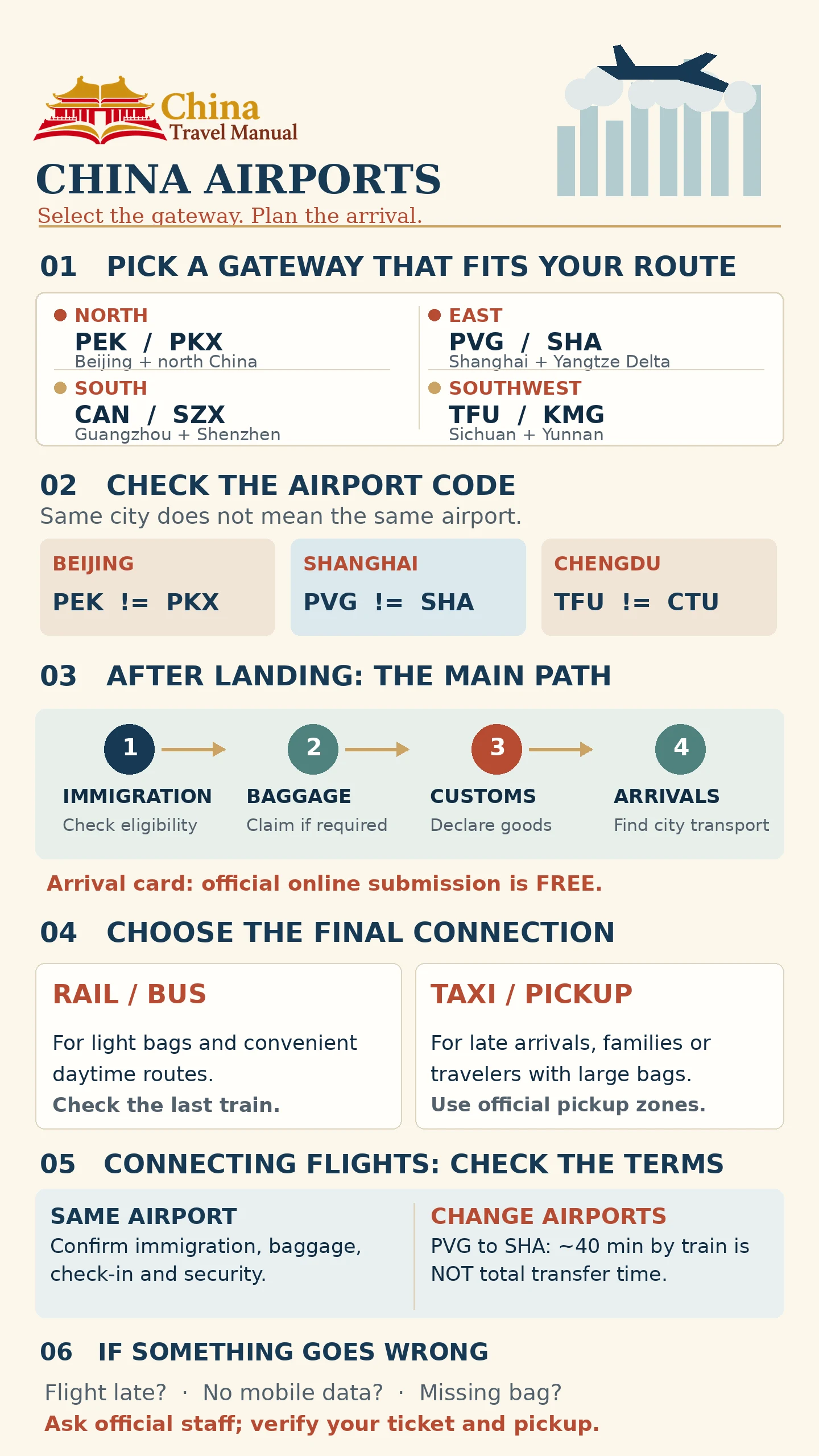
Chinese airports are efficient major transport hubs, but airport codes, immigration rules and terminal changes can complicate a first arrival. This guide focuses on choosing an airport and planning what happens after landing. For full international-flight planning, see flights to China; for one airport’s exact gates and facilities, use its dedicated guide.
Major Airports in China: Which Gateway Fits Your Trip?
Use this comparison to shortlist gateways, then verify which flights actually operate on your dates. A good airport for a region does not automatically have a nonstop flight from your US departure city. Codes identify airports, not cities; they are also the fastest way to catch a mistaken booking.
| Mainland airport | Code | Best starting point for | Arrival consideration |
|---|---|---|---|
| Beijing Capital | PEK | Beijing, northern China and a classic north-to-east route | Northeast of central Beijing; check your hotel’s location |
| Beijing Daxing | PKX | Beijing and itineraries connecting southward | South of Beijing; different rail and road links from PEK |
| Shanghai Pudong | PVG | Shanghai, the Yangtze River Delta and many intercontinental arrivals | Major international gateway; city-center transfer takes planning |
| Shanghai Hongqiao | SHA | Shanghai and some regional international or domestic connections | Close to Hongqiao railway station, but the two are separate facilities |
| Guangzhou Baiyun | CAN | Guangzhou and the Pearl River Delta | Verify terminal assignments after 2025–26 moves |
| Shenzhen Bao’an | SZX | Shenzhen and the Greater Bay Area | Good when Shenzhen itself is part of your route |
| Chengdu Tianfu | TFU | Chengdu, Sichuan and much of southwestern China | Farther from central Chengdu than Shuangliu |
| Chengdu Shuangliu | CTU | Chengdu and many domestic connections | Closer to the city, with a different flight network |
| Xi’an Xianyang | XIY | Xi’an and Shaanxi | An onward domestic flight may be needed from a larger gateway |
| Kunming Changshui | KMG | Kunming, Dali, Lijiang and Yunnan | Often convenient for trips focused on southwestern China |
Hangzhou Xiaoshan (HGH) can suit a southern Yangtze River Delta trip, Chongqing Jiangbei (CKG) a Chongqing-focused one, and Haikou Meilan (HAK) or Sanya Phoenix (SYX) a Hainan vacation. These are alternatives, not a ranking of airport quality. For a first-time north-to-east itinerary, compare the complete China travel route before buying a flight simply because it lands at a famous hub.
A smaller gateway may save a domestic connection if flights work; a major hub may offer a more reliable range of international schedules. Compare arrival time, onward travel, baggage conditions and the final cost rather than airport size alone. Shanghai’s official airport guide confirms that both Pudong and Hongqiao serve passenger flights but differ in services and city connections.[2]
Avoid Mixing Up Airports in Beijing, Shanghai and Chengdu
Beijing Capital (PEK) vs Daxing (PKX)
PEK and PKX are separate airports, located in different directions from central Beijing. Capital can be convenient for some northeastern or central-city hotels, while Daxing may suit accommodations and activities south of the city. Neither is automatically best for every Dongcheng or Chaoyang hotel: compare the actual public-transport route or road journey at the time you land.
For a Beijing–Xi’an–Shanghai itinerary, the route after Beijing matters less than you might assume: your hotel and eventual railway departure station may be more important than the airport’s compass position. If you will spend three nights sightseeing in Beijing, do not pick PKX solely because the next city lies to the south. See Beijing Capital vs Daxing Airport for the location-specific comparison. Beijing’s official visitor guidance confirms both airports offer public-transport and taxi choices, but their connections differ.[3]
Shanghai Pudong (PVG) vs Hongqiao (SHA)
PVG is the major international gateway for many long-haul itineraries; SHA handles extensive domestic services and some regional international flights. They are not interchangeable. Shanghai Hongqiao Airport sits beside the Shanghai Hongqiao railway station, but changing from a flight to a train still means moving between facilities, observing check-in and boarding rules, and allowing walking and security time.
The Shanghai Airport Link Line connects the two airports in roughly 40 minutes of train travel. That figure excludes walking, waiting, baggage, immigration, security and terminal-specific connections. It is not an all-in transfer estimate.[4] If you fly into PVG, use the Pudong Airport arrival guide rather than directions intended for SHA.
Chengdu Tianfu (TFU) vs Shuangliu (CTU)
TFU and CTU are independent airports. Tianfu serves many international flights but is farther from central Chengdu; Shuangliu is closer for many city stays and serves a different mix of routes. Check the airport code before selecting a hotel or arranging pickup. A flight listed simply as “Chengdu” on a travel summary is not enough. The Chengdu Tianfu Airport guide and Shuangliu Airport guide own the individual transport and terminal details.
Plan Your Arrival Airport Around Your Flight Route and Entry Eligibility
Round-Trip vs Open-Jaw Flights
A conventional round trip returns from the same airport you flew into. An open-jaw itinerary arrives in one city and departs from another. For example, fly into Beijing, visit Xi’an, then depart internationally from Shanghai. This avoids returning to Beijing just to catch a flight, potentially saving a railway journey and a hotel night.
Open-jaw fares are not automatically cheaper. Compare the total airfare, train or domestic-flight expense, arrival times and any extra accommodation. If an open-jaw ticket costs substantially more, a return to the first airport might still make sense—especially if the final segment is already covered by a convenient connection. Follow the separate China open-jaw flights guide for that booking decision.
Check Visa, Transit and Airport Entry Conditions
Choose your legal entry route before paying for nonrefundable flights. A US ordinary passport generally requires an appropriate mainland Chinese visa for a conventional tourist visit unless a specific exemption applies. Having a flight to an international airport does not itself confer visa-free entry. The US passport entry guide explains the ordinary requirements.
China’s 240-hour visa-free transit scheme is different. As of August 20, 2026, it covers ordinary-passport travelers from 57 eligible countries, including the United States, entering through 65 designated ports while meeting onward-travel, permitted-area and other conditions. A confirmed trip to a third country or region is essential; a regular round-trip vacation cannot simply be relabeled “transit.”[5] Check the 240-hour transit rules before selecting a connection.
The 24-hour transit framework has different rules and generally concerns remaining within the restricted port area unless separate temporary entry permission is granted.[5] Hong Kong and Macau are Chinese Special Administrative Regions with separate immigration systems; arrival in Hong Kong is not mainland admission. See mainland, Hong Kong and Macau entry planning if your journey crosses those boundaries.
What to Check Before Flying to a Chinese Airport
About two or three days before departure, recheck your actual flight rather than relying on an old itinerary screenshot. Five minutes spent on these details can prevent a costly missed pickup or connection:
- Airport code and terminal: Confirm PEK versus PKX, PVG versus SHA, TFU versus CTU, and the operating airline’s latest terminal notice. A codeshare booking may list a marketing airline rather than the carrier operating your flight.
- Documents: Carry your passport, visa or evidence supporting the applicable entry exemption, and onward-travel documents when relevant. Keep accessible copies of booking information without treating a copy as a substitute for your passport.
- Arrival card: If required, complete the free official online foreigner arrival card, or use the permitted arrival options. The National Immigration Administration (NIA) warns against imitation websites that charge for this service.[6]
- Address and pickup: Save your hotel’s address in Chinese characters, its phone number, and the exact pickup or rail station you plan to use.
- Land-side connections: Check the arrival time against the last convenient airport train or bus, and note an alternative if the flight lands late.
Guangzhou Baiyun (CAN) warrants special attention. Terminal 3 opened in 2025; international and domestic airline movements continued through 2026, with former Terminal 1 carriers transferring to Terminal 3. A terminal assignment from a 2024 travel blog may be wrong today. Confirm the specific flight and terminal directly with your airline or airport before departure.[7]
Have essential information available offline. Your mobile data might not work immediately, and a boarding pass alone will not tell a taxi driver the correct hotel entrance. For broader preparations, see arriving in and departing from China.
What Happens After Landing at an International Airport in China?
Arrival Card and Immigration Inspection
After an international flight arriving from outside mainland China, follow Arrivals / 到达 (dàodá) and immigration signs toward passport inspection. Depending on your route and status, officials may inspect your passport, visa or visa-free eligibility, purpose of stay, accommodation and onward travel.
The NIA introduced official online arrival-card submission on November 20, 2025. Eligible travelers can complete it in advance at the official NIA arrival-card service; at the port, designated electronic or paper options remain available. Certain travelers, including some direct 24-hour airside transit passengers, are exempt. The service is free. Completing the card does not itself grant permission to enter.[6][8]
You should not assume the procedure is identical for a domestic flight, an international-to-international airside transfer, and a traveler formally entering mainland China. Follow the appropriate signs and border-officer instructions. The separate China arrival card guide covers the form itself.
Baggage Claim, Customs and the Public Arrivals Hall
For a typical first entry on an international flight, the sequence is:
- Follow arrival and immigration signs and complete the required entry inspection.
- Find your flight on the baggage-claim display and collect any luggage that must be reclaimed at this airport.
- Pass customs, declaring goods where required. Green means nothing to declare; red is for goods that require declaration. Travelers using green are still subject to inspection.[9]
- Enter the public arrivals hall, where ground-transport signs and visitor service desks can be found.
Baggage and customs sequencing can differ when a ticket includes a special through-connection arrangement. If you have an onward domestic flight, check its luggage instructions with the airline rather than assuming all bags stay checked through—or that every passenger must reclaim them at the same point.
Airport signs to recognize include Baggage Claim / 行李提取 (xínglǐ tíqǔ), Customs / 海关 (hǎiguān) and Exit / 出口 (chūkǒu). Knowing these three terms helps even when English signs are present.
How to Get from a Chinese Airport to Your Hotel
Airport Express, Metro, Shuttle Bus, Taxi or Ride-Hailing?
Once you reach the public arrivals hall, choose transport using the hotel’s exact location and your landing time, not the city-center distance listed on a search page.
| Transport | Usually suits | Check before relying on it |
|---|---|---|
| Airport express or metro | Light luggage, daytime arrival, hotel near rail service | Last service, transfers and station-to-hotel walk |
| Airport shuttle bus | Hotels near a published stop, lower-cost travel | Route, ticket method and departure schedule |
| Official taxi | Large luggage or an unfamiliar destination | Use the marked taxi queue; show the Chinese address |
| Ride-hailing | Travelers with working mobile data and a supported payment method | Designated pickup zone, driver contact and app access |
| Prebooked transfer | Late arrival, family travel or assistance needs | Driver meeting point, flight-delay policy and total charge |
Do not follow unsolicited drivers who approach passengers inside or outside the arrivals hall. Use the airport’s marked taxi service, official transport desk or verified pickup instructions. Beijing’s official visitor guidance describes taxi queues, airport rail and buses as available transport choices, but the exact routes differ between PEK and PKX.[3]
Late-Night Arrivals, Large Luggage and Families
A scheduled landing at 11:30 p.m. does not mean you will reach the taxi stand at 11:30 p.m. Immigration queues, luggage and walking may add substantial time. Some airports retain bus or taxi services after metro hours, but do not assume every train or shuttle stops at 11 p.m. Check the actual service date and terminal.
Traveling with children, reduced mobility or several large bags may justify a taxi or prearranged pickup even if rail is cheaper. If no rail connection is operating, an official taxi may be simpler than trying to register for a ride-hailing app without connectivity. Individual airport transfers are documented in the nationwide airport transfer guide and the Pudong-to-Shanghai transport guide.
Connecting Flights and Changing Airports in China
International-to-Domestic Connections
If your flight from Los Angeles arrives in Shanghai and the next flight goes to Xi’an, check immigration requirements, baggage routing, ticket protection and check-in separately. On a self-booked itinerary with two unrelated tickets, the safe default is to plan for mainland entry, collecting checked bags, checking in again and passing security. Ask the carriers whether any special transfer service actually applies.
A single ticket or interline arrangement may provide connection assistance or through-checking, but it does not guarantee you can skip immigration or baggage procedures: local airport and customs arrangements still control. Conversely, selected services may make a bag transfer possible even across airports. Shanghai government information describes such an arrangement for specified China Eastern itineraries.[10]
For independently purchased tickets, a delayed first flight may leave the second airline with no obligation to rebook you without charge. Three hours is not a universal safe connection, particularly if you must enter mainland China, collect a bag or change terminals. Compare the airlines’ minimum connection time only where a protected itinerary is actually offered, and add extra margin for a self-connection. Read the international-to-domestic flight transfer guide before committing to separate bookings.
Changing Terminals or Airports
A terminal change within one airport is different from an airport change across a large city. PVG to SHA, PEK to PKX, and TFU to CTU are cross-airport transfers requiring an actual land journey. Confirm both three-letter codes on your tickets; a convenient-looking search result may hide a change of airport.
Shanghai’s Airport Link Line covers the PVG–SHA rail portion in approximately 40 minutes. It does not eliminate the time for immigration, baggage, reaching the rail station, buying or validating the ticket, reaching the next terminal, checking in and clearing security.[4] A cross-airport transfer on separate tickets may need a generous multi-hour margin or even an overnight stay. See China airport layovers for more detailed connection planning.
Your First Hour: Internet, Payments and Airport Services
After clearing customs, establish three essentials before heading into the city:
- Connection: Confirm that mobile data works, or locate verified airport Wi-Fi and a service counter. A preinstalled travel eSIM, active international roaming or a locally issued SIM may be options, depending on your device. The China internet access guide covers connectivity beyond the airport.
- Payment: Keep an accessible backup such as cash or a usable payment card. Do not assume your foreign card works at every counter, or that a wallet can be topped up like a mainland account. Review China mobile payments before departure.
- Directions: Open the saved Chinese hotel address and verify the transport route and correct pickup area.
Major hubs may have foreign-visitor assistance counters. Beijing’s Beijing Service desks, for instance, provide guidance related to transport, communications and payment.[11] Services vary by airport and opening time; avoid counting on a particular counter being staffed after midnight.
What If Your Airport Arrival Plan Goes Wrong?
Start with the part you can still control: confirm the airport code, check the operator’s instructions and preserve your booking evidence. Different problems require different first actions.
| Problem | Immediate action |
|---|---|
| Booked PEK but intended PKX, or PVG instead of SHA | Contact the airline about changes; if unchanged, recalculate the actual airport-to-hotel or onward transfer |
| Arrive after the airport train has stopped | Use official taxi signs, a verified pickup or another confirmed late-night service |
| Miss a domestic connection after an international delay | Contact the responsible carrier first; verify whether the tickets were protected together |
| Checked bag does not appear | Report it at the airline’s baggage-services desk before leaving the restricted baggage area; keep the case reference |
| Phone has no data and ride-hailing will not open | Use marked airport taxis or seek help at an official service desk |
| Card payment is declined | Verify whether you were charged, then try an accepted alternative such as cash or another payment method |
| Immigration or visa-free eligibility is questioned | Follow immigration officials’ directions; do not attempt to proceed without permission |
Example: late arrival in Guangzhou. A visitor lands at CAN around 11:40 p.m., discovers the flight now uses Terminal 3, and cannot get mobile data. Rather than searching for an old Terminal 2 taxi pickup, the visitor follows the current arrival signs, asks an official service point where possible, and uses the airport’s designated taxi line with the hotel’s Chinese address. Guangzhou’s 2026 terminal reorganization makes current airline information essential.[7]
Example: Beijing airport price comparison. A US traveler finds a cheaper flight into PKX than PEK for a Beijing–Xi’an–Shanghai journey. The correct calculation includes the cost of getting to the first hotel, the arrival hour and later rail connections. The airfare difference alone does not decide the airport.
Example: separate flights through Pudong. A visitor buys Los Angeles–PVG and PVG–XIY separately. Even if the domestic flight departs from the same airport, the traveler should plan for entry, luggage instructions, another check-in and security. If the first flight arrives late, the onward ticket might not be protected. These are planning illustrations, not promised outcomes for any specific flight.
For changes after booking, consult China flight delays and cancellations or airport lost baggage procedures as appropriate.
FAQs About Airports in China
What Is the Best Airport to Fly Into China for a First Visit?
There is no single best airport. Beijing and Shanghai are practical gateways for a classic first visit, while Guangzhou, Shenzhen, Chengdu and Kunming may better match a southern or southwestern itinerary. Choose by actual flights, entry eligibility, hotels and onward route.
Are Beijing Capital Airport and Beijing Daxing Airport the Same?
No. PEK (Capital) and PKX (Daxing) are separate airports with different ground connections. Check the code on every arrival, departure and pickup reservation.
Is Shanghai Pudong the Same Airport as Shanghai Hongqiao?
No. PVG (Pudong) and SHA (Hongqiao) are separate. The Airport Link Line takes about 40 minutes between them, excluding all other connection steps; it is not a protected flight transfer.[4]
How Much Time Do I Need Between International and Domestic Flights in China?
It depends on the tickets, border procedures, bags, terminals and carrier requirements. There is no safe universal figure. Allow significantly more time for independently booked connections or an airport change, and check each airline’s actual procedures.
Can I Fly Into Hong Kong Airport to Visit Mainland China?
Yes, Hong Kong can be your flight gateway, but its immigration system is separate from mainland China’s. Arriving in Hong Kong does not automatically authorize entry to the mainland; confirm the required documents and border crossing for the onward journey.
Sources
[1] Civil Aviation Administration of China. Civil Aviation Information
[2] Shanghai Municipal Government. Traveling Between Shanghai Airports and the City Center
[3] Beijing Municipal Government. Transportation for Foreign Visitors
[4] Shanghai Municipal Government. Transportation at Shanghai Airports
[5] National Immigration Administration. Visa-Free Transit Policies, August 20, 2026
[6] National Immigration Administration. Beware of Fraudulent Arrival Card Websites
[7] Guangzhou City Government. Baiyun Terminal Relocations, May 9, 2026
[8] National Immigration Administration. Entry Measures and Arrival Card Exemptions
[9] Shanghai Municipal Government. Inbound Customs Clearance Guide
[10] Shanghai Municipal Government. Airport Transfer and Baggage Arrangements, August 2026
[11] Beijing Municipal Government. Airport Service Counters, May 2026





