

Quick Answer: Where Should You Go in China?
Match the destination to the experience you want most:
- First visit and iconic landmarks: Choose Beijing for imperial heritage, Xi’an for the Terracotta Warriors and Shanghai for modern city life.
- Food and everyday culture: Consider Chengdu’s teahouses and Sichuan cooking, Guangzhou’s Cantonese food or Chongqing’s hillside neighborhoods.
- Relaxed river scenery: Choose Guilin and Yangshuo for karst hills, countryside stays and boat trips.
- Dramatic mountains: Compare Zhangjiajie’s sandstone pillars with Huangshan’s granite peaks and hiking paths.
- Gardens and water towns: Pair Shanghai with Suzhou and Hangzhou in the well-connected Yangtze River Delta.
- Winter landscapes: Consider Harbin or Changbai Mountain when snow and seasonal operations suit your dates.
For a trip of roughly 7–10 days, prioritize a small number of well-connected stops. Nature-focused regions and remote Silk Road destinations generally reward extra time.
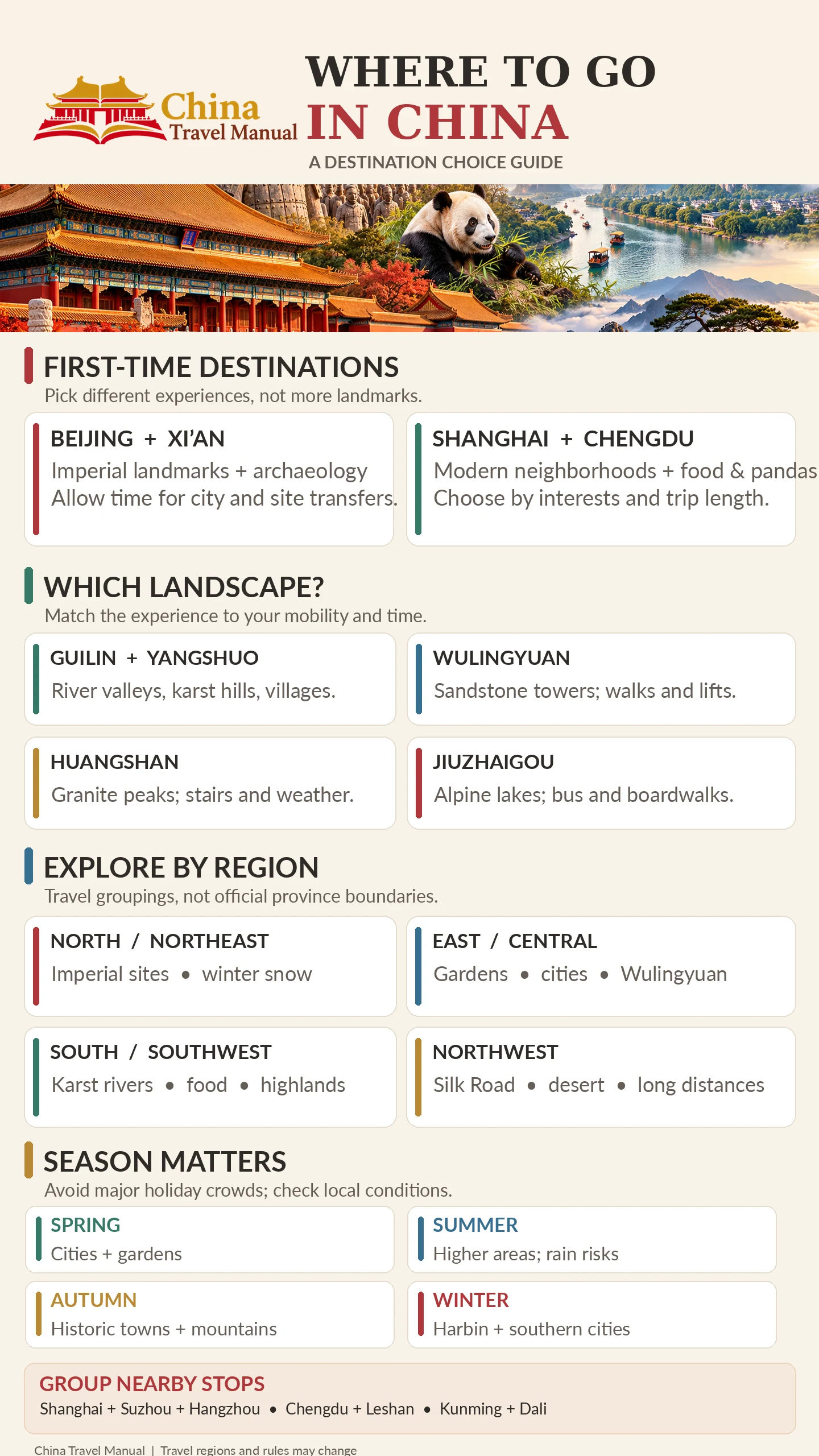
Choosing where to go in China is easier when you compare the kind of experience you want, not just the fame of each landmark. Beijing and Xi’an reveal different chapters of imperial history; Shanghai shows contemporary urban life; Chengdu offers pandas, food and teahouses. For landscapes, Guilin’s river valleys, Zhangjiajie’s sandstone pillars and Huangshan’s mountain trails call for very different trips.
For a first visit, start with two or three manageable destinations, then check how they connect. A city used as an arrival base is not necessarily next to the scenic area you came to see. This guide compares China’s major cities, visitor-friendly travel regions and natural destinations so you can choose places worth your limited time. For visas, apps, reservations and other logistics, use our step-by-step China trip planning guide.
How to Choose Where to Go in China
Four questions narrow the choice: What do you most want to experience? How many full days will you have after arrivals and transfers? What season are you traveling in? And how much intercity travel are you comfortable with?
If history is the main goal, Beijing and Xi’an create a clear contrast between imperial architecture and archaeological sites. If you prefer easy city walks, museums and gardens, Shanghai with Suzhou or Hangzhou is more compact. If nature takes priority, choose one landscape region and allow time to reach its actual scenic entrance.
Pay attention to city versus scenic area. Zhangjiajie is a city and transport gateway; the famous quartz-sandstone landscapes lie in Wulingyuan. Guilin has airports and train stations, while the celebrated river scenery extends toward Yangshuo. Arriving at a destination city’s station does not mean you are already at the main attraction. [1]
Use the comparisons below to make a shortlist. Then build the actual route with our China itineraries rather than squeezing every appealing place into one vacation.
Best Cities and Destinations for First-Time Visitors
The suggested stays below include local travel and reasonable sightseeing buffers. They are planning ranges, not minimum entry requirements or promises that everything can be seen in that time.
| Destination | Why choose it | Suggested stay | Main trade-off |
|---|---|---|---|
| Beijing | Forbidden City, Great Wall, imperial history and major museums | 3–4 days | Large city; landmarks can be far apart |
| Shanghai | The Bund, varied neighborhoods, contemporary China and regional rail links | 2–3 days | Faster pace and relatively high urban costs |
| Xi’an | Terracotta Warriors, city wall and ancient capital history | 2–3 days | Best combined with a wider route |
| Chengdu | Giant pandas, Sichuan cooking and teahouse culture | 2–3 days | Far from Beijing and Shanghai |
| Guilin and Yangshuo | Li River scenery, karst hills and rural activities | 2–3 days | Transfers from arrival hub to countryside |
| Zhangjiajie and Wulingyuan | Sandstone towers, viewpoints and mountain walks | 2–3 days | Steps, queues, weather and scenic-area transfers |
| Suzhou and Hangzhou | Classical gardens, West Lake and Jiangnan culture | 2–3 days combined | Need to choose which sights justify an overnight stay |
| Chongqing | Steep hillside districts, river skyline and spicy food | 2–3 days | Hills, stairs and hot, humid summers |
| Guangzhou | Cantonese food, Lingnan culture and Pearl River Delta access | 2–3 days | Less focused on monumental imperial sights |
Beijing is the clearest starting point for royal architecture, monumental sites and the Great Wall. The Great Wall is not in central Beijing, and a museum-heavy day can involve long city journeys. See our Beijing travel guide and Forbidden City guide for deeper coverage.
Xi’an suits travelers interested in archaeological history, especially the Terracotta Warriors, city wall and Tang-era heritage. Shanghai is the opposite kind of experience: the Bund, historic urban streets, contemporary design and quick onward connections to Jiangnan cities. The combination is often more varied than visiting several ancient capitals on the same short trip.
Chengdu is a strong choice for pandas and a slower food-and-teahouse itinerary, with Leshan and Mount Emei as possible extensions. Chongqing offers a striking built landscape but requires more climbing and navigation. Guangzhou is particularly rewarding for travelers who value Cantonese cuisine and lived-in neighborhoods over a checklist of landmark monuments.
For scenery, choose Guilin and Yangshuo if you want a gentler river-valley stay. Choose Wulingyuan near Zhangjiajie if elevated viewpoints and mountain paths are the appeal. A relaxed day by the Li River is not interchangeable with a long day on mountain walkways.
Explore China by Region
These seven travel regions are convenient planning groups, not an official administrative division. Provinces, autonomous regions, municipalities and scenic areas may have different climates and very different journey times even within one group.
North China
Beijing is the anchor for imperial sites and northern architecture. Tianjin adds a different cityscape; Datong’s Yungang Grottoes, Pingyao’s old town and Chengde’s historic complex are reasons to extend into Shanxi and Hebei. They require their own transport planning rather than being assumed effortless Great Wall-style day trips.
Spring and autumn often suit outdoor heritage visits better than the hottest summer weeks or colder winter days. A history-focused traveler could build an entire northern trip without adding Shanghai or southwestern China. Read the Beijing guide before choosing extensions.
Northeast China
Harbin and parts of Jilin and Liaoning offer a distinct seasonal identity. Harbin is associated with winter ice-and-snow displays, while Changbai Mountain draws visitors for forest and mountain landscapes. Summer can also be worthwhile for cooler northern outings, rather than being a season without attractions.
Winter experiences depend on temperatures, operating dates and outdoor safety. Travelers need substantial cold-weather gear, and a snowy mountain trip should not be planned as though it has the same accessibility as a major-city museum visit.
East China and the Yangtze River Delta
Shanghai makes an efficient base for Suzhou’s classical gardens, Hangzhou’s West Lake and, with more time, Nanjing. Fast rail connections make these a practical cluster, although the right stations and total door-to-door journey still matter. [2]
Farther west, Huangshan’s mountains and southern Anhui villages provide another kind of Jiangnan experience. These scenic places are not necessarily quick add-ons to a half-day in Shanghai. Late-spring rain, summer heat and major holiday crowds can affect both urban and mountain visits.
Central China
Central China offers several different travel stories. Luoyang is known for Longmen Grottoes and early imperial heritage; Wuhan and Changsha represent major river-connected urban centers; Zhangjiajie in Hunan is the gateway to Wulingyuan’s sandstone scenery.
Do not assume Luoyang and Zhangjiajie form a simple short-trip pairing because they appear under the same regional heading. Mountain entrances can involve separate road journeys after reaching a railway station or airport. A focused Hunan trip is more sensible than trying to collect distant central-China attractions in two days.
South China and the Southern Coast
Guangzhou and Shenzhen represent different faces of the Pearl River Delta: Cantonese food and neighborhood culture in one, a modern technology-oriented metropolis in the other. Guangxi offers the karst waterways of Guilin and Yangshuo, while Hainan attracts beach travelers seeking a different pace.
This region should not be treated as one climate zone. Southern rain, heat and tropical storms can affect parts of the coast, while inland karst excursions have their own river and road conditions. Travelers combining Guangzhou with Hong Kong or Macao also need to account for separate immigration arrangements.
Southwest China
The Sichuan Basin favors food, pandas and city experiences around Chengdu, while nearby Leshan and Mount Emei offer major excursions. Chongqing has steep urban terrain and dramatic riverside settings. Yunnan is a different journey: Kunming, Dali, Lijiang and potentially Shangri-La form a progression toward higher elevations.
Guizhou adds waterfalls and karst scenery. The Tibet Autonomous Region requires an entirely separate assessment of permits, guided arrangements, altitude and emergency support. Southwest China is too varied to share a single recommended season or level of travel difficulty. For a regional starting point, use our Sichuan travel guide.
Northwest China and the Silk Road
Xi’an is an accessible introduction to imperial and Silk Road history, but the desert landscapes and Buddhist cave art around Dunhuang lie much farther west. UNESCO recognizes the Mogao Caves as a major site of artistic and cultural exchange along the Silk Road. [3]
Gansu, Qinghai and Xinjiang offer desert, grassland, mountain and oasis journeys on a scale that requires longer stays. Xi’an to Dunhuang is not a local excursion: long-distance rail connections exist, but some services take roughly eleven hours. [4] Summer heat, winter conditions, sparse services and additional requirements in particular border areas should all influence the decision.
Best Natural and Scenic Destinations in China
Choose natural destinations by the experience and physical effort involved, not just their appearance in photographs. The following comparison highlights the differences; for a longer breakdown, visit our China nature travel guide.
Rivers, Karst Landscapes and Rice Terraces
Guilin and Yangshuo are about river valleys, distinctive limestone hills, villages, cycling and scenic boat journeys. They are often easier to enjoy at a gentle pace than steep mountain parks, although individual rafting activities and trails have their own requirements. Yangshuo can make a convenient countryside base; Guilin city remains useful for major transport connections.
Longji Rice Terraces offer hillside cultivation landscapes that change with planting, growing and harvest seasons. Unlike a Li River cruise, terraces involve travel into the hills and potentially many stairs. Weather and seasonal agricultural activity affect the view more than a generic annual list of “best months.”
Mountains, Forests and National Parks
Wulingyuan, reached through the Zhangjiajie area, is famous for thousands of narrow quartz-sandstone pillars, ravines and elevated viewpoints. Some routes use lifts or cableways, but they do not remove all walking or queues. Heavy mist can transform the view—or obscure it. [1]
Mount Huangshan is a different landscape of granite summits, shaped pines and cloud seas. It is closely associated with Chinese landscape painting; stairs and mountain weather are central planning concerns. An overnight summit stay is an option for sunrise, not a necessity for everyone. [5]
Jiuzhaigou, in northern Sichuan, is known for clear multicolored lakes, waterfalls and forested alpine valleys. Scenic buses and constructed walkways reduce some walking demands, but its elevation and distance from larger cities still matter. It is a separate destination rather than an attraction in central Chengdu. [6]
Highlands and Desert Landscapes
Yunnan is best understood as a multi-stop region, not a single scenic site. Kunming and Dali offer relatively accessible city-and-lake experiences; Lijiang adds historic streets and mountain excursions; Shangri-La is substantially higher and calls for altitude awareness. A week in this corridor may make more sense than trying to add it to a tightly packed Beijing–Shanghai trip.
Dunhuang offers a desert-oasis environment alongside the Mogao Caves. Tiger Leaping Gorge offers hiking but demands more preparation than a leisurely lakeside visit. Remote hiking routes, weather shifts and access constraints should be considered individually, not grouped into one easy “nature day.”
Best China Destinations by Travel Interest
Use this table when deciding between otherwise appealing places. These are editorial matches, not official rankings.
| Your main interest | Destinations to consider | Selection note |
|---|---|---|
| Imperial and archaeological history | Beijing, Xi’an, Luoyang, Pingyao | Choose complementary periods instead of stacking similar old towns |
| Modern urban life | Shanghai, Shenzhen, Chongqing | Chongqing adds substantial hills and stairs |
| Food and daily culture | Chengdu, Guangzhou, Chongqing | A slower neighborhood stay works better than a landmark race |
| Gardens and water towns | Suzhou, Hangzhou and nearby Jiangnan towns | Easy to combine from Shanghai with realistic transfers |
| Gentle rivers and countryside | Yangshuo, selected Guilin outings | Select activities to suit individual mobility |
| Mountain paths and big views | Huangshan, Wulingyuan, Tiger Leaping Gorge | Check hiking demands and weather |
| Colorful lakes and forest valleys | Jiuzhaigou | Allow travel from the gateway and account for altitude |
| Family-focused mix | Beijing, Shanghai, Chengdu, Yangshuo | Balance outings with rest and convenient transport |
| Winter snow and ice | Harbin, selected Changbai Mountain trips | Check season-specific opening and weather |
| Silk Road and deserts | Dunhuang, Gansu’s Hexi Corridor | Better suited to a dedicated longer route |
For travelers primarily seeking relaxed meals and neighborhood life, two comfortable bases can be better than three famous attractions in different provinces. For hikers, the decisive question may be trail difficulty rather than whether a mountain appears on a heritage list.
Best Time to Visit Different Parts of China
China has no single best month: destinations can be in monsoon rain, dry heat, snow or comfortable walking weather at the same time.
| Season | Destinations worth considering | Planning caveat |
|---|---|---|
| Spring (March–May) | Beijing, Xi’an, Suzhou, Hangzhou and selected Yunnan routes | Rain varies; Qingming and Labor Day periods can be busy |
| Summer (June–August) | Some northeastern forests and suitable higher-elevation regions | Many cities are hot; mountains can face storms, landslides or rain |
| Autumn (September–November) | Beijing, Xi’an, Huangshan, Guilin and parts of northwest China | Early-October National Day travel is exceptionally busy |
| Winter (December–February) | Harbin, Changbai Mountain winter trips, Guangzhou and Hainan | Northeast cold is severe; Lunar New Year affects travel demand |
In East China, early-summer rainy weather may affect cities and mountain visibility. In southern China, summer can bring heavy rain and tropical storm risks. Chengdu and Chongqing often feel humid in summer, while the higher mountains of western Sichuan may have entirely different conditions.
For Jiuzhaigou, autumn foliage is popular, but its exact peak changes with temperature and weather; no short late-September-to-mid-October window is guaranteed every year. For Huangshan and Wulingyuan, check forecasts and trail access shortly before setting out. Major public holidays also change what is realistically enjoyable: a famous destination is not always the best choice when tickets and transport are heavily constrained.
How to Combine China Destinations Without Wasting Travel Time
The most efficient combinations usually share a transport corridor or a convenient regional base. The main test is hotel-to-hotel time, not the duration shown on one train schedule.
| Combination | Why it works | Important limitation |
|---|---|---|
| Shanghai + Suzhou + Hangzhou | Frequent rail links and contrasting city, garden and lake experiences | Confirm the exact stations; allow an overnight stay if needed |
| Beijing + Xi’an | Clear historical contrast with established rail service | Reserve substantial time for the intercity transfer |
| Chengdu + Leshan + Mount Emei | Sichuan-based culture, giant Buddha and mountain experiences | Mount Emei can merit an overnight stay |
| Guilin + Yangshuo + Longji | One Guangxi scenic cluster | Rural road transfers can be longer than expected |
| Kunming + Dali + Lijiang | Established western Yunnan progression | Adding Shangri-La increases altitude and trip length |
A useful counterexample: Zhangjiajie and Fenghuang Ancient Town are connected by high-speed rail, with some rail journeys close to one hour, but you still need transfers between the actual scenic areas, stations and old town. They can be combined if the trip is long enough; calling them a mandatory four-hour bus journey is outdated. [7]
Likewise, Xi’an and Dunhuang both belong to a broader Silk Road story, but they are far apart. Neither a map nor a regional label makes Dunhuang suitable for a casual day trip from Xi’an. A Beijing–Lijiang–Jiuzhaigou chain is another poor default for a short first visit because it strings together distant transport gateways.
If you only have 7–10 days, consider a focused urban corridor or one region with nearby excursions. When building an actual day-by-day plan, use our itinerary collection and China transportation guide.
China Destinations That Require Extra Planning
- Tibet Autonomous Region: Foreign visitors generally need advance travel permits and arrangements through an authorized travel agency; independently entering on a standard China visa alone is not sufficient. Requirements may depend on itinerary and current local policy. High elevation, limited medical access and restricted U.S. consular access add to the planning burden. [8][11]
- Xinjiang and remote border areas: Major cities and common tourist routes are not automatically closed to foreign visitors. Specific border zones can have separate permit or access rules, and distances are extensive. Check the individual destination, current government advice and transportation before committing. [8]
- High-elevation areas: Shangri-La, parts of Qinghai and high mountain trips are not equivalent to a lowland city stay. Allow time to adjust, understand altitude-illness symptoms and assess personal health with a clinician when relevant; storms or landslides can interrupt road access.
- Hong Kong and Macao: These special administrative regions operate entry arrangements separate from mainland China. U.S. ordinary passport holders can generally visit Hong Kong visa-free for up to 90 days and Macao for short stays of up to 30 days, but those permissions do not automatically authorize entry to the mainland. [9][10]
A destination can be spectacular yet poorly matched to a short first-time itinerary. Where medical access, permits or travel restrictions matter, verify them before selecting the area rather than treating the details as an afterthought.
FAQs About Choosing China Destinations
What Are the Best Places to Visit in China for First-Time Travelers?
Beijing, Xi’an and Shanghai provide a clear contrast between imperial history, archaeology and modern city life. Chengdu adds pandas and Sichuan food. Travelers who prefer scenery can replace a city with Guilin and Yangshuo or choose a focused regional nature trip rather than attempting all of them.
Where Should I Go in China for Natural Scenery?
Choose Guilin and Yangshuo for river valleys, Wulingyuan near Zhangjiajie for sandstone pillars, Huangshan for mountain paths and Jiuzhaigou for colorful alpine lakes. Their travel times, altitude, walking demands and seasonal conditions differ substantially, so select by experience rather than photographs alone.
How Many Places Can I Visit in China in 10 Days?
Two or three main bases generally make a manageable ten-day visit when you include arrival, departure and intercity transfers. Shanghai with nearby Jiangnan destinations can support more short outings than a route crossing multiple distant regions. Avoid counting a long transfer as a full sightseeing day.
Is It Better to Visit One Region or Several Cities in China?
Choose one region if you want slower travel, fewer hotel changes and deeper local experiences. Choose a few cities on a good rail or flight corridor if contrasting history and modern life is your priority. The better option depends on the actual door-to-door route and how many full days you have.
Sources
[1] UNESCO World Heritage Centre. Wulingyuan Scenic and Historic Interest Area
[2] China Railway travel information. China Railway 12306 Official English Service
[3] UNESCO World Heritage Centre. Mogao Caves
[4] TravelChinaGuide. Xi’an to Dunhuang Train Information
[5] UNESCO World Heritage Centre. Mount Huangshan
[6] UNESCO World Heritage Centre. Jiuzhaigou Valley Scenic and Historic Interest Area
[7] TravelChinaGuide. Zhangjiajie to Fenghuang Train Information
[8] U.S. Department of State. China Travel Advisory
[9] Hong Kong Immigration Department. Hong Kong Visa and Entry Permit Requirements
[10] U.S. Department of State. Macao Travel Information
[11] Embassy of China in the Philippines. Visa for China Mainland and Tibet Visit Procedures





