

Quick Answer: Where Should You Stay in China?
Choose accommodation according to the places you will actually visit, not just the lowest nightly rate.
- For major cities: Start with a well-reviewed hotel within a manageable walk of a useful metro station; check the route on a walking map rather than relying on straight-line distance.
- For scenic destinations: Stay near the entrance or official shuttle point you intend to use, particularly at Wulingyuan, Huangshan and Jiuzhaigou.
- For a first visit: A reputable budget or mid-range hotel with reliable reception is often simpler than an unfamiliar private rental.
- For families or older travelers: Confirm occupancy, bed arrangement, elevator access and the route between the property and transport.
- For a private home or non-hotel rental: Agree with the host on the legally required accommodation registration before arriving.
- Before paying: Confirm the property can process your foreign passport, especially if your reservation is nonrefundable.[1]
The right accommodation is the one that makes everyday travel and check-in predictable—not necessarily the one nearest a famous landmark.
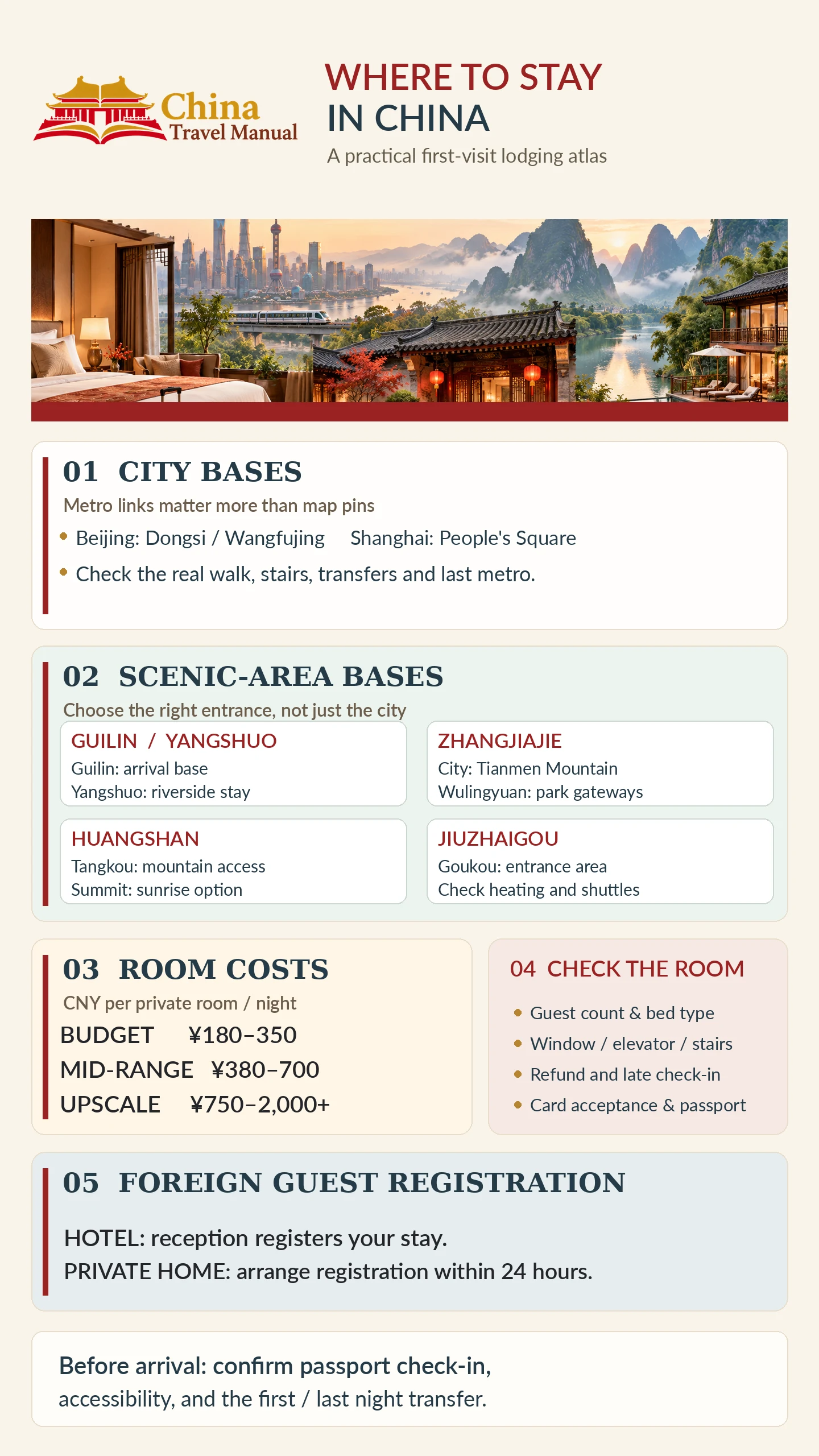
If you are traveling to China for the first time, choosing a hotel can be easier than deciding where to put it. A room shown as “five minutes from the sights” may involve a long detour to a metro entrance, heavy luggage on steep steps, or a late-night taxi after trains stop running.
Older guides can cause a second problem: they suggest that foreign travelers are legally restricted to a small group of specially approved international hotels. That is not an accurate description of the current policy. This guide helps you compare practical city neighborhoods and scenic-area bases, understand your accommodation choices, and check the booking and registration requirements that matter when traveling with a foreign passport.
How to Choose the Right Location for Your Stay
For city sightseeing, assess a property’s actual journey to the places you will visit most often. Check the walking route to the station entrance, the lines and transfers you would use, the last service at night, and whether there are usable elevators or escalators on your route. A pin on a map may look close to a station but sit across a complicated intersection or behind a long pedestrian detour.
A useful location usually gives you a choice of inexpensive meals, a convenience store and a straightforward route back after dinner. Hotels directly beside a major attraction may be noisy and expensive, while a room one or two metro stops away may offer a quieter night without making sightseeing difficult. Conversely, saving on a remote room can become costly when you need repeated taxis.
Consider luggage and terrain as well. Older lanes in Beijing and Xi’an may have lovely character but limited vehicle access. Chongqing’s steep slopes, stairs and multi-level streets can make a seemingly short walk surprisingly demanding. A hotel beside a railway station can be convenient for an early departure, but it is not automatically the best base for several nights of sightseeing.
This is a location decision, not a hotel-star decision. For a wider look at which cities fit your route, use our China destinations guide.
Best Areas to Stay in China’s Major Cities
The neighborhoods below are practical starting points for first-time visitors, not the only good places to stay. Check each property’s precise street and nearest station: a large district can contain both very convenient hotels and awkward locations.
| City | Useful first-time areas | Best suited to | Main trade-off |
|---|---|---|---|
| Beijing | Wangfujing, Dongsi, Qianmen | Major historical sights and central metro connections | Qianmen and Wangfujing can be crowded and costly; some hutong stays have no elevator |
| Shanghai | People’s Square, Jing’an, East Nanjing Road area | Central city walks, the Bund and connections to other districts | Busy shopping streets mean noise and higher rates |
| Xi’an | Bell Tower and South Gate (Yongningmen) | Old-city sights, the city wall and evening walks | Popular streets are noisy; heritage inns may have stairs |
| Chengdu | Chunxi Road and Tianfu Square | Food, city sightseeing and accessible metro routes | Central shopping areas can be congested, especially after dark |
| Chongqing | Jiefangbei, Linjiangmen and Jiaochangkou vicinity | Skyline, river views and central attractions | Steep grades, stairs and confusing building levels |
| Guangzhou | Yuexiu around useful metro stops, or Tiyu Xilu in Tianhe | Local food, city connections and onward travel | Older hotels in Yuexiu may have dated facilities; central Tianhe costs more |
| Hangzhou | East side of West Lake or Wulin Square | West Lake sightseeing with urban transport nearby | Lakeside hotels carry a premium; western lakeshore locations can be harder to reach by metro |
In Beijing, being central does not mean everything is within walking distance. The Forbidden City, Temple of Heaven and Great Wall are separate outings. In Shanghai, a metro-connected location may be more versatile than a room overlooking a single waterfront attraction. Our Beijing travel guide can help you decide which sights matter before selecting a neighborhood.
The biggest accessibility trap is Chongqing: confirm not only the distance but the elevation change, road access and the entrance floor used by your hotel. In Xi’an and Hangzhou, attractive tourist streets may work beautifully for a short stay but less well if you are leaving with heavy bags or making daily train journeys.
Where to Stay Near China’s Scenic Destinations
Scenic areas have a different rule from cities: choose a base for the correct park entrance and its transport, not simply for a city name in a booking search.
Guilin, Yangshuo and the Longji Rice Terraces
Guilin city is useful for arrival, onward travel and an urban overnight. It is not interchangeable with Yangshuo, where travelers often stay for the Yulong River, countryside cycling and local karst scenery. Yangshuo’s West Street area has dining and activity, but rooms directly on the busiest lanes can be noisy late at night. Quieter countryside guesthouses may require a car or scooter transfer.
Longji Rice Terraces are a separate mountain stay. Villages such as Ping’an and the Jinkeng/Dazhai area offer convenient access to terrace viewpoints, but paths can involve steep flights of steps and luggage may need to be carried. Do not assume that a hotel in Guilin or Yangshuo puts the terraces at your doorstep. Ask the property exactly where cars or shuttles can drop you off.
Zhangjiajie City or Wulingyuan: Which Is Better?
Choose Wulingyuan, especially around a useful park gate, if the main reason for your trip is the sandstone pillars and trails of the Wulingyuan scenic area. Staying around the entrance can avoid a substantial road transfer from Zhangjiajie city each morning.
Choose Zhangjiajie city (Yongding District) when you need a convenient arrival or departure base, or when Tianmen Mountain is the primary attraction. Tianmen Mountain and Wulingyuan are not the same park and do not share one entrance. Check the actual gate against your intended sightseeing before booking. Our China nature travel guide provides the broader scenic-destination context.
Huangshan and Jiuzhaigou: Stay Near the Right Entrance
For Huangshan Mountain, Tangkou is the usual practical base for the southern access route and park shuttle arrangements. Hotels in downtown Huangshan city (Tunxi) serve a different purpose: they work for onward transport or city activities, but you should not assume a short trip to the mountain gate. A mountain-top hotel can support a sunrise visit, but it costs more, fills quickly and often provides simpler rooms than the rate suggests.
At Jiuzhaigou, staying near the main park entrance around Zhangzha/Goukou reduces the morning transfer. Verify heating, stairs, pickup options and the actual distance to the ticketing/shuttle entrance. Mountain weather and the high-altitude environment can affect comfort even if the property photos look inviting.
Types of Accommodation in China
China offers familiar international hotels alongside domestic chains, independent inns and private stays. The important distinction is what the property provides—not whether its brand sounds international.
| Accommodation type | Good for | What to check |
|---|---|---|
| International or upscale hotel | Travelers wanting more predictable services | Actual card acceptance, family room rules and location |
| Domestic budget chain | Affordable private rooms in cities | Room size, window, soundproofing and foreign-passport procedures |
| Mid-range business hotel | Comfortable city stays at moderate rates | Laundry, breakfast, reception hours and payment terms |
| Hostel | Solo or budget travelers | Dorm versus private-room price, lockers and bathrooms |
| Boutique or courtyard inn | Travelers seeking a characterful stay | Stairs, heating/cooling, vehicle access and noise |
| Minsu or private rental | Scenic stays or longer groups | Operating arrangements, host support and registration |
| Serviced apartment | Longer stays and some families | Kitchen/laundry facilities and check-in/registration process |
Budget, Mid-Range and Luxury Hotels
Budget chains typically emphasize a bed, bathroom and convenient location rather than extensive amenities. A mid-range business hotel may add a larger room, breakfast or laundry. Upscale hotels may provide more staff support and facilities, but neither a star rating nor a recognizable brand guarantees that a particular desk employee speaks English or that the hotel accepts your foreign-issued card.
Read recent reviews about the specific room type. A well-located mid-range property may suit a busy sightseeing trip better than a luxurious hotel far from transport. Where reception reliability matters, ask whether someone can assist in English or by translation app at your expected arrival time.
Hostels, Boutique Hotels and Traditional Courtyard Inns
Hostels may offer inexpensive shared dormitories as well as private rooms. Compare price per bed with price per room and confirm whether bathrooms and lockers are shared. Social common areas can be useful for solo travelers but may bring late-night noise.
A Beijing courtyard inn or Xi’an old-town guesthouse can be memorable, yet older buildings may have narrow stairways, small bathrooms, weak sound insulation or variable winter heating. Check whether a taxi can reach the entrance; historic atmosphere should not come as a surprise to someone traveling with heavy luggage or limited mobility.
Minsu, Private Rentals and Serviced Apartments
The Chinese term mínsù (民宿, mínsù) broadly describes small-scale guest accommodation in travel settings; the label alone does not establish its legal registration category. A properly operated inn may handle guest registration similarly to a hotel, while a private apartment or someone’s home can fall under the separate non-hotel rules discussed below.
Do not assume that Airbnb is the default way to book a mainland Chinese home: the company withdrew its mainland accommodation listings in 2022.[4] With any independent rental, confirm that the property genuinely exists, the host knows the check-in procedure, and there is a lawful plan for registering foreign guests.
How Much Does Accommodation Cost in China?
Use CNY per private room per night as the standard for comparing hotels. The following are broad planning allowances supplied for typical non-holiday dates, not live quotes or nationwide market averages.
| Accommodation level | Illustrative room cost, CNY/night | Typical considerations |
|---|---|---|
| Budget private room | ¥180–350 | Smaller local hotels, some basic chains; check windows and location |
| Mid-range | ¥380–700 | Business hotels, ordinary boutique inns and some registered minsu |
| Comfort or upscale | ¥750–2,000+ | Better-equipped hotels and selected scenic stays; premium rooms can cost far more |
A hostel dorm bed may instead cost roughly ¥40–80 per person per night in some locations, and should never be compared directly with a private-room rate. Prices can vary sharply by city, exact location, weekends, festivals and demand. Hotels around National Day, Labor Day, Spring Festival or popular scenic destinations can be significantly more expensive than the same room on an ordinary weekday.
Compare the total payable amount: breakfast, taxes or fees if applicable, deposits, extra beds and cancellation costs all matter. An apparently cheap hillside inn is not a bargain if you repeatedly pay for transfers—or cannot carry your bags to the front door.
How to Book Hotels in China as a Foreigner
You can book hotels using international booking services, a property’s official website, or a direct reservation. China’s official traveler guidance describes online and telephone reservations, and notes that acceptance of Visa, Mastercard or other international cards must be checked with the property.[3]
Choose a Booking Method and Confirm the Property
Follow a short verification sequence:
- Check the exact property address and Chinese hotel name, not just the English listing title.
- Confirm the room and dates match your intended route; save the Chinese address offline.
- Ask whether reception can complete check-in using your foreign passport and whether your payment method is accepted.
- Save the confirmation number and the property’s reply, particularly for a prepaid or nonrefundable stay.
Major English-language platforms may be easier for overseas cards, while some local systems require a mainland phone number or domestic payment workflow. A property that accepts an online booking may still have staff unfamiliar with the passport entry screen; confirming before you pay is sensible, though it is not a legal requirement for foreigners to use an international chain.
For broader travel preparation, see how to plan a trip to China.
Check the Room Details Before Paying
An English room title can hide an important difference. Double/King may describe one bed; Twin generally means two separate beds; a Family Room may still have only one large bed plus a small bed. Always verify the property’s photos and stated configuration. A room advertised for two guests is not automatically authorized for four just because the bed looks large.
Before confirming, check the exact guest limit, children’s ages and charges, baby cot or extra-bed availability, breakfast coverage, windows, smoking status, elevator access and heating or air-conditioning. Some economy hotels sell a windowless room at a lower rate. A traditional inn may offer no lift and no round-the-clock reception.
Finally, distinguish free cancellation, partial refund before a deadline and nonrefundable rates. If you expect to arrive after midnight, ask when the front desk closes and whether it will preserve your room if your flight or train is delayed. Keep the late-check-in acknowledgment alongside your reservation.
Hotel Check-In and Accommodation Registration Rules
The laws distinguish a stay in a hotel from a stay in a non-hotel dwelling, such as a friend’s home. That distinction matters more than the marketing word used on an accommodation listing.
| Where you stay | Who handles registration | Applicable timing |
|---|---|---|
| Hotel or accommodation legally operating under hotel registration | Property or hotel registration staff | During check-in under hotel procedures |
| Friend’s home or another non-hotel dwelling | Host or eligible foreign guest | Within 24 hours after arrival |
Article 39 of China’s Exit and Entry Administration Law places hotel guest registration and reporting duties on hotels, while foreigners or their hosts must register stays in non-hotel dwellings within 24 hours.[2]
Checking In With a Foreign Passport
Bring your original valid passport or another officially accepted original identity document. A photograph of your passport should not be assumed sufficient. At an ordinary hotel, reception records your identification and completes the accommodation registration; you are not normally expected to visit a police station separately for the same hotel stay.[3]
China’s July 2024 accommodation measures told local agencies and booking platforms not to restrict foreign guests solely based on purported special qualification requirements and prohibited unlawful advertising that foreigners were not accepted.[1] This corrected a persistent misconception about “foreign-licensed hotels.” It does not mean every property will always have functioning equipment or a trained employee. If a booking is refused at the desk, keep the confirmation and messages, contact your booking service and ask for a workable alternative.
Registration for Private Homes and Non-Hotel Stays
When you stay with a friend, in a private home or in another dwelling outside the hotel-registration system, you or the person accommodating you must arrange registration within 24 hours of arrival. The obligation is not optional because the visit is informal or unpaid.[2]
The National Immigration Administration expanded its online registration service nationwide on September 21, 2026. Available channels include its government service website, the NIA 12367 app, and associated WeChat or Alipay mini programs; local in-person registration remains possible. Online and in-person registrations have the same legal effect.[2]
Crucially, the official guidance says first-time online registration normally should be completed with help from the accommodation host, who knows the address and dwelling details. Foreigners may register independently in specified situations, such as a return registration for the same previously registered dwelling or a self-owned residence.[5] Ask the host how this will be handled before you book a private rental. A guesthouse’s label alone is not enough to determine which procedure applies.
Which Accommodation Suits Your Travel Style?
The same room can be convenient for one traveler and unsuitable for another. Use the following checks to filter your shortlist rather than relying on hotel category alone.
| Traveler | Prioritize | Common oversight |
|---|---|---|
| Solo traveler | Easy transit, reception hours, good door security | Isolated accommodation with no late support |
| Family with children | Maximum occupancy, bed layout, elevator, laundry | Extra breakfast or bedding charges; limited cots |
| Older traveler or limited mobility | Lifts, accessible bathrooms, level routes and pickup access | Unavoidable stairs in hutongs, mountain inns or Chongqing |
| Extended-stay guest | Laundry, work space, kitchen facilities and registration plan | Assuming a private flat follows hotel check-in rules |
| Scenic-area traveler | Correct park entrance, early shuttle and manageable luggage route | Property far from the operating gate or up steep stairs |
For accessibility, contact the property for specific measurements and photographs if they matter: step-free route, door width, lift availability and accessible bathroom features. An upscale rating is not proof that a room is accessible. Families should similarly request written confirmation of the number of permitted occupants, not just an assurance that the bed is large.
Plan Your First and Last Hotel Nights Carefully
Your first night deserves extra care if your international flight lands late. At Beijing Capital or Daxing, Shanghai Pudong or Guangzhou Baiyun, public transit options vary with the terminal and arrival time. A city-center hotel with a confirmed late check-in and reliable taxi access may be preferable, but an airport-area hotel can reduce stress after an exhausting arrival. Check that any promised shuttle actually operates at your arrival hour.
For the last night, work backward from the time you must reach the airport or railway station. A very early flight may justify an airport stay; an ordinary daytime departure often does not. The same principle applies to a first-train departure from Shanghai Hongqiao or another major railway hub.
Staying beside a railway station for a transfer is a situational convenience, not a rule for your entire city visit. If you are comparing airport locations and transfers, consult the China airports guide and China transportation guide rather than choosing accommodation based only on a station pin.
FAQs About Staying in China
Can Foreign Tourists Stay in Any Hotel in China?
China’s 2024 measures reject blanket restrictions based solely on so-called foreign-guest qualification requirements. That does not guarantee every property can complete your reservation without operational problems. Confirm passport check-in directly with the property, especially before paying for a nonrefundable room.[1]
Do I Need My Passport to Check Into a Hotel?
Usually, yes. Foreign travelers commonly check in with their original passport, although official guidance lists certain other acceptable original documents in specific circumstances. Do not assume a passport photo will replace an accepted original ID. The hotel normally handles the accommodation registration at reception.[3]
Is It Better to Stay Near a Metro Station or a Tourist Attraction?
In large cities, a hotel near a useful metro stop often saves more time across several sightseeing days than a property beside one attraction. Near a national park or mountain, the correct entrance or shuttle pickup point matters more. Compare the actual walking route, stairs and operating hours in either case.
Can I Stay in an Apartment or Private Home in China?
Yes, subject to the property’s lawful accommodation arrangements. If it is a non-hotel dwelling, you or the host must complete foreign-guest accommodation registration within 24 hours after arrival. Nationwide online options are available, and hosts are normally important for first-time online registration.[2][5]
Sources
[1] State Council of China / Xinhua. Measures to facilitate foreign travelers’ accommodation, July 2024
[2] National Immigration Administration. Nationwide online registration for non-hotel accommodation, September 21, 2026
[3] Travel China. How to check in at hotels in China, November 2025
[4] Associated Press. Airbnb ends mainland China rentals, May 2022
[5] National Immigration Administration. Explanation of online non-hotel accommodation registration





