
Quick Answer: What Should You Eat and Drink in China?
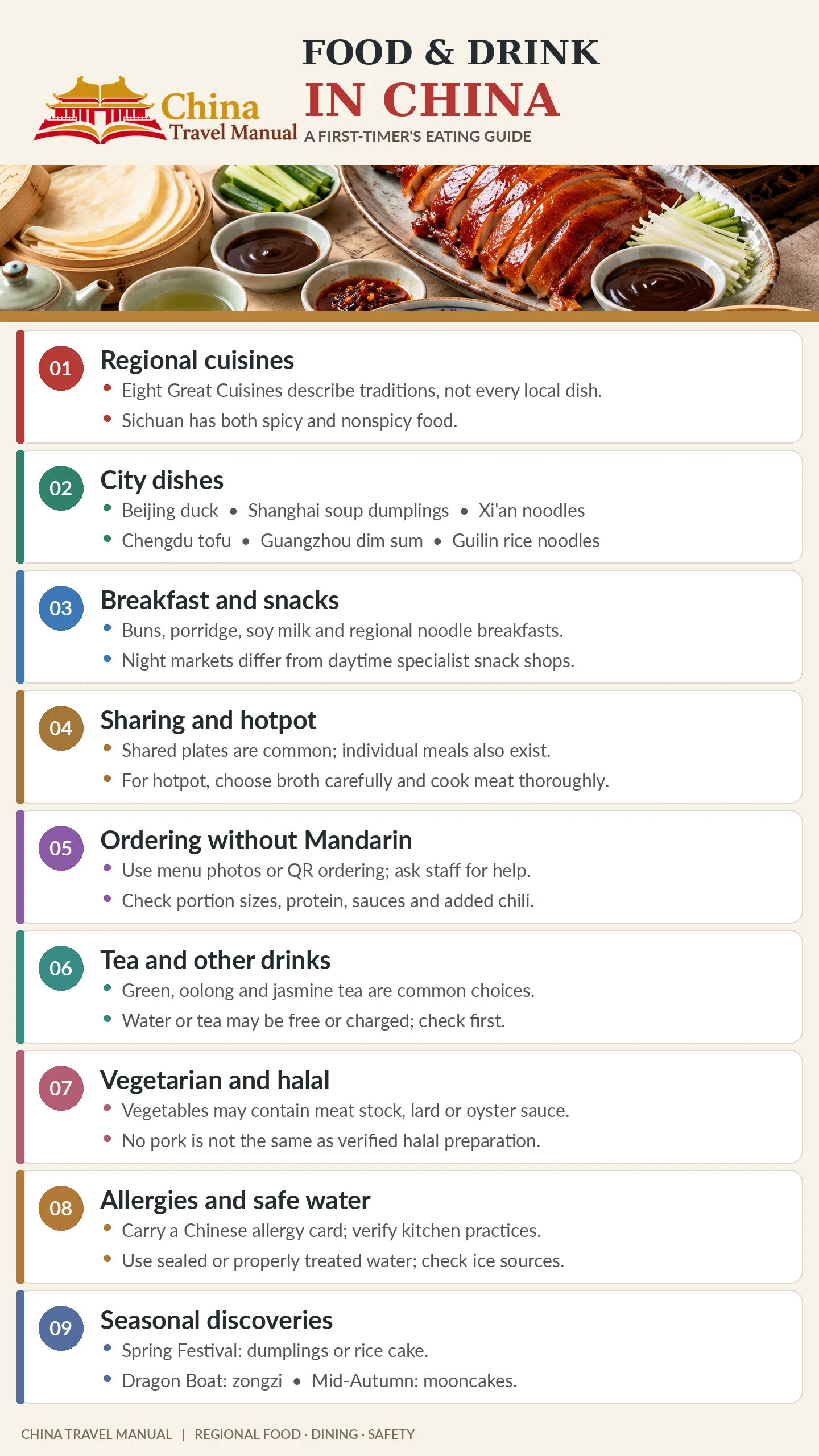
You do not need to try every famous dish on your first visit. Match a few approachable specialties to the cities you actually visit:
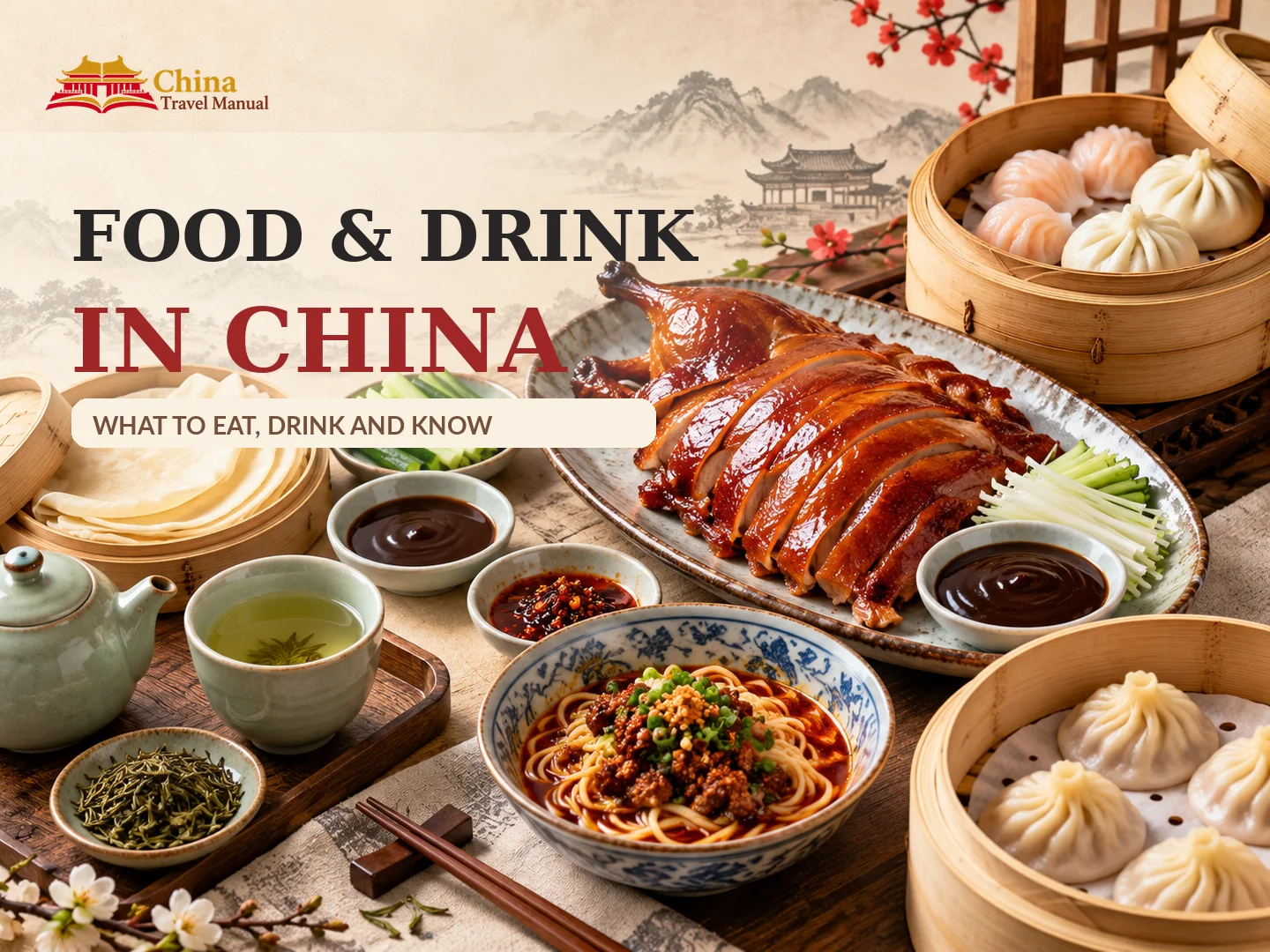
- Beijing: Try Peking duck with thin pancakes, scallions, cucumber and sauce.
- Xi’an: Look for roujiamo, a meat-filled flatbread, and wide biangbiang noodles; ask before ordering if you avoid chili or pork.
- Shanghai: Try xiaolongbao, small soup-filled dumplings; the filling and broth can be very hot.
- Chengdu or Chongqing: Share a hotpot (火锅, huǒguō), choosing a broth that suits your heat tolerance.
- Guangzhou: Explore Cantonese dim sum (点心, diǎnxīn), including shrimp dumplings and steamed buns, at a morning or lunchtime tea meal.
- Across China: Try locally served green, oolong or jasmine tea, but check whether tea service is included in the price.
Chinese food is not uniformly spicy. If you have dietary restrictions or allergies, verify ingredients rather than judging by a dish’s name or photograph.
For a first-time visitor, eating in China is a way to understand how different its regions really are. Familiar American Chinese dishes developed within a distinct North American food culture; they do not capture the full range of what people eat in Beijing, Xi’an, Chengdu, Guangzhou or smaller Chinese towns. Even the meaning of a simple noodle breakfast changes from one city to the next.
This guide helps you choose regional specialties, recognize everyday drinks, share a meal, and order without fluent Mandarin. It also explains what to check when you avoid certain ingredients and how to approach drinking water and food safety. Use it as a starting point, then explore the local food traditions of the places on your China destinations list.
Chinese Regional Cuisines: A Practical Food Map
China’s traditional Eight Great Cuisines (八大菜系, bā dà càixì) describe influential regional cooking traditions, not a legal classification or a complete menu of everything eaten across the country. Geography, climate, ingredients and local history have shaped the differences. The framework is useful for understanding flavors, but travelers will also encounter well-established food traditions outside these eight labels.[1]
The Eight Traditional Regional Cuisines
| Cuisine | Main region | What makes it distinctive |
|---|---|---|
| Shandong (Lu) | Shandong | Savory, fresh flavors; seafood, clear stocks and quick-frying techniques |
| Sichuan (Chuan) | Sichuan and Chongqing | Layered seasoning, including numbing-spicy, aromatic and nonspicy dishes |
| Cantonese (Yue) | Guangdong | Ingredient-forward cooking, steaming, roasting and delicate seafood preparations |
| Jiangsu (Su) | Jiangsu | Refined knife work, gentle braising and balanced savory-sweet flavors |
| Fujian (Min) | Fujian | Seafood, broths, fermented red rice seasonings and bright flavors |
| Zhejiang (Zhe) | Zhejiang | Tender freshwater produce, fresh seasonal ingredients and restrained seasoning |
| Hunan (Xiang) | Hunan | Direct chili heat, preserved foods, smoked meat and assertive aromatics |
| Anhui (Hui) | Historically southern Anhui | Mountain ingredients, bamboo shoots, dried produce and slow-cooked dishes |
Sichuan cuisine is not synonymous with extreme heat: fish-fragrant seasoning and other classic flavor profiles can differ considerably in chili intensity. Hunan dishes often emphasize a different sort of direct chili heat, while Cantonese kitchens also prepare dishes with chili. Even within one cuisine, an individual restaurant’s recipe determines the actual result.
Food Traditions Beyond the Eight Cuisines
Beijing duck and zhajiang noodles, Northeastern dumplings and pickled-cabbage stews, Xi’an’s wheat noodles and lamb dishes, and Yunnan’s rice noodles all matter to visitors even though their labels do not appear on the traditional list. Xinjiang’s grilled meats and wheat-based dishes reflect additional regional and community traditions.
The practical lesson is to follow the food of your destination rather than hunt for all eight cuisines in one city. Xi’an is a strong stop for Shaanxi noodles; Chengdu makes sense for Sichuan cooking; Guangzhou is an obvious base for Cantonese tea meals. For the broader journey, our China travel planning guide explains how to choose a manageable route.
What to Eat in China’s Main Travel Cities
Many dishes can be found nationwide, but eating a region’s specialties where they are widely prepared adds variety to your trip. The table below is a selection guide, not a list of restaurants or a guarantee that every kitchen uses the same recipe.
| City or region | Representative food | Flavor or experience | What to know before ordering |
|---|---|---|---|
| Beijing | Peking duck; zhajiang noodles | Roast duck with pancakes; noodles in a savory soybean-based sauce | Duck is usually shared; ask for less sauce if you dislike salty noodle toppings |
| Shanghai | Xiaolongbao; shengjianbao | Brothy steamed dumplings; pan-fried buns with crisp bases | Bite carefully: hot broth can scald; fillings commonly contain pork |
| Xi’an | Roujiamo; biangbiang noodles | Braised meat in flatbread; broad, chewy wheat noodles | Classic lazhi roujiamo often contains pork; chili oil may be added to noodles |
| Chengdu | Mapo tofu; dan dan noodles | Complex savory spice and Sichuan pepper | Mapo tofu often contains minced meat; do not assume tofu means vegetarian |
| Chongqing | Beef-tallow hotpot; xiaomian noodles | Robust chili-and-peppercorn broth; punchy noodle bowls | Clarify the broth and chili level before ordering |
| Guangzhou | Dim sum; char siu | Steamed or baked tea-time dishes; sweet-savory roast pork | Char siu contains pork; shrimp dumplings contain shellfish |
| Guilin | Guilin rice noodles | Rice noodles with seasoned broth or sauce and optional toppings | Pickled bamboo shoots have a strong aroma; ask for them separately if unsure |
| Kunming and Yunnan | Crossing-the-bridge rice noodles | Hot broth with varied noodles and toppings | Follow the restaurant’s instructions; raw ingredients must be fully cooked |
| Hangzhou | Dongpo pork; Longjing-inspired dishes | Tender braised pork; local tea-related flavors | Dongpo pork is rich and fatty; tea dishes vary by season and restaurant |
| Harbin and Northeast China | Guo bao rou; dumplings | Crisp sweet-sour pork; substantial wheat dumplings | Ask about portion size before ordering several shared plates |
Use the table to select two or three local experiences per city rather than repeating the same famous dish at every stop. For example, a traveler visiting Beijing and Sichuan gets more contrast from roast duck in the north and a teahouse or Sichuan meal in the southwest than from eating hotpot every night.
When traveling alone, a noodle shop or dumpling counter may be easier than ordering multiple shared dishes. With friends, a roast-duck meal, dim sum or hotpot provides more variety. In Beijing, allow enough time for both the meal and sightseeing; see the Beijing travel guide for broader destination context.
Chinese Breakfast, Street Food and Snacks
Breakfast and snacks show another side of daily eating. A breakfast stall, a daytime specialist shop and an evening food market can serve entirely different dishes; the busiest night market is not automatically the best place to find every traditional snack.
What Is a Typical Chinese Breakfast?
Across many cities, mornings bring steamed buns, rice porridge, fried dough sticks (youtiao), warm soy milk and flatbread. But there is no single national breakfast. Shanghai has pan-fried buns and sticky-rice rolls; Beijing has its own traditional savory breakfast foods; Guilin residents commonly eat rice noodles; and in Guangzhou, a leisurely tea meal with small dishes may replace a quick breakfast.
Many travelers accustomed to restaurant dinners overlook the fact that neighborhood breakfast shops often specialize in one or two items. Their service can be fast and inexpensive, but some close by late morning. If a breakfast item contains meat, egg, nuts or dairy, check the filling or toppings rather than assuming all buns and porridge are plain.
How to Explore Street Food and Night Markets
Common street snacks include grilled skewers, roasted sweet potatoes, corn, small filled breads, braised eggs and regional noodles. Some night markets offer a cluster of grills and sweets after sunset; established snack shops may operate only during the day.
Choose stalls where food is cooked thoroughly and served hot, and be cautious with raw garnishes or cooked dishes left at room temperature. A long queue is not a guarantee of good hygiene, but watching how food is handled can help you make a better choice. If you want to try fermented or strongly aromatic specialties, start with a small portion instead of treating unfamiliar flavors as a challenge.
Shared Meals, Hotpot and Chinese Dining Etiquette
Many Chinese restaurants serve dishes to the center of the table for everyone to share. Yet solo noodle bowls, individual set meals and cafeteria-style restaurants are also common. Understanding which format you have chosen makes ordering easier and helps avoid buying far too much food.
How Shared Restaurant Meals Work
A group might order a vegetable plate, one or two proteins, a soup and rice, then share the central dishes. Serving chopsticks or spoons may be provided; use them when available rather than placing personal utensils into communal plates. You can still request individual rice bowls and ask staff for extra utensils.
Avoid leaving chopsticks standing upright in a bowl of rice, a gesture associated with funeral offerings. You may also see diners rinse cups or dishes with hot tea or water, especially in parts of southern China. That is a regional practice, not a mandatory rule for every restaurant or traveler. Restaurants vary in when they bring rice, soup or cold dishes, so there is no rigid national serving sequence.
How to Enjoy Hotpot for the First Time
Hotpot puts a simmering broth at the center of the table. Guests cook ordered vegetables, sliced meat, tofu and other ingredients, then dip them in sauces. Sichuan-Chongqing styles often use chili and Sichuan pepper; northern mutton hotpot can use a lighter broth and sesame-based dipping sauce.
A split “yin-yang” pot may let a group choose both spicy and mild broths, but check availability and whether a supposedly mild broth includes animal stock. Keep raw meat separate from ready-to-eat food and cook meats, seafood and eggs thoroughly. Some restaurants offer fixed broths or limited spice adjustments, so clarify your preference before the pot arrives.
How to Order Food in China Without Speaking Mandarin
You can order in many Chinese restaurants without fluent Mandarin, although the method varies by establishment. A QR code on a table may open a mobile menu, while another shop may use a paper menu, counter display or direct conversation with staff. Shanghai’s municipal international-visitor guidance describes translation-based ordering and asking staff for help as two practical options.[2]
- Identify the ordering method: Check for a paper menu, counter photos or QR code. If the online menu is difficult to use, ask whether staff can take your order.
- Choose the food, not just the photograph: Translate the dish name, then confirm the actual protein, broth, toppings and sauces when necessary.
- Ask about portions and preferences: A shared plate may feed several people. Check small versus large portions, how spicy the dish is, and whether an ingredient can be omitted.
- Confirm the order and pay: Check quantities and the total. Mobile payments are common, but do not assume your international card will work for every merchant; use our China mobile payments guide for setup and backups.
A few useful phrases are bù yào là (不要辣, no chili), bù yào ròu (不要肉, no meat) and wǒ guòmǐn (我过敏, I have an allergy). These can start a conversation, but a generic phrase is not sufficient to explain a severe food allergy. Save key translations offline using the suggestions in our China travel apps guide.
What to Drink in China
You will encounter hot water, tea, soy milk, packaged drinks and both traditional and modern alcoholic beverages. Tea or water may be complimentary in some eateries, charged per person in others, or unavailable without ordering. Do not assume an American-style glass of iced tap water will arrive automatically.
Chinese Tea and Teahouse Culture
Green tea such as Longjing is associated with Hangzhou; oolong includes styles such as Tieguanyin and Dahongpao; black tea is known as hóngchá (红茶, literally “red tea”) in Chinese; and jasmine tea is a familiar scented choice. These names describe different processing or scenting traditions, not a ranking of quality.
A neighborhood teahouse, especially in Chengdu, may be a place to sit for a long conversation, while a formal tasting emphasizes preparation and flavor. In 2022, UNESCO inscribed China’s traditional tea-processing techniques and associated social practices on its intangible cultural heritage list. This recognition concerns living traditions and knowledge, not certification of every individual tea shop.[3]
Other Everyday Drinks and Alcohol
Warm soy milk is widely seen at breakfast. Bottled juice, soft drinks and milk-tea beverages are easy to find in cities; fresh juices require the same water and hygiene precautions as other drinks. Beer is generally lower in alcohol than Chinese baijiu, a distilled spirit that is often much stronger than visitors expect. Huangjiu is a distinct fermented grain wine, not another name for baijiu.
Read the alcohol-by-volume label rather than relying on the English translation of a drink’s name. Price and service customs vary: hot drinking water may be provided without charge, whereas specialty tea, bottled drinks and alcohol often cost extra.
Vegetarian, Halal and Food Allergy Needs
Dietary preference, religious requirements and medically serious allergies need different questions. A dish can appear meat-free but contain animal stock; a meal with no pork is not necessarily halal; and a photo cannot reveal every sauce or shared cooking surface.
Vegetarian and Vegan Food
Tofu, greens, mushrooms, rice and noodles offer many potential choices, including at dedicated vegetarian restaurants. But vegetable dishes may contain chicken stock, rendered pork fat, oyster sauce or minced meat used as a seasoning. For instance, traditional mapo tofu frequently includes minced meat.
If you are vegan, explain that you avoid meat, fish, eggs, dairy and animal-derived broth or condiments as relevant to your practice. Ask what is in the sauce and how the dish is prepared. Some kitchens cannot change a stock or premade seasoning; a clearly vegetarian restaurant may be a more reliable choice than trying to modify several dishes at a busy general restaurant.
Finding Halal Food
Look for signs reading qingzhen (清真, qīngzhēn), commonly used for halal food and restaurants. Certain beef or lamb noodle shops and Muslim food traditions in Xi’an provide familiar starting points, but a dish’s name alone does not confirm the sourcing, preparation or cooking practices you require.
If halal observance is important to you, confirm the establishment’s practices and any relevant certification or signage directly. Simply requesting “no pork” does not address other ingredients or shared utensils.
Communicating Food Allergies
Peanuts, sesame, soy, wheat, shellfish, fish and tree nuts may appear in oils, sauces, noodles, condiments or broths without being obvious from a menu picture. Cross-contact can happen when food is prepared on shared equipment.
For a serious allergy, carry a professionally checked Chinese-language allergy card that names the exact allergens and explains cross-contact requirements. Show it to restaurant staff and ask them to confirm with the kitchen; if they cannot establish what is safe, choose a different meal. CDC and Food Allergy Research & Education recommend translated allergy information and an individualized emergency plan for travelers at risk of severe reactions.[4][5]
Food and Drinking Water Safety in China
China has many well-run eateries, but travelers should apply ordinary food-handling precautions rather than assume all street food is safe or all stalls are unsafe. The CDC’s China guidance states that mainland tap water should not be drunk untreated, even in major cities; bottled and boiled drinking water are widely available.[6]
- Drink treated water: Choose unopened, factory-sealed bottled water or water that has been boiled or otherwise appropriately treated. Do not assume a water dispenser is safe without knowing its drinking-water status.
- Be careful with ice: Ice may be made with untreated water. Skip it when the source cannot be verified.
- Choose thoroughly cooked food: Favor hot, freshly prepared dishes; be cautious with raw fish, undercooked shellfish, meats and unrefrigerated ready-to-eat food.
- Watch storage and handling: Food held at room temperature, unwashed raw produce or poorly stored ingredients are higher-risk than freshly cooked food kept at a safe temperature.
- Take extra care with wild mushrooms: Eat only properly identified, safely prepared food from reliable kitchens. Do not assume cooking makes a toxic species harmless.
These are practical risk-reduction steps, not a claim that Chinese restaurants generally have poor hygiene. They follow the CDC’s broader 2026 travel food-and-water precautions.[7]
Seasonal and Festival Foods to Look For
Seasonal foods offer an easy way to notice local traditions without planning a festival-centered trip. What is popular still varies by city and household.
| Season or festival | Foods you may encounter | Useful context |
|---|---|---|
| Spring Festival, usually January or February | Dumplings, particularly in the north; rice cakes in many regions | Availability changes around holiday closures and family celebrations |
| Dragon Boat Festival, usually May or June | Zongzi, sticky-rice parcels with sweet or savory fillings | Both versions are sold beyond the festival day |
| Mid-Autumn Festival, usually September or October | Mooncakes with fillings such as lotus seed paste or regional flaky crusts | Regional recipes and sweetness vary substantially |
| Summer in some regions | Waxberries, lotus seeds, crayfish and seasonal mushrooms | Freshness and availability depend on place and weather |
Do not treat a holiday food as a dish everyone eats in exactly the same way. In southern China, for instance, savory zongzi may be more prominent than in some northern families. Regional specialty stalls often sell festival items well before the actual date.
FAQs About Food and Drink in China
Is All Chinese Food Spicy?
No. Many familiar Cantonese, Jiangsu, Zhejiang and Shandong dishes are mild or savory rather than chili-hot. Sichuan and Hunan cookery also include varied flavors, although certain specialties can be very spicy. Ask about the individual dish instead of assuming its cuisine label predicts its heat.
What Should I Eat on My First Day in China?
Choose a manageable local classic near your hotel: roast duck in Beijing, soup dumplings in Shanghai, dim sum in Guangzhou or a mild noodle soup elsewhere. Start with fully cooked food and a heat level you enjoy. “Mild” does not mean allergen-free; confirm ingredients whenever needed.
Can Vegetarians Find Food in China?
Yes, especially with tofu, vegetables, noodle dishes and dedicated vegetarian restaurants. However, vegetable dishes may be cooked with animal stock, oyster sauce or pork fat, and tofu dishes can include minced meat. Strict vegetarians and vegans should ask about stocks, oils, sauces and shared preparation, not just visible meat.
Is Tap Water Safe to Drink in China?
Do not drink ordinary mainland Chinese tap water untreated. Use sealed bottled drinking water or water that has been properly boiled or treated. Be cautious with ice if you cannot verify the water source. Hotels often supply bottled or boiled water, but an unmarked tap or dispenser is not automatically drinking water.[6]
Sources
[1] State Council Information Office of China. Eight major cuisines of China
[2] Shanghai Municipal Government. Dining solutions for international visitors
[3] UNESCO. Traditional tea processing techniques and associated social practices in China
[4] US Centers for Disease Control and Prevention. Allergies and Travel
[5] Food Allergy Research & Education. Food Allergy Chef Cards
[6] US Centers for Disease Control and Prevention. China — CDC Yellow Book
[7] US Centers for Disease Control and Prevention. Food and Water Precautions for Travelers





