

Quick Answer: How Should You Plan a Trip to Sichuan?
- 3–4 days: Base yourself in Chengdu and add one nearby attraction, such as Sanxingdui or Dujiangyan.
- 5–7 days: Choose either Chengdu plus Leshan and Mount Emei or Chengdu plus Jiuzhaigou and Huanglong—not both long branches.
- 8–10 days: Combine Chengdu with carefully chosen regional additions; count transfer days separately from full sightseeing days.
- 12–14 days or longer: Consider an extended western Sichuan mountain journey only with time for road travel, weather delays and gradual altitude adaptation.
- The key rule: Pick the region that matters most to you rather than trying to collect every famous Sichuan sight in one trip.
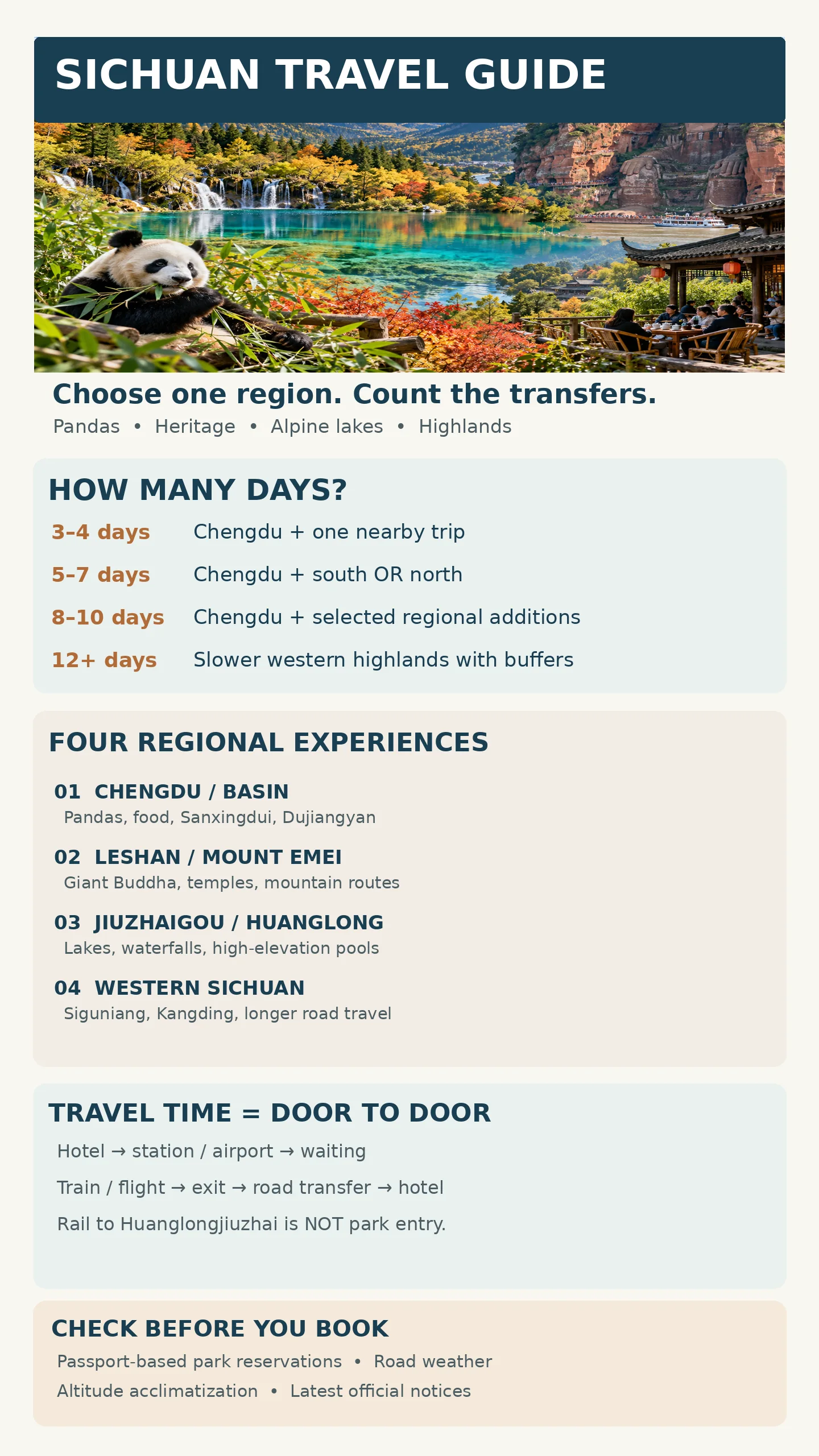
Sichuan offers far more than a quick panda encounter in Chengdu. The province stretches from a busy lowland capital and centuries-old religious sites to turquoise mountain lakes and high-altitude valleys. That variety is its attraction—and its main planning problem. A trip that looks short on a map may involve a train, a road transfer, a different climate and an overnight stay.
This guide helps first-time visitors choose one workable Sichuan travel branch, estimate the days it deserves, and understand where tickets, altitude and seasonal conditions change the decision. Detailed attraction entry routes and reservations belong in the linked destination guides.
Where Is Sichuan, and What Makes It Worth Visiting?
Sichuan is a province in southwestern China, with Chengdu as its capital. The eastern Sichuan Basin contains dense cities, rail links and relatively low elevations. Farther north and west, travel moves into steep valleys, forests, alpine lakes and mountains along the eastern edge of the Tibetan Plateau. A favorable forecast in Chengdu tells you little about conditions in Huanglong or a mountain pass farther west.
There are three reasons many visitors choose Sichuan: giant pandas and the everyday culture of Chengdu; Buddhist, engineering and ancient Shu heritage; and extraordinary northern and western mountain landscapes. You can combine two of these experiences, but the geography forces choices. Chongqing is a separate municipality, not a city within Sichuan. It can be an entry point or an additional stop on a wider China trip, but should not be counted among Sichuan destinations.
If you are still choosing among Chinese regions, start with the China destinations overview. If Sichuan is already on your list, the following sections help narrow its scope.
Best Places to Visit in Sichuan
Chengdu: Pandas, Food and City Life
Chengdu is the most practical base for a first visit. Its substantial hotel supply, urban transit and rail connections simplify a short stay. At the Chengdu Research Base of Giant Panda Breeding, the main appeal is watching pandas in a managed conservation setting; seeing them active is never guaranteed. People’s Park offers a very different experience: tea houses and unhurried local social life. Kuanzhai Alley is a restored commercial heritage district rather than an untouched historic neighborhood.
History-minded travelers can choose Wuhou Shrine, linked to the Three Kingdoms tradition, or Jinsha Site Museum, which introduces the ancient Shu civilization. For a full treatment of neighborhood choices, sightseeing days and transportation, see the Chengdu Travel Guide.
Chengdu’s urban elevation is roughly 500 meters, so the city itself is not comparable to western Sichuan’s high mountains. However, staying in Chengdu does not acclimatize visitors to the much higher elevations they may reach later.
Leshan Giant Buddha and Mount Emei
South of Chengdu, these two landmarks belong to the combined UNESCO World Heritage property Mount Emei Scenic Area, including Leshan Giant Buddha Scenic Area. The giant seated Buddha was carved into a riverside cliff beginning in the eighth century. Visitors may explore designated walking routes or view it from a boat when available; weather, crowding and operating arrangements can affect either option. [1]
Mount Emei is not simply another stop on the same city walk. Its sacred mountain landscape includes temples, forest, changing weather and elevated viewpoints served by various combinations of scenic buses, cable cars and walking. A full mountain visit can justify two days, particularly if you want both lower temples and the summit area. One day is better spent selecting either Leshan or a limited Emei experience than claiming to see both properly.
Plan around the Leshan Giant Buddha guide and Mount Emei visitor guide, which own ticketing and on-site decisions.
Jiuzhaigou and Huanglong
Northern Sichuan’s most celebrated natural pairing is Jiuzhaigou Valley and Huanglong. They are separate UNESCO World Natural Heritage sites, not two entrances to the same park. Jiuzhaigou is known for its vividly colored lakes, waterfalls, woods and scenic shuttle network. Huanglong is known for travertine pools and an alpine setting at substantially higher elevation. [2][3]
These places deserve overnight planning. Arriving by rail at Huanglongjiuzhai station does not mean you have reached Jiuzhaigou Valley: you still need a road connection, followed by the park’s own visitor process. Some departures and road routes may make Huanglong easier to reach than Jiuzhaigou; do not assume the same transfer for both. The actual connection can take considerably longer than an optimistic one-hour estimate, depending on route, conditions and traffic.
Jiuzhaigou requires real-name reservations with acceptable original identification documents. The park’s published 2026 standard adult rates are ¥190 admission plus ¥90 sightseeing bus in peak season (April 1–November 15) and ¥80 plus ¥80 in low season (November 16–March 31); eligibility, operations and future prices may change. A 2026 notice listed a peak-season daily capacity of 41,000. Check the official site for your exact visit date. [4][5]
Huanglong’s elevation adds a distinct health decision. A cable car or shuttle may reduce walking, but it does not erase altitude exposure. For a fuller combined route, consult the Jiuzhaigou and Huanglong itinerary and Getting to Jiuzhaigou.
Mount Siguniang and Western Sichuan
Western Sichuan is best viewed as a separate mountain journey, not as a list of Chengdu day trips. Mount Siguniang provides several different levels of activity. Shuangqiao Valley has established sightseeing transport and is a relatively accessible introduction to dramatic mountain scenery, although the altitude still matters. Changping Valley and Haizi Valley can demand much longer walking, and technical mountaineering is an entirely different undertaking.
Beyond it, Kangding, Tagong grasslands, Xinduqiao and the more distant Daocheng Yading area attract travelers seeking broad plateau landscapes. Travel is heavily road-dependent, and conditions can shift quickly. The farthest destinations should not be appended casually to a one-week trip. In particular, high-altitude overnight stays require a slower ascent plan; physical fitness alone does not prevent altitude illness. [6]
Start with the Mount Siguniang visitor guide if you want to test whether western Sichuan suits your interests and comfort level.
Sanxingdui, Dujiangyan and Qingcheng Mountain
These are useful extensions from a Chengdu base rather than a fourth distant region. Sanxingdui Museum displays remarkable ancient Shu bronzes and other archaeological finds. The area’s high-speed rail access does not automatically mean the museum is only a 40-minute hotel-to-entrance trip: allow for urban transport, station time and the final road connection. Ticket rules also need separate checking.
Dujiangyan is an ancient water-management system still associated with irrigation and flood control. Nearby Mount Qingcheng is a significant Daoist mountain setting, with different experiences on its front and back slopes. Each can occupy much of a day depending on the route. Combine them only after evaluating your walking ability and actual door-to-door travel time. The Sanxingdui visitor guide offers more museum-specific details.
How Many Days Do You Need in Sichuan?
Decide how many calendar days you have, how many hotel nights they include, and how many days will actually be available for sightseeing. A transfer that takes a few hours in a train timetable can consume most of a travel day after packing, getting to the station, waiting, exiting and reaching the next hotel.
| Time available | Realistic scope | Best fit | Main trade-off |
|---|---|---|---|
| 3–4 days | Chengdu and one nearby excursion | First visit, food and pandas | No major northern or western mountain branch |
| 5–7 days | Chengdu plus Leshan–Emei or Jiuzhaigou–Huanglong | One strong regional theme | Cannot comfortably fit both distant branches |
| 8–10 days | Chengdu plus two carefully chosen additions | Travelers comfortable with transfers | Transport can crowd out sightseeing |
| 12–14+ days | Chengdu with a slower mountain-focused exploration | Experienced, nature-focused travelers | More weather and altitude exposure |
A 5–7-day trip that tries to include Leshan, Emei, Jiuzhaigou and Huanglong leaves too little time for the places themselves. Longer does not automatically mean better if every extra day is spent transferring.
Suggested Sichuan Travel Routes
The following are regional decision models, not packaged tours or fixed departure schedules. Adjust the order according to your flights, rail availability, weather and health needs. For the wider China context, compare the China itineraries guide.
Chengdu and Southern Sichuan: 5–6 Days
A reasonable starting allocation is three nights in Chengdu and two nights around Leshan and Emei. Use Chengdu for pandas, food and urban heritage; then follow the southern corridor to see the giant Buddha and a meaningful portion of Mount Emei. Base selection matters: a hotel convenient for Leshan’s riverside attraction is not necessarily convenient for an early mountain departure.
This route avoids the very high-altitude conditions of northern and western Sichuan, but it still involves mountain weather, stairs and possible slippery paths. Do not describe altitude risk as literally zero everywhere on Mount Emei.
Chengdu, Jiuzhaigou and Huanglong: 6–7 Days
Use approximately two or three nights in Chengdu and three nights in the northern scenic area, with the remaining time absorbed by transfers or an adjustable buffer. Reserve one full day for Jiuzhaigou itself. Add Huanglong only if the route, operating conditions and travelers’ response to elevation support it; skipping Huanglong may result in a better trip than forcing both sites into a short window.
Remember that arrival at the railway station is only one leg of the journey. Check the Huanglongjiuzhai Railway Station guide for onward transfer decisions.
Western Sichuan Nature Route: 8–10 Days or Longer
An introductory version focuses on Chengdu and Mount Siguniang, with time at lower elevations before going higher and room for a weather-related road change. A more ambitious variation may add Kangding and Tagong. Daocheng Yading belongs to a longer, carefully assessed trip rather than a last-minute add-on.
Road journeys of several hours should occupy their own planning blocks. Do not turn a full mountain transfer into an after-lunch activity, and do not assume the fastest possible drive will be repeated in adverse weather.
Best Time to Visit Sichuan
Sichuan has no single best month for every region. The basin and the alpine valleys can experience entirely different conditions on the same day.
Spring and Summer
March and April often work well for Chengdu and lower-elevation cultural sites. Higher mountain areas can remain cold. May through August brings lush landscapes but also greater rainfall exposure in parts of northern and western Sichuan. Road closures, landslides and changing park access can follow severe weather. During popular school-holiday periods, check admission capacity and tickets before finalizing accommodation.
Autumn
September through November can offer striking foliage in Jiuzhaigou, Huanglong and mountain valleys. Color timing varies annually with elevation and weather: late September to October can be productive, but there is no guaranteed peak week. The October 1–7 National Day holiday creates exceptional crowd pressure in many years. The relevant year’s official holiday dates and the park’s latest admission notices matter more than a fixed advance-booking formula.
Winter
Chengdu and many lowland sights remain viable through December–February, often with fewer visitors. Jiuzhaigou may operate on its published low-season schedule, subject to weather and notices. Mountain roads and trails can be icy or temporarily closed, and the Golden Summit area of Mount Emei can be considerably colder than the city below. Winter planning favors flexible transport and appropriate footwear, not assumptions that every part of the mountains will be open.
How to Get to Sichuan and Travel Around
Flying Into Chengdu
Chengdu has two major airports: Chengdu Tianfu International Airport (TFU) and Chengdu Shuangliu International Airport (CTU). They are at different distances from central Chengdu and use different transfers. Check the airport code on both arrival and departure bookings. An attractive airfare can lose its advantage if it creates a difficult transfer to your hotel or onward train.
High-Speed Rail and Intercity Connections
Rail is useful between Chengdu and the Leshan area, with many journeys taking around an hour aboard the train, but your hotel-to-attraction time also includes city travel, station access, waiting and the onward transfer. Northern routes can involve a train to Huanglongjiuzhai and a road leg to the intended valley or hotel. When comparing options, write both the scheduled ride and the full door-to-door estimate; confirm actual departure times rather than treating illustrative figures as tickets.
The broader decision between rail, flights and local connections is covered in Getting Around China.
Reaching Mountain and Remote Areas
Much of western Sichuan still depends on road travel. Depending on the destination, a mountain transfer may require four to eight hours or longer, and poor weather or traffic controls can interrupt it altogether. Prefer established transport providers, review road and weather alerts close to departure, and retain a day or flexible half-day where a missed connection could have serious consequences.
Sichuan Food: What Should First-Time Visitors Try?
Sichuan cuisine is famous for là (辣, spicy heat) and má (麻, the tingling sensation associated with Sichuan peppercorn), which are not identical flavors. Not every Sichuan dish is intensely hot. Popular choices include hot pot, mapo tofu, dan dan noodles and twice-cooked pork. Leshan has its own food traditions, including bobo chicken and sweet-skinned duck.
If you want less heat, ask for shǎo là (少辣, less spicy) or bú là (不辣, not spicy). Some dishes cannot easily lose their chili or peppercorn character, and a reduced-spice request is not an allergy safeguard. For dietary restrictions and allergy communication, use the site’s dedicated food guidance rather than relying on a short spoken phrase.
Where to Stay in Sichuan
Choose accommodation based on your next travel connection, not simply the most famous hotel district.
| Base | What to prioritize |
|---|---|
| Chengdu | Convenient metro access and a practical route to the station or airport you will actually use |
| Leshan / Emei | Whether you need the city, a mountain entrance or an early scenic shuttle |
| Jiuzhaigou | Road access to the park entrance and confirmed transport the next morning |
| Western Sichuan | Elevation, heating, road accessibility and access to basic medical help |
At high altitude, the lowest-priced remote guesthouse may be a poor trade if it has limited heating or makes travel difficult. Foreign guests should expect passport-based accommodation registration; confirm document and check-in arrangements in advance, without assuming a separate nationwide class of “foreigners-only hotels” is legally required.
Practical Sichuan Travel Tips and Safety Considerations
| Situation | What can go wrong | Better planning response |
|---|---|---|
| Jiuzhaigou peak season | Ticket inventory and visitor-capacity limits | Reserve through official channels and check the dated park notice |
| Northern and western highlands | Altitude illness | Ascend gradually; seek medical help for concerning symptoms and descend when medically indicated [6] |
| Mountain roads in heavy rain | Rockfalls, landslides and closures | Check official traffic/weather notices and leave an alternative day |
| Mount Emei summit | Cold and slippery steps | Carry layers and suitable traction; follow local access restrictions |
| Too many distant regions | Constant transfers and fatigue | Choose one main branch and protect full sightseeing days |
| Major public holidays | Crowded transport and scarce rooms | Book critical components early; keep backup choices |
High-altitude symptoms deserve attention rather than being dismissed as normal fatigue. New severe breathlessness, confusion or problems walking at altitude are urgent warning signs. The safest approach is to stop ascent and seek appropriate medical assessment, with descent when indicated. The CDC emphasizes that risk depends on elevation and speed of ascent; being fit does not make a traveler immune. [6]
Sichuan also has monitored seismic and geological hazards. Follow official closure notices, local safety directions and established routes rather than treating dramatic scenery as permission to enter a restricted area. For broader preparation, see Health Preparation for China Travel and Travel Insurance for China.
Sichuan Travel Planning Checklist
- Choose one principal Sichuan branch rather than aiming for the whole province.
- Record calendar days and lodging nights separately.
- Count railway time, road transfers and hotel connections in every door-to-door estimate.
- Recheck passport-based ticketing and current rules for Jiuzhaigou, the panda base and Sanxingdui.
- Prepare for mountain cold, rain or snow according to your exact route and season.
- Review altitude-related health considerations before a highland trip.
- Save Chinese hotel and attraction addresses and emergency contacts offline.
- Keep an adjustable buffer, ideally about a day on a longer mountain itinerary, for transport or weather changes.
FAQs About Traveling in Sichuan
Is Sichuan Worth Visiting for First-Time Travelers to China?
Yes, if you want a mix of pandas, regional food, historical sites and outstanding landscapes. Its size means you should choose a main focus rather than attempting the entire province during a short China visit.
How Many Days Should I Spend in Sichuan?
Three or four days suit Chengdu with a nearby excursion. Five to seven days can support one longer extension, while eight to ten or more allow additional regions if you reserve realistic transfer time.
Can I Visit Jiuzhaigou as a Day Trip From Chengdu?
It is not a sensible default. Even when a rail segment is relatively quick, station transfers, road travel, ticket checks and a full day inside the valley make an overnight stay near Jiuzhaigou considerably more practical.
Is Sichuan Safe for Travelers Who Are Not Used to High Altitude?
Chengdu and many basin destinations are low elevation; Huanglong and western mountain destinations are not. Travelers unfamiliar with altitude should build an appropriate acclimatization plan and obtain medical advice where health conditions make that necessary.
Is Sichuan Food Always Spicy?
No. Different dishes balance chili heat, Sichuan-pepper tingling and other flavors. You can request less chili, but confirm ingredients individually if you have allergies or dietary restrictions.
Sources
[1] UNESCO World Heritage Centre, Mount Emei Scenic Area, including Leshan Giant Buddha Scenic Area.
[2] UNESCO World Heritage Centre, Jiuzhaigou Valley Scenic and Historic Interest Area.
[3] UNESCO World Heritage Centre, Huanglong Scenic and Historic Interest Area.
[4] Jiuzhaigou Scenic Area, official ticket information, accessed October 31, 2026.
[5] Jiuzhaigou Administration, 2026 peak-season visitor notice, March 23, 2026.
[6] CDC Yellow Book, High-Altitude Travel and Altitude Illness, April 23, 2025.





