

Quick Answer: Using Shanghai Pudong Airport
Shanghai Pudong International Airport (PVG) is Shanghai’s main international gateway. Its two principal terminals, T1 and T2, connect to satellite concourses S1 and S2 for some departure gates; Hongqiao Airport (SHA) is a different airport across the city.
- Arrivals: International entrants usually complete immigration, baggage collection and customs before ground transport.
- Departures: Check in at the assigned main terminal; follow secure-side people-mover signs if the gate is in S1 or S2.
- Connections: Immigration and baggage requirements depend on tickets, airlines, route and visa eligibility.
- Transport: Compare Metro Line 2, Maglev to Longyang Road, Airport Link to Hongqiao, buses and licensed cars.
T3 is not an operating passenger terminal. Check live flight, transit, ticket and transport details before traveling; satellite gates and airport services can change.
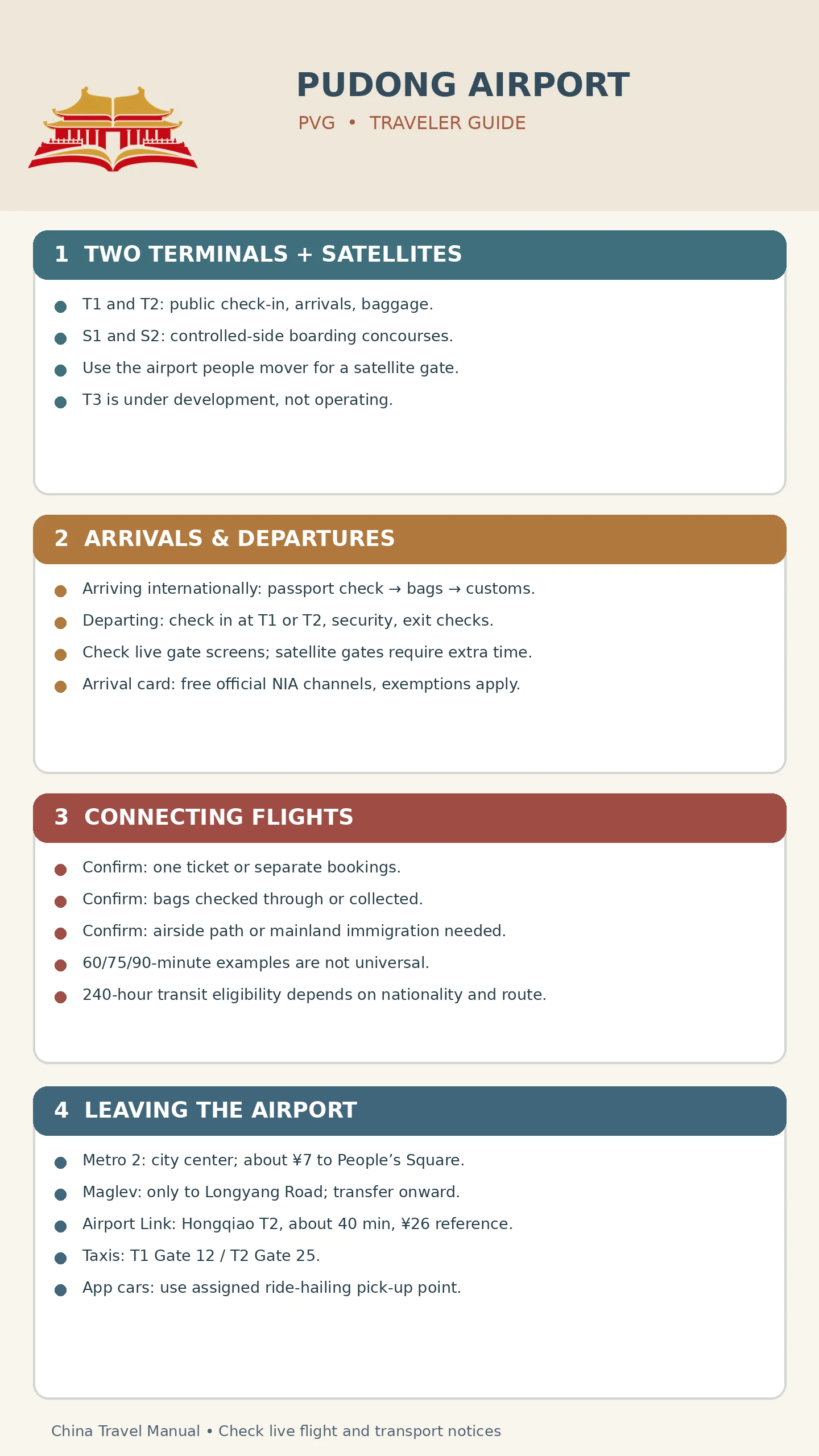
Shanghai Pudong International Airport (上海浦东国际机场, PVG) is the city’s major international gateway. Its two main passenger terminals, T1 and T2, connect with secure-side satellite concourses S1 and S2. Check your actual flight terminal before traveling: Pudong Airport is not Hongqiao Airport (SHA), and a satellite boarding gate is not a separate public check-in terminal. For city orientation, see the Shanghai Travel Guide.
This guide focuses on what to do inside PVG: arrivals and departures, passport checks, baggage, connections and transport choices. Airport rules and flight arrangements may change, particularly for separate-ticket connections. Verify airline and airport instructions for the particular day rather than assuming another traveler’s route will apply.
Shanghai Pudong Airport at a Glance
Location, Airport Code and Terminals
PVG is in Shanghai’s Pudong New Area, roughly 30 kilometers from the central city, depending on the destination. Shanghai Airport’s public service hotline is +86-21-96990. T1 and T2 are the main public-facing terminals for check-in, baggage handling and arrival services. S1 and S2 are satellite boarding facilities inside the airport’s controlled passenger system, not public airport terminals with their own curbside check-in desks. The planned Terminal 3 remains a development project; it should not be treated as an operating passenger terminal.[1]
| Airport feature | What travelers need to know |
|---|---|
| Airport code | PVG |
| Main terminals | T1 and T2: check-in, arrivals and departures |
| Satellite concourses | S1 and S2: secure-side gates, reached by airport people mover |
| Airport information | +86-21-96990 |
| Ground links | Metro Line 2, Maglev, Airport Link Line, buses, taxis and ride-hailing |
Pudong Airport vs. Hongqiao Airport
The other major Shanghai airport is Shanghai Hongqiao International Airport (虹桥国际机场, SHA), in western Shanghai near the Hongqiao railway hub. Pudong and Hongqiao are far apart, so flights arriving at PVG and departing from SHA require an inter-airport trip. Double-check both three-letter airport codes when booking: a same-city transfer may still require baggage collection, leaving the airport and completing new flight formalities. The general China Airports Guide explains the wider airport system.
Shanghai Pudong Airport Terminal Layout
Terminal 1 and Terminal 2
Both T1 and T2 handle domestic and international flights. Each has check-in, baggage drop, arrivals, security and departure areas. Do not assume that an airline always uses a particular terminal based on its country or brand. Your airline message, flight status display and boarding pass are more reliable than a fixed terminal list copied from an old website.
After reaching the correct terminal, look for the departure boards and the airline’s check-in island. Arriving passengers should follow the international or domestic arrival signs for their actual flight. Terminal facilities include help desks, money-changing services, communications assistance and onward transport routes, but opening hours vary between operators.
Satellite Concourses S1 and S2
S1 and S2 serve passenger boarding gates beyond the main terminal buildings. A typical departing passenger completes check-in and checked-baggage drop in T1 or T2, passes the appropriate security and international departure formalities, then follows signs for the automated people mover to the satellite boarding gates. The usual terminal relationship is T1 with S1 and T2 with S2, but the live gate assignment determines the actual path.
The people mover is airport-controlled transport for screened passengers, not a taxi, metro or public bus. You cannot arrive in S1 or S2 from the street for check-in. If you land at a satellite gate, follow the airport’s marked arrival or transfer path back toward the relevant main-terminal processing area; your required route depends on whether you are entering China or connecting onward.
Allow for walking, people-mover waiting and an additional walk after reaching your satellite gate. A gate change may alter that route. Follow airport screens and staff even if an old airport map shows another gate.[2]
How to Move Between Terminals
| Connection | What it means | How to navigate |
|---|---|---|
| T1 to T2 in the public area | A landside transfer before check-in or after arrival | Follow terminal shuttle signs; the airport lists free buses with approximately 10–15 minute intervals as a reference |
| Main terminal to S1 or S2 | Secure-side access to assigned boarding gates | Follow airport people-mover and gate signs after the required checks |
| Connecting flight | Depends on ticket, baggage and immigration clearance | Ask the airline transfer desk for the authorized route |
The airport has described a free 24-hour landside shuttle between the two main terminals; exact boarding stands and intervals should be checked in person. Do not attempt to use that bus to reach a satellite gate. Equally, the internal people mover does not substitute for a public-side terminal transfer with baggage.[1]
International Arrivals at Shanghai Pudong Airport
Immigration and Passport Control
For an international flight entering mainland China, follow International Arrivals / 国际到达. The usual sequence is passport inspection, baggage claim, customs and then the public arrivals hall. Present your valid passport and whatever visa or visa-free entry eligibility is applicable to your nationality and travel purpose. Some passengers entering from international flights will instead be directed to a qualified transit procedure; do not join the ordinary arrivals line without confirming which route applies.
China’s National Immigration Administration introduced free online foreigner arrival-card filing on November 20, 2025. Eligible travelers may submit in advance through official NIA channels; some categories are exempt, including qualifying direct international transit passengers who do not leave the port restricted area. Travelers who cannot complete it before departure may use the authorized channels available upon arrival. Avoid websites asking for payment to submit the government arrival card.[3]
Baggage Claim and Customs
After passport checks, look up your flight number on baggage-claim screens to find the carousel. Match the bag tag to your checked baggage before leaving. If a suitcase is missing or damaged, report it to your airline or its appointed baggage-services agent while still in the claim area, and keep the report number. The airport customs desk is not the first stop for an airline baggage-delivery problem. See delayed and lost baggage at China airports for follow-up steps.
After collecting bags, proceed through the customs channel that fits your declarations. Declare goods where required and ask customs officers if unsure. Avoid treating the green channel as a universal exemption. The China Customs Guide for Travelers explains the separate customs requirements.
First Things to Do After Landing
Before leaving PVG, arrange a way to connect, pay and reach your destination. In 2026, Shanghai expanded traveler support through arrival-area information points and one-stop international visitor service centers. Official coverage describes SIM cards, portable Wi-Fi rental, currency exchange, transport cards and assistance with mobile payment. These services are especially helpful for passengers without a mainland Chinese mobile number.[4]
Free airport Wi-Fi includes a passport-identification option, so a Chinese phone number is not always necessary for access. Look for the posted official airport connection procedure rather than entering passport details into a random link. A service desk may direct you to the appropriate Wi-Fi login, SIM counter or transport ticketing desk. Verify the operating time of the specific counter; not every seller is open all night. For preparation, read SIM Cards for China Travel.
Departing from Shanghai Pudong Airport
Find Your Airline and Check-In Counter
First confirm PVG, the flight date and your airline’s current main-terminal assignment. In T1 or T2, check the departure information screen for the flight number and check-in counter. Have your passport and booking ready. If you are checking a suitcase, complete baggage drop here. A boarding pass showing S1 or S2 still generally means the public-side check-in was in a main terminal, not the satellite concourse.
Check-in and baggage-drop deadlines differ by airline, route and booking conditions. Do not infer a deadline from another carrier’s rule or the scheduled departure time. Confirm special requirements for excess baggage, oversized items and lithium batteries with your airline and current airport security instructions; see Airline Baggage in China.
Security and Exit Immigration
After completing check-in, follow the domestic or international departure signs. Your bags and permitted personal items must pass aviation security. International travelers must also follow the required exit-border inspection process; domestic travelers do not complete international exit immigration. The sequence and screening lanes can vary, so take the route indicated by the live signs and airport personnel.
Keep your passport, boarding pass and electronic devices accessible until checks are complete. Do not assume that restrictions for liquids, sharp items or power banks are identical on all routes. The rules for your flight and security checkpoint take precedence over broad travel advice.
Finding Your Boarding Gate
Once you have cleared the necessary controls, check the gate number again. If the display points to S1 or S2, follow the internal airport people-mover signs, allow time for its departures and continue to the assigned gate. There may be substantial corridors on both sides of the people-mover ride. Never assume the first concourse you enter is where the aircraft will board.
Boarding may close significantly before takeoff. Your flight’s boarding-pass deadline, airline announcement and gate display control; do not arrive at the gate only at the scheduled aircraft departure time. If the boarding gate changes, follow the new airport instruction rather than relying on a screenshot.
How Early Should You Arrive?
Work backward from the airline’s actual check-in and baggage-drop cutoff. Add enough time for a busy terminal, security, international exit inspection when applicable, internal travel to a satellite gate and the final walk. Major Chinese holidays or several flights departing together can lengthen queues. A planning buffer is useful, but no single published minimum can safely cover every airline and itinerary.
Flight Connections and Layovers at Pudong Airport
A smooth PVG transfer depends on the combination of your ticket, carrier, checked baggage, domestic or international flight types, terminal and legal permission to enter China if necessary. Before your first flight, ask the airline to confirm whether your bags are checked through, whether you will receive the second boarding pass and which transfer desk you should use.
Domestic-to-Domestic Connections
On a protected through-ticket, your airline may transfer checked baggage and direct you along a designated domestic connection path. If the booking consists of two separate tickets, you may instead have to leave the controlled area, collect your bag, check in again and pass security a second time. Changing between main terminals or satellites also adds walking and people-mover time. Confirm your particular arrangement with the operating carrier.
International-to-International Connections
Some through-ticket international passengers can remain in the international transit area when the airline can transfer baggage and issue the onward boarding pass. Other passengers must enter mainland China to collect luggage, change terminals landside or complete a fresh check-in. Separate tickets make this more likely, but a through-ticket alone is not an unconditional guarantee of airside transit. Ask the airline and airport transfer desk before choosing the route.
International-to-Domestic Connections
An international arrival connecting to a mainland domestic flight normally involves immigration clearance and the relevant customs processes before continuing to domestic travel. Depending on the airline product, baggage may or may not have to be reclaimed and checked again. Special through-check programs exist, but their terms can be limited to certain carriers, ticket types and routes. Check every segment instead of assuming that an international-to-domestic transfer is automatic.
Minimum Connection Times and Baggage Transfers
| Decision to check | Why it changes the transfer |
|---|---|
| One through-ticket or separate bookings | Whether the airline protects and coordinates the connection |
| Checked baggage through to final destination | Whether you need baggage claim and a new baggage drop |
| Domestic or international flight segments | Which security, customs and border procedures apply |
| Main terminal or satellite gate | Whether internal transport and long corridors are required |
| Eligibility to enter China | Whether a landside recheck can be legally completed |
Pudong publicized selected optimized connecting products in 2025 with 60-, 75- or 90-minute minimum connection references. These figures are not general advice for all PVG passengers: the correct minimum for your specific booking must be confirmed by the operating airlines. Shanghai expanded some international through-check services in 2026, but eligibility remains route- and carrier-dependent.[2][5]
Visa-Free Transit Considerations
China’s 24-hour transit-without-visa system and its 240-hour visa-free transit scheme have distinct requirements. The National Immigration Administration’s August 2026 guidance lists 57 eligible nationalities for the 240-hour scheme, with specific passports, onward third-country or region itineraries, permitted entry ports and travel areas. The 24-hour policy also distinguishes remaining inside the restricted port area from applying to leave it.[6]
Do not assume that every layover qualifies for entry or that a traveler can change flights on separate tickets without passing immigration. Check the current China Visa-Free Transit Guide and 240-Hour Visa-Free Transit in China before booking a tight connection. The China Arrival Card Guide covers entry-form preparation.
Transport from Pudong Airport and Connections Across Shanghai
Choose ground transport according to your actual destination, luggage, budget and arrival time. A train’s running time is not a door-to-door travel estimate, especially after an international arrival.
Metro Line 2
Metro Line 2 connects the airport to major areas of Shanghai and links onward through the wider network. Shanghai’s published transport reference gives approximately one hour and about ¥7 for travel to People’s Square, excluding the walk from baggage claim and any wait for a train. It is a useful lower-cost option when you have manageable luggage. Check current operating hours if arriving late.[1]
For stations, transfers and payment methods, see Shanghai Metro Guide and the detailed Pudong Airport to the City guide.
Shanghai Maglev
The Shanghai Maglev connects Pudong Airport with Longyang Road. From there, travelers continue by metro or road transport. It does not run directly to the Bund, People’s Square or Hongqiao Airport. Check the latest departures, fare and the onward metro route before deciding whether it saves time. The Shanghai Maglev Guide covers ticketing and the ride itself.
Airport Link Line to Hongqiao
The Airport Link Line connects Pudong Airport T1 and T2 transport access with Hongqiao Airport Terminal 2, with a published rail running time of around 40 minutes between airports and a published full fare of ¥26. These are reference operating figures that may change. The Hongqiao end is an airport-linked station, not the high-speed railway waiting hall; allow separate walking and boarding time if your connection is by train.[7]
Use Pudong to Hongqiao Airport Transfer for inter-airport travel, or Pudong Airport to Hongqiao Railway Station if connecting to rail. See the Shanghai Hongqiao Railway Station Guide for train entry and platform details.
Airport Buses, Taxis and Ride-Hailing
Airport buses serve different Shanghai areas; there is no single route that directly serves every central destination. For a regular licensed taxi, Shanghai Airport’s reference places T1 pickup outside Arrival Gate 12 and T2 pickup outside Arrival Gate 25. Follow Taxi signs to the official queue and confirm the destination with the driver.[1]
Ride-hailing services use app-assigned locations that can differ from taxi ranks. Check the approved pick-up zone in the app and signs at your actual terminal, then verify the car plate. Road travel time and fares depend on traffic, destination and time of day. For broader air-to-rail choices, use Air-to-Rail Connections in China.
Passenger Facilities and Services
Wi-Fi, SIM Cards, Payment and Currency Exchange
Shanghai’s official 2026 visitor-service updates describe multilingual help with travel information, mobile payment, communication and transportation at airport arrival service centers. Passport-verified airport Wi-Fi access can help if you have no Chinese mobile number. Check the posted network name and seek assistance at official counters if the connection fails. SIM, portable Wi-Fi and exchange counters may have separate opening hours.[4]
Luggage, Rest Areas and Showers
If you need storage between flights, ask the current airport information desk whether a staffed or self-service baggage facility can accept your bags, what the limits are and how long it operates. The airport has seating and rest spaces; some special facilities or shower services may require payment or a lounge entitlement. Do not assume that an online price or a claimed free shower applies at every terminal.
Accessibility, Families and Special Assistance
Passengers needing an accessible route should follow elevator and step-free signs and ask airport staff for a route suitable for their terminal and gate. For wheelchair or other airline-assisted travel, arrange the required service with the airline before travel where possible. Families may also find designated facilities, but their exact locations vary. Do not plan a tight satellite connection without allowing for the time needed to use lifts and internal transport.
FAQs About Shanghai Pudong Airport
Is PVG the Same as Shanghai Hongqiao Airport?
No. PVG is Shanghai Pudong International Airport in eastern Shanghai; SHA is Hongqiao Airport in the west, near Hongqiao transport hub.
How Many Terminals Does Pudong Airport Have?
PVG has two main passenger terminals, T1 and T2, plus satellite concourses S1 and S2. The satellites are not independent public check-in terminals.
Can I Take the Metro from Pudong Airport to Shanghai City Center?
Yes. Metro Line 2 connects Pudong Airport with central Shanghai, including People’s Square. Check current operating hours and allow for station access.
How Do I Transfer Between Terminals at Pudong Airport?
For T1-to-T2 public-side travel, follow the airport terminal shuttle signs. For a satellite gate, use the secure-side people mover after the required checks.
Do I Need to Go Through Immigration During a Layover at PVG?
It depends on the flight combination, checked baggage, through-ticket arrangements and whether you must enter mainland China. Confirm the procedure with the airline and airport transfer staff.
Sources
[1] Shanghai Municipal Government. Transportation at Shanghai airports
[2] Shanghai Municipal Government. Pudong airport transit services
[3] National Immigration Administration. Free official online arrival card service
[4] Shanghai Municipal Government. Pudong airport upgrades international traveler services
[5] Shanghai Municipal Government. International through-check updates
[6] National Immigration Administration. Visa-free transit policies as of August 2026
[7] Shanghai Municipal Government. How to take the Airport Link Line





