
Quick Answer
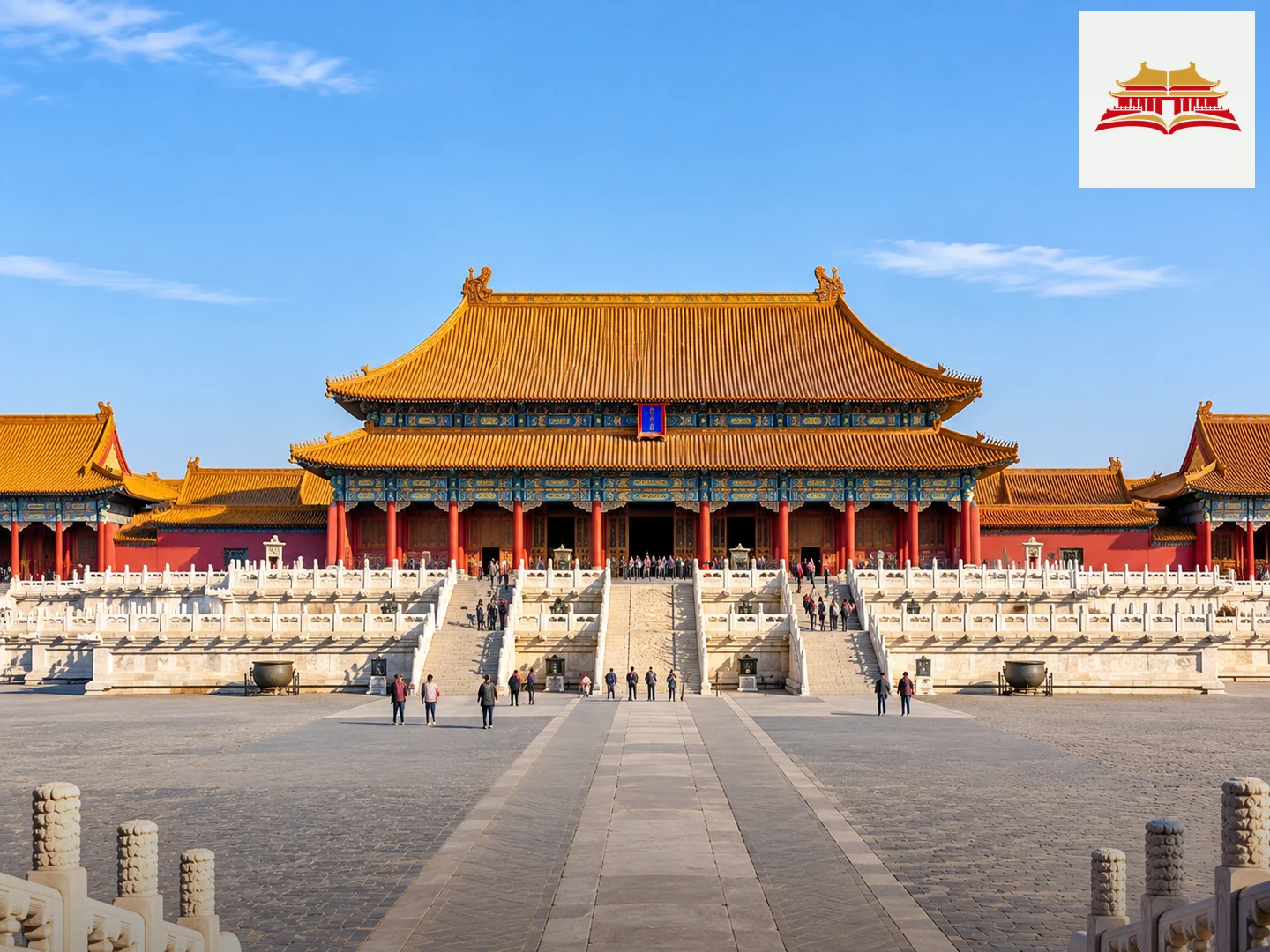
The Forbidden City is Beijing’s historic imperial palace, now managed as the Palace Museum. For a first visit, plan a half day and follow the central axis from south to north: enter through Meridian Gate, see the Three Great Halls and Three Rear Palaces, continue to the Imperial Garden, then leave through Shenwu Gate or Donghua Gate.
- Best first-visit plan: Half a day, with the central axis plus one side area or gallery if it is open.
- Short visit: Around two hours for the central-axis highlights only.
- Opening: 08:30–17:00 in high season (last entry 16:00); 08:30–16:30 in low season (last entry 15:30).
- Closed: Normally Mondays, with qualifying holiday exceptions; check the official calendar.
- Tickets: Advance booking is required. Foreign visitors provide passport numbers during online booking.
- Current closures: Check the Palace Museum’s live announcements; individual palaces and galleries may close for conservation.
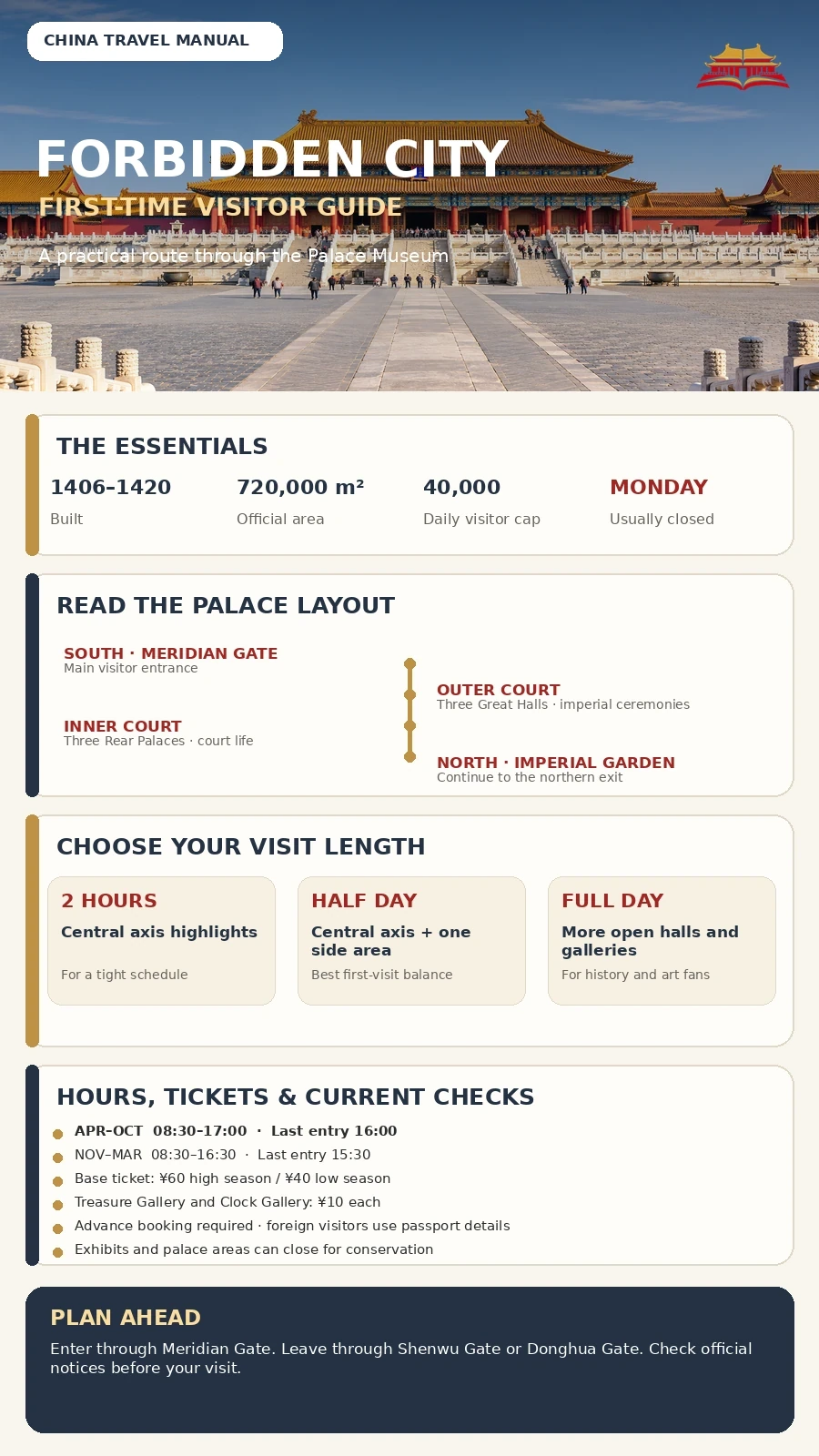
The Forbidden City is the historic imperial palace complex in central Beijing; today, it is home to the Palace Museum. For a first visit, the most useful way to understand it is to follow the palace from south to north: the ceremonial Outer Court comes first, the residential Inner Court follows, and the Imperial Garden lies near the northern end. This is not a collection of unrelated halls. Its central axis, gates, courtyards, and side palaces form a carefully ordered architectural complex.
Plan on a half day if this is your first visit and you want time to look beyond the main courtyards. A shorter central-axis visit is possible, while a full day suits visitors with a strong interest in palace history and exhibitions. All visitors enter through Meridian Gate (Wumen) on the south. At the end, leave through Gate of Divine Prowess (Shenwu Gate) or East Prosperity Gate (Donghua Gate); you cannot simply walk back out through the entrance. Before setting out, check the Palace Museum’s current opening notices, because conservation work can close individual buildings or galleries. For a wider city overview, see our Beijing travel guide.
What Is the Forbidden City?
From the Ming and Qing Imperial Palace to the Palace Museum
Built between 1406 and 1420 under the Ming emperor Yongle, the Forbidden City served as the imperial residence and center of state power during the Ming and Qing dynasties. UNESCO records that 14 Ming and 10 Qing emperors were enthroned here. The Palace Museum was established in 1925, turning the former palace into a public museum.
The names describe two connected things. “Forbidden City” is the familiar name for the historic palace complex, while “Palace Museum” is the institution that manages the site and its collections today. You will see both names used by official and travel sources. When looking for current opening hours, tickets, visitor trails, and service information, use the Palace Museum’s official website rather than an old third-party listing.
Why the Forbidden City Is a UNESCO World Heritage Site
The imperial palaces in Beijing and Shenyang form one UNESCO World Heritage property, inscribed in 1987 and extended in 2004. The Forbidden City is also part of the Beijing Central Axis, a separate World Heritage property inscribed in 2024. These are two distinct heritage listings.
How Is the Forbidden City Laid Out?
The Outer Court: Imperial Ceremonies and State Affairs
The southern Outer Court centers on the Three Great Halls: the Hall of Supreme Harmony, Hall of Central Harmony, and Hall of Preserving Harmony. This was the ceremonial and official part of the palace, used for major audiences, state occasions, and court rituals. Its broad courtyards and raised terraces created a formal setting for imperial ceremonies.
The Inner Court: Imperial Residences and Palace Life
North of the Outer Court, the Inner Court was associated with the emperor’s household, family life, and more private palace activity. Its central group is the Three Rear Palaces: the Palace of Heavenly Purity, Hall of Celestial and Terrestrial Union, and Palace of Earthly Tranquility. Their functions changed between the Ming and Qing periods.
The Central Axis: The Main South-to-North Route
The central axis links the main gates, ceremonial halls, residential palaces, and Imperial Garden. Side courtyards and palace compounds spread east and west, but first-time visitors can understand the overall design by following the main axis and adding a side area only if time and opening status allow.
What to See Inside the Forbidden City
The Three Great Halls
The Hall of Supreme Harmony (Taihe Dian) is the ceremonial centerpiece of the Outer Court and hosted the highest-ranking imperial occasions. The smaller Hall of Central Harmony (Zhonghe Dian) served as a place for the emperor to prepare or pause before formal events. The Hall of Preserving Harmony (Baohe Dian) was used for court functions and, during the Qing dynasty, the final stage of the imperial examinations.
The Three Rear Palaces
The Palace of Heavenly Purity (Qianqing Gong), Hall of Celestial and Terrestrial Union (Jiaotai Dian), and Palace of Earthly Tranquility (Kunning Gong) form the central residential group. Their roles included imperial residence and work, imperial seals and empress-related rites, and—especially in the Qing period—marriage and Manchu religious ceremonies.
The Eastern and Western Palaces
The six eastern and six western palaces housed members of the imperial household and now contain historic interiors and exhibition spaces. They add context about court life, but are not essential on a short visit. Choose one accessible compound rather than trying to cover every courtyard.
Opening status is especially important here. Buildings may close for conservation, collection care, or exhibition changes. As checked on November 5, 2026, the Palace Museum had announced that Yanxi Palace would stop receiving visitors from November 4 until further notice. Do not build a route around it unless a later official notice confirms that it has reopened.
The Imperial Garden
Near the northern end of the route, the Imperial Garden offers a quieter contrast to the ceremonial courtyards, with old trees, rockeries, pavilions, and winding paths. Slow down here before leaving, and avoid blocking narrow paths or crossing barriers around historic features.
The Treasure Gallery and Gallery of Clocks
The Treasure Gallery is in the Palace of Tranquil Longevity area; the Gallery of Clocks is in the Hall for Ancestral Worship area. Each requires an additional ticket. They suit visitors interested in court objects, decorative arts, and historic craftsmanship, but are optional if your priority is the palace architecture.
Do not assume that every named gallery is open on every date. The Wuying Hall area, which has housed the Ceramics Gallery, was announced as closed from October 19, 2026 for repairs, collection care, and exhibition upgrades. The official visitor guide also marks some specialist galleries as temporarily closed. Recheck the live open-area map before deciding whether an additional ticket is worthwhile.
Which Forbidden City Visitor Route Should You Choose?
The 2-Hour Central Axis Route
For a tight schedule, follow the central axis from Meridian Gate through the Three Great Halls, Three Rear Palaces, and Imperial Garden, then leave through Shenwu Gate or Donghua Gate. Two hours is a highlights visit, with little time for long exhibitions, queues, or side courtyards.
The Half-Day Route: Central Axis and One Side Area
A half day offers the best balance for most first-time visitors. Follow the central axis, then choose one side area or one specialist gallery that matches your interests and is confirmed open. Leave time for security, photographs, labels, restrooms, and walking between courtyards.
Leave a buffer for security, photographs, reading exhibition labels, restroom stops, and walking between courtyards. The half-day plan should remain flexible: if an area is closed or crowded, continue along the main route rather than spending valuable time trying to force the original plan.
The One-Day Route: Exploring More of the Palace Museum
A full day suits visitors who enjoy history, architecture, and exhibitions. It can include the central axis, several open palace compounds, and one or more galleries, but you should not expect to see every building. Some spaces are closed or viewed only from outside, and the walking can be tiring.
How Long Should You Spend at the Forbidden City?
A Short Visit for Travelers with Limited Time
A Half-Day Visit for First-Time Visitors
A Full-Day Visit for History and Art Enthusiasts
Forbidden City Opening Hours and Ticket Information
Seasonal Opening Hours and Monday Closures
The current seasonal schedule is shown below. The Palace Museum is normally closed on Mondays, except on qualifying national holidays; the official site also notes an exception for Chinese New Year’s Eve. Special events or temporary circumstances can change hours, so confirm the date-specific notice before traveling.
| Season | Dates | Opening hours | Last entry |
|---|---|---|---|
| High season | April 1–October 31 | 08:30–17:00 | 16:00 |
| Low season | November 1–March 31 | 08:30–16:30 | 15:30 |
Advance Reservations and Passport Requirements
The Palace Museum does not sell same-day admission at the gate. Book in advance through its official ticketing channel. The official English visitor page requires foreign visitors to provide passport numbers and states a daily limit of 40,000 visitors. The current ticketing notice says reservations open at 20:00 seven days before the visit; confirm the release window on the official ticket page before relying on it.
This guide covers only the basic admission requirements. For the booking platform, passport entry, payment, reservation changes, and other step-by-step details, use our dedicated Forbidden City ticket booking guide. Do not rely on unofficial resellers or old screenshots of the booking process.
Admission Tickets and Additional Galleries
The published standard admission price is CNY 60 in high season and CNY 40 in low season. The Treasure Gallery and Gallery of Clocks each cost an additional CNY 10. These charges are separate from general admission; check the official ticket policy for current prices, eligibility, and availability.
| Ticket | Published price | What it covers |
|---|---|---|
| General admission | CNY 60 high season / CNY 40 low season | Palace Museum general visit |
| Treasure Gallery | CNY 10 extra | Palace of Tranquil Longevity area and associated displays |
| Gallery of Clocks | CNY 10 extra | Hall for Ancestral Worship area |
How to Get to the Forbidden City: Entrance and Exits
Enter Through Meridian Gate
Meridian Gate (Wumen) on the south side is the visitor entrance. Plan to arrive at this gate and allow time for the surrounding Tian’anmen security procedures and the walk to the entrance. A Palace Museum reservation may qualify as an access record for Tian’anmen Square during specified periods, but check the current rules for your date. For a fuller explanation of the square and its access arrangements, see our Tiananmen Square visitor guide.
Exiting Through Shenwu Gate or Donghua Gate
At the end of the visit, leave through Shenwu Gate (the north gate) or Donghua Gate (the east gate). Shenwu Gate is the most natural exit for visitors continuing to Jingshan Park, which lies directly to the north. Donghua Gate may suit a different onward route. Do not plan to return to Meridian Gate on foot from inside the museum; the one-way visitor arrangement is part of the site’s operating rules. The nearby Jingshan Park visitor guide can help you plan the next stop after the north exit.
Reaching the Palace Museum Through the Tian’anmen Area
Allow extra time for security checks and crowd-control arrangements around Tian’anmen. The square has its own access rules, and a Palace Museum ticket does not grant entry to every nearby attraction. Check the current reservation guidance for your date and follow staff instructions. For citywide route planning, consult Getting Around Beijing and the Beijing Metro Guide.
Facilities, Accessibility, and Visitor Rules
Visitor Services, Audio Guides, and Restrooms
The official service map lists visitor service points, audio guides, restrooms, nursery facilities, food and drink, coffee, first aid, shops, and stroller rental. Check the map for current locations before you start walking.
Accessibility, Wheelchairs, and Luggage Storage
The museum lists accessibility services, but the historic site is not fully step-free: many courtyards and buildings have stairs, slopes, level changes, and uneven stone surfaces. Visitors with limited mobility should check the current accessibility map and confirm a suitable route with the museum; not every hall or side compound is wheelchair-accessible.
Luggage storage is available at designated service points, subject to current size and item rules. Avoid bringing large suitcases or bulky items, check the official storage instructions before arrival, and allow time to collect belongings after exiting.
Important Rules for Protecting the Palace Museum
Visitors undergo security checks before entry. Smoking is prohibited throughout the site, as are climbing on historic structures or rockeries and touching or defacing cultural relics. Eating, flash photography, selfie sticks, and tripods are prohibited in exhibition halls; commercial photography and unauthorized livestreaming or promotional activity are also restricted.
Watch for signs around steps, slopes, eaves, trees, and narrow passages. The museum’s visitor guidance emphasizes that the site has many staircases and uneven surfaces. In bad weather or an emergency, follow staff instructions and public announcements. Read the current official visitor notice and prohibited-items list before departure, especially if you plan to bring camera equipment, mobility aids, or children’s items.
What to Visit Near the Forbidden City
Jingshan Park: A View of the Palace Roofscape
Jingshan Park is immediately north of the Palace Museum, across from Shenwu Gate. It is a natural follow-up if you want a broader view of the palace roofs and the north–south layout. The climb to the viewpoint involves steps, so consider your energy and mobility after several hours of walking inside the Forbidden City.
Tian’anmen Square
Tian’anmen Square lies south of the palace approach and has its own access and security arrangements. It can be combined with a palace visit, but check current reservation rules and do not assume the two venues share one ticket.
Beihai Park
Beihai Park is another nearby historic landscape and can be a calmer addition if you have more time in central Beijing. It is better treated as a separate visit rather than an automatic extension of a short Forbidden City route. For details, see our Beihai Park visitor guide. To fit the palace into a wider city plan, use our three-day Beijing itinerary or browse things to do in Beijing.
Common Mistakes to Avoid When Visiting the Forbidden City
Arriving on a Monday
The Palace Museum is normally closed on Mondays, with stated exceptions for qualifying holidays. Check the calendar and official notice for your exact date before booking other parts of your day.
Underestimating the Walking Time
The site is extensive, with long courtyards and open-air stretches. Wear comfortable shoes and choose a realistic route instead of trying to see every named building.
Entering or Exiting Through the Wrong Gate
Use Meridian Gate for entry. Plan to leave through Shenwu Gate or Donghua Gate, and decide which exit best matches your next destination before you reach the northern end.
Assuming Every Palace and Gallery Is Open
Conservation work can close individual buildings while the museum remains open. As of November 5, 2026, official notices listed Yanxi Palace as closed from November 4 until further notice and Wuying Hall as closed from October 19. Recheck official announcements before visiting.
Leaving Reservations Until the Last Minute
Same-day tickets are not sold at the entrance. Secure your reservation through the official channel and make sure your passport details match your travel document. Keep the confirmation accessible for the day of the visit.
Frequently Asked Questions About the Forbidden City
Is the Forbidden City the Same as the Palace Museum?
The Forbidden City is the historic imperial palace complex. The Palace Museum is the museum institution established there in 1925. In everyday travel writing, the names often refer to the same place, but the official institution uses “Palace Museum.”
How Many Hours Do You Need to Visit the Forbidden City?
Two hours is enough only for a focused central-axis highlights visit. A half day is the best balance for most first-time visitors, while a full day suits people who want to explore more open palace compounds and exhibitions.
Is the Forbidden City Closed on Mondays?
It is normally closed on Mondays, except for qualifying national holidays. The official site also notes an exception for Chinese New Year’s Eve. Check the date-specific opening notice before visiting.
Can Foreign Tourists Visit the Forbidden City?
Yes. Foreign visitors can book through the official Palace Museum ticketing channel and must provide passport numbers during online booking. Advance reservations are required; the museum does not sell same-day tickets at the entrance.
Which Gate Is the Main Entrance to the Forbidden City?
Meridian Gate (Wumen) on the south side is the visitor entrance. Plan to arrive at this gate and allow time for the surrounding Tian’anmen security procedures and the walk to the entrance. A Palace Museum reservation may qualify as an access record for Tian’anmen Square during specified periods, but check the current rules for your date. For a fuller explanation of the square and its access arrangements, see our Tiananmen Square visitor guide.
Can You Exit the Forbidden City Through the Same Gate?
No. The visitor route is one-way from south to north. Visitors enter through Meridian Gate and leave through Shenwu Gate or Donghua Gate.
Is the Treasure Gallery Included in the General Admission Ticket?
No. The Treasure Gallery and Gallery of Clocks each have a separate additional ticket according to the currently published ticket policy. Check the official ticket page for current prices and availability.
Is Jingshan Park Worth Visiting After the Forbidden City?
It is a strong nearby option, especially if you want a wider view of the palace roofs from the north. The climb includes steps, so decide based on your energy, mobility, weather, and remaining time.
Official Sources and Further Reading
Use the following official sources for current visitor information. The Palace Museum can change opening hours, ticket arrangements, routes, and access to individual buildings. Recheck notices close to your visit rather than relying on a saved screenshot.
- The Palace Museum – Visit, Opening Hours, Tickets, Visitor Trails and Service Map.
- The Palace Museum – About the Palace and Its Architectural Layout.
- The Palace Museum – Explore and Highlights.
- The Palace Museum – Official Announcements and Temporary Closures.
- The Palace Museum – Official Ticketing and Ticket Policy.
- The Palace Museum – Visitor Notice and Prohibited Items.
- The Palace Museum – Visitor Rules and Luggage Storage.
- UNESCO – Imperial Palaces of the Ming and Qing Dynasties in Beijing and Shenyang.
- UNESCO – Beijing Central Axis.
- Beijing Municipal Government – Tian’anmen Square Reservation FAQ for Visitors.
- Tian’anmen Area Administration – 2026 Square Reservation Notice.
Official operating details were checked on November 5, 2026. Individual buildings, galleries, and access arrangements may change after this date. Confirm the latest information directly with the Palace Museum and the relevant Beijing authorities.





