
Quick Answer: How Should You Plan a First Trip to Hangzhou?
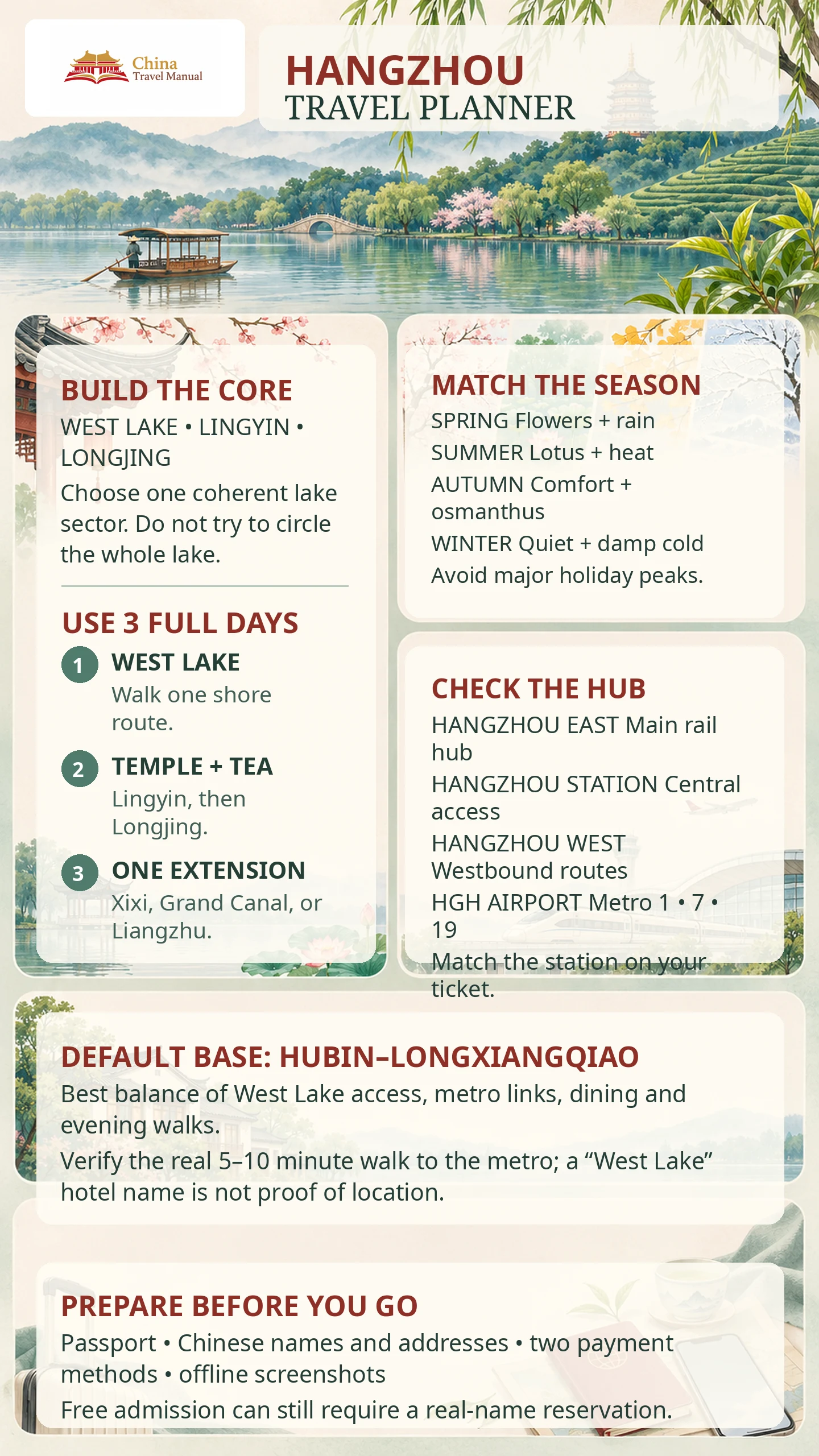
Allow three full sightseeing days for a balanced first visit. Use one day for a chosen section of West Lake, one for Lingyin Temple and Longjing tea country, and one for either Xixi Wetland, the Grand Canal, or Liangzhu. Two full days can cover the classic core, while a Shanghai day trip should focus on only one part of West Lake plus one nearby area.
- Day 1: Walk one coherent West Lake route instead of trying to circle the entire lake.
- Day 2: Visit Lingyin early, then continue to Longjing village or the China National Tea Museum.
- Day 3: Choose Xixi for nature, the Grand Canal for local urban history, or Liangzhu for archaeology.
- Best base: Stay near Hubin, Longxiangqiao, or Fengqi Road for the easiest mix of lake access, metro connections, and evening dining.
Do not treat West Lake as one pin on a map. Its shores, causeways, hills, gardens, temples, and boat landings form a large cultural landscape, so route direction matters more than the number of attractions you save.
Hangzhou rewards travelers who slow down. The city is famous for West Lake, but its best first trip also connects Buddhist heritage, Longjing tea hills, canal neighborhoods, wetlands, and one of China’s most important archaeological sites. The practical challenge is not finding enough to see. It is grouping places that work together without spending the day crossing the city.
This Hangzhou travel guide is for first-time independent visitors with one to four days. It explains what belongs in a core itinerary, how to choose a third-day extension, which transport hub to use, and where weather or crowds should change the plan.
Choose What to See in Hangzhou
The West Lake Cultural Landscape is a UNESCO World Heritage property made up of the lake, surrounding hills, causeways, islands, temples, pagodas, gardens, and designed views—not just the water itself.[1] That scale is why a useful Hangzhou plan is built by area. Start with West Lake, Lingyin, and Longjing, then add one place that offers a genuinely different landscape or historical story.
West Lake, Lingyin and Longjing: The First-Trip Core
West Lake is the natural first stop, but trying to complete its entire perimeter usually produces a long, repetitive day. Choose a sector according to your next stop. The eastern shore around Hubin is the easiest city-facing introduction. The northern shore connects Broken Bridge, Bai Causeway, and the Gushan area. The southern and western shores work better for Su Causeway, Flower Harbor, Leifeng Pagoda, and quieter garden scenery.
A practical first day combines two or three adjacent features, a short boat ride only if the queue is reasonable, and time to sit by the water. Three Pools Mirroring the Moon requires a boat connection; it is not a normal roadside stop. On crowded weekends, walking a coherent shore route is often more reliable than repeatedly waiting for buses or taxis near the lake.
Lingyin Temple and the Feilai Peak scenic area belong on the second day. Since December 1, 2025, the entire Lingyin–Feilai Peak scenic area has offered free entry, but visitors still need a real-name reservation for a time slot.[4] Free admission therefore does not mean unrestricted walk-in access. Go early, carry the original passport used for the reservation, and allow time for security and the walk from the vehicle drop-off area.
Continue in the afternoon to Longjing village or the China National Tea Museum. The village is better for tea fields, rural lanes, and a casual tasting; the museum is better for structured interpretation and a lower-pressure introduction to Chinese tea. A bus connection is possible, but it can be slow and crowded. A taxi or Didi between Lingyin and Longjing is often the more efficient choice for two or more travelers.
Xixi Wetland, the Grand Canal and Liangzhu: Choose One Extension
These three places should be alternatives, not a checklist for one day.
| Extension | Choose it for | Main trade-off |
|---|---|---|
| Xixi Wetland | Reeds, waterways, boats, birdlife, and a quieter landscape | Weather-sensitive and spread out; boats and paid zones need current checks |
| Grand Canal and Gongchen Bridge | Canal history, neighborhood streets, museums, and an easier urban day | Less dramatic scenery than West Lake; museum closures can reshape the route |
| Liangzhu | Archaeology, jade culture, early urban civilization, and open landscapes | Farthest from the center, with more outdoor exposure and last-mile planning |
Xixi National Wetland Park is the best contrast after two days of temples and lake scenery. It works especially well in mild weather and in late autumn when reed landscapes become prominent. Decide before arrival whether you want a walking route, a boat-centered visit, or a specific paid area; the park is too large to improvise efficiently.
The Grand Canal is a better choice for travelers who want local streets, bridges, museums, and shorter walking segments. The canal is part of a UNESCO-listed waterway system that once linked major river basins across eastern China.[2] Around Gongchen Bridge, the value comes from combining the waterway, historic streets, and one or two museums rather than chasing a long canal cruise.
Liangzhu is the strongest choice for archaeology. UNESCO describes the ruins as evidence of an early regional state built on rice agriculture, urban planning, water management, social hierarchy, and a shared belief system.[3] The museum and archaeological park are separate experiences, and the outdoor site is exposed to sun, rain, and wind. Treat Liangzhu as a major half-day or full-day commitment, not an add-on after West Lake.
Hefang Street, Museums and Smaller Additions
Hefang Street and Southern Song Imperial Street work best as an evening addition after a lighter sightseeing day. They are useful for snacks, souvenir browsing, old-city atmosphere, and a convenient transition to Wushan Square. They do not replace West Lake or Lingyin, and the most commercial blocks can feel crowded.
Museums are valuable rain-day substitutes. Check the exact campus before setting out: the Zhejiang Provincial Museum has more than one location, and online listings can send visitors to the wrong one. The China National Silk Museum pairs naturally with the southern West Lake area, while the China National Tea Museum fits the Lingyin–Longjing day. Reserve major museums when required and confirm their weekly closing day.
Decide How Many Days You Need in Hangzhou
| Time | Realistic plan | What to leave out |
|---|---|---|
| 1 full day | One West Lake sector plus Lingyin or Hefang Street | Xixi, Liangzhu, and distant day trips |
| 2 full days | West Lake; Lingyin plus Longjing or the tea museum | Choose no more than one evening addition |
| 3 full days | The two-day core plus Xixi, the Grand Canal, or Liangzhu | Do not force Wuzhen or Qiandao Lake into the same trip |
| 4 or more days | Add a day trip, deeper tea experience, or a slower museum day | Avoid changing hotels unless the next destination requires it |
Three days is the best first-trip length because it allows one weather-sensitive day to move without breaking the entire plan. Two days is enough for the classic core. One day can still be worthwhile, especially from Shanghai, but it should be treated as a focused introduction rather than a complete Hangzhou experience.
Count full sightseeing days, not a late arrival or early departure. If you arrive after dinner, stay near your chosen base and begin the itinerary the next morning. If you leave on an early train, do not schedule a final West Lake boat or distant museum visit before departure.
Choose the Best Time to Visit Hangzhou
Hangzhou has four distinct seasons, but humidity, rain, and holiday crowds often matter more than the average temperature. The best general windows are spring and autumn, with important qualifications.
| Season | Why visit | What can disrupt the plan |
|---|---|---|
| Spring | Flowers, fresh green scenery, and Longjing harvest season | Frequent rain, slippery paths, and heavy weekend crowds |
| Summer | Lotus displays and long daylight | Heat, humidity, thunderstorms, and little shade on exposed routes |
| Autumn | Comfortable walking weather, osmanthus, and Xixi reeds | Golden Week and peak-season weekends can overwhelm transport |
| Winter | Lower visitor numbers and quiet lake scenery | Damp cold, limited flowers, and rare rather than reliable snow |
Avoid May Day, National Day Golden Week, and the busiest Spring Festival dates if you have flexibility. On popular weekends, begin with the attraction that requires a reservation, then use open West Lake paths later. Never promise yourself a fixed Longjing harvest, lotus peak, osmanthus bloom, autumn color, or snow date; seasonal timing moves with weather.
Rain does not automatically ruin Hangzhou. Light rain can suit temples, tea museums, canal streets, and misty lake views. Heavy rain, lightning, or flooding warnings should move you indoors. Boat services, elevated paths, and exposed archaeological areas may close or become unpleasant even when the city remains open.
Plan a Realistic Hangzhou Itinerary
One Day: West Lake Plus One Nearby Area
Arrive early and choose either the northern/eastern lake sector or the southern/western sector. For the northern route, start near Hubin or Broken Bridge, continue across Bai Causeway toward Gushan, and finish around Hubin for dinner. For the southern route, combine Leifeng Pagoda, Flower Harbor, and part of Su Causeway.
Add only one nearby second area. Lingyin works if you leave the lake by late morning and already hold a reservation. Hefang Street works better for a relaxed afternoon and evening. Do not attempt West Lake, Lingyin, Longjing, and Hefang in a single day; traffic and walking time will turn the plan into a sequence of rushed transfers.
Two Days: The Classic First Visit
- Day 1: Walk one West Lake sector, take a boat only if it supports the route, and finish near Hubin or Wushan for dinner.
- Day 2: Enter Lingyin in the first available morning slot, continue to Longjing village or the tea museum, and return to the city before the evening traffic peak.
This plan keeps the two most important experiences while limiting cross-city travel. If the first morning is rainy but the forecast improves, swap the lake and temple days. If both days are wet, keep Lingyin and replace the tea fields with the museum.
Three Days: Add One Different Landscape or Heritage Area
Use Day 3 for one deliberate extension. Choose Xixi if the weather is mild and nature is the priority. Choose the Grand Canal if you want a lower-stress urban route or need museums as a weather backup. Choose Liangzhu if archaeology is a major interest and you are comfortable spending more time in transit.
A detailed three-day Hangzhou itinerary can refine the order, but the key rule remains simple: keep each day geographically coherent. Moving from Liangzhu to Lingyin and then to the southern lake is possible on a map, not sensible as a visitor plan.
Get to Hangzhou and Move Around the City
Arrive by High-Speed Rail or Air
Hangzhou has several rail stations, and they are not interchangeable. Hangzhou East is the principal hub for many high-speed trains, including frequent services from Shanghai. Hangzhou Station, often shown as Chengzhan, is closer to the traditional city center and can be convenient when your exact train stops there. Hangzhou West serves many westbound and newer routes but is far from West Lake for most first-time plans. Always book the station printed on the ticket, not simply “Hangzhou.”
For route-specific details, use the Hangzhou railway stations guide. Foreign passport holders should buy rail tickets with the same passport they will carry and allow extra time for manual identity checks if automated gates do not read the document.
Hangzhou Xiaoshan International Airport is connected to the metro by Lines 1, 7, and 19.[5] The best line depends on your hotel, not on which train looks fastest. Line 19 is useful for some major hubs, while Lines 1 and 7 may reduce transfers for other areas. Late-night arrivals should confirm the current last train after immigration and baggage collection, then use an official taxi or prearranged car if rail service has ended.
Use Metro, Bus, Taxi and Walking by Area
The metro is best for crossing the city and reaching major hubs. It does not solve every West Lake trip: the western shore, Lingyin, Longjing, and parts of Xixi still require a bus, taxi, Didi, or substantial walk. City buses reach many scenic areas, but holiday congestion and crowded stops can make them slow.
Use walking for compact areas, not for linking every attraction around the lake. A route that looks short across water, hills, or gated gardens may require a long detour. At West Lake, set navigation to a named gate, pier, bridge, or landmark rather than “West Lake.” At Lingyin and Xixi, confirm the correct entrance before calling a car.
Taxis and Didi are valuable for the last mile and for the Lingyin–Longjing connection. Save the destination’s Chinese name, full address, and a map screenshot. During major holidays, temporary traffic controls can move drop-off points away from scenic entrances, so allow more time and follow local signs.
Choose Where to Stay in Hangzhou
For most first visits, the best base is the eastern side of West Lake around Hubin, Longxiangqiao, or Fengqi Road. It combines lake access, metro stations, restaurants, shopping, and simple evening walks. A hotel within a genuine five-to-ten-minute walk of the metro is usually more useful than a “West Lake” hotel name that sits far from an entrance.
| Area | Best for | Main drawback |
|---|---|---|
| Hubin–Longxiangqiao | First visits, West Lake, dining, and transport balance | Busy and often expensive |
| Wushan–Hefang | Old-city atmosphere, evening snacks, southern lake access | Tourist crowds and variable hotel quality |
| Fengqi Road–Wulin | Metro connections, shopping, and broader city access | Less immediate lakeside atmosphere |
| Lingyin or western lake | Quiet mornings, greenery, retreats, and repeat visitors | Weak metro access and slow holiday road traffic |
| Hangzhou East Station | Late arrival, early departure, or one-night rail transfer | Poor base for a multi-day sightseeing trip |
The detailed where to stay in Hangzhou guide compares these areas more closely. Wherever you stay, confirm that the property accepts foreign passports, has staffed reception at your arrival time, and can complete the required accommodation registration.
Eat and Drink in Hangzhou Without Overplanning
Hangzhou food works best when it follows the itinerary. Around West Lake and the old city, look for Dongpo pork, Longjing shrimp, Pian’erchuan noodles, Hangzhou-style soup dumplings, scallion pancakes known as congbao hui, and Dingsheng cake. Dongpo pork is rich and slightly sweet; portions can be smaller than visitors expect, so ask how many people a dish serves.
West Lake vinegar fish is famous but not a universal crowd-pleaser. Its sweet-sour profile and fish preparation can surprise first-time diners, so share one portion rather than building a meal around it. For a broader selection and practical ordering advice, see the Hangzhou food guide.
For tea, a museum or established tea venue is easier for beginners than an unplanned stop at a village shop. In Longjing, ask the price before tasting or buying, confirm the weight and grade, and do not assume every leaf marketed near the village is from the most prestigious protected plots. A tasting should be optional, clearly priced, and separate from transport or entrance arrangements.
Add Day Trips Only When the Main City Plan Is Complete
Wuzhen is the clearest full-day extension for travelers who want a managed water-town experience. Shaoxing suits old streets, canals, literature, and yellow-rice-wine culture. Both require their own transport plan and should not replace the classic Hangzhou core on a short first visit.
Qiandao Lake is too far and too spread out for a satisfying rushed day from central Hangzhou; it works better with an overnight stay. Huangshan is a next destination, not a normal Hangzhou day trip. If your trip continues east, compare a combined Shanghai, Hangzhou, and Suzhou route rather than repeatedly returning to the same base.
Practical Planning for Foreign Visitors
- Save Chinese details: Keep every hotel, station, attraction, and entrance in Chinese, with the full address and a map screenshot.
- Carry the original passport: It may be needed for rail travel, real-name reservations, and hotel registration. A photo is only a backup record.
- Prepare two payment methods: Set up Alipay or WeChat Pay before arrival and keep a small amount of cash for failures or small vendors.
- Reserve the fixed-time item first: Book Lingyin, major museums, or another timed attraction before arranging the flexible West Lake walk.
- Keep offline evidence: Screenshot reservations, ticket orders, hotel details, and the next day’s weather forecast.
Do not rely on Google Maps alone for exact entrances or transit. Amap or Baidu Maps usually has stronger local routing, though the interface may be less accessible in English. Hotel staff can help confirm the Chinese name of a gate or pier before you leave.
Common Mistakes and Accessibility
- Treating West Lake as a single stop. Choose a shore and direction before leaving the hotel.
- Scheduling too many distant areas. Lingyin, Liangzhu, Xixi, and the Grand Canal do not form one efficient loop.
- Confusing rail stations. Hangzhou East, Hangzhou, and Hangzhou West require different transfer plans.
- Assuming free means reservation-free. Lingyin–Feilai Peak currently requires a real-name time slot.
- Using the wrong museum campus. Confirm the full Chinese address, not just the institution name.
- Buying tea without a clear price. Confirm grade, weight, origin claim, and total cost before agreeing.
- Underestimating rain and humidity. Use non-slip shoes and keep an indoor alternative.
West Lake’s eastern shore and many city museums are relatively manageable for visitors with limited mobility, but a fully step-free trip cannot be assumed. Causeways can be long, boat boarding involves gaps or steps, and the western hills, Lingyin paths, tea villages, and Liangzhu’s outdoor areas require more walking. A station or attraction may have elevators without every entrance being accessible.
For wheelchairs, strollers, older travelers, or large luggage, reduce transfers and verify the exact accessible entrance in advance. Use a vehicle for the last mile, avoid peak crowds, and do not plan around a final bus or boat departure.
FAQs About Visiting Hangzhou
Is Hangzhou Worth Visiting for the First Time in China?
Yes. Hangzhou combines a famous cultural landscape, major Buddhist and tea traditions, easy high-speed rail access, and several quieter extensions. It is especially useful after Shanghai because the atmosphere and daily pace feel different.
Can You Visit Hangzhou as a Day Trip from Shanghai?
Yes, but keep the route focused. Take an early train to Hangzhou East or Hangzhou Station, choose one West Lake sector, and add either Lingyin or Hefang Street. Do not plan a complete lake circuit plus Longjing and Xixi.
Is West Lake Free to Visit?
The open lakeside landscape and most public paths are free. Boat trips, some islands, pagodas, museums, performances, and individual attractions may charge separately or require reservations.
How Many Days Are Enough for Hangzhou?
Two full days cover West Lake, Lingyin, and Longjing at a reasonable pace. Three days is better because it adds Xixi, the Grand Canal, or Liangzhu and gives more flexibility for weather.
Which Hangzhou Railway Station Should You Use?
Use the station served by the best train for your route. Hangzhou East is the main high-speed hub, Hangzhou Station is closer to the traditional center, and Hangzhou West is useful for specific westbound routes but usually less convenient for West Lake.
Sources
[1] UNESCO World Heritage Centre. West Lake Cultural Landscape of Hangzhou
[2] UNESCO World Heritage Centre. The Grand Canal
[3] UNESCO World Heritage Centre. Archaeological Ruins of Liangzhu City
[4] eHangzhou. Hangzhou’s Lingyin Feilai Peak Scenic Area Launches Free Admission Service
[5] Hangzhou Xiaoshan International Airport. Metro





