
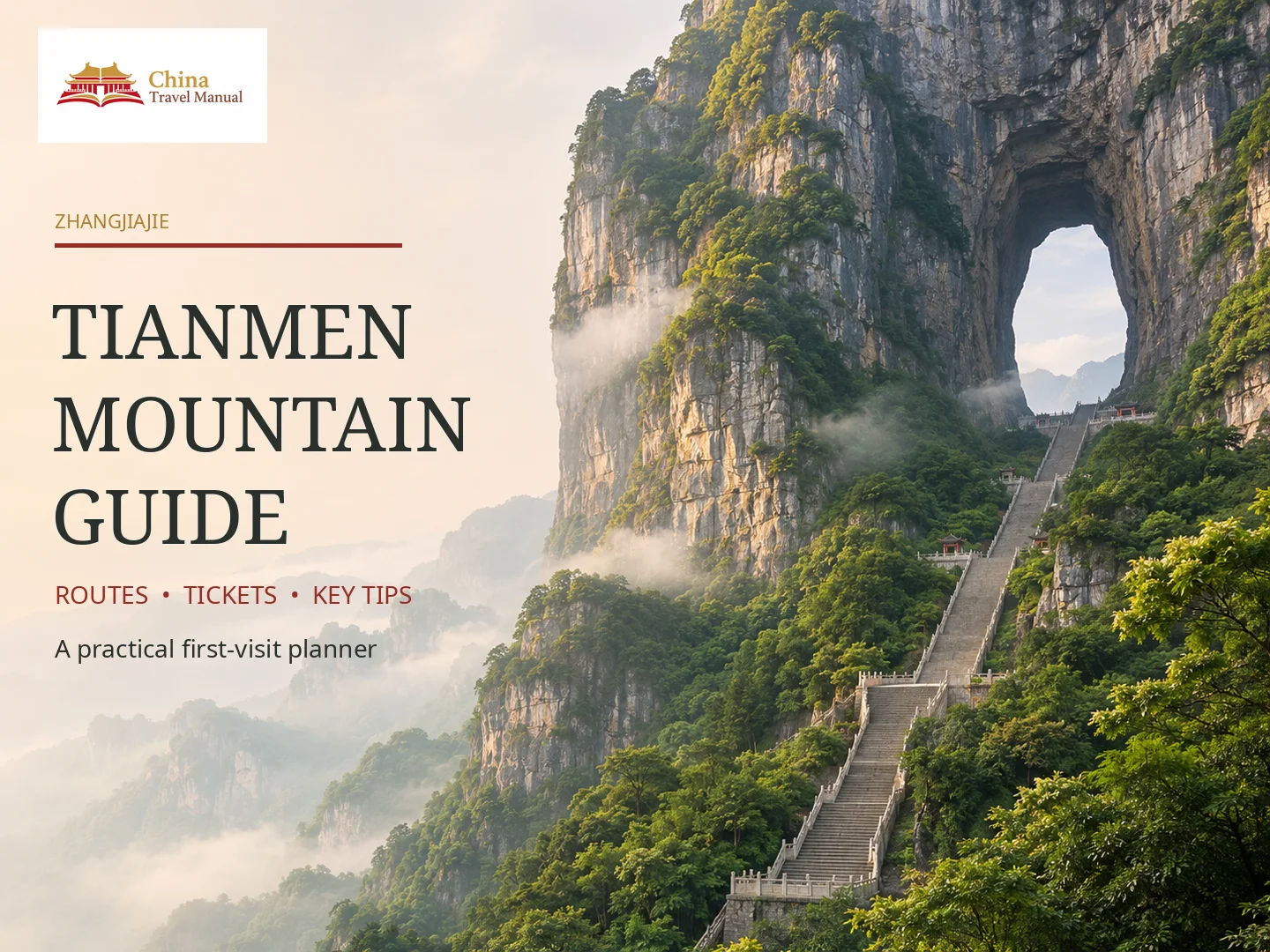
Quick Answer: How Should You Visit Tianmen Mountain?
Treat Tianmen Mountain as a separate full-day trip from downtown Zhangjiajie. As of November 12, 2026, the main cableway is closed for a major upgrade and only round-trip Route C is operating, so ignore old itineraries that begin with the long city-to-summit cable car.[1]
- Allow a full day: Plan about 6–7 hours from the city transfer point back to the city, and longer on busy weekends or holidays.
- Book the current route: Route C uses the Tianmen Cave Express Cableway and the seven-stage Transmountain Escalator in both directions.
- Carry the original passport: Tickets are real-name and time-slot based; use the same document for booking and entry checks.
- Protect your knees: The 999-step stairway is optional when the separate lower escalator is operating, but summit paths still require several kilometers of walking.
- Keep plans flexible: Glass walkways, stairs, cableways and exposed paths may close independently for wind, rain, maintenance or crowd control.
Tianmen Mountain is not Tianzi Mountain in Wulingyuan, and its cliffside glass walkways are not the Zhangjiajie Grand Canyon Glass Bridge.
Tianmen Mountain National Forest Park sits beside downtown Zhangjiajie but operates as a self-contained mountain attraction with its own tickets, transport systems and route controls. A successful visit depends less on collecting every named viewpoint than on booking the route actually sold for your date, reaching the correct entry point and leaving enough time for queues, escalators and summit walking.
This guide is for a first-time independent traveler using a foreign passport and planning one full day. It separates the operating pattern in force on November 12, 2026 from the normal A/B/C route system. For the wider destination context, start with our Zhangjiajie travel guide.
Know Which Tianmen Mountain Area You Are Visiting
Tianmen Mountain is easy to confuse with several other Zhangjiajie attractions. The names sound similar in English, but the places do not share tickets, entrances or internal transport.
| Name | Location and identity | Part of this guide? | Common mistake |
|---|---|---|---|
| Tianmen Mountain | A separate mountain attraction south of downtown Zhangjiajie | Yes | Searching only for “Tianmen” and arriving at the wrong transport point |
| Tianzi Mountain | A high-level scenic area inside Wulingyuan | No | Assuming Tianzi and Tianmen are two entrances to one park |
| Zhangjiajie National Forest Park | A major part of the Wulingyuan scenic system | No | Expecting a forest-park ticket to include Tianmen Mountain |
| Zhangjiajie Grand Canyon Glass Bridge | A separate attraction in Cili County | No | Confusing a canyon-spanning bridge with Tianmen summit skywalks |
The UNESCO World Heritage property is Wulingyuan Scenic and Historic Interest Area, not Tianmen Mountain.[6] Tianmen Mountain’s glass attractions are short cliffside walkways attached to summit paths. The Grand Canyon attraction is a large bridge over a separate canyon; compare it in our Grand Canyon Glass Bridge guide.
For navigation, save the exact Chinese destination. Use 天门山索道下站 for Tianmen Mountain Cableway Lower Station in the city, or 天门山山门 for Tianmen Mountain Gate. Do not ask a driver for “the glass bridge” or “Zhangjiajie mountain.” Wulingyuan and Tianmen Mountain are normally 60–90 minutes apart door to door, and each can consume a complete sightseeing day. Our three-day Zhangjiajie itinerary therefore gives Tianmen Mountain its own day.
Choose the Current Ticket Route Before You Book
The Current Route C-Only Operation
The current route is a temporary but open-ended operating arrangement. From October 13, 2026, the full Tianmen Mountain Cableway stopped carrying passengers for an upgrade. Round-trip Routes A and B and one-way Routes 1 and 2 were suspended; no reopening date was announced. Only round-trip Route C remains available.[1]
| Current Route C stage | Transport or action | What it means |
|---|---|---|
| City connection | Official shuttle between the lower-station area and Mountain Gate | The city station is now a transfer point, not a long cable-car boarding point |
| Mountain Gate | Ticket check and Tianmen Cave Express Cableway | This short cableway reaches the Tianmen Cave area |
| Tianmen Cave | View the cave and choose stairs or the separately operated lower escalator | The lower escalator is not included in the current C package |
| Summit | Seven-stage Transmountain Escalator, then walking routes | The escalator is included in both directions, but summit walking remains |
| Return | Reverse the escalator and express-cableway route, then shuttle to the city | Afternoon queues can build at the same transport bottlenecks |
The October notice listed ticket sales from 7:30 am to 4:00 pm and passenger operations from 8:00 am, but it also warned that times can change.[1] Recheck the notice and the exact admission period on your ticket. Route C still reaches Tianmen Cave, the summit paths and any glass walkway open that day. It does not include the famous 7.4-kilometer city-to-summit cableway or a ride along the complete 99-bend road. If that long cable-car journey is your main reason for visiting, consider waiting for a confirmed reopening.
For a dedicated update on changing route products, use our Tianmen Mountain ticket-route guide immediately before booking.
How Routes A, B and C Normally Differ
The route letters mainly describe the up-and-down transport combination. They do not grant access to different mountains. The historical pattern remains useful for reading older maps, but it is not a menu of choices while the main cableway is closed.
| Route | Normal transport pattern | Normal advantage | Status on November 12, 2026 |
|---|---|---|---|
| A | Main cableway up; summit and cave; express cableway down | Classic first visit with the long cableway first | Suspended |
| B | Express cableway and cave first; main cableway down | Reverses the flow and places the long cableway at the end | Suspended |
| C | Tianmen Cave Express Cableway and Transmountain Escalator both ways | Does not depend on the main cableway | Open |
A provincial transport guide documents the normal A/B/C relationship and the shuttle between the city station and Mountain Gate.[2] The current scenic-area notice always overrides that older framework. When the main cableway returns, verify the new route names, quotas, vehicle segments and entry points instead of assuming the pre-upgrade design has returned unchanged.
Tickets, Passport Checks and Booking Priorities
Tianmen Mountain uses real-name, date-specific and time-slot ticketing. The safest sequence is to lock the visit around the route and admission period, not around a hotel transfer or an old cableway timetable.
- Check the current operating notice: Confirm which route is sold and whether any cableway, escalator or summit walkway is closed.
- Select the date and entry period: Choose a period you can reach without counting an arrival flight or train as punctual.
- Enter each traveler’s passport details: Match the Latin spelling and passport number exactly, including every child.
- Read the package inclusions: Confirm the shuttle, express cableway and escalator segments rather than assuming one price covers every mechanical ride.
- Carry the same original passport: A photo, scan or order screenshot is useful backup but is not a replacement for the identity document.
If an online interface does not accept a foreign passport, use a staffed official channel or contact the scenic area before travel. Do not wait until a holiday morning and assume the window will have inventory. A practical target is at least three days ahead, with more time for summer weekends and national holidays. If a name, passport number, route or date is wrong, the usual remedy is cancellation and rebooking, which risks losing the admission slot.
| Cost component | Current planning point | Do not assume |
|---|---|---|
| Scenic-area admission | The government-guided admission component is CNY72 | This is the complete Route C package price |
| Route transport | Current C includes the express cableway and upper seven-stage escalator round trip | Every cableway, vehicle and escalator is included |
| Lower cave escalator | Optional when open and sold for the required direction | It is included or operating all day |
| Glass walkways | Open sections may require a small on-site service or shoe-cover charge | All three walkways are open together |
| Summit forest chairlift | An optional shortcut within the summit area | It is the main up-and-down cableway |
The CNY72 figure is the government-guided admission price, not the total price of a route product that bundles transport.[5] The same pricing notice defines age and student concessions by valid documents. Foreign travelers should bring the original passport plus any supporting student or disability document and confirm how the booking channel applies the concession before paying. Never claim an age discount without checking whether the offered package and your document qualify.
Getting to Tianmen Mountain and Leaving After Your Visit
The city-side lower station and Mountain Gate are different places. Under the current C-only arrangement, the scenic-area shuttle between them continues to run, but the admission instructions on your ticket determine where you report first.[1]
| Place | Chinese name | Current role | Navigation risk |
|---|---|---|---|
| Tianmen Mountain Cableway Lower Station | 天门山索道下站 | City transfer, ticket-service and shuttle area | Arriving here expecting the long cableway to be operating |
| Tianmen Mountain Gate | 天门山山门 | Current Route C check-in and express-cableway area | Taking an unofficial ride without confirming the ticket’s report point |
The provincial visitor guide confirms both navigation names and the shuttle connection.[2] Allow about 25–45 minutes for ordinary waiting and road travel; holiday queues can add much more. This is a planning estimate, not a schedule.
From a central downtown hotel, allow about 10–25 minutes to reach the lower-station area before traffic and waiting. From Zhangjiajie West Railway Station, plan roughly 35–55 minutes door to door; from Zhangjiajie Hehua International Airport, allow around 30–50 minutes in ordinary traffic. Wulingyuan generally needs 60–90 minutes. These ranges are deliberately wider than drive-time estimates because exits, pickup, traffic and unfamiliar navigation matter. Use our Zhangjiajie transportation guide, airport transfer guide and West Station transfer guide for the complete connection.
Leave large suitcases at your hotel or a storage facility you have verified for the same day. Do not build the plan around an unconfirmed locker size or overnight service. Staying downtown is simplest for this attraction; compare bases in our guide to where to stay in Zhangjiajie.
A late train or flight after the mountain is possible but fragile. After leaving Mountain Gate, you still need the shuttle, luggage collection, road travel and station or airport procedures. Keep at least 60 minutes for a West Station transfer and about 75–90 minutes for the airport after you are fully back at the city transfer point, then add the operator’s required check-in buffer. The safest plan is to depart the following day.
Follow the Route from Downtown to the Summit
Route C is simple on a map but slow at its bottlenecks. Use this sequence as a planning framework and follow the signs, ticket instructions and staff directions on the day.
| Stage | Current action | Typical planning time | Check before moving on |
|---|---|---|---|
| City reporting point | Arrive at the lower-station or ticket-designated meeting area | 15–30 minutes for finding the point and joining the queue | Passport, entry period and correct shuttle line |
| Transfer to Mountain Gate | Official scenic-area shuttle | 25–45 minutes including ordinary waiting | Last return-shuttle information |
| Enter and ascend | Ticket check and Tianmen Cave Express Cableway | 30–60 minutes including the queue; ride itself is short | Wind and cableway status |
| Tianmen Cave area | Walk to the plaza; choose the stairway or lower escalator | 30–75 minutes depending on the 999-step choice | Stair and lower-escalator operation |
| Reach the summit | Seven-stage Transmountain Escalator | 20–35 minutes with internal walks and queues | Summit path and glass-walkway closures |
| Summit circuit | Choose the west side, east side or a compact combination | 1.5–3 hours | Descent queue and final transport |
| Return | Reverse the escalator, express cableway and shuttle | 60–100 minutes in ordinary conditions | Luggage and onward-travel buffer |
The busiest points are usually the morning shuttle and express-cableway queue and the afternoon escalator return. A 6–7 hour visit can become 8 hours without another viewpoint, so start early.
After the express cableway, the walk toward Tianmen Cave includes level ground and some steps. The seven-stage escalator is a chain of long indoor escalators rather than one continuous moving walkway. There are short transfers between sections, and the summit begins with more walking. Mechanical transport reduces elevation gain; it does not create a zero-walking day.
Food and drink are available around the main service zones, but choices are limited and cost more than downtown. Carry water and a sealed snack, and use toilets before a longer summit branch.
What to See on Tianmen Mountain
Tianmen Cave and the 999-Step Stairway
Tianmen Cave is the natural arch in the mountain; the Stairway to Heaven is the steep man-made staircase between the visitor plaza and the cave. The official provincial description counts 999 steps.[4] The lower cave-climbing escalator is a third, separate facility and should not be confused with the seven-stage escalator between the cave and summit.
Climbing the full staircase commonly takes 35–60 minutes with rests and photographs. It is steep, exposed and harder on the descent than many visitors expect. The broad plaza below gives the best full-cave view, so climbing every step is not required for the main photograph. Travelers with knee, balance or heart concerns should use the lower escalator when it is open in the needed direction, or remain at the plaza and continue only through an approved low-strain route.
The current Route C package does not include the lower escalator’s uphill segment.[1] Check its operating direction and on-site charge. In thick fog, the cave opening can disappear from the distant plaza. Save your energy rather than climbing only to find the same view obscured.
Summit Cliff Paths and Glass Skywalks
The summit is a network of cliff paths, forest sections and optional glass walkways. For most first-time visitors, the west side is the strongest compact choice: it includes dramatic cliff exposure and reaches major viewpoints with less distance than a complete east-and-west circuit. The east side is longer and often feels more like a forest-and-stair route.
| Summit choice | Best for | Planning estimate | Main trade-off |
|---|---|---|---|
| Compact west route | First visit, limited time, average fitness | About 3.5–4.5 km and 90–120 minutes | Skips distant eastern stops |
| East route | Forest walking and a quieter extended circuit | About 4–5 km and 110–150 minutes | More stairs and a longer return |
| Both sides | Strong walkers with an early start | Roughly 7–8 km before route detours | Can endanger the descent buffer |
These distances are planning estimates, not official measured routes. Detours, one-way controls and closed links change the total. The Panlong Cliff Glass Walkway faces toward the winding road; the west and east glass walkways occupy different cliff sections. Each can close independently. In May 2026, the east walkway closed for maintenance while the west and Panlong sections remained open.[3]
Every glass section has or normally connects to a solid-path alternative. A traveler who dislikes glass can bypass it, but the ordinary cliff paths still have railings, drop exposure and narrow busy points. Strong fear of heights may remain a problem even without stepping on transparent panels.
Tianmen Mountain Temple and Optional Summit Stops
Tianmen Mountain Temple, Yunmeng Summit and the summit forest chairlift are secondary choices, not mandatory parts of a good first visit. Add the temple if you enjoy quiet architecture and have enough time to reach a more distant summit area. Skip it when fog, queues or a late entry have already reduced the day.
The forest chairlift is a short internal ride that can replace part of a summit walk. It is not the main city cableway and may charge separately. Yunmeng Summit is useful only when visibility rewards another high view. A sensible deletion order is distant east-side branches first, then the chairlift, temple and repeated viewpoints. Preserve Tianmen Cave, one strong cliff-path section and one open glass walkway if those conditions suit you.
How Much Time Do You Need?
Plan from the city reporting point back to the city, not from the first cable-car boarding to the summit. The complete day includes the shuttle, security or ticket checks, queues, cave area, escalators, summit walking and the same transfers in reverse.
| Total time | What is realistic | Who should use it |
|---|---|---|
| 4–5 hours | Tianmen Cave, short west-side route, no distant summit stops | Low-crowd day, early arrival, confident navigation |
| 5–7 hours | Cave plus one substantial summit side and normal rest stops | Average first-time visitor |
| 6–8 hours | City shuttle, ordinary queues and a fuller summit route | Safer default for independent travelers |
| Full day | Slow pace, family group, photography or holiday queues | Older travelers, children and anyone avoiding time pressure |
A half-day plan requires an early entry, smooth transport and removal of the east side, temple, chairlift and repeated viewpoints. Never pair it with Wulingyuan. If your ticket is late, set a fixed turnaround time and do not use cableway ride time to justify a tight evening train.
Walking Difficulty, Heights and Accessibility
Tianmen Mountain has extensive cableway and escalator infrastructure, but it is not step-free. Even the lightest route combines standing queues, ramps, transfers, summit paths and stairs between viewpoints.
| Effort level | Route choice | Who it suits | Remaining difficulty |
|---|---|---|---|
| Lightest practical | Lower escalator when open, upper escalators, compact west summit route | Visitors reducing knee strain | Several kilometers of walking and standing remain |
| Moderate | One summit side plus selected stairs | Average fitness | Uneven steps and cliff exposure |
| High | 999 steps plus east and west summit routes | Strong walkers with a full day | Long descent queues can follow the hardest walking |
A compact west route can still involve roughly 600–800 steps depending on detours and open paths; a complete east-and-west day can exceed 1,000. Treat those as route-planning estimates, not an accessibility certification. Strollers may work on limited level sections but cannot solve the cliff stairs. Heavy powered wheelchairs and mobility devices require confirmation from the operator before travel.
Glass walkways are optional, but the current C route still requires an enclosed cableway and exposed mountain paths. Someone with severe cable-car anxiety or intense fear of cliffs may not find a comfortable alternative. Older travelers and families should also count queue standing as physical work. If assistance is essential, arrange it in advance rather than expecting staff to carry equipment over every stair.
Best Time, Weather and Visibility
There is no month that guarantees a clear cave, a sea of clouds or every walkway open. Choose a season by balancing walking comfort, visibility, crowds and weather disruption. The summit is cooler and windier than downtown in every season.
| Season | Likely advantage | Main risk | Planning response |
|---|---|---|---|
| Spring | Green forest and atmospheric mist | Frequent rain and low cloud | Keep a flexible date and prioritize near views in fog |
| Summer | Cooler summit than the city | Thunderstorms, heat below and peak crowds | Use an early slot and carry sun and rain protection |
| Autumn | Comfortable walking and often steadier visibility | National Day and weekend congestion | Avoid the holiday week or reserve well ahead |
| Winter | Lower visitor numbers and possible snow scenery | Ice, strong wind and temporary path closures | Use grippy shoes and accept a shorter route |
In light rain with normal operations, shorten the glass and exposed cliff sections and move carefully on stone. In dense fog, keep Tianmen Cave at close range, forest paths and the temple rather than chasing multiple white-out viewpoints. During high wind, lightning, heavy rain or ice, obey every cableway, stair and walkway closure. The current operating notice expressly warns that the three glass walkways and the Stairway to Heaven may close for weather, maintenance or events.[1]
Do not use unofficial paths to bypass a closure. Check the latest scenic-area notice and weather warning on the morning of the visit, then carry a thin warm layer even when downtown feels hot. See our best time to visit Zhangjiajie guide for the wider regional pattern.
Practical Limits and Common Mistakes
| Mistake | Likely consequence | Better action |
|---|---|---|
| Following an old A/B route article | Wrong entry point and expectation of a closed cableway | Check the dated operating notice before booking |
| Going to the city station expecting to ride up | Lost time and missed admission period | Read the ticket’s report point and use the official shuttle |
| Counting only cableway ride time | Underestimating the visit by several hours | Budget shuttle, queues, cave, escalators and summit walking |
| Expecting the 99-bend road ride | Disappointment under current Route C | Treat the road as a viewpoint, not an included transport segment |
| Arriving without the original passport | Real-name verification failure | Carry the exact document used for the booking |
| Booking an early evening departure | Missed train or flight after a queue delay | Leave the next day or choose a genuinely late service |
| Wearing smooth-soled shoes | Higher slip risk in rain, fog or winter ice | Use shoes with dependable tread |
Bring the original passport, offline order screenshot, charged phone, water, compact food, rain shell and light warm layer. Drones, fuel canisters and other restricted equipment should stay out of the park unless explicitly approved. Keep food sealed and do not block narrow paths while photographing.
English signs are strongest around the main transport and Tianmen Cave areas. Download the current map, save the two Chinese entry names and set a return deadline. Missing a minor viewpoint is better than missing your descent or onward journey.
FAQs About Visiting Tianmen Mountain
Is Tianmen Mountain the Same as Tianzi Mountain?
No. Tianmen Mountain is a separate attraction beside downtown Zhangjiajie. Tianzi Mountain is inside Wulingyuan. They require different tickets, entrances and transport, and neither visit can be treated as a short branch of the other.
Is Route C Still Worth It Without the Main Cableway?
Yes if Tianmen Cave, summit cliff paths and an open glass walkway are your priorities. No if the long city-to-summit cable car is the main experience you want; that cableway is closed during the current upgrade.
Do You Have to Climb the 999 Steps?
No. The separate lower escalator can reduce the main stair climb when it is open in the needed direction, although it is not included in the current Route C package. Summit paths still contain walking and stairs.
Can You Visit Tianmen Mountain on a Rainy or Foggy Day?
Light rain or mist can be manageable when the park remains open. Dense fog may remove the distant views, while high wind, lightning, heavy rain or ice can stop cableways and close stairs or glass walkways. Follow the day’s official controls.
Can You Visit Tianmen Mountain and Wulingyuan in One Day?
It is not recommended. The attractions are independent, the road connection takes substantial door-to-door time, and each involves reservations, internal transport and hours of walking. Give Tianmen Mountain one day and Wulingyuan at least one separate day.
Sources
[1] Voice of Hunan. Tianmen Mountain Route C-Only Operating Notice
[2] Hunan Provincial Department of Culture and Tourism. Tianmen Mountain Transport and Route Guide
[3] Hunan Provincial Government. Tianmen Mountain East Line Glass Walkway Maintenance Notice
[4] Hunan Provincial Department of Culture and Tourism. Tianmen Mountain National Forest Park
[5] Hunan Provincial Development and Reform Commission. Tianmen Mountain Admission Price Notice
[6] UNESCO World Heritage Centre. Wulingyuan Scenic and Historic Interest Area





