

Quick Answer
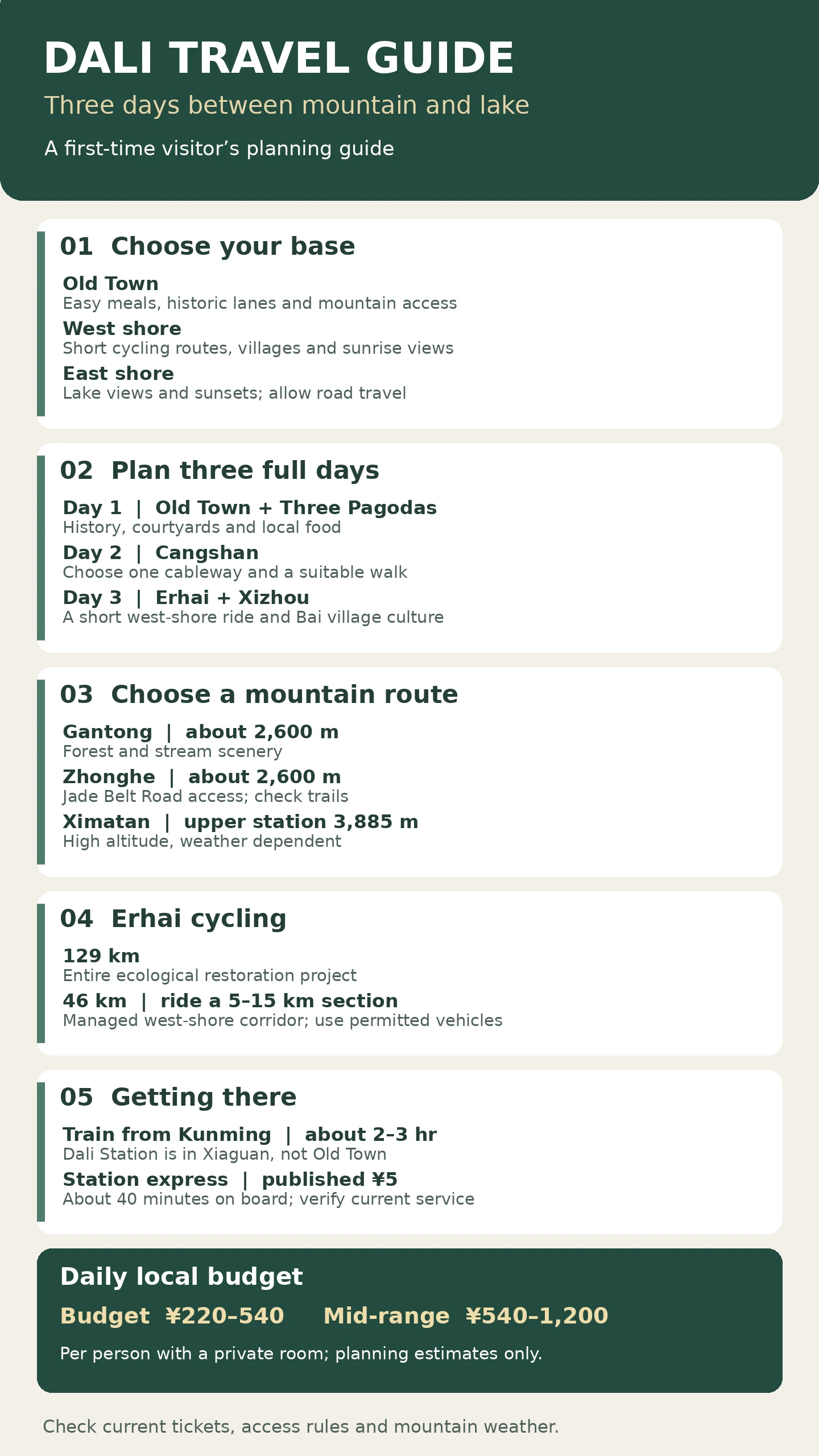
Dali is best experienced slowly, with three full sightseeing days based near Dali Old Town or the western shore of Erhai Lake. The mountains, Bai villages and lakeside paths are spread out, so choose a few connected experiences each day rather than trying to circle the lake.
- Top sights: Dali Old Town, Erhai Lake, Cangshan, the Three Pagodas and Xizhou.
- Outdoor highlight: Cycle a 5–15 km section of the western lakeside corridor.
- Mountain highlight: Choose one cableway; Gantong is a gentler introduction than high-altitude Ximatan.
- Culture: Visit Bai courtyards in Xizhou and a tie-dye workshop in Zhoucheng.
- Best seasons: Spring and autumn; check mountain weather.
- Getting there: Take a train from Kunming; continue to Lijiang or stop overnight in Shaxi.
Between the mountains of Cangshan and the waters of Erhai, Dali offers an inviting combination of village life, historic architecture and outdoor activities. It is one of the easiest places to slow down on a Yunnan trip, provided you choose a sensible base. This guide helps you choose routes and a base.
Dali at a Glance
Dali can refer to the autonomous prefecture or its capital city. The historic old town is only one part of Dali City, and many attractions are outside its walls. The area preserves important traces of the Nanzhao and Dali kingdoms and is a major center of Bai culture. The local expression Wind, Flowers, Snow and Moon (风花雪月, fēng huā xuě yuè) evokes the winds of Xiaguan, the flowers of Shangguan, snow on Cangshan and the moon over Erhai. These are cultural associations, not guaranteed sights.
| Item | Details |
|---|---|
| Chinese name | 大理 (Dàlǐ) |
| Province | Yunnan |
| Region | Dali Bai Autonomous Prefecture |
| Elevation | About 2,000 m (6,560 ft) in the urban and lakeside area |
| Airport | Dali Fengyi Airport (DLU) |
| Railway station | Dali Railway Station, in Xiaguan |
| Recommended stay | Three to four full days |
| Main experiences | Mountains, lakes, Bai culture and slow travel |
Understanding Dali’s Geography
Cangshan (苍山, Cāngshān) runs along the western side of the basin, and Erhai Lake (洱海, Ěrhǎi) stretches north from the area around Xiaguan. Dali Old Town (大理古城, Dàlǐ Gǔchéng) sits between the mountain slopes and the west shore. The airport is southeast of the main tourist area. Road access matters more than straight-line distance.
| Area | What to expect |
|---|---|
| Dali Old Town | Walkable streets, dining, practical base for first visits |
| Western shore | Cycling, villages and sunrise views; Longkan, Caicun and Panxi |
| Eastern shore | Views across the lake toward Cangshan, sunsets and scattered lakeside stops |
| Cangshan | Multiple mountain access points and cableways |
| Xiaguan | Modern urban district and the railway station |
| Northwestern Erhai | Xizhou and Zhoucheng, traditional courtyards, fields and crafts |
A room advertised as being in Dali or beside Erhai could be on the opposite side of the lake from your planned activities. Check the pin on the map, not just the property name. Sunrise enthusiasts generally prefer the western shore; travelers interested in mountain silhouettes across the water may prefer the east. The comparison of old-town and lakeside stays explains these choices in more detail.
Is Dali Worth Visiting?
Dali suits travelers who enjoy historic towns, outdoor activities and regional culture. It balances a busy city itinerary or a strenuous mountain trip elsewhere in Yunnan.
| Destination | Main experiences |
|---|---|
| Dali | Lake, Bai villages, Cangshan and relaxed exploration |
| Lijiang | Naxi culture, historic streets and Jade Dragon Snow Mountain |
| Kunming | Urban culture, Stone Forest and a major transport hub |
| Shangri-La | Tibetan culture, highland landscapes and mountain scenery |
Dali and Lijiang complement each other. If your schedule permits, visit both rather than expecting one to reproduce the other’s attractions. The Kunming, Dali and Lijiang itinerary helps distribute days across these destinations.
Best Things to Do in Dali
Explore Dali Old Town
Start at the South Gate and explore the surrounding lanes on foot. Renmin Road has cafes, restaurants and evening activity; Fuxing Road is another useful orientation point, with shops and local snacks. Wuhua Tower and the old city gates help you find your bearings. Respect private homes and ask before photographing residents.
Public streets are generally free to explore. Individual museums, courtyards and exhibitions may charge admission. Allow half a day at minimum, or a full day if you enjoy unhurried meals and browsing. Early mornings are comparatively quiet, while the evening works well for dinner. Our Dali Old Town visitor guide covers the individual landmarks and walking routes.
Visit Erhai Lake and the Western Ecological Corridor
Erhai is more enjoyable when you pick a section of shoreline rather than aiming for a complete circuit. The ecological restoration project extends for 129 km around the lake, but the managed western tourism corridor covers 46 km. These are not interchangeable distances. A 2025 municipal enforcement notice identifies the managed section between Yangnanxi and Taoyuan in Xizhou and addresses unauthorized motorized and electric vehicle access. The operator offers bicycles, authorized power-assisted rentals and sightseeing vehicles. [1][2]
| Lakeside stop | Main experience |
|---|---|
| Longkan Wharf (龙龛古渡) | Sunrise views and shoreline walks |
| Caicun (才村) | Village lanes and a convenient lakeside outing |
| Panxi (磻溪) | Scenic S-shaped bend and cycling |
| Xizhou (喜洲) | Traditional architecture and agricultural scenery |
| Haishe Ecological Park (海舌生态公园) | Peninsula and wetland landscape; check access and reservation instructions |
A 5–15 km ride is a useful target for a casual cyclist. Choose a starting point near your accommodation, confirm where you can return a rental bicycle and count the return distance if the rental must go back to the same shop. Stop for photographs without blocking the path. Avoid assuming that an electric scooter rented outside the corridor can enter it. Follow current entrance signs and local restrictions. See the Erhai Lake visitor guide and Erhai cycling guide for route choices. If visiting Haishe, leave additional time and check whether a reservation is needed for your date; a daily quota is not assumed here.
Take a Cableway up Cangshan Mountain
There are three principal visitor cableways, each with a separate access point and a different mountain experience. Choose according to your fitness, weather and altitude tolerance. Do not buy a ticket for one route assuming it covers the others. January 2026 reported round-trip package prices are indicative, not live fares. [3]
| Cableway | Approximate upper area elevation | Best for | Reference cost |
|---|---|---|---|
| Gantong (感通索道) | 2,550–2,600 m | Forest, stream scenery and shorter walks | ¥110 |
| Zhonghe (中和索道) | Around 2,600 m | Temple area and Jade Belt Road access | ¥95–100 |
| Ximatan (洗马潭索道) | Upper station 3,885 m | High mountain views, when fully operating | ¥320 |
Gantong is a sensible first choice for a moderate mountain day, with Qingbi Stream and forest scenery in the surrounding area. Zhonghe is worth investigating if you want to walk on the Jade Belt Road (玉带路, Yùdài Lù). Some mountain paths connect routes; check trail access, transport and the last descent before a point-to-point hike. Do not assume the terrain is effortless because parts of the path follow a contour.
Ximatan has separate lower and upper sections. The operator’s 2026 engineering notice places the top station at 3,885 m; the lake area is around 3,920 m, not the same as the station. Malong Peak, at 4,122 m, is the highest peak in the range. None of these numbers means that a cable car takes you to the summit of Cangshan. Dali-Cangshan is a UNESCO Global Geopark, a designation distinct from a UNESCO World Heritage Site. [4][5]
Ask what sections are operating, whether the fare includes scenic admission or other attractions, and how much walking remains at the top. Strong winds and weather can affect service. Read the Cangshan visitor guide before choosing a high-altitude outing.
See Chongsheng Temple and the Three Pagodas
The Three Pagodas (崇圣寺三塔, Chóngshèng Sì Sāntǎ) stand north of the old town against the Cangshan backdrop. They are historic structures, whereas much of the current temple complex behind them was reconstructed in modern times. Allow time for the religious buildings behind the towers.
Allow roughly three to four hours on foot, or two to three with the sightseeing shuttle. Budget about ¥75 for adult admission as a provisional reference, and confirm the current ticket and shuttle price before traveling. A morning here followed by a relaxed afternoon in the old town is a convenient pairing. See the Three Pagodas visitor guide for further planning.
Discover Bai Culture in Xizhou
Xizhou (喜洲, Xǐzhōu) is a historic market town on the northwestern side of Erhai. Its traditional Bai houses, courtyard layouts and local food are the strongest reasons to visit. Walk around Sifang Street, explore permitted public lanes and consider an admission-based courtyard such as the Yan family compound.
Set aside two to four hours, or more for a courtyard tour and lunch. The surrounding fields change with the farming calendar; golden rice fields are seasonal, not a guaranteed backdrop. Respect working farmland. Our Xizhou travel guide offers more detail about village sightseeing.
Try Bai Tie-Dye in Zhoucheng
Zhoucheng (周城, Zhōuchéng), a short drive north of Xizhou, is known for Bai tie-dye (扎染, zhārǎn). At workshops, visitors may learn how fabric is tied to resist dye, then dyed and rinsed to reveal patterns. Classes vary in length, materials, the finished item and language support. Ask about those details before booking rather than assuming every class uses the same natural dye or the same technique. Allow roughly one and a half to three hours and pair the workshop with Xizhou if you have a fourth day. See Bai tie-dye workshops in Dali.
Explore Shuanglang and Eastern Erhai
For a different lake perspective, explore the eastern shore, where views look across the water toward the mountains. Shuanglang (双廊, Shuāngláng) is a practical northern base for a lakeside stay, but the shore’s attractions are separated by substantial road journeys.
| Stop | Main experience |
|---|---|
| Shuanglang | Lakeside town, dining and scenic accommodation |
| Wase | Village streets and lakeside scenery |
| Little Putuo | Small island temple viewed from the shore |
| Wenbi Village | Hillside viewpoints, photography and cafes |
A separate day for this shore works better than squeezing it into a western cycling trip. Pick two or three stops according to your starting point and driving time; a sunset break may be more rewarding than another attraction. Browse things to do in Dali for additional options.
Best Time to Visit Dali
Spring and autumn are generally comfortable for outdoor exploration. The wetter part of the year in Dali Prefecture is typically May through October, while November through April tends to be drier. Mountain conditions differ substantially from those beside the lake. [6]
| Season | Good for | Considerations |
|---|---|---|
| March–May | Flowers, village walks, cycling | Wind and increasing rain toward summer |
| June–August | Green fields and cooler highland breaks | Rain showers and changing mountain conditions |
| September–November | Harvest scenery, photography and outdoor plans | Early autumn can still be wet |
| December–February | Clear-day lake views and winter birds | Cold mornings and evenings, wind, possible mountain snow |
The March Street Festival (三月街, Sānyuè Jiē) follows the lunar calendar, so check the announced dates rather than assuming it takes place in Gregorian March. Flowering, harvest and snowfall depend on the year. Even in a generally dry month, clouds may hide the peaks or wind may interrupt cableway service. Pack layers for early mornings, sunlight and the temperature change on the mountain. See the best time to visit Dali for more detail.
How Many Days Do You Need in Dali?
Three full sightseeing days make a useful first visit, with one day each for the historic area, the mountain and the western lakeside. Add time for the eastern shore or a workshop instead of packing them into already busy days.
| Full sightseeing days | Suggested focus |
|---|---|
| 1 | Old Town and a short west-shore outing |
| 2 | Three Pagodas, Old Town, west shore and Xizhou |
| 3 | Add one Cangshan route |
| 4 | Add Zhoucheng or an east-shore day |
| 5 | Add slow village time or a lakeside stay |
| 6–7 | Add Weishan or Shaxi as separate destinations |
Count usable days rather than hotel nights. Arriving at 4 p.m. on day one and leaving at 9 a.m. on day four gives you only two full sightseeing days, despite a three-night booking. If your flight arrives late, four nights are usually more useful than trying to make your arrival evening count as a full day.
Suggested Dali Itineraries
Two-Day Dali Itinerary
| Day | Suggested plan |
|---|---|
| 1 | Three Pagodas in the morning, Old Town in the afternoon and evening |
| 2 | Short western corridor ride and Xizhou in the afternoon |
If mountains matter more to you than cultural sightseeing, replace the second day with Cangshan, or shorten the first day and take a brief shoreline walk. Do not treat all three themes as mandatory in a two-day visit.
Three-Day Dali Itinerary
| Day | Suggested plan |
|---|---|
| 1 – Old Town and Three Pagodas | Explore the historic sites and eat dinner in the old town. |
| 2 – Cangshan Mountain | Choose one cableway, take a suitable walk and return well before the final descent. |
| 3 – Erhai Lake and Xizhou | Ride or walk a short western shore section, then travel to Xizhou for lunch and courtyards. |
Keep the same hotel through the three days, and arrange a vehicle or shuttle between the cycling section and Xizhou if they are not within a comfortable riding distance. The three-day Dali itinerary develops this plan at a more detailed pace.
Four- or Five-Day Dali Itinerary
Use day four to explore Shuanglang and selected eastern shore stops, or choose Zhoucheng if crafts are a priority. On day five, enjoy the remaining experience or spend a relaxed day near your hotel. An overnight stay in Shuanglang is optional. Swap the mountain and lake days if cableway weather is unfavorable. See the five-day itinerary.
How to Get to Dali
Getting to Dali by Train
Dali Railway Station (大理站, Dàlǐ Zhàn) is in Xiaguan, not inside the historic town. Search both Kunming and Kunming South for a train to Dali if starting from the capital. Allow around two to three hours on the train from Kunming, or one and a half to two and a half hours from Lijiang, depending on service. Check actual departures through 12306. [7]
The local tourism transport operator’s 2025 guide describes a direct old-town bus costing ¥5 per person, with departures coordinated with arriving trains. The trip covers approximately 17 km in about 40 minutes on board, ending at the old-town tourism service center. Find its service desk after leaving the arrival gates and confirm the current stop and fare. [8]
See Kunming to Dali, Dali railway station and transfers and high-speed train travel in China for booking and arrival details.
Getting to Dali by Air
Dali Fengyi Airport (DLU) lies southeast of the main lakeside sightseeing area. Published June 2026 airport-bus information lists ¥15 to Dali Railway Station and ¥25 to the old-town airport city terminal at Fenghua Xueyue Hotel near the East Gate. An October promotion also advertised an old-town South Gate arrival route and discounted return fares for that month only. Verify the current drop-off, not just the ticket price. Budget ¥25 for the regular old-town return fare. [9][10]
Allow extra time for road traffic, especially when heading back for a flight. See Dali airport transfers for the detailed arrangements.
Getting Around Dali
Walking works inside the old town and villages, bikes suit short western corridor trips, while road transport is more useful between distant lakeside areas. Prices below are planning estimates and depend on distance, season and operator.
| Transport | Best for | Budget |
|---|---|---|
| Walking | Old Town and village interiors | Free |
| Bicycle | Short approved lakeside routes | ¥20–60/day |
| Local bus | Urban routes and selected attractions | ¥2–10/trip |
| Tourist shuttle | Connections between sights | Route or pass price |
| Taxi or Didi | Point-to-point rides | ¥15–80+/ride |
| Private driver | East shore and longer shared outings | ¥300–600+/day |
Ordinary roads are not the same as the managed corridor; do not take unauthorized motor vehicles into the protected lakeside section. Check the latest entry signs even if your rental provider claims access is permitted. Ask a hotel about vehicle access if its lane is pedestrian-only. See Dali transportation and using Didi.
Where to Stay in Dali
A first-time visitor usually benefits from staying near an old-town gate or the western shore. Choose according to daytime plans and nighttime access, not just a photograph of a lakeview room.
| Area | Best for | Possible drawback |
|---|---|---|
| Old Town | First visits, meals and sightseeing | Busy streets can be noisy |
| Longkan or Caicun | Sunrise, cycling and lakeside walks | Dining choices vary by village |
| Xizhou | Bai culture and rural pace | Long transfers to the airport or railway station |
| Shuanglang | Scenic lake stays | Farther from Old Town and Cangshan |
| Xiaguan | Early trains or transit | Less convenient for historic sights |
| Haidong | Lake views and photography | Greater reliance on vehicles |
Ask whether your specific room has an unobstructed view, whether a taxi can reach the property and whether food is available nearby after dark. Consult where to stay in Dali for a more detailed neighborhood comparison.
What to Eat in Dali
Bai cooking is a distinctive part of Dali’s appeal. Try everyday snacks and a shared regional meal.
| Food | What to expect |
|---|---|
| Xizhou baba (喜洲粑粑, xǐzhōu bābā) | Sweet or savory baked flatbread |
| Grilled milk fan (烤乳扇, kǎo rǔshàn) | Thin dairy sheets, often with rose jam |
| Sour and spicy fish (酸辣鱼, suānlà yú) | Tangy cooked fish dish |
| Ersi (饵丝, ěr sī) | Rice strips often served in soup |
| Bai three-course tea (白族三道茶, báizú sāndàochá) | Bitter, sweet and lingering flavors in a hospitality ritual |
| Rubing (乳饼, rǔbǐng) | Firm fresh cheese, often served cooked |
Avoid raw or undercooked pork preparations such as shengpi (生皮, shēngpí), and favor cultivated mushrooms over unfamiliar wild varieties. Some sweets contain lard or dairy, so ask about ingredients if you have dietary restrictions. The Dali food guide and Yunnan food guide explain more regional choices.
Best Day Trips and Where to Go Next
Day Trips and Short Extensions from Dali
Weishan Ancient Town is an appealing full-day outing for its historic streets and regional food. Eryuan offers rural scenery, lakes and hot springs; decide whether to stay overnight depending on the location of the facility you want to visit. Shaxi deserves a slower visit of one or two nights rather than a rushed round trip. It is in Jianchuan County farther north, with historic market-town architecture and Tea Horse Road heritage. See day trips from Dali and the Shaxi travel guide.
Continuing Your Yunnan Trip
The straightforward route runs from Kunming to Dali by rail, then onward to Lijiang. Add a road transfer through Shaxi if you have extra nights. From Lijiang, continue to Shangri-La if you want higher-altitude scenery and Tibetan culture. Alternatively, Tengchong is an extension into western Yunnan, not a necessary detour on the classic northbound route. Check Dali to Lijiang and Dali to Tengchong for transportation choices.
Dali Travel Costs
Use these estimates in CNY for a solo traveler paying for one room. They cover local expenses only; accommodation and activities account for most of the variation.
| Expense | Budget | Mid-range |
|---|---|---|
| Accommodation | ¥120–260 | ¥300–650 |
| Food | ¥50–100 | ¥100–180 |
| Local transportation | ¥20–60 | ¥60–150 |
| Attractions and activities | ¥30–120 | ¥80–220 |
| Daily total | ¥220–540 | ¥540–1,200 |
Two people sharing one mid-range room for three nights and paying three days of other expenses could budget ¥2,340–5,250 in total, or ¥1,170–2,625 each. Higher-end lake hotels, a private driver or the full Ximatan cableway can increase costs significantly. For upscale stays, allow roughly ¥1,200–2,500 or more per person per day. Exclude flights, intercity trains and shopping. Adjust the figures in the Dali travel budget guide to your actual trip.
Practical Travel Tips
Altitude and Mountain Safety
The lake and town are around 2,000 m above sea level, but the upper Ximatan area approaches 3,900 m. Give yourself time to adjust before going high. Carry sun protection, warm layers and water. If altitude symptoms develop, stop ascending; descend if symptoms persist or worsen, and seek medical help for severe symptoms such as breathlessness at rest or confusion. Never enter closed trails.
Reservations and Weather
Check cableway operations and the last descent, Three Pagodas tickets, Haishe access, workshop availability, boat cancellations and train reservations before committing to a route. For general booking procedures see attraction tickets in China.
Common Mistakes to Avoid in Dali
| Mistake | Better approach |
|---|---|
| Confusing Xiaguan with the old town | Check the actual hotel pin |
| Attempting a full lake circuit in one day | Choose a short corridor section |
| Assuming any e-bike may enter the corridor | Use permitted vehicles |
| Treating Ximatan as a low-altitude walk | Consider altitude and weather |
| Trying all three cableways in one day | Choose one route |
| Calling Cangshan a World Heritage Site | Use UNESCO Global Geopark |
FAQs About Visiting Dali
Is Dali worth visiting?
Yes. Dali combines Bai culture, historic villages, lake views and mountain experiences in a destination suited to a slower itinerary.
How many days should I spend in Dali?
Three full sightseeing days are a good starting point. Allow four or five for the eastern shore, tie-dye workshops or unhurried lakeside time.
Is Dali or Lijiang better to visit?
Dali is particularly good for lakeside cycling and Bai villages, while Lijiang offers Naxi culture, historic streets and access to Jade Dragon Snow Mountain. They work well together.
Can you cycle all the way around Erhai Lake?
Experienced cyclists can plan a longer circuit using suitable roads, but that route is not the same as the 46 km managed western corridor. Most first-time visitors should choose a shorter section.
Do you need a car in Dali?
No. Walking, cycling, buses and taxis can cover Old Town and much of the west shore. A car or driver is more convenient for scattered eastern shore stops and remote villages.
Sources
[1] China Tourism Group. Erhai ecological corridor project and managed western section
[2] Dali Municipal Government. 2025 management and enforcement notice for the western corridor
[3] Qunar. January 2026 Cangshan cableway planning prices
[4] Dali Tourism Group. Ximatan cableway engineering notice, January 2026
[5] UNESCO. Dali-Cangshan UNESCO Global Geopark
[6] China Weather. Dali climate overview
[7] China Railway 12306. Official train reservations
[8] Dali Tourism Distribution Center. Dali railway station to Old Town express bus, January 2025
[9] Dali Daily. Airport bus routes and fares, June 2026
[10] Civil Aviation Resource Network. October 2026 Dali airport bus promotion





