
Quick Answer: How to Visit the Terracotta Warriors
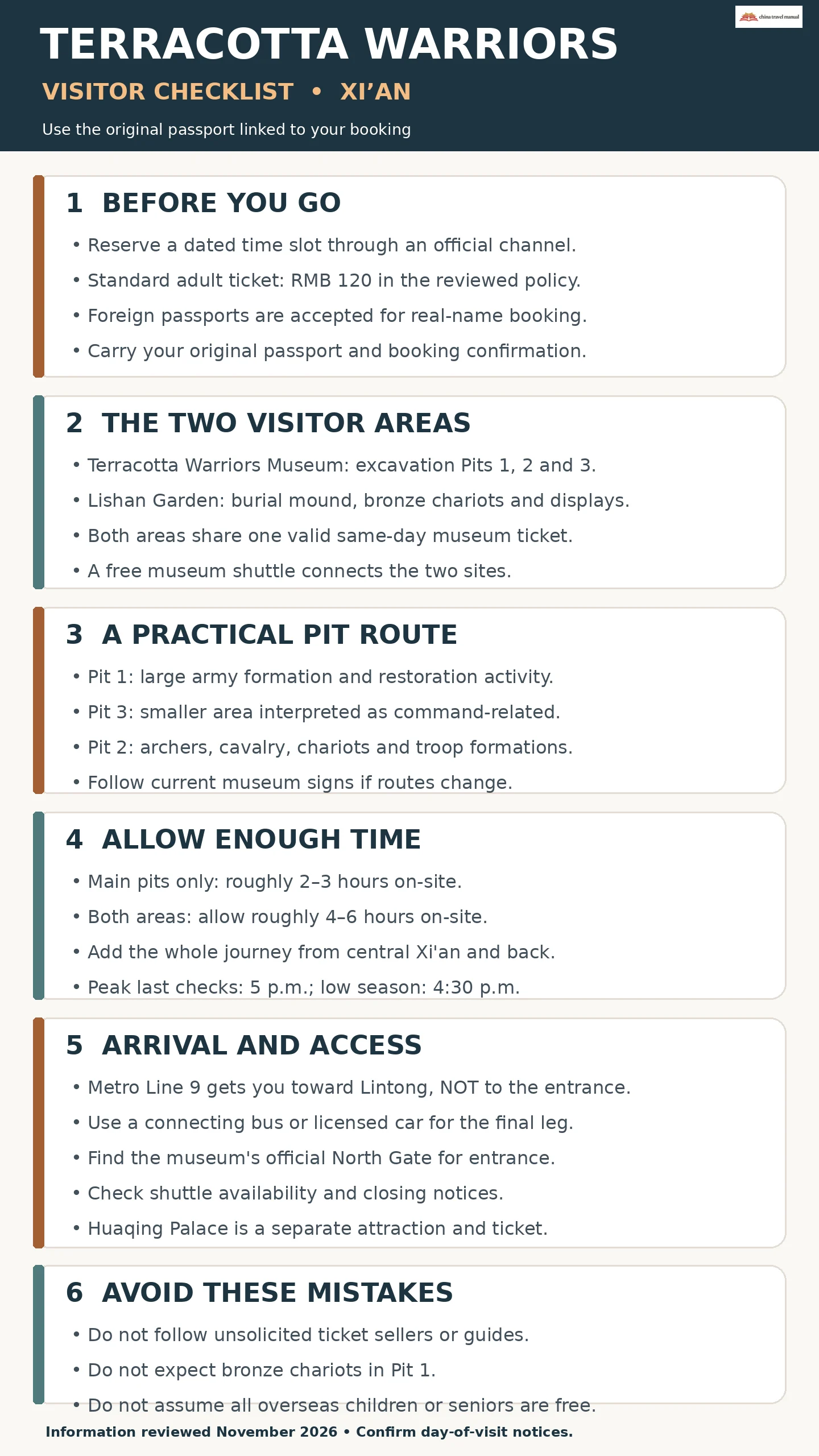
Book the Terracotta Warriors in advance through an official real-name ticket channel and carry the original passport used for the reservation. The Emperor Qinshihuang’s Mausoleum Site Museum has two visitor areas: the Terracotta Warriors Museum, where you can see Pits 1, 2 and 3, and Lishan Garden, home to the bronze chariots and other mausoleum remains. One valid same-day ticket covers both; a free shuttle connects them. Plan a full day from central Xi’an if you want to visit both areas.
- Tickets: The published standard adult price is RMB 120; verify current discounts and eligibility.
- Passport: Foreign visitors can reserve with a valid passport and must bring the original document.
- Route: Start at the official North Gate, see Pits 1, 3 and 2, then take the shuttle if time allows.
- Hours: Published last ticket checks are 5 p.m. in peak season and 4:30 p.m. in low season.
- Time: Allow 2–3 hours for the main pits or about 4–6 hours on-site for both areas.
Check the museum’s current notices before leaving; operating arrangements, entry slots and transport connections may change.
Visiting the Terracotta Warriors involves two separate visitor areas: the famous Terracotta Warriors Museum and Lishan Garden, where the burial mound, additional archaeological displays, and bronze chariots can be seen. A single valid admission ticket covers both areas, with a free shuttle connecting them. For wider destination planning, see our Xi’an travel guide. [1][2]
Are the Terracotta Warriors Worth Visiting?
Why the Terracotta Army Matters
Yes, especially if you enjoy history, archaeology, ancient engineering, or seeing original cultural heritage in place. The mausoleum of China’s first emperor, Qin Shi Huang, became a UNESCO World Heritage Site in 1987. Farmers discovered the first famous warrior pit in 1974, but the archaeological landscape is much larger than the three exhibition halls most visitors recognize. The complex contains a burial mound, associated pits, architectural remains, and artifacts that help explain the formation of China’s first unified empire. UNESCO highlights the extraordinary artistic detail and military organization represented by these remains. This is why a visit can be rewarding even if you are not normally a museum enthusiast. [3]
What First-Time Visitors Should Expect
Expect an archaeological museum, not a walk-through reconstruction. Most warriors are viewed from raised platforms above excavation trenches; you cannot enter the pits. Some areas reveal conservation work or protected remains, and exhibits can change. Lishan Garden is separate and adds outdoor walking. Plan for more than the main hall if you want both areas.
Where Are the Terracotta Warriors?
Location in Lintong, Xi’an
The site is in Lintong District, northeast of central Xi’an, not inside the old city walls. Its official English name is Emperor Qinshihuang’s Mausoleum Site Museum (秦始皇帝陵博物院). The core attraction is the Terracotta Warriors Museum (秦始皇兵马俑博物馆). The second location is the Qinshihuang Mausoleum Archaeological Site Park, usually called Lishan Garden (丽山园). Save both Chinese names in your map or phone so a driver does not take you to the burial mound when you intend to enter the warriors’ museum. [2][3]
Terracotta Warriors Museum vs. Lishan Garden
| Place | What you see | Ticket relationship |
|---|---|---|
| Terracotta Warriors Museum | Pits 1, 2 and 3 and other open displays | Included in museum admission |
| Lishan Garden | Burial mound setting, bronze chariots and open archaeological displays | Included in the same valid admission |
| Huaqing Palace | Separate Tang-era historical attraction in Lintong | Separate ticket required |
A free shuttle connects the two museum areas; neither is a continuous indoor hall. Huaqing Palace is a separate, ticketed attraction. [1][2]
Terracotta Warriors Tickets, Prices and Passport Rules
Admission Prices and What’s Included
The museum’s ticket instructions reviewed on November 8, 2026 list standard adult admission at RMB 120 and an eligible student half-price ticket at RMB 60. The standard adult price is the same in the published peak and off-peak seasons. Both the Terracotta Warriors Museum and Lishan Garden are covered by one valid same-day museum ticket; the official inter-site shuttle is free. Guided interpretation, optional on-site transport, meals, and travel from Xi’an are separate expenses. Prices and qualifying conditions may change, so check the official ticket page for your actual date before paying. [2]
Official Reservations for Foreign Visitors
The museum requires real-name advance reservations, including for foreign visitors and people eligible for free admission. The official website and the museum’s recognized WeChat ticketing accounts accept reservations using the permitted identification documents, including valid foreign passports. Choose the correct date and available time window, enter your passport details carefully, complete payment as instructed, and keep the confirmation accessible offline. A reservation channel may ask for a mobile number or payment account; overseas access varies, so test the process while you still have time to contact the museum if it fails. [1][2]
Avoid promises of admission without a valid reservation. For screenshots and troubleshooting, use our separate Terracotta Warriors ticket booking guide; this guide focuses on the visit itself.
Passport Verification and Entry
Carry the original, currently valid passport used when booking. The museum requires the person, ticket and identification document to match. A photo, screenshot, or photocopy is not a dependable substitute for the actual passport at the gate. Save your order number too, but treat the passport as the essential identity document. Allow extra time if the name format differs between a booking platform and your passport, or if you must request staff assistance. The published guidance advises arriving around half an hour before your reserved entry window. [2]
Discounts, Refunds and Common Booking Issues
Free and reduced tickets are not universal across nationalities. Some posted concessions for children, seniors, and certain other groups explicitly refer to Chinese nationals or specific documents; do not assume that an overseas visitor qualifies simply by age. Students should check the current eligibility and whether their school document meets the rule. The museum says unused tickets should be canceled before inspection and that a ticket already used for entry cannot be refunded. Date changes and third-party ticket conditions depend on the actual booking channel and product. If an app rejects your passport or payment, contact the official ticket service before traveling to Lintong. [2]
Terracotta Warriors Opening Hours and Best Time to Visit
Seasonal Admission Hours
| Published season | First ticket checks | Last ticket checks |
|---|---|---|
| March 16–November 15 | 8:30 a.m. | 5:00 p.m. |
| November 16–March 15 | 8:30 a.m. | 4:30 p.m. |
These are the official seasonal ticket-checking times reviewed for this guide, not guaranteed closing times for every exhibition. The published site closing time is later, and holiday notices may change operations. Do not plan to enter Lishan Garden at the last possible minute just because the overall museum stays open beyond the final ticket inspection. Check both areas’ current instructions before departure. [1][2]
Weekends, Holidays and Morning Visits
An early reservation leaves more time for both areas but cannot guarantee short lines. Holidays, weekends and tour groups may be busy. If your booking is late, prioritize the warrior pits; never assume you can enter Lishan Garden after its final ticket check.
How to Get to the Terracotta Warriors from Xi’an
Metro Line 9 and the Final Bus Connection
The metro can get you toward Lintong but does not run directly to the Terracotta Warriors Museum entrance. A common public-transport route is to reach Fangzhicheng (纺织城), transfer to Metro Line 9 in the Qinling West direction, and then continue by local bus or a legal vehicle. The museum’s published transport guidance describes Huaqing Pool (华清池) with local buses such as Lintong Tourist 613 or 602; other routes may use Qinling West (秦陵西) and a connecting service. Bus numbers, stops and last departures can change. Follow the current city transit map and confirm that the bus actually reaches the museum’s visitor entrance, not merely another Lintong landmark. [4]
Public transit can cost less but requires walking, waiting and a final connection. See Getting Around Xi’an for city transport details.
Taking a Taxi, DiDi or Prearranged Car
A licensed taxi or verified ride-hailing service can be easier with children, heavy luggage or limited mobility. Enter the museum’s Chinese name and verify the pin before confirming your ride. Ask the driver to use the current approved drop-off point for the Terracotta Warriors Museum, not simply the mausoleum mound. If you prearrange a return pickup, specify whether you will finish at the main museum or Lishan Garden, because those are different locations. A fixed wait of only one hour is inadequate if you plan to see both areas. Refuse unsolicited offers involving shopping stops, unverified admission promises or a required private guide.
Travel Time and Return Planning
From a hotel near central Xi’an, allow roughly 1.5–2 hours as a conservative planning allowance for reaching the attraction, depending on the chosen mode, traffic, wait time and the last connection. This is not the published running time of a single train or a guaranteed taxi ETA. Also estimate the journey back before choosing a late reservation; a local bus may stop operating before you finish. Consider the location of your hotel when choosing transportation. Our where to stay in Xi’an guide helps compare central areas, while the museum itself supplies the current destination and visitor guidance.
How to Enter the Terracotta Warriors Museum
Finding the Official Entrance
After arriving in the museum area, follow signs for the official North Gate (北门) visitor entrance. The museum’s ticket instructions specify a one-way circulation arrangement, with the north gate used for entry. Do not follow a random shortcut suggested by a seller on the street. The bus stop or taxi drop-off point may still be some distance from the inspection point. Keep the reservation confirmation and passport ready before reaching the first gate. [2]
Security, Real-Name Ticket Checks and Entry
- Confirm that you are at the Terracotta Warriors Museum entrance for your reserved slot.
- Follow the official visitor queue and complete the required bag and security screening.
- Present the original passport used in the booking for real-name ticket verification.
- Keep the admission record accessible because the two visitor areas may require additional checks.
- Follow the current route into the open exhibition buildings; staff directions take priority over old online maps.
Arrive about 30 minutes before your entry slot as advised by the museum. Follow one-way signs and staff instructions. [2]
How to Visit Pits 1, 2 and 3
Best Viewing Order for First-Time Visitors
One clear route is Pit 1, followed by Pit 3, then Pit 2 and any available related displays. This is an editorial recommendation, not a compulsory museum path. It moves from the large formation to a smaller command-related area and finally to the variety of soldiers and formations in Pit 2. If crowd controls, guided movement, conservation work, or exhibition closures alter the route, follow museum signs and staff directions instead.
Pit 1: The Main Army Formation
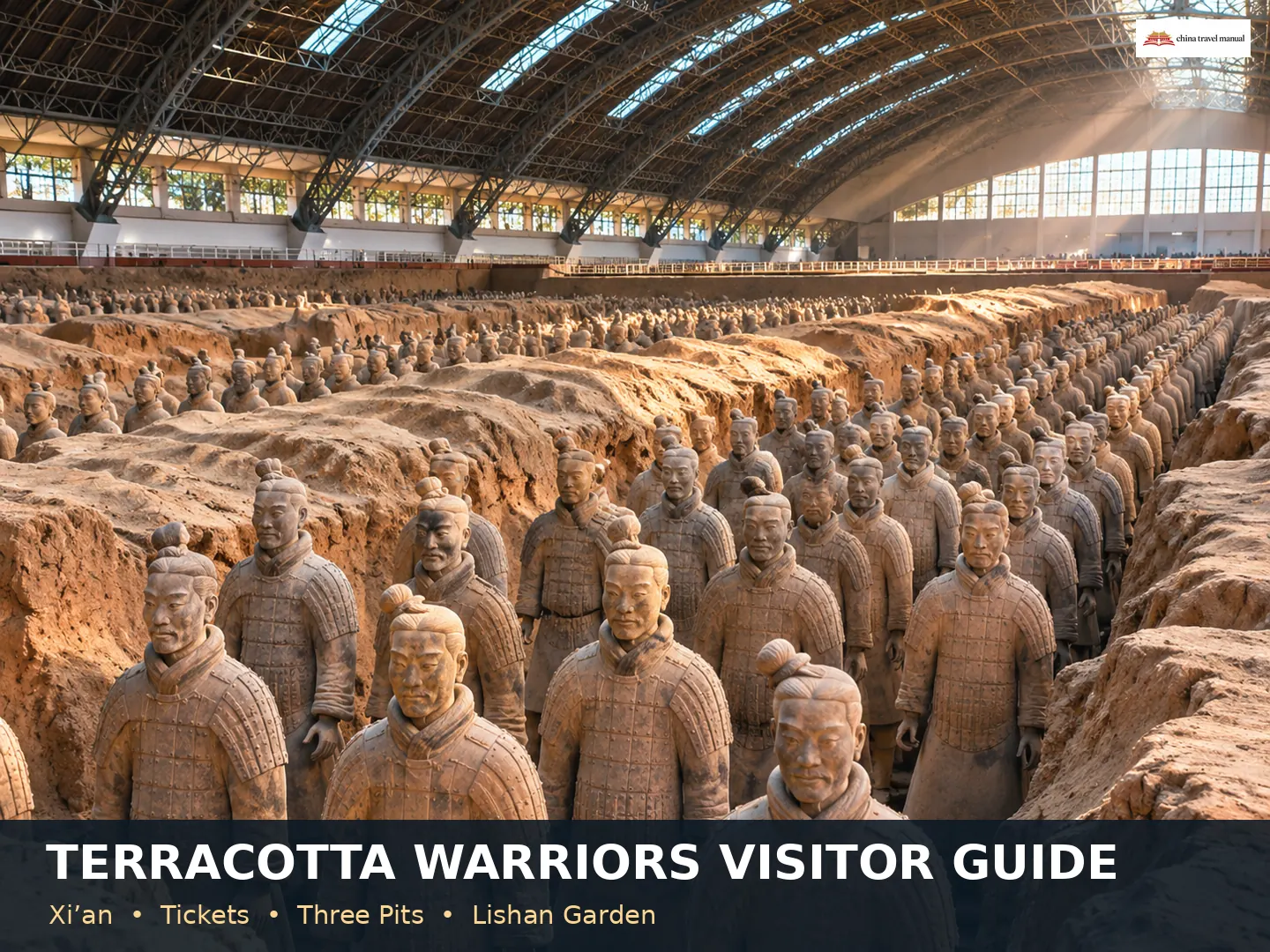
Pit 1 is the spectacular hall most visitors have imagined. The official museum describes an excavation area of about 14,260 square meters. From the viewing platforms, look across the long trenches and ranks of figures, then examine the differences in armor, hairstyles and stance that emerge when you slow down. Notice that the excavation is not one uniform room: soil partitions, damaged figures, reconstructed soldiers and archaeological work areas reveal how the site is studied and preserved. Take a wide view first, then move to less congested viewing points for details. [2]
Pit 1 is impressive enough to absorb your whole visit. Save time for the other pits and Lishan Garden, where the broader burial complex becomes clearer.
Pit 3: The Command Area
Pit 3 is substantially smaller. Its layout and associated remains have led archaeologists to interpret it as an area linked to command or military headquarters. This interpretation helps visitors understand that the pits represent an organized army with different roles, rather than an undifferentiated collection of sculptures. The museum’s published description associates its internal layout with a command post. The exact function is an archaeological interpretation, not a surviving written label attached to the pit. [2]
Pit 2: Different Troop Types
Pit 2 emphasizes variety. Its archaeological layout includes formations associated with archers, cavalry, chariots and infantry. Look for evidence of how different units were arranged rather than expecting row after row identical to Pit 1. Museum displays may highlight excavated pieces, preserved ground surfaces or conservation work. Some sections can be restricted or covered during ongoing research and maintenance; the view is not necessarily identical on every visit. If you have little time, a shorter walk here still provides a valuable contrast with the grand arrangement of Pit 1. [2]
Guided Tour vs. Self-Guided Visit
You can visit independently using museum labels and a little background reading. A licensed or official guide is useful if you want deeper explanations of Qin military structure, the history of excavation, firing and painting techniques, or the wider mausoleum plan. Ask the official service desk about available languages, charges and tour formats. Do not assume an English-speaking guide is available at all hours, and do not let an unsolicited seller handle your passport. A self-guided visit is entirely reasonable if you prefer to move at your own pace.
Lishan Garden and the Bronze Chariots
Taking the Free Shuttle Bus
When you have finished the warrior pits, leave via the signed official exit and find the museum’s free shuttle to Lishan Garden. Published museum information identifies the transfer area near the west side of the Terracotta Warriors Museum’s north gate and the east gate of Lishan Garden. Boarding points and operating procedures can be revised, so follow current signs rather than treating an old map as exact. Both sites use the same valid museum admission, but your ticket or passport may be checked again. The shuttle ride, queue and onward walk all count toward your visit time. [2]
What to See at Lishan Garden
Lishan Garden puts the warriors into their larger archaeological setting. Its main themes are the First Emperor’s burial mound, associated burial pits, and objects found in the mausoleum complex. The bronze chariots and horses are particularly important: the museum’s separate Bronze Chariot Museum is within Lishan Garden, rather than the main Terracotta Warriors Pit 1 hall. Some older travel guides still direct visitors to the wrong area because the chariots were moved from their earlier display location. Check current exhibit notices, but plan for Lishan Garden if seeing them is a priority. [2]
Lishan Garden involves outdoor walking and separate displays. Select the exhibits that interest you; ask staff about mobility support if needed.
Is Lishan Garden Worth Visiting?
Lishan Garden is valuable for the full mausoleum story. For only 2–3 hours on-site, prioritize the pits. With 4–6 hours, both areas become more realistic. Visitors with young children, restricted mobility or late reservations may prefer to skip the second area.
How Long Should You Spend at the Terracotta Warriors?
Short Visit vs. Full Visit
| Available time | Practical plan |
|---|---|
| 2–3 hours on-site | Main warrior pits and nearby open displays |
| 4–5 hours on-site | Warrior pits, shuttle and a focused Lishan Garden visit |
| 5–6 hours or longer on-site | More time for interpretation, both visitor areas and breaks |
| One full hotel-to-hotel day | More comfortable when traveling from central Xi’an |
These are planning ranges, not official service guarantees. The museum suggests roughly 1.5 hours per visitor area, but a real trip also includes the walk from transport, ticket verification, security, food, shuttle queues and the journey home. Keep on-site time separate from hotel-to-hotel time. [1][2]
Sample Half-Day and Full-Day Plans
For a short visit, see the open pits and return to the city. For a full day, enter at your reservation time, see the pits, take the shuttle and explore Lishan Garden before returning. For broader scheduling, see our three-day Xi’an itinerary.
Practical Tips for International Visitors
Luggage Storage and Security Rules
The museum lists a luggage storage facility, but it does not accept valuables, identity documents, electronic equipment and certain fragile, hazardous or perishable items. Keep passports, money, cameras and phones with you. If possible, leave large suitcases at your hotel instead of carrying them to Lintong. Follow the museum’s current security notice for restricted objects and do not take drones, dangerous articles or professional filming equipment without the appropriate permission. [2]
Accessibility and Family Facilities
Wheelchairs, strollers and some accessible routes are available, but full accessibility of every walkway and shuttle is not guaranteed. Contact the visitor desk about your specific needs before traveling.
Payment, Mobile Data and Language
Make sure you can open your reservation and route information on the day. An overseas eSIM or international roaming plan can help, but some ticketing functions may still require account or phone verification. Save the Chinese museum name and your ticket reference offline. Bring a backup way to pay for transport or incidental purchases; foreign bank-card and mobile-payment acceptance is not identical everywhere. Our guide to mobile payments in China explains preparation for visitors. For food after your return, see what to eat in Xi’an rather than assuming you must eat at a particular tourist stop.
Avoiding Unofficial Ticket Sellers
Avoid sellers offering special admission shortcuts or mandatory expensive tours. Use official services, request receipts and never surrender your passport to an unsolicited guide.
Should You Visit Huaqing Palace on the Same Day?
Huaqing Palace is a separate Tang-era historical attraction with its own ticket. Archaeology-focused visitors should pair the warriors with Lishan Garden; Tang-history enthusiasts may choose Huaqing Palace after checking times and transport. See the Huaqing Palace visitor guide. Do not attempt to see the warriors, Lishan Garden, Huaqing Palace and Mount Li in depth on one day. Other options appear in our day trips from Xi’an and Shaanxi travel guide.
Common Mistakes to Avoid
- Arriving without a reservation: complete the museum’s real-name booking before the journey.
- Leaving your passport behind: bring the original document used to book.
- Expecting the metro to stop at the museum gate: plan the Lintong bus or taxi connection.
- Confusing admission and closing hours: check the seasonal last ticket-inspection time.
- Looking for the bronze chariots in Pit 1: allow time for Lishan Garden.
- Assuming every senior or child is admitted free: check nationality, document and product conditions.
- Trying to add too much: account for walking, shuttle queues and the return journey.
- Buying from an unsolicited seller: use official booking and interpretation channels.
Frequently Asked Questions
Do You Need to Book Terracotta Warriors Tickets in Advance?
Yes. The museum requires real-name advance reservations, including for foreign visitors and eligible free-admission groups. Reserve through a recognized official channel before traveling to Lintong.
Can Foreigners Visit the Terracotta Warriors with a Passport?
Yes. Foreign visitors may book with a valid passport. Bring the same original passport for identity verification when you enter; a photo is not a reliable substitute.
How Long Does It Take to Visit the Terracotta Warriors?
Allow about 2–3 hours for the main pits. Visiting both the warriors museum and Lishan Garden more comfortably takes around 4–6 hours on-site, plus the journey to and from Xi’an.
Is Lishan Garden Included in the Terracotta Warriors Ticket?
Yes. The museum’s same-day ticket covers the Terracotta Warriors Museum and Lishan Garden, and a free museum shuttle connects the two visitor areas. Last-entry times still apply.
Where Can You See the Bronze Chariots?
The Bronze Chariot Museum is within Lishan Garden. Do not assume you will find the famous bronze chariots in the Terracotta Warriors Museum’s main pit halls.
Can You Reach the Terracotta Warriors by Xi’an Metro?
You can take the Xi’an metro toward Lintong, commonly using Line 9, but you need a final bus, taxi or other ground connection to reach the museum entrance.
Can You Visit the Terracotta Warriors Without a Guide?
Yes. You can visit independently. Official interpretation or audio commentary may be useful if you want a deeper understanding of the army, archaeological methods and wider imperial tomb complex.
Sources
[1] Emperor Qinshihuang’s Mausoleum Site Museum. Visitor Guide and Opening Hours
[2] Emperor Qinshihuang’s Mausoleum Site Museum. Official Ticketing Instructions
[3] UNESCO World Heritage Centre. Mausoleum of the First Qin Emperor
[4] Emperor Qinshihuang’s Mausoleum Site Museum. Official Transportation Guide





