
Quick Answer: How Do You Use a Railway Station in China?
To use a railway station in mainland China, first match the full departure station on your confirmed ticket—not just the city. Arrive with time for security and ID checks, then find your train number on the departure board and follow the assigned boarding gate to your carriage. Foreign visitors can use the original passport or other accepted ID used to buy their tickets at supported automatic or staffed checkpoints. [1][2]
- Check both station names: Shanghai and Shanghai Hongqiao are different stations.
- Allow a buffer: For a first visit to a large terminal, arriving about 60–90 minutes early is a practical recommendation, not a universal rule.
- Follow your train number: The board’s final destination may differ from your stop.
- Carry the original booking ID: A screenshot alone is not a substitute for the required identification.
- Watch the gate status: Stations stop ticket checks before departure; the posted cutoff controls.
For a connection, verify whether your next train uses the same station or another terminal across the city.
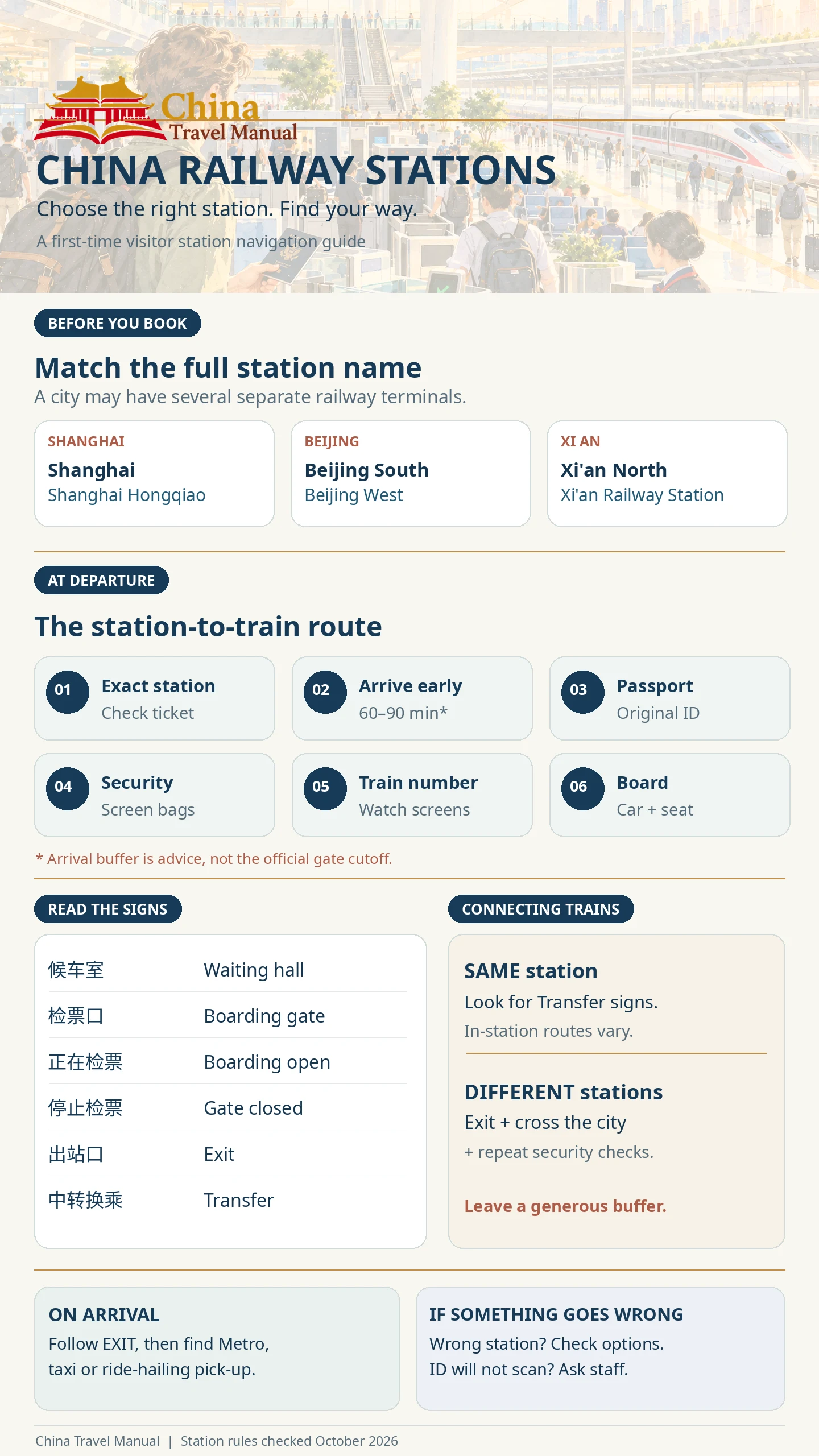
A ticket for the correct city is not necessarily a ticket from the station nearest your hotel. Chinese cities often have several railway terminals, each with its own entrances, metro links, departure halls and taxi pick-up areas. The journey becomes easier when you plan it in three parts: reach the exact station, navigate the departure process, and know how you will exit or transfer on arrival. This guide covers those station decisions; train classes and detailed ticket purchasing belong in our train travel in China guide.
How to Choose the Right Railway Station Before Booking
Check the Exact Station Name, Not Just the City
In a booking search, entering “Beijing” may return several different stations. Look beyond the city or route name: the ticket must identify a precise departure station and a precise arrival station. The Chinese characters are useful cross-checks when an English translation looks abbreviated, but always use the station selected in the actual ticketing system.
For example, Beijing South (北京南) and Beijing West (北京西) are distinct terminals. Similarly, Shanghai Hongqiao (上海虹桥) is not Shanghai Railway Station (上海). You cannot simply arrive at another terminal in the same city and expect to board the booked train. The stations have different addresses, access routes and services. Shanghai’s official visitor guide specifically warns travelers to verify the station before setting out. [3]
Before paying, look up the full station name in a map, estimate travel time from your hotel and confirm that the arrival station works for the next part of your itinerary. If you are booking through an English-language intermediary, double-check the original 12306 station information rather than relying on a city-only search label. The railway ticket booking guide covers booking channels in detail.
Common Station Mix-Ups in Beijing, Shanghai and Beyond
| City | Commonly confused stations | Why the distinction matters |
|---|---|---|
| Beijing | Beijing South (北京南); Beijing West (北京西) | Separate terminals serving different train routes and city transport links |
| Shanghai | Shanghai (上海); Shanghai Hongqiao (上海虹桥); Shanghai South (上海南) | Hongqiao links with the airport and metro interchange; the other two are elsewhere in the city |
| Guangzhou | Guangzhou South (广州南); Guangzhou (广州) | The large southern high-speed hub is not the central Guangzhou station |
| Shenzhen | Shenzhen North (深圳北); Shenzhen (深圳) | Shenzhen North is a separate hub; Shenzhen station is in the Luohu area |
| Xi’an | Xi’an North (西安北); Xi’an (西安) | Different station sites with different access times and departures |
A train described as “high-speed” does not guarantee that it leaves from the station with “North” or “South” in its name. Use the full ticketed station name as the final authority. For city-specific decisions, see Beijing South, Beijing West, Shanghai Hongqiao and Guangzhou South.
How to Get to the Station and When to Arrive
Metro, Taxi, Ride-Hailing and Airport Connections
Choose transport only after you have identified the correct terminal. Metro services are often predictable in busy cities, while taxis or ride-hailing may suit passengers with several bags or limited mobility. But the drop-off point may be a considerable walk from the actual railway entrance, especially at extensive hubs such as Shanghai Hongqiao.
On a map, a railway-station pin does not necessarily mark the departures entrance. Check whether the metro exit, taxi drop-off, road entrance and passenger security entrance are on different sides or levels of the complex. If you are coming from an airport, include immigration if relevant, baggage claim, the transfer itself and the walk to the departures hall—not just the road or metro travel time. Our airport and station transfers guide covers the larger connection decision.
At the destination, taxi and ride-hailing queues can be in separate areas. Beijing’s published railway-station guide, for example, places several taxi and e-hailing pick-up options at Beijing South on different levels or sides of the transport hub. Follow current signs rather than assuming a pick-up point from an old screenshot. [4]
Allow Time for the Entrance, Security and Boarding Gate
For an unfamiliar large station, 60–90 minutes before departure is a sensible arrival target, particularly during holidays or when carrying large luggage. This is a risk buffer, not a government-wide minimum or a promise that every terminal requires that long. Add more time when airport transfers, mobility needs or uncertain traffic are involved.
The binding deadline is the station’s posted end of check-in, which comes before the train’s departure time. Entry checkpoints, security queues, waiting areas and platforms may be far apart. Railway guidance specifically tells passengers to check local cutoff notices and allow time for these procedures. [2] Do not interpret a train leaving at 10:00 as permission to turn up at the gate at 09:59.
What Will You Find Inside a Chinese Railway Station?
Departures, Waiting Halls and Check-In Gates
A major railway station typically has entry or ID-check points, security screening, ticket-service facilities, waiting areas, boarding gates, platforms and a separate arrival route. The order of the first two checks can vary. Some stations place waiting halls above the tracks; others use different layouts. There is no universal floor plan for Chinese high-speed railway stations.
After entering, stay in the correct waiting area and keep watching the live boards. One gate may serve several trains in sequence, so arriving at a gate shown in your itinerary does not mean your train is already boarding. Gate assignments and platform information can change; treat current screens and staff directions as controlling.
Station Signs and Screens You Need to Recognize
| Chinese sign | Typical English label | What you should do |
|---|---|---|
| 候车室 | Waiting Hall | Find the area for your departure |
| 检票口 | Check-In Gate / Boarding Gate | Go here when your train is called |
| 站台 | Platform | Follow the approved route to your train |
| 正在检票 | Boarding / Check-In Open | Join the correct gate line |
| 停止检票 | Check-In Closed | Ask staff about your ticket options; do not cross the barrier |
| 出站口 | Exit | Follow the arrival route out of the station |
| 中转换乘 | Transfer / Connections | Ask whether the in-station transfer route is available |
English wording differs among stations. The departure board may show the train’s final destination, which can be a city beyond your own stop. Match the train number and time to your confirmed ticket, not the destination name alone. If two departures are close together, recheck the train number before entering the queue.
How to Enter, Pass Security and Board Your Train
Use Your Passport or Other Booked ID for Entry
China uses real-name ticketing and electronic ticket records. A US visitor normally buys a ticket using the passport and must carry that same original, valid passport on travel day. A phone image of the passport or a booking screenshot by itself does not replace the accepted original identification. Foreign travelers may use supported automatic or manual entry and exit gates; when a scanner cannot read your passport, ask for the staffed lane. [1][5]
At the entrance, follow instructions for ticket and identity checks and place your bags through the security scanner when directed. Security screening is required; do not assume that passing one checkpoint elsewhere in the building exempts you. Keep the ticket order or train number accessible on your phone, especially if an employee needs to locate the electronic booking. [2][5]
Example: Shanghai Hongqiao → Beijing South. An American visitor staying in central Shanghai has a confirmed ticket from 上海虹桥, not 上海站. They take the metro to Hongqiao, allow time to walk to departures and show the booked passport at the checkpoint. If the automatic reader fails, they use a staffed gate. The example illustrates the steps, not a guaranteed gate layout or timetable.
Find the Correct Gate, Platform, Carriage and Seat
Once inside, follow this sequence:
- Find your train number and scheduled departure on the live departures screen.
- Check the assigned gate, then wait until the screen or announcement says boarding has begun.
- Pass the correct ticket and identity check; follow the signed passage to the platform.
- Match the carriage number on your order to the platform markings or the train exterior.
- Board safely and find the seat printed in your booking.
For example, Car 03, Seat 05F refers to carriage 3 and seat 5F—not gate 3 or platform 5. Platform carriage markings vary; follow staff directions if the train formation changes. A passport that requires manual inspection is not, by itself, evidence of an invalid ticket. For more on document checks, see passport checks on China trains.
What to Do When You Arrive at Your Destination Station
When the train stops at your booked station, take your belongings and follow 出站口 / Exit signs. Large terminals may direct arrivals down ramps, through corridors or to an exit check. Keep the passport used to purchase the ticket handy in case it is needed again. Do not follow a Transfer sign unless you actually have a connecting train.
Before passing into the public area, check the station map for your preferred next transport. Metro entrances, city buses, taxi ranks and app-based ride pick-up zones may be in separate halls or parking levels. Beijing South, for example, has several taxi and ride-hailing collection areas; the official city guide distinguishes them carefully. [4]
If you have booked a driver, send or confirm the exact station and agreed pick-up zone rather than simply sending “Beijing station.” Follow the newest on-site signage when it conflicts with an old online guide. The Shanghai Railway Station guide covers one city-center arrival, while Shanghai Hongqiao Railway Station covers the larger transport hub.
How to Transfer Between Trains or Railway Stations
Same-Station Transfers
If the first ticket’s arrival station is exactly the same as the next ticket’s departure station, look for 中转换乘 (Transfer / Connections). At stations operating an in-station transfer service for your journey, staff may direct eligible passengers to a dedicated route back toward the waiting area.
Do not assume every station, platform or ticket combination allows this route. It may be necessary to show both confirmed bookings, complete another identity check or exit and re-enter through security. If there is no clearly available transfer route, follow station staff instructions rather than attempting to enter a restricted passage.
The transfer buffer must cover getting off the first train, finding the connection, document checks and the next train’s boarding cutoff—not merely the gap between published arrival and departure times. Delays to the arriving service make a short self-arranged connection particularly risky.
Changing Between Different Stations in One City
Shanghai Hongqiao → Shanghai Railway Station is a cross-city station change, not an in-station connection. The same applies to Beijing South → Beijing West. You must exit the first terminal, travel across the city, enter the second terminal, pass security and reach the next boarding gate.
Avoid booking these transfers with a very narrow gap. Check urban transport time for the specific hour of travel, include walking with luggage and allow extra margin for road congestion or rail disruptions. If you need to change an existing ticket or decide whether a transfer is feasible, see our dedicated China train transfers guide.
Special case: Hong Kong West Kowloon is a cross-border railway terminal. Taking a train between Hong Kong and mainland China involves separate immigration requirements; do not treat it as ordinary domestic station entry. See Hong Kong West Kowloon Station and mainland China, Hong Kong and Macau entry planning.
Luggage Storage, Facilities and Accessibility at Stations
Facilities differ by station size, operating hours and service provider. Large hubs commonly have toilets, drinking water, seating, stores and places to eat, but do not assume every smaller station has the same amenities or English assistance.
| Station service | What to check before relying on it |
|---|---|
| Luggage lockers or staffed storage | Whether available, size limits, fee, opening hours and retrieval deadline |
| Food and drinking water | Location relative to security and whether outlets are open at your hour |
| Elevators and accessible routes | Which entrance and platform path support your needs |
| Passenger assistance | How to request help with a wheelchair or limited mobility |
| Luggage transfer services | Station eligibility, booking requirements, collection and delivery area |
China Railway’s Easy Travel (轻装行) luggage-transfer service started as a limited station pilot in 2025 and subsequently expanded; a January 2026 Beijing notice listed it at all seven major Beijing railway stations. Its availability is not identical to a staffed left-luggage counter or locker. Verify your particular station and booking eligibility before counting on the service. [7]
Travelers who cannot comfortably manage stairs or long corridors should ask about passenger-assistance services in advance. The same applies to families with strollers and passengers needing elevators. For storage specifics see luggage lockers at China railway stations; for assistance see accessible train travel in China. Train baggage size limits are a different subject, explained in China train luggage rules.
What If You Go to the Wrong Station or Have a Problem?
A problem at the station does not always mean the trip is lost. First establish whether your booking is still usable and what official option remains—then decide how to move. Do not rush between terminals if the timing is unsafe.
| Problem | First useful action |
|---|---|
| You are at the wrong departure station | Confirm the correct terminal and boarding cutoff; calculate a safe journey or check ticket-change options |
| Your passport will not scan | Move to a staffed inspection lane with the original booked passport |
| You cannot find your gate | Match the train number on the departure board and ask station staff |
| Your gate has closed | Go to the railway service or ticket counter; do not attempt to bypass the barrier |
| The train is delayed or cancelled | Check station announcements and 12306 for the operator’s actual arrangements |
| Your luggage is missing | Report it promptly to the station information or lost-property desk |
| You cannot find your ride | Confirm the correct exit, station name and official ride-hailing pick-up area |
Wrong-station example: A traveler holding a Beijing West ticket arrives at Beijing South. If the trip across Beijing is likely to exceed the time left before boarding closes, the sensible next step is to check available changes—not assume a staff member can board them on another train. Under the current railway rules, one change may be possible subject to availability, timing and applicable fees; even after departure, qualifying changes can be made under specific conditions. They are not guaranteed free or always available. [6]
For deeper recovery steps, use missing a train in China, train refunds and changes or what to do when a train is cancelled.
FAQs About Railway Stations in China
Do I Need a Paper Train Ticket or Just My Passport?
Most domestic journeys use an electronic ticket, so a printed ticket is generally unnecessary. However, you need a confirmed valid booking and the original valid ID used to buy it—usually your passport. A screenshot alone is insufficient. [1]
How Early Should I Arrive at a Railway Station in China?
For a first visit to a large station, aim for around 60–90 minutes before departure, with extra time for holidays, luggage or accessibility needs. That is travel advice; the station’s published check-in cutoff is the controlling rule. [2]
Is Shanghai Hongqiao the Same as Shanghai Railway Station?
No. Shanghai Hongqiao (上海虹桥) and Shanghai Railway Station (上海) are separate terminals in different parts of the city. Check the exact station on your ticket before booking onward transport. [3]
Can I Change Trains Without Leaving the Station?
Sometimes. Eligible same-station connections may use a signed in-station transfer corridor. But access depends on the station and service; you may need to exit, pass security and re-enter. Allow time for either arrangement.
What If My Passport Will Not Scan at the Gate?
Ask for a manual ticket and identity check with the original passport used in the booking and your order information. Supported gates may also scan foreign documents, so a failed automatic scan does not automatically invalidate your ticket. [1]
Sources
[1] Government of China. China’s Guide to Working and Living: Train Travel for Foreign Visitors
[2] China Railway 12306. China Railway 12306: Entering, Checking In and Leaving Stations
[3] Shanghai Municipal Government. Shanghai Government: Guide to Railway Stations in Shanghai
[4] Beijing Municipal Government. Beijing Government: Taxi and E-Hailing Services at Major Railway Stations
[5] China Railway 12306. China Railway: Railway Passenger Transport Rules, Effective June 2026
[6] China Railway 12306. Railway 12306: Ticket Change Conditions
[7] Beijing Municipal Government. Beijing Government: Easy Travel Luggage Service at Major Stations





