
Quick Answer: Which Experience Fits Your Trip?
Choose a short guided demonstration when you want context, a hands-on class when you want to learn a step, or a performance when the venue and program are the draw. For tea, food and festivals, confirm the local format and how visitors take part before you build the day around it. [1][2][3][4][5]
- Plan one main experience per city: Pick a local specialty that fits your route and leave time afterward.
- Verify the actual activity: Ask what you will make, watch, taste or hear and in which language.
- Check the finish as well as the start: Confirm show end time, how a craft piece gets to you or the way back from a rural venue.
An official heritage listing names a shared tradition. Individual classes, shows and seasonal events set their own access and booking rules. [1][2][3][4][5]
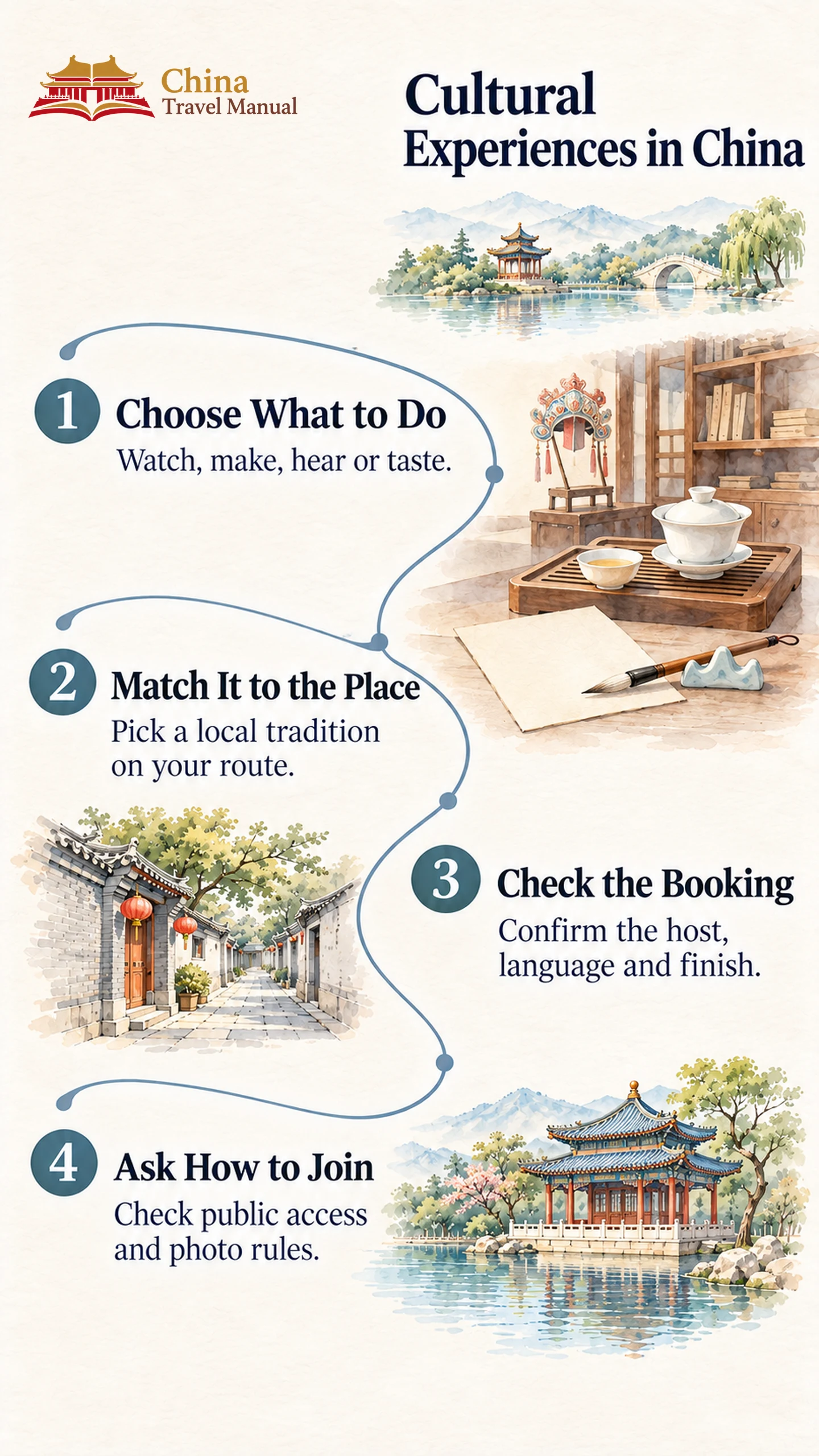
A good cultural experience in China can be as simple as watching a potter fit a lid, comparing teas brewed at one table or hearing a regional music ensemble. Start with what you want to do and the place you already plan to visit. Then choose an experience with enough time for the host to explain what you are seeing or doing. [1][2][3][4]
Choose What You Want to Do
| If you want to | Choose this format | Ask before booking |
|---|---|---|
| Learn one physical skill | A craft class such as shaping clay or writing with a brush | Which step do I do, and what is already prepared? |
| Understand skilled work | A maker demonstration or workshop visit | Who leads it, and can I ask questions or photograph? |
| Hear music or see theater | A dated program in a theater or smaller venue | What is on, how long is it and is there a synopsis or subtitles? |
| Taste and compare a regional specialty | A guided tea tasting, market visit or cooking class | What will be served or made, and can dietary needs be accommodated? |
| Follow a local celebration | A scheduled public festival or community program | Which part welcomes visitors, and what is the current date and entry process? |
If you have only an evening, a performance with a known finish time is easy to plan. If you prefer something hands-on, allow a block without a tight onward booking. For a family, ask about age limits and whether a parent can join or observe. Choose the host’s explanation language early if understanding the story or process matters to you.
Match the Tradition to the Destination
For ceramics, Jingdezhen is a useful example of a place where galleries, historic kilns and practical lessons complement one another. Spend time on a Jingdezhen pottery workshop if you want to form or decorate a piece. If you prefer an activity with paper and ink, ask a calligraphy class which script or strokes it teaches, and what materials you can take with you. [3][6]
For tea, a tasting can teach how a host adjusts water, leaves and steeping. A farm or producer visit can focus on growing and processing when there is work to see. For examples, compare gongfu tea in Chaozhou, tea experiences in Wuyishan and Longjing tea near Hangzhou. UNESCO’s description of tea knowledge and social practices covers more than the tasting itself. Ask whether the session includes processing, guided tasting or shopping time. [1]
For a performance, Peking opera in Beijing and Nanyin music in Quanzhou offer different forms. Check the advertised program for the whole production, an excerpt, an introductory demonstration or a different show entirely. If you are interested in how the art is made, ask whether the venue offers a workshop linked to a performance. Shadow puppetry is one example where a center can show both the figure and the action behind the screen. [2][4][7][8]
Book Around the Host, Language and Practical Details
Share your date, group size and preferred language. Ask who leads the session and request one example of what visitors will actually do from start to finish. For a craft, check materials, drying, firing, trimming or packing and any collection or delivery window. A studio should be able to tell you whether you start with raw material, a blank or a piece the instructor has partly prepared. The craft workshop guide gives more ways to compare sessions. [3][6][8]
For shows, get the exact venue, theater, seats and ending time. For a tea visit, request an explanation of the leaves, the preparation and what you will taste. For cooking or market visits, describe dietary restrictions directly. Save the full meeting address in Chinese and check whether the final ride is included in any rural outing.
Check Who Can Join a Festival or Community Visit
A public New Year market or a dated performance can be straightforward to plan. Household observances and some ceremonies follow the rules of their hosts. Check what part of an event is public, whether registration is needed and what photography is allowed. Ask permission before making portraits, entering a private workspace or recording a demonstration. [4][5]
For a simple first itinerary, book one local activity with a clear time and place, then keep a museum, shop or neighborhood walk flexible around it. If festival dates or production schedules change, you can still visit a craft district, attend an open performance or arrange a tasting on another day.
FAQs About Cultural Experiences in China
Do I need to speak Mandarin to join a workshop?
Ask which language the instructor uses and whether the session includes a demonstration you can follow. For a technical or story-driven session, confirm interpretation, subtitles or a synopsis in advance.
Which experience works if I only have two hours?
Look for a dated tasting, brief demonstration or short seated performance near your current route. Confirm the start, finish and venue before combining it with another booking.
Can I take a finished craft home the same day?
Ask the host. Paper or some decorated items may be ready quickly. Clay work can require drying and firing, which affects collection or shipping. [3][6]
Does a UNESCO-listed tradition mean every local show is the same?
UNESCO describes named traditions and how communities practice them. Check the venue’s actual program to learn which version visitors will see. [1][2][4][5]
Sources
[1] UNESCO Intangible Cultural Heritage. Traditional tea processing and social practices
[2] UNESCO Intangible Cultural Heritage. Peking opera
[3] China Intangible Cultural Heritage. Jingdezhen ceramic workshops and heritage sites
[4] UNESCO Intangible Cultural Heritage. Nanyin
[5] UNESCO Intangible Cultural Heritage. Spring Festival social practices
[6] UNESCO Intangible Cultural Heritage. Chinese calligraphy
[7] UNESCO Intangible Cultural Heritage. Chinese shadow puppetry
[8] Travel China national tourism portal. Visitor example for a shadow-puppet workshop





