

Quick Answer: How to Visit Zhangjiajie National Forest Park
Plan two full sightseeing days for a first visit to Zhangjiajie National Forest Park; one day is best used for the main summit viewpoints, while three days give hikers and photographers more flexibility.
- One day: Prioritize Yuanjiajie and Tianzi Mountain.
- Two days: Add a valley experience such as Golden Whip Stream; Huangshizhai is optional.
- Best gate: East Gate suits many visitors staying in Wulingyuan; South Gate suits Golden Whip Stream and Huangshizhai.
- Tickets: Four-day admission does not automatically cover cableways or Bailong Elevator.
- Reservations: Book a date, ticket station and time for every park entry, including re-entry.
Tianmen Mountain and the Grand Canyon Glass Bridge are separate attractions. Always check same-day transport and weather notices.
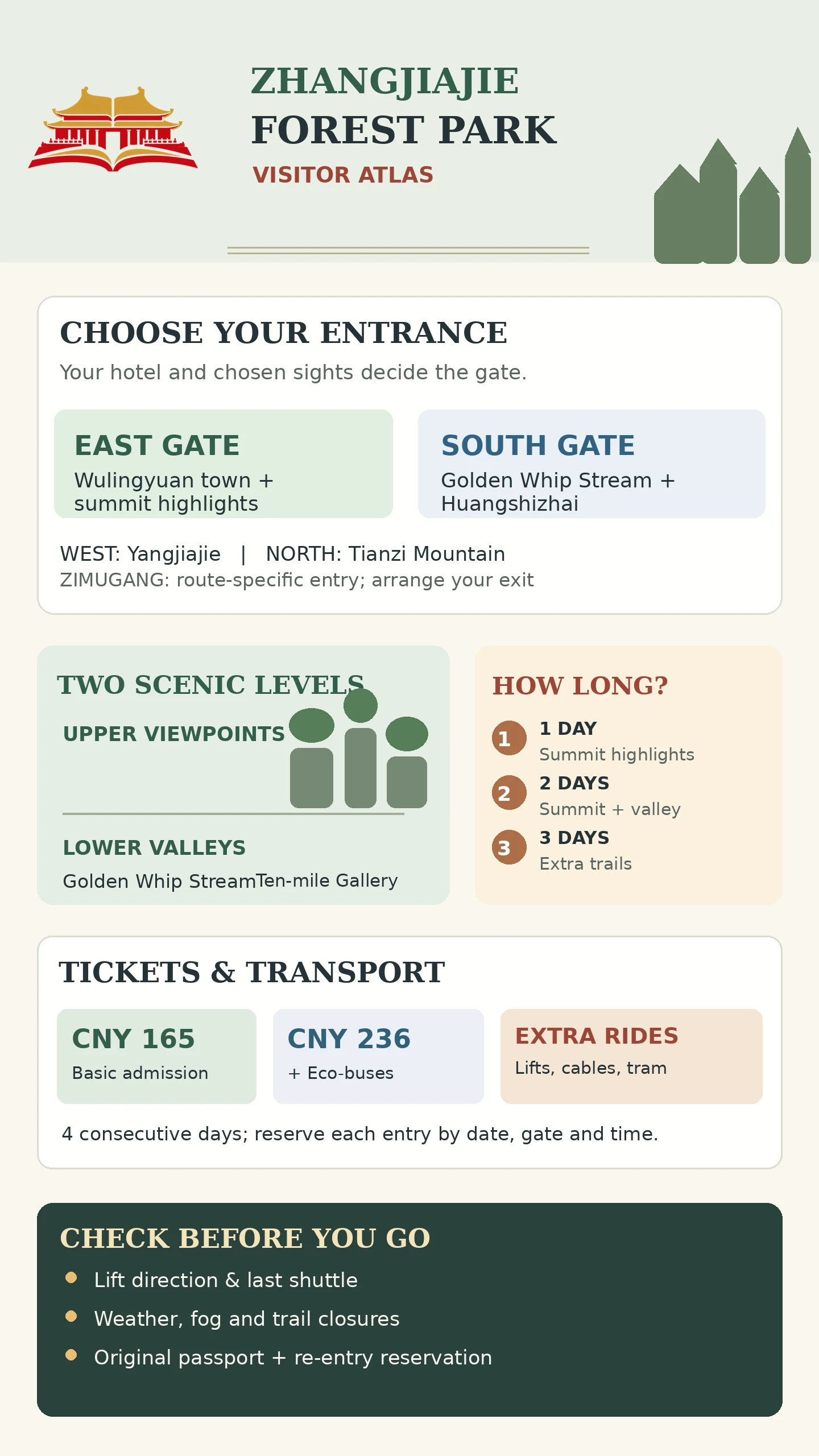
Zhangjiajie National Forest Park is a vast landscape of towering quartz-sandstone pillars, forested ridges and stream valleys in northwest Hunan. The difficult part of visiting is not choosing a viewpoint—it is choosing the right gate, entrance reservation, elevation change and exit before the last transport service. This practical guide covers the main scenic zones, one- and two-day plans, ticket combinations, shuttle buses, cableways and weather decisions. For broader trip logistics outside the park, use the Zhangjiajie travel guide.
Zhangjiajie National Forest Park, Wulingyuan and Tianmen Mountain
The UNESCO-listed site is formally called the Wulingyuan Scenic and Historic Interest Area (武陵源风景名胜区). Inscribed in 1992, it encompasses over 26,000 hectares of remarkable quartz-sandstone pillars and ravines. Zhangjiajie National Forest Park (张家界国家森林公园) is an important part of this wider protected landscape; the two names are often used loosely in travel material, but they do not describe exactly the same administrative area. [1]
Two common name traps deserve attention. Tianzi Mountain (天子山) is an upper-level scenic area within the Wulingyuan ticketed landscape. Tianmen Mountain (天门山), by contrast, is an entirely separate attraction near downtown Zhangjiajie, with its own entrance and ticket system. The Zhangjiajie Grand Canyon Glass Bridge in Cili County is separate again; it is not included with forest-park admission. The dramatic formations here are primarily quartz sandstone, unlike the more familiar limestone karst scenery around Guilin.
If you are still deciding which attractions to include across the city, compare the main things to do in Zhangjiajie before buying park tickets. For the regional context, see the Hunan travel guide.
What to See in Zhangjiajie National Forest Park
The ticketed core scenic landscape contains high viewpoints and lower walking valleys. Their locations, transport connections and physical demands differ substantially, so your choice should be based on available time rather than a desire to check off every named place.
Yuanjiajie and Tianzi Mountain
Yuanjiajie (袁家界) is the classic first-time choice for tall, isolated sandstone pillars. Popular overlooks include the Qiankun Pillar, Enchanting Terrace and the First Bridge Under Heaven. The area is widely associated with the floating-mountain imagery of Avatar, although the movie association should be understood as an artistic inspiration rather than a literal film itinerary. Viewpoint paths can be busy and involve steps, but many principal overlooks are clustered on the elevated platform.
Tianzi Mountain gives a broader panorama across successive ridges and pinnacles. Imperial Writing Brush Peaks and the area around He Long Park are well-known stops. Ecological shuttle buses link the upper scenic areas, with waiting and walking time in addition to the ride itself. Travelers who want the best-known elevated scenes can combine these two zones in one long day, provided transport is operating. For separate viewpoint details, see the Yuanjiajie guide and Tianzi Mountain guide.
Yangjiajie and Huangshizhai
Yangjiajie (杨家界) is known for its striking walls of sandstone and more strenuous walking sections. Some traditional walks involve repeated steep staircases, and closures for maintenance or rockfall risk can affect individual paths. It makes more sense for experienced walkers with extra time than for a rushed first visit. Check the current open trails and the operating status of Yangjiajie Cableway before adding it to a route.
Huangshizhai (黄石寨) is an elevated lookout area reached by hiking or a dedicated cableway. It offers a loop of views and an alternative perspective on the forest of pillars. The circuit still requires walking and should not automatically be called accessible or effortless. A visitor with just one day may reasonably skip both Yangjiajie and Huangshizhai in favor of Yuanjiajie and Tianzi Mountain. A second or third day gives more room to choose one of them without turning the trip into a race.
Golden Whip Stream and Ten-mile Gallery
Golden Whip Stream (金鞭溪) follows a shaded valley beneath the tall rock columns, reversing the usual summit perspective. The commonly described full stream walk is roughly 7–8 km between the forest-park-side trailhead and the Shui Rao Si Men area; a short out-and-back near the south-side trailhead is a more flexible choice for families and travelers avoiding a long traverse. Surfaces and step counts vary, especially at approach and exit paths. A Golden Whip Stream visitor guide covers that separate walk.
Ten-mile Gallery (十里画廊), in the park’s Suoxiyu area, is another valley-level experience, with an optional sightseeing tram on its own route. The tram is a way to reduce walking along this local corridor; it does not travel to Yuanjiajie or Tianzi Mountain. These valleys are not interchangeable with the cliff-top viewpoints. If you have knee trouble or young children, a shorter valley visit and tram ride may be more sensible than attempting the entire stream walk.
How Many Days Do You Need in the Forest Park?
| Full sightseeing days | Practical focus | Best for |
|---|---|---|
| 1 day | Yuanjiajie and Tianzi Mountain | First-time visitors with limited time |
| 2 days | Summit views, then a valley walk; Huangshizhai optional | Most independent first-time visitors |
| 3 days | Core sights plus Yangjiajie or extra photography and hiking | Longer hikes and slower travel |
Two full sightseeing days are a practical default. A travel day spent arriving by train or plane is not a complete park day: reaching your hotel, collecting a ticket and making the entrance reservation all take time. Three days help when fog obscures the viewpoints or when you want extended trails. The ticket’s four-day validity is a flexibility allowance, not a reason to plan four exhausting days.
One Full Day: The Summit Highlights
A representative, conditional circuit starts at East Gate (Wulingyuan Sign Gate), uses the eco-bus to Bailong Elevator, rises to Yuanjiajie, continues by upper-level shuttle to Tianzi Mountain, then descends by Tianzi Mountain Cableway and returns by shuttle. This is an orientation framework, not a promise that every vehicle will operate or that queues will fit a fixed timetable. Check the current shuttle routing, lift availability and your final exit before committing; busy periods can mean substantial waiting. Combining the full Golden Whip Stream or Huangshizhai loop with this summit day is usually unrealistic.
Two Full Days: Summit and Valley
Spend day one on Yuanjiajie and Tianzi Mountain. On day two, choose the South Gate for a Golden Whip Stream outing and consider Huangshizhai only if your walking stamina and time permit. You may instead make Ten-mile Gallery the lighter valley choice. If day two begins at South Gate and ends at a different gate, arrange transport back to your hotel or parked vehicle. A shuttle route inside the park does not necessarily provide a simple public return between outside gate areas. For step-by-step sequencing and alternatives, use Zhangjiajie Forest Park Routes.
When your park days sit within a citywide trip, the three-day Zhangjiajie itinerary helps decide how to fit a separate Tianmen Mountain visit without doubling up on long mountain days.
Which Zhangjiajie Forest Park Entrance Should You Use?
There are five principal ticket stations. The sign at your reserved gate matters: a booking for one entrance is not interchangeable with arriving at another. Hunan’s tourism authority lists all five, including 梓木岗 as the southeast-side gate; newer visitor material may also call it the central gate. [2]
| Common English gate name | Chinese ticket-station name | Best starting use |
|---|---|---|
| East Gate / Wulingyuan Sign Gate | 吴家峪门票站 / 武陵源标志门 | Wulingyuan town; upper scenic areas and main transfers |
| South Gate / Forest Park Gate | 森林公园门票站 / 锣鼓塔 | Golden Whip Stream and Huangshizhai |
| West Gate | 杨家界门票站 | Yangjiajie-specific route |
| North Gate | 天子山门票站 | Approach to Tianzi Mountain by local park transport |
| Zimugang / southeast or central gate | 梓木岗门票站 | Selected routes requiring a planned pickup or exit |
East Gate or South Gate?
East Gate is the default for many first-time visitors staying in Wulingyuan town: it has an established visitor service area and leads into the principal shuttle network for summit sightseeing. South Gate is often a better starting point when the priority is Golden Whip Stream or Huangshizhai. These gates are separated by a significant road journey; you cannot treat them as adjoining entrances. If you start on one side and finish on the other, decide how you will return to your hotel before entering.
West, North and Zimugang Gates
West Gate favors a Yangjiajie-oriented route; North Gate may provide a way to approach Tianzi Mountain from the northern side without using a cableway on the initial ascent, subject to current shuttle arrangements. Zimugang is less convenient for casual first-time visitors and needs a clear route and transport plan. Do not select an uncommon gate just because it appears less crowded on a map. The route, pickup point and reservation are more important than a theoretical queue advantage.
Tickets, Prices and Entry Reservations
What Does the Four-Day Ticket Include?
The Hunan provincial government-price directory lists the Wulingyuan core scenic-area admission at CNY 165 per adult, valid for four consecutive days and excluding transport. A 2026 park fare listing identifies a CNY 236 admission-and-eco-bus ticket. Neither basic ticket automatically includes Bailong Elevator, the cableways or the Ten-mile Gallery tram. [3][4]
| Ticket or vehicle | Published adult reference (CNY) | Important distinction |
|---|---|---|
| Basic park admission | 165 | Four consecutive days; internal transport excluded |
| Admission + eco-buses | 236 | Four consecutive days; cableways and elevator separate |
| Bailong Elevator | 65 one way | Ascend or descend according to ticket direction |
| Tianzi Mountain Cableway | 72 one way | Separate from basic ticket |
| Huangshizhai Cableway | 65 one way | Serves Huangshizhai only |
| Yangjiajie Cableway | 76 one way | Serves Yangjiajie |
| Ten-mile Gallery tram | 38 one way (reference) | Local valley ride, not a cross-park transfer |
There are also combination products, so do not assume every cableway ride must be purchased individually. Public Hunan government information describes a CNY 518 park-plus-eco-bus-and-unlimited “three cableways and one elevator” ticket, as well as a four-ride CNY 238 transport pass and a CNY 298 multi-ride pass. A November 2026 local fare report again lists the combination products. Check which combinations remain on sale for your dates and whether any insurance or service charge is optional; a package makes sense only when the intended number of rides justifies it. [5][4]
For a typical two-day visit using one uphill elevator and one downhill cableway, compare the total of the eco-bus ticket plus two individual rides with any offered bundled product. Do not buy a multi-ride package just because it looks comprehensive. A fixed-date, fixed-direction ticket cannot always be repurposed if you reverse your route.
How to Book First Entry and Re-entry
The park operates real-name, time-slot and entrance-specific reservations. Its September 29, 2026 notice says both first entry and each later entry during validity must be reserved: select the entry date, ticket station and time window, and arrive at that reserved gate. The park recommends the “Zhangjiajie Tourism Assistant” (张家界旅游小助手) WeChat mini-program. A valid four-day ticket does not remove the need for another entry reservation. [6]
- First entry: Choose the date, exact ticket station and time slot; check that your ticket covers the eco-bus and any additional transport you plan to use.
- Later entry: Rebook the day, station and time slot through the current system even if the original four-day admission remains valid.
- Change of plan: Check the system or staff instructions for modifications before traveling to a different gate or arriving outside your original time.
- Lift/cableway rides: Confirm the facility, date and direction; the September notice warns that an uphill ticket will not be accepted for the downhill trip.
Foreign Passports and Discount Tickets
Foreign visitors should book using their valid passport details and carry the same original passport to the gate. If the online channel cannot process your document, or you need a student or senior discount verified, contact the ticket office or an official service channel before purchasing an incorrect fare. Eligibility for concessions depends on the currently accepted documents and the specific ticket product; it should not be assumed from age alone. Keep your booking confirmation available on your phone, but do not rely on a passport photograph instead of the original document.
The attraction’s entry rules and ticket products can change. Treat the published fares above as a November 2026 research reference, not a real-time checkout guarantee. The ticket page’s final total and the park’s same-day notices govern your purchase. The Zhangjiajie travel budget explains where these costs fit into a larger trip.
Getting Around the Park: Eco-buses, Cableways and Walking
Eco-buses and Transfers
Eco-buses are the internal backbone of the core scenic area, connecting gates, valleys, major transport facilities and the upper viewpoints. They run along distinct corridors, not one all-purpose sightseeing loop. Changing from a valley route to an upper-area route may require a lift or cableway plus a further shuttle connection. The park road network and queues determine actual time, not the short line visible on a tourist map. Private vehicles do not simply drive between the core viewing areas.
When buying the combined admission-and-eco-bus fare, confirm the current number and direction of rides allowed under the issued terms. At a stop, check the displayed destination and ask a staff member if the bus name is unclear; a bus with the right scenic-area name can still be going in the wrong direction for your planned exit.
Bailong Elevator and Three Cableways
Bailong Elevator (百龙天梯) connects the valley with the high ground near Yuanjiajie. Tianzi Mountain Cableway (天子山索道) serves the Tianzi Mountain side, Yangjiajie Cableway (杨家界索道) serves the western area, and Huangshizhai Cableway (黄石寨索道) serves Huangshizhai. Each facility has its own queue, boarding point, fare and last operating time. Strong winds, lightning, icing, maintenance or crowd controls can interrupt operations.
The elevator is not a shortcut between all zones; similarly, descending one cableway may place you a long way from the gate where you entered. Check a route diagram that includes both the upper and lower station, and reserve enough time for a final shuttle. Tickets sold for “up” or “down” cannot be interchanged when direction control is active.
Walking Trails and the Ten-mile Gallery Tram
Walking can replace some paid ascents, but steep stair trails require more than the geographic distance suggests. An easy-looking 2 km on a map may be a tiring climb involving thousands of steps. Before substituting a trail for a closed cableway, ask whether the route is currently open, how demanding it is and where it reaches the shuttle system. The Ten-mile Gallery tram is useful only for that valley corridor; it is not transport to the summit regions.
How to Reach the Park and Where to Stay
From Downtown, the Airport and Zhangjiajie West Station
Buses, tourism shuttles and road transfers connect downtown Zhangjiajie with Wulingyuan. Departures, stops and fares change, so confirm whether your bus goes to Wulingyuan town and East Gate or to the separate South Gate. A vehicle bound for “the forest park” is not precise enough if you have a timed reservation at a specific ticket station. The Zhangjiajie transportation guide covers the wider network.
If you arrive by high-speed train, use the Zhangjiajie West Railway Station transfer guide to plan the last leg; high-speed rail arrival does not mean you are already near the park gate. Airport arrivals have a similar extra road journey, explained in the Zhangjiajie airport transfer guide. A pre-booked transfer can simplify an early gate appointment or late arrival, especially with luggage. No fixed year-round direct service or fare is assumed here.
Wulingyuan or Downtown Base?
For two or more days in the forest park, staying near Wulingyuan town and East Gate usually reduces morning travel and makes dining after the park easier. Downtown Zhangjiajie makes more sense for Tianmen Mountain, flight or rail connections, or a short overnight stop. If your trip includes both mountain areas, weigh the time saved at the gates against the hassle of moving bags between hotels. Compare the Zhangjiajie accommodation guide with the dedicated downtown-versus-Wulingyuan comparison.
Best Time to Visit and Weather Contingencies
| Season | What you may see | What can disrupt a visit |
|---|---|---|
| Spring (Mar–May) | Fresh greenery and mist among the pillars | Rain, slick paths and limited views |
| Summer (Jun–Aug) | Dense forest and active streams | Thunderstorms, heat, crowds and possible closures |
| Autumn (Sep–Nov) | Clearer-feeling hiking days and seasonal color | October holiday crowds and changing mountain weather |
| Winter (Dec–Feb) | Occasional frost, snow or icy pillars | Icing, closed steps and transport suspensions |
The summit and the valley can have different visibility on the same day. Mist sometimes creates atmospheric photographs, but it can also conceal almost all viewpoints. In heavy rain or geological-risk alerts, a valley route such as Golden Whip Stream may be unsafe too; switching automatically from summit to valley is not a sufficient contingency plan. Check the morning park notices and do not cross closure barriers. For monthly conditions, use the best time to visit Zhangjiajie guide.
Practical Tips for a Safe Park Visit
- Carry original ID: Bring the passport used for reservations, your confirmation and a phone with sufficient battery.
- Wear suitable shoes: Wet stone, steps and steep viewpoints require good grip. A lightweight rain layer is more practical than relying only on an umbrella in exposed wind.
- Plan the last descent: Confirm each cableway, elevator and eco-bus last departure on the day. Do not leave the return until the final few minutes.
- Choose a realistic walk: Account for staircase elevation, route closures, queues, fatigue and the time to get back to the correct exit.
- Carry water and snacks: Food may be available around some upper tourist hubs, but not continuously along each hiking corridor. Do not feed the wild macaques or approach them with food.
- Respect closures: Rockfall controls, lightning, heavy rain and ice can close trails or equipment without much notice. Follow current staff directions.
If you are spending a long park day, plan breakfast near the gate and check the available food options for your chosen route. For local dinner ideas after you leave, the Zhangjiajie food guide covers dishes and dining areas.
FAQs About Zhangjiajie National Forest Park
Is Zhangjiajie National Forest Park the Same as Tianmen Mountain?
No. The national forest park forms part of the Wulingyuan World Heritage landscape. Tianmen Mountain is a separate attraction near downtown Zhangjiajie and requires its own ticket.
Can You Visit Zhangjiajie National Forest Park in One Day?
Yes, but focus on one coherent route such as Yuanjiajie and Tianzi Mountain. A full Golden Whip Stream walk and Huangshizhai circuit generally need more time than the same day allows.
Does the Entrance Ticket Include Bailong Elevator?
No. The CNY 165 basic admission excludes internal transport, and the CNY 236 eco-bus combination does not automatically include the elevator or cableways. Separate and bundled transport products may be available.
Can You Re-enter During the Four-Day Validity Period?
Yes, within the four consecutive days of ticket validity, but each visit requires its own real-name reservation for the chosen date, entrance and time slot.
Which Entrance Is Best for First-Time Visitors?
East Gate is usually most convenient for travelers staying in Wulingyuan town and focusing on the summit areas. South Gate is a better starting point for Golden Whip Stream or Huangshizhai. Choose according to the route and exit plan.
Sources
[1] UNESCO World Heritage Centre. Wulingyuan Scenic and Historic Interest Area
[2] Hunan Department of Culture and Tourism. Wulingyuan Visitor Transport Guidance
[3] Hunan Development and Reform Commission. Government-Priced Scenic Sites Directory
[4] Rednet Tourism. Wulingyuan Ticket and Transport Products, November 2026
[5] Hunan Provincial Government. Combined-Ticket System for Wulingyuan
[6] Zhangjiajie National Forest Park. September 29, 2026 Entrance and Transport Notice





