

Quick Answer: Best China Travel Experiences for First-Time Visitors
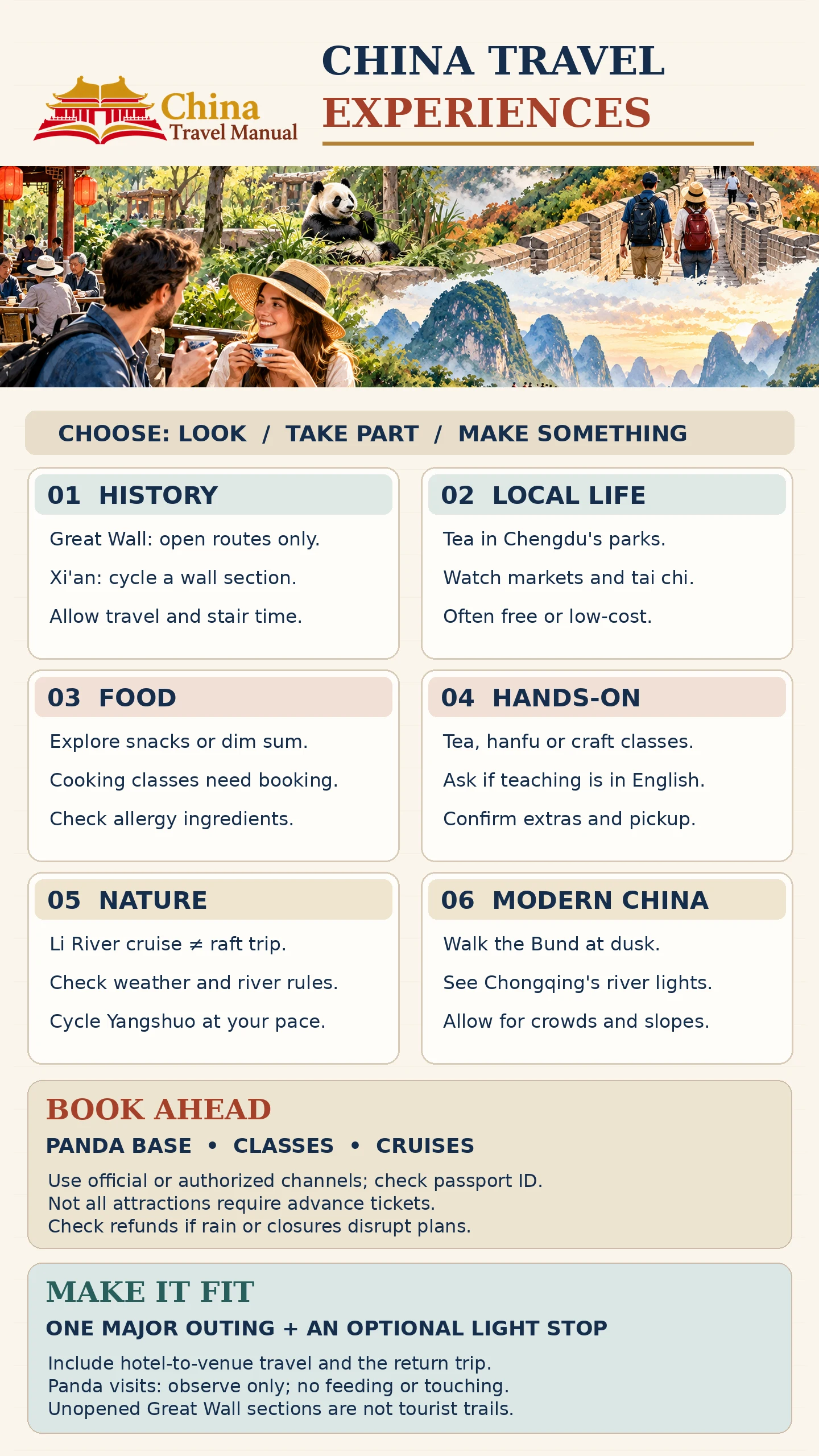
The best China travel experiences combine memorable sights with something you actually do. Choose one or two activities that fit your interests, energy, and available time rather than booking every famous attraction.
- History: Walk an officially open section of the Great Wall or cycle part of Xi’an’s City Wall.
- Wildlife: Observe giant pandas at a regulated Chengdu facility without feeding or touching them.
- Local life: Drink tea in a Chengdu park, visit a morning market, or watch neighborhood park activities respectfully.
- Food and culture: Try regional dishes or join an instructor-led cooking, tea, or craft session.
- Landscapes: Take a Li River cruise or explore Yangshuo’s countryside at a comfortable pace.
- Modern China: See Shanghai’s riverfront or Chongqing’s illuminated cityscape on foot.
Balance paid reservations with flexible, inexpensive experiences. Some of the most rewarding hours in China need no tour booking at all.
You do not need a new city for every new experience. A panda visit and an unhurried teahouse afternoon both fit Chengdu; a boat trip and countryside cycling fit a stay near Yangshuo. This guide helps you compare activities and decide what deserves a place in your trip. For where to go, see China destinations; for the route between cities, see China itineraries.
Which China Travel Experiences Match Your Interests?
Begin with participation level: watching a performance or cruising a river is mostly observational; visiting a teahouse or cycling a historic wall is lightly participatory; a cooking or craft workshop involves guided hands-on practice. Consider whether you would enjoy the activity itself, not just its photographs.
| Interest | Experience and where to try it | Planning time* | Typical booking decision | Best-fit consideration |
|---|---|---|---|---|
| History and landmarks | Great Wall walk near Beijing; City Wall cycling in Xi’an | Half to full day | Check the chosen section or rental operator | Uneven surfaces and physical effort |
| Everyday life | Chengdu teahouse, neighborhood park, or morning market | 1–3 hours | Usually flexible; pay for drinks or food | Slow pace; respect regular users |
| Regional food | Guangzhou dim sum, Xi’an snacks, or a cooking class | 2–4 hours | Explore food streets freely; reserve classes | Check ingredients and allergies |
| Hands-on culture | Tea instruction, hanfu styling, pottery, or tie-dye | 1–4 hours | Reserve an instructor or studio | Ask about language and final price |
| Landscapes | Li River boat, Yangshuo cycling, or Zhangjiajie walk | Half to full day | Book major transport; monitor weather | Terrain and service disruptions |
| Modern city life | Shanghai Bund or Chongqing riverside after dark | 1–3 hours | Public walks generally flexible | Crowds, stairs, and return transport |
*Times are rough outing-planning ranges, not guaranteed door-to-door totals from every hotel. A Great Wall day trip from central Beijing, for example, can take much longer than a short walk on the Wall itself. Allow for round-trip transport, queues, and breaks.
Free access is not the same as a free experience: a public market may be free to enter but buying breakfast costs money. Likewise, a demonstration in a shop is not necessarily the guided, hands-on workshop you thought you booked. If cultural participation is your priority, compare options in cultural experiences in China.
Iconic Experiences Worth Having in China
Walk a Section of the Great Wall
The Great Wall is a network of different sections, not one continuous walk you can complete in a day. At Mutianyu, visitors can choose cable-car-assisted access and a shorter route or spend longer on steep steps. It is a sensible first-time choice because visitor facilities and official entrances are established. However, it still involves hills, exposure to weather, and travel to and from Beijing.
Do not confuse an adventurous-sounding guided hike with permission to enter an unrestored section. Beijing’s Great Wall conservation measures address illegal climbing of unopened or unrestored sections, while areas around Jiankou can be steep and hazardous. Hiring a guide does not override closure signs or heritage restrictions.[1][2] For alternatives, compare the Mutianyu visitor guide with the Great Wall hiking guide.
Also check the specific entrance rules: Beijing’s tourism listing for Mutianyu says on-site tickets are available, so it would be wrong to claim every Great Wall visit requires an advance reservation. Holiday capacity, transport, and third-party tour arrangements may still make booking ahead sensible.[1]
Explore Ancient China Beyond a Photo Stop
Cycling atop the roughly 13.7-kilometer Xi’an City Wall is a way to experience the scale of an old city rather than just view its gates. You can choose a short section instead of riding a full circuit. Confirm which bicycle rental points are operating, the rental time allowance, and whether a return at another gate is permitted. The brick surface can be uneven, with limited shade.
Beijing’s hutongs are a different kind of experience: a walk through public lanes around the old residential quarters, with stops for snacks or tea if you wish. Commercial streets such as Nanluoguxiang are busier than quieter surrounding lanes. Respect residential privacy; a traditional courtyard entrance is not an invitation to enter someone’s home.
Watch Giant Pandas Responsibly in Chengdu
At the Chengdu Research Base of Giant Panda Breeding, the experience is observing pandas from designated visitor areas, not holding, feeding, or touching them. Be skeptical of unrelated vendors promising special paid animal contact. Follow barriers and animal-welfare instructions, and never buy a supposed fast-track ticket from an unauthorized reseller.[3][4]
Early visits often give you a better chance of seeing activity before hotter midday periods, but animal behavior cannot be promised. Allow several hours on site, plus transport. The base says most visitors need an online real-name booking and the original ID document used for the reservation; it lists exceptions for eligible older visitors and young children, and limited on-site purchasing for people unable to pay online when tickets remain. Check its current rules before choosing a time slot.[3] See the wider panda travel guide if you are deciding among locations.
Experience Chinese Food and Everyday Local Life
Visit a Teahouse, Morning Market, or Local Park
A teahouse visit is a social pause; a tea workshop is a lesson. In Chengdu’s People’s Park, ordering a cup of gaiwan tea lets you sit, talk, and watch the public space at your own pace. There is usually no formal class or instructor included in the tea price. The park’s teahouse can be a relaxed stop after a morning attraction; details of local tea etiquette belong in the Chengdu teahouse guide.
Morning markets offer another low-cost glimpse of routine: vendors arranging produce, residents buying breakfast, and neighborhood conversations. Hours and public access differ from market to market, so ask your hotel which local market welcomes visitors and go earlier rather than assuming a fixed nationwide 6–9 a.m. schedule. Parks can include tai chi, dance, and music groups. Observe quietly; ask before photographing people closely or joining a regular group. Read more about public park life in China.
Try Regional Food Beyond a Restaurant Meal
Guangzhou’s dim sum is a leisurely meal with multiple small dishes, while Chengdu hotpot is often shared around a simmering pot. Xi’an’s snack streets can be explored without a guide. These are distinct experiences, not items on a national “must-eat” scorecard; choose one that fits the city where you are already staying.
A guided food walk adds neighborhood context; a cooking class may include market shopping and preparing dishes under supervision. Check whether the booking actually includes the market visit, English instruction, and ingredients. If you have an allergy, keep a clear Chinese explanation on your phone and tell the instructor before paying. A casual street-food visit does not require a paid “authentic food” package.
Try Hands-On Culture and Traditional Performances
Tea, Traditional Dress, and Craft Workshops
Choose a workshop when you want to make or learn something, rather than simply watch a demonstration. A tea lesson may let you handle utensils and practice brewing; a hanfu session may mainly involve costume rental, hair styling, and photography. Pottery, paper cutting, calligraphy, and Bai tie-dye can involve different levels of hands-on work. Some studios advertise a short photo stop as a full cultural experience, so ask exactly what you will do yourself.
| Activity | What to confirm before paying | Common surprise |
|---|---|---|
| Tea workshop | Instruction language, duration, whether you brew tea yourself | A tasting sold as a hands-on class |
| Hanfu styling | Costume, makeup, photographer, photos, and return deadline | Final price much higher than the rental headline |
| Pottery or other craft | Materials, firing time, delivery and shipping cost | Finished work cannot leave with you that day |
Local artisans may teach only in Mandarin, even if the online listing is translated into English. A bilingual guide or a demonstration-led class may be a better choice if verbal explanation matters to you. Detailed comparisons belong in craft workshops in China, hanfu experiences, and pottery workshop booking.
Watch Opera, Acrobatics, or Other Live Shows
Beijing opera, Sichuan opera performances with face-changing segments, and acrobatic shows offer different levels of language dependence. Acrobatics is often understandable without dialogue; a full traditional opera may be harder to follow without subtitles. Do not assume a venue provides an English program or that a brief face-changing demonstration equals a full-length opera performance.
Check the actual show, venue, start time, seat category, and cancellation rules. An evening performance can work well after a light afternoon, but do not promise a universal 90-minute runtime. Use the China performances guide to select a format.
Explore China’s Landscapes Through Outdoor Experiences
The Guilin–Yangshuo area offers a useful choice between looking at scenery and moving through it. A conventional Li River sightseeing cruise from the Guilin area toward Yangshuo often spends roughly four hours on the water, while a raft excursion covers a selected section rather than being the same end-to-end journey. Boats and rafts can have different piers, age or height restrictions, and weather cancellation policies. Compare the Li River cruise with cruise versus raft before booking.[5]
Once in Yangshuo, a countryside bicycle outing lets you stop beside fields and karst hills as you wish. Choose roads suited to your experience, wear a helmet where appropriate, and do not assume a rental electric scooter is legally or safely equivalent to a pedal bicycle. See Yangshuo cycling routes.
Zhangjiajie presents another contrast: gentler valley walks versus long days involving steep stairways and multiple park transport legs. Rain makes stone paths slippery; low cloud may hide the views you traveled for. Build a weather alternative into any mountain-heavy day rather than assuming you can complete every viewpoint. For broader outdoor choices, use China national parks.
See Modern China and Its Nighttime City Life
You do not have to buy a night cruise to enjoy a waterfront city. Shanghai’s Bund is a public promenade looking toward Lujiazui’s skyline; the simple Huangpu ferry and a paid sightseeing cruise are different products with different routes and prices. A walk before or after dusk can be enough. For paid boat options, see the Huangpu River cruise guide and Shanghai at night.
In Chongqing, bridges, riverside viewpoints, and stacked buildings create an especially dramatic after-dark landscape. The steep street network can mean stairs and slopes even over short map distances. Choose an accessible viewpoint if your group has mobility limitations, and confirm the last return transport rather than assuming a fixed citywide light-switch-off time. See nightlife in China or the Chongqing night photography route.
A high-speed train journey can itself be a memorable look at contemporary China, but it should still serve the route you need. Do not add a distant train journey just for the experience; the China transportation guide covers practical transfers.
How to Fit Experiences Into Your China Trip
Plan around the true time and effort of an outing, not the duration printed on its ticket. A useful default is one demanding excursion in a day, with an optional light activity afterward; it is a pacing suggestion, not a rule for every traveler.
- Beijing: A Mutianyu visit can consume much of a day once the trip from central Beijing is included. An optional evening hutong stroll fits better than committing to another major timed attraction.
- Chengdu: Reserve an early panda-base slot, then keep a teahouse afternoon flexible. If the panda visit runs long, shorten the tea stop rather than rushing an animal enclosure.
- Yangshuo: An end-to-end Li River cruise typically reaches Yangshuo after substantial time on the water. Cycling immediately afterward is possible for some visitors, but a short riverside walk or a separate cycling morning gives more margin for delays and fatigue.
Put fixed-time experiences first, then fill the gaps with markets, parks, and public walks. Save Chinese venue addresses offline and calculate hotel-to-meeting-point travel. If you are arranging several regions, the China itinerary hub handles the larger sequencing question.
What to Book Ahead and What Can You Do Spontaneously?
Advance booking is an activity-specific decision, not a blanket rule for travel in China. The government has encouraged major attractions to improve offline ticket services for overseas visitors, but venues may still apply real-name limits or require timed entry.[6]
| Booking priority | Activities | What can go wrong | Better fallback |
|---|---|---|---|
| Secure a date or place | Panda base, instructor-led classes, major cruises, popular performances | Sold-out slot, passport mismatch, language or payment issue | Authorized channel, another date, or a different experience |
| Check same-day availability | City Wall cycling, smaller shows, local rentals | Rental station closed, limited seats, weather restrictions | Walk instead, select a different gate, or move activity |
| Usually spontaneous | Public parks, accessible markets, hutong strolls, waterfront promenades | Venue-specific access, opening hours, crowding | Another nearby public space |
For panda-base tickets, the official reservation platform gives the booking conditions and warns against unauthorized resellers; it also describes limited on-site sales when online payment is not possible and tickets are still available.[3] Mutianyu’s official tourism listing, by contrast, notes that on-site admission tickets are available.[1] Check each venue rather than trusting a third-party statement that all attractions require advance purchase.
Before paying for a workshop or cruise, verify the meeting point, accepted passport information, language support, whether your card works, and the refund rule if bad weather cancels the activity. Carry a second payment method: Chinese authorities have promoted bank-card and cash acceptance for overseas visitors, though individual small studios may still have practical limits.[7] The attraction ticket guide, sold-out attraction alternatives, and payment troubleshooting cover the detailed next steps.
FAQs About China Travel Experiences
What Are the Best Experiences in China for First-Time Visitors?
Choose a blend: an officially open Great Wall walk, a responsible panda visit if you are in Chengdu, an ordinary local-life activity, and either a scenic river excursion or a hands-on class. You do not need all of them on one trip.
What Can You Do in China Beyond Sightseeing?
Sit in a teahouse, explore a morning market, take a cooking or craft class, try hanfu styling, attend a performance, or cycle the countryside. These let you participate in a place rather than only photograph it.
Can You Enjoy Local Experiences in China Without Speaking Chinese?
Yes. Promenades, markets, many cruises, and observation-based activities require little conversation. Small workshops may have Mandarin-only instructors, so confirm English support or arrange translation before paying.
Are There Free or Low-Cost Experiences in China?
Public parks, neighborhood walks, riverside views, and some markets can be free to enter. Tea, snacks, bicycle hire, ferries, and guided sessions cost extra; check the specific venue instead of assuming everything advertised as “local” is free.
Do You Need to Book China Travel Experiences in Advance?
Book time-specific popular visits such as the Chengdu panda base and limited-capacity classes early. Public walks are generally flexible, while other attractions—including Mutianyu—may have on-site ticket options. Always check the actual venue and date.
Sources
[1] Beijing Municipal Government. Mutianyu Great Wall Ticketing Information
[2] Beijing Municipal Government. Beijing Implements Great Wall Protection Regulations
[3] Chengdu Research Base of Giant Panda Breeding. Official Tickets and Real-Name Reservation Rules
[4] Chengdu Research Base of Giant Panda Breeding. Visitor Information and Animal Safety Rules
[5] Li River Cruise Service. Guilin–Yangshuo Cruise Planning FAQs
[6] State Council of the People’s Republic of China. China to Enhance Tourism Convenience for Inbound Visitors
[7] State Council of the People’s Republic of China. Payment Service Guide for Overseas Visitors





