

Quick Answer: How Much Time Do You Need Between Cities in China?
Plan China travel times from one hotel door to the next—not just by the train ride or flight duration. A four-hour train can occupy much of a sightseeing day once you include packing, station transfers, security, waiting, arrival transport, and hotel check-in. For a first trip:
- Count real sightseeing days: Separate arrival, departure, and major transport days from full days available for attractions.
- Compare door to door: Add both ends of the journey before deciding between train and plane.
- Limit hotel changes: As a starting point, use one or two bases for seven days and two or three for ten days, then adapt to your route.
- Check the exact hubs: Beijing and Shanghai each have different airports or stations with very different onward connections.
These are planning guidelines, not rail or aviation rules. Verify your actual stations, schedules, check-in cutoffs, and transfer routes before booking.
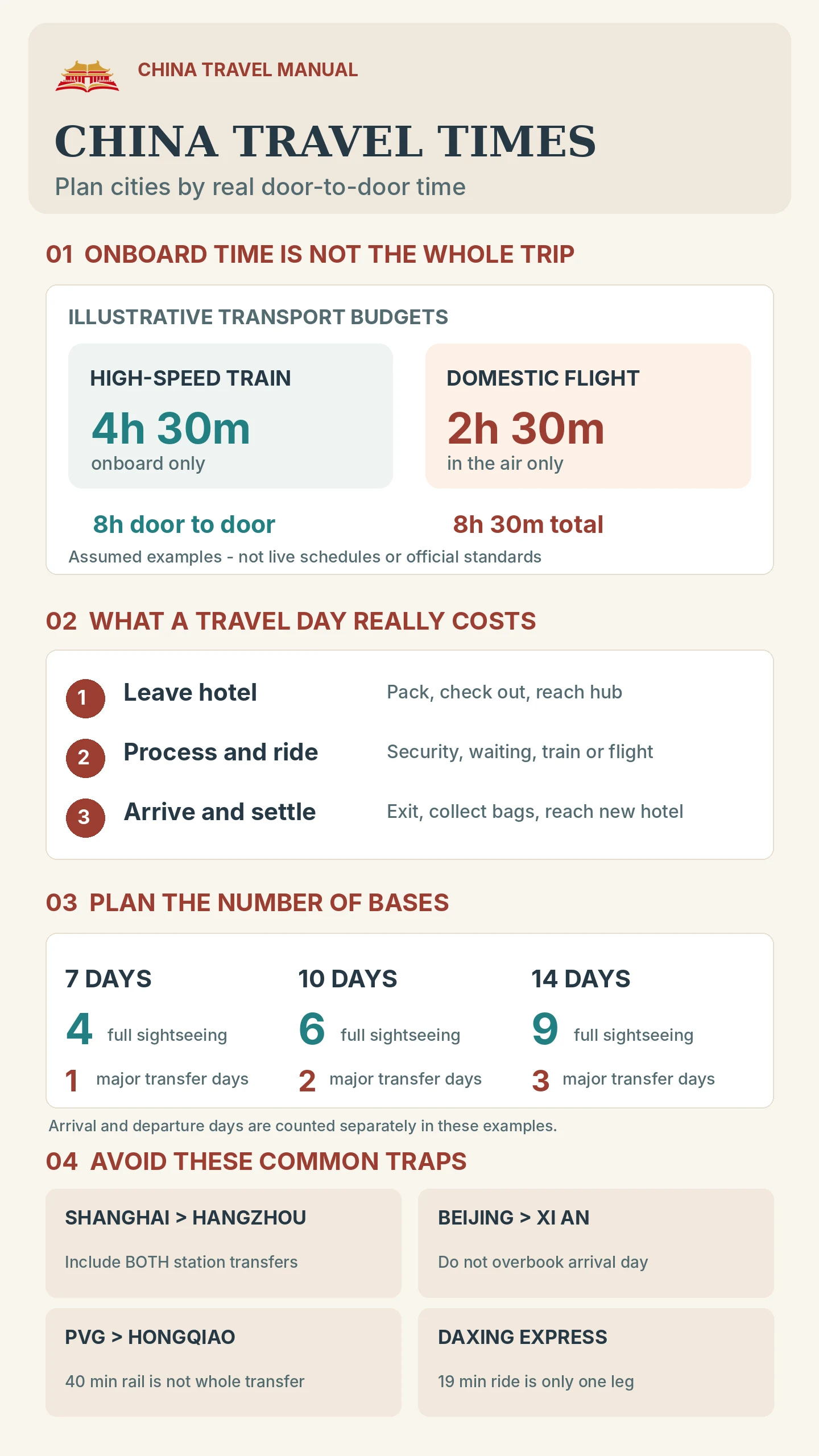
China has fast intercity trains and a large domestic flight network, yet the time displayed on a booking screen is only part of the journey. This guide helps first-time independent travelers decide how many places actually fit, how to budget transfer days, and when a supposedly short trip deserves an overnight stay. It covers mainland China; journeys involving Hong Kong or Macau have separate border and transport considerations.
Count Calendar Days, Nights and Sightseeing Days Correctly
When deciding where to go, begin with the time you can use rather than a list of cities. Four different measures prevent a deceptively crowded itinerary.
| Time measure | What it actually counts | Planning use |
|---|---|---|
| Calendar days | Every date from arrival through departure, including travel dates | Your overall trip length |
| Hotel nights | Nights for which accommodation is needed | Where you must move luggage and change bases |
| Full sightseeing days | Dates without a substantial intercity move or major arrival/departure procedure | Days for fixed-time attractions and major activities |
| Transport days | Dates on which moving between places takes a meaningful part of the day | Days for light, flexible plans |
Calendar Days vs. Hotel Nights
A straightforward ten-day trip arriving on day one and flying home on day ten usually contains nine hotel nights. An overnight train, unusually late check-in, or onward international connection can change that calculation. Nights tell you how often you must pack and move; they do not tell you how much usable daylight remains.
Full Sightseeing Days vs. Transfer Days
Suppose a ten-day plan includes an arrival day, a departure day, and two substantial intercity moves. That leaves six full sightseeing days under this conservative accounting method. It does not mean the other four dates are worthless: you may enjoy dinner, a short walk, or a museum near your hotel when the schedule permits. The point is to protect your main attractions from transport delays and check-in surprises.
Why Arrival and Departure Times Matter
An early arrival can leave several free hours after entry formalities; a late arrival may leave only enough time for dinner. Likewise, a flight departing in the morning makes the final date a transfer obligation, not a sightseeing day. Use actual flight times before allocating attractions to the first and last dates. For broader arrival planning, see Your First Day in China
Calculate Door-to-Door Travel Time
The most useful China travel-time calculation is the journey from your current accommodation to your next settled base. Add packing and check-out, travel to the departure station or airport, processing and waiting, onboard time, arrival procedures, onward travel, and hotel check-in. Add any separate-ticket connection or transfer wait not already counted. Avoid double counting time that occurs within another segment.
| Segment | Beijing hotel to Shanghai hotel, illustrative train trip | Illustrative domestic flight |
|---|---|---|
| Pack and check out | 45 minutes | 45 minutes |
| Hotel to departure hub | 35 minutes | 60 minutes |
| Security, verification and waiting | 40 minutes | 120 minutes |
| Onboard train or flight | 4 hours 30 minutes | 2 hours 30 minutes |
| Exit, deplane or baggage collection | 20 minutes | 45 minutes |
| Arrival hub to next hotel | 40 minutes | 60 minutes |
| Check in and settle | 30 minutes | 30 minutes |
| Total door to door | 8 hours | 8 hours 30 minutes |
Every number in this table is an assumed planning input, not a live timetable, an official journey benchmark, or a universal security allowance. The flight is not a comparison of the same Beijing–Shanghai service; it is a separate generic calculation. Replace each line with your actual hotel locations, ticket times, baggage needs, and transfer plans.
China Railway advises passengers to allow for walking within stations, security screening, identity verification, queues and gate closure before departure. The exact cutoff depends on station notices. Its guidance does not establish one guaranteed arrival buffer for every station.[1]
For flights, China’s civil aviation authority similarly explains that check-in deadlines vary by airport and terminal. The two hours in our illustrative flight table are a budgeting assumption, not a nationally mandated rule.[2]
To calculate your own transfer, record departure-hotel time, boarding time, arrival time, and the estimated next-hotel arrival in a single timeline. If a connection is uncertain, work out a slower plausible version as well. For transport options, use Getting Around China
How Many Cities Can You Realistically Visit?
More destinations create more checkouts, luggage moves, booking decisions and chances for disruption. The number of hotel bases is often more useful than the number of named cities because you can visit nearby places without moving hotels.
| Calendar days | Suggested main accommodation bases | Typical major intercity moves | Useful starting approach |
|---|---|---|---|
| 5–6 | 1–2 | 0–1 | One region or two nearby places |
| 7 | 1–2 | 0–1 | Preserve several full sightseeing days |
| 10 | 2–3 | 1–2 | A classic two- or three-base route |
| 14 | 3–4 | 2–3 | Add one region or special-interest stop |
| 21 | 4–5 | 3–4 | Link a few regions without changing hotels daily |
| 28 | 5–7 | 4–6 | Allow remote stops and slower travel |
These are editorial planning ranges for a typical first trip, not maximum limits or official recommendations. A family with small children, visitors who need accessible transfers, and travelers heading into mountain areas may reasonably use fewer bases. Two adjacent cities with quick station access can be easier than two cities linked by a distant airport.
Start by identifying the places you would regret missing, then test every intercity leg. For selecting a route rather than checking its feasibility, visit China Itineraries
Train or Flight: Compare the Entire Journey
Compare complete door-to-door rail and air options. Airports may be farther from your hotel than stations—or the opposite.
When High-Speed Rail Is More Practical
Rail can be particularly attractive when a direct service links well-situated stations, the boarding process is relatively predictable, and you avoid journeys to distant airports. But a faster train from a remote station is not automatically the better choice. Compare the exact departure and arrival stations, not just the city names, and include the last-mile journey.
When Flying Makes More Sense
For long-distance moves across regions, a nonstop flight may replace a very long train ride or several rail connections. Check whether the flight leaves from the airport you expect, whether baggage collection is necessary, and how far the destination airport is from your accommodation. A short flight at an inconvenient time can still consume most of a day.
Avoid Comparing Only Onboard Time
Put two alternatives on the same worksheet: the time you leave the original hotel, the time you can actually enter the next hotel, transfers, and a backup if one leg fails. A 6 a.m. train could cost a comfortable morning even if its onboard duration looks ideal. The dedicated Train vs Flight in China guide covers the transport trade-offs in more detail.
Check Which Station or Airport You Actually Need
Large cities have several transport hubs, and their locations can disrupt an otherwise workable itinerary.
Multiple Stations in the Same City
Shanghai’s official English-language station guide distinguishes Shanghai Railway Station, Shanghai South, Shanghai Hongqiao and Shanghai Songjiang, each in a different district with its own metro connections.[3] Write down the full English and Chinese station names for both ends of every rail leg. If you need help understanding the station network, see China Railway Stations and Train Travel in China
Cities With More Than One Major Airport
Beijing Capital (PEK) and Beijing Daxing (PKX) are not interchangeable. Shanghai Pudong (PVG) and Shanghai Hongqiao (SHA) are similarly separate airports. For example, Beijing’s official guide describes a 19-minute run on the Daxing Airport Express between Caoqiao and Daxing Airport. That is the rail segment, not an estimate from an arriving aircraft to a downtown hotel.[4] Check terminal, airport code, onward service and walking time. See China Airports Guide
Remote Stations and the Last Mile
At an unfamiliar city, look up the final destination—not only the terminus. A railway station that includes the city name may still require a long metro ride or taxi journey to the historic center, resort or scenic area. Save the exact Chinese address for your hotel and check whether a late arrival leaves a realistic onward connection. The Airport and Station Transfers in China guide covers that handoff.
Build a Route That Avoids Unnecessary Backtracking
First fix your international arrival city, your departure city, and two or three top-priority places. Then arrange the stops so that each move carries you toward the next destination instead of returning through the same hub unnecessarily. This does not mean the mathematically shortest route is always best: seat availability, opening dates, interests and direct connections matter too.
Sketch them on a map, then look for a natural regional sequence. If you arrive in one major city and depart from another, an open-jaw international itinerary may eliminate a return journey to your starting city. Check the actual international flight prices and ticket conditions before assuming it saves money.
When a fourth city pushes the trip beyond your time budget, remove the stop that creates the largest detour or the least usable sightseeing time. Sometimes the better adjustment is changing a hotel night to a day trip, or substituting a direct flight for a complicated rail connection. Evaluate the new route using the same door-to-door method; do not improve the timetable on paper by silently shrinking boarding or transfer buffers. For contingency-friendly planning, see Building a Flexible China Itinerary
Day Trip, Overnight Stop or Longer Stay?
Close cities can be visited without packing again, but travel time still accumulates on both the outward and return journeys. A day trip works when the sights are concentrated, transport operates at useful times, and the hours left on location justify the journey.
| Decision factor | Day trip may work better | An overnight stop may work better |
|---|---|---|
| Total round-trip travel | Short and reliable | Consumes much of the day |
| Where you want to go | One area or a small group of sites | Several distant neighborhoods or attractions |
| Luggage | Can remain in the original hotel | You plan to continue onward afterward |
| Pace | One focused visit is enough | You want slow exploration |
| Evening plans | No essential night activity | Night markets, performances or evening views matter |
Shanghai to Hangzhou is a useful example. Shanghai municipal travel information cites an approximate 45–60-minute high-speed rail journey, depending on service.[5] But if your hotel-to-attraction travel takes an illustrative 2 hours 40 minutes each way, the round trip consumes 5 hours 20 minutes before sightseeing. For several sites across Hangzhou, a night there may be more comfortable. Compare both full plans rather than labeling every nearby city a free extra stop.
Four Travel-Time Mistakes That Disrupt China Itineraries
1. Treating Shanghai to Hangzhou as a 45-Minute Outing
The hidden cost is two station journeys plus local transport inside Hangzhou. An attraction near Hangzhou East is a different proposition from one that requires another long cross-city transfer. For a day trip, look at the time you must leave your Shanghai hotel, the time the last convenient return service departs and the actual hours left at the attraction. Otherwise, spend a night or choose a closer day-trip target.
2. Packing a Full Xi’an Sightseeing Day After Traveling From Beijing
A direct train does not erase the trip from your Beijing accommodation to the station, the ride itself, and the transfer from Xi’an North to your next hotel. Treat the arrival as a substantial transport day unless the booked service and location calculations clearly support more. A flexible evening walk or meal is safer than stacking timed attractions after a long journey.
3. Landing at Shanghai Pudong and Immediately Rushing to Hangzhou
A traveler entering China at Pudong must clear entry procedures, collect luggage if required, and reach a suitable railway station before taking the next train. Shanghai’s Airport Link Line connects Pudong and Hongqiao airports in about 40 minutes of rail running time, according to the city government.[6] That 40-minute figure does not include immigration, baggage, waiting, platform access, walking to the rail station or security there. An independently booked tight train connection can fail even when the flight lands on time. Allow a substantial buffer or stay in Shanghai first.
4. Mistaking Daxing Airport Express Time for Hotel Arrival Time
The advertised 19-minute Caoqiao–Daxing Airport ride covers one rail segment. A traveler arriving on a flight must still leave the aircraft, complete relevant arrival steps, find the train, wait, change to another service from Caoqiao and reach the hotel. Check the entire sequence before putting an attraction on the same evening.[4]
Sample Time Budgets for 7, 10 and 14 Days
Use these models to count days, not to select attractions. Each assumes arrival on day one, departure on the last day, and one separate calendar date for each major intercity relocation. A lighter rail move can leave room for sightseeing and change the count.
| Calendar trip | Example hotel-night allocation | Full sightseeing days | Major transport days | Arrival / departure days |
|---|---|---|---|---|
| 7 days / 6 nights | Beijing 3, Shanghai 3 | 4 | 1 | 2 |
| 10 days / 9 nights | Beijing 3, Xi’an 2, Shanghai 4 | 6 | 2 | 2 |
| 14 days / 13 nights | Beijing 4, Xi’an 3, Chengdu 3, Shanghai 3 | 9 | 3 | 2 |
These are arithmetic examples, not preferred routes or verified booked itineraries. On the other hand, a transfer involving a remote airport, several changes or an overnight journey may demand extra recovery time.
One full day at a destination after two lengthy transfers may not justify the move. For actual day-by-day trip ideas, see 7 Days in China, 10 Days in China, or 14 Days in China
Build Buffer Time for Connections and Peak Seasons
Leave room for queues, delays, and unfamiliar station layouts, especially when you have large bags, limited mobility, or children traveling with you. Your airline’s check-in closing time and the railway station’s gate closing notice are hard operational constraints; a suggested buffer in a travel article is not a substitute.[1][2]
China Railway’s published ticket presale period was 15 days including the travel date at the October 31, 2026 review date; schedules and seat availability should be checked for your intended day, and the operator may announce changes.[7] During busy holidays, build a more conservative plan: official figures show 25.204 million rail passenger trips nationwide on October 1, 2026.[8]
Do not assume the other operator will protect your onward journey. Save a realistic alternative and keep the final approach to an international departure especially simple.
Final Checklist Before Booking Your Multi-City Trip
- Record the first and last calendar dates, flight arrival and departure hours, and nights needed.
- Mark full sightseeing dates separately from major intercity transfer dates.
- Verify both ends of every journey: exact railway station or airport, terminal if applicable, and accommodation location.
- Compare door-to-door train and flight choices, including queues, baggage, hotel changes and separate-ticket risk.
- Check live schedules, booking windows, gate or check-in cutoffs, and a backup for critical connections.
Review this list before paying. How to Book Train Tickets in China explains the booking process itself.
FAQs About Travel Times in China
How many cities should I visit in 10 days in China?
For a first independent trip, two or three main accommodation bases and no more than about two substantial intercity moves are a useful starting point. Adjust for travel distances, arrival hours, accessibility needs and how much time you want in each place. There is no official city-count limit.
Does a four-hour train ride take only four hours of my trip?
No. Four hours describes the onboard portion. Include the journey to the departure station, time for security and boarding, exit at the destination, local transport and hotel check-in before deciding what you can do that day.
Is flying always faster than taking a high-speed train in China?
No. A shorter flight may need longer airport transfers and more time for check-in, security and baggage. Compare complete hotel-to-hotel plans on your actual date, including the precise airports and stations.
Can I visit Hangzhou from Shanghai in one day?
Yes, it can be practical with well-timed trains and a focused sightseeing target. Calculate the round trip from your Shanghai hotel to the place you actually want to visit. If local transfers or multiple attractions consume most of the day, consider staying overnight.
How much time should I leave between trains, flights and other connections?
There is no one universally safe number. Check the specific train gate cutoff, airline check-in deadline, terminal or station location, and whether separate tickets offer any missed-connection protection. Add more margin for busy periods, baggage and unfamiliar transfers.
Sources
[1] China Railway 12306. Station Entry and Exit Guidance
[2] Civil Aviation Administration of China. Air Travel Check-in and Documentation Guidance
[3] Shanghai Municipal Government. Guide to Railway Stations in Shanghai
[4] Beijing Municipal Government. Daxing Airport
[5] Shanghai Municipal Government. Discover Zhejiang: A Journey to China’s Poetic Heart
[6] Shanghai Municipal Government. How to Take Airport Link Line
[7] China Railway 12306. Railway Ticket Presale Rules
[8] State Council of China / Xinhua. China’s Railway Passenger Trips Hit Record Single-Day High





