

Quick Answer: Which Great Wall Section Should You Visit?
For most first-time visitors, Mutianyu is the best-balanced Great Wall section near Beijing. It combines mountain views, restored ramparts, lift choices and flexible walking routes.
- Best all-round first visit: Choose Mutianyu for scenery, facilities and flexible walking.
- Best for independent public transport: Choose Badaling for high-speed rail, bus and suburban-rail options.
- Best for serious hiking and photography: Choose Jinshanling and allow a full day.
- Best for an evening or overnight trip: Choose Simatai with Gubei Water Town.
- Best alternative scenery: Choose Huanghuacheng for lake views or Juyongguan for a compact fortified pass.
There is no best section for everyone. Choose one per day, and do not combine the Great Wall with the Forbidden City.
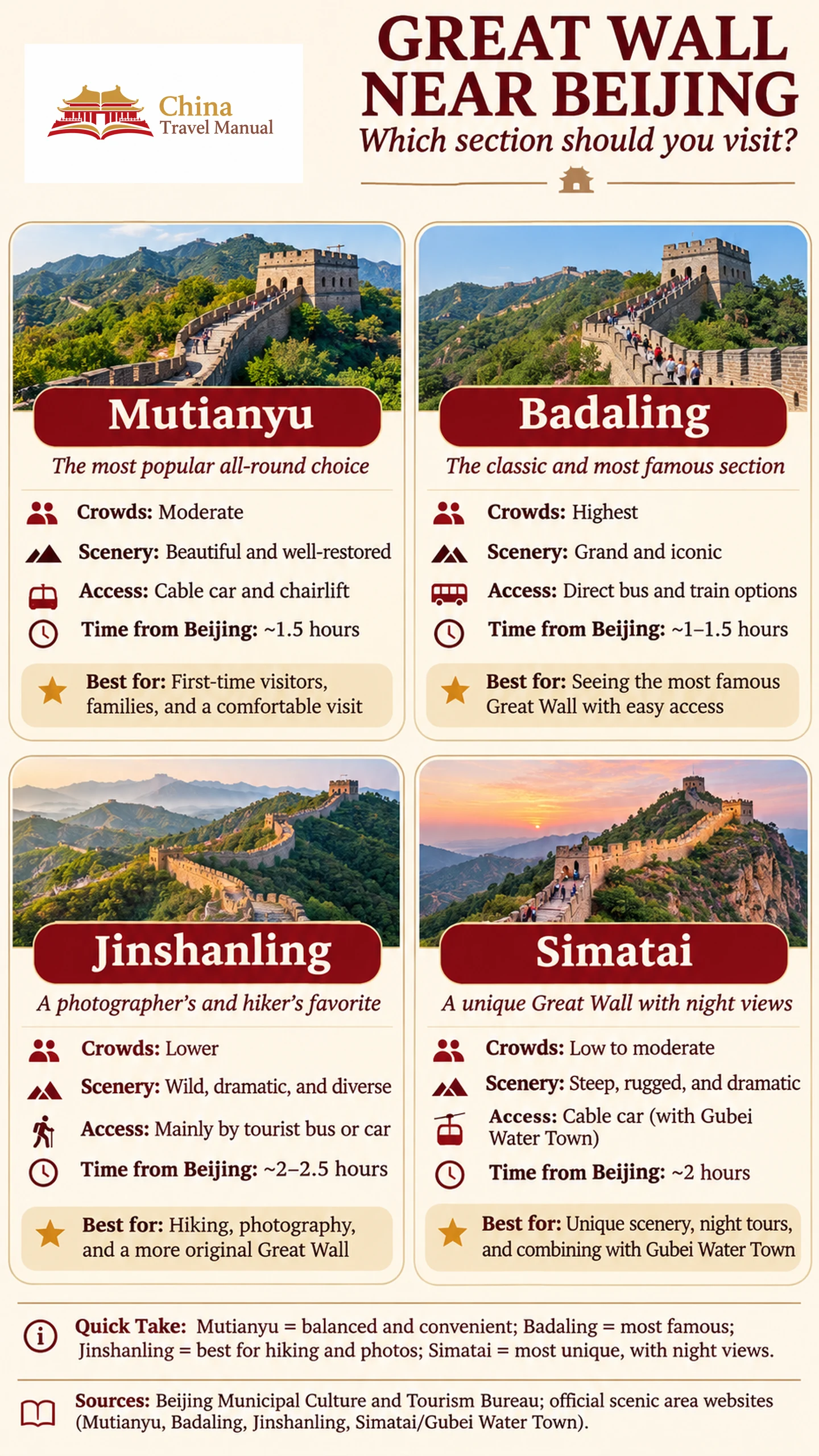
The Great Wall is not one continuous visitor attraction. It is a vast defensive system built and rebuilt over many centuries, extending for more than 20,000 kilometers. The sections most travelers visit from Beijing are managed scenic areas on the Ming Great Wall, each with different transport, terrain and access rules.[1] This guide helps you choose the right section; the linked section guides handle detailed tickets and walking routes.
Compare the Main Great Wall Sections Near Beijing
The right choice depends less on fame and more on the job you need it to do. Mutianyu is the strongest default, Badaling is easiest without a driver, Jinshanling is the hiking choice, and Simatai works best as an evening or overnight trip.
| Section | Best for | Walking level | Most practical transport | Time to allow | Main trade-off |
|---|---|---|---|---|---|
| Mutianyu | First visits, families and flexible sightseeing | Light to moderate with lifts; harder on longer walks | Tourist bus, bus transfer or booked car | Most of a day; a tightly planned half-day is possible | Road traffic and lift queues at busy times |
| Badaling | Independent travelers prioritizing rail and public transport | Moderate; steep steps on both main branches | High-speed rail, Bus 877 or the current S2 service | Half to full day | Highest crowd pressure on holidays and popular weekends |
| Jinshanling | Hiking, ridge views and photography | Moderate to strenuous | Booked car, organized day trip or limited seasonal service | Full day; overnight for sunrise or sunset | Long transfer and weak public-transport backup |
| Simatai | Night views and an overnight Gubei Water Town stay | Moderate; night access is limited to designated areas | Direct coach or booked car | Full day plus evening, ideally overnight | Longest return and several separate ticket products |
| Huanghuacheng | Lake scenery and a quieter second visit | Light to moderate | Booked car or multi-stage public transport | Half to full day | Less convenient transport |
| Juyongguan | Fortified-pass architecture and a shorter outing | Moderate, with steep local stairways | Road transport | Half day | Less of the long mountain-ridge view |
Mutianyu: The Best All-Round First Visit
Mutianyu Great Wall is the safest recommendation for a first visit because it gives travelers several ways to control the effort. You can use a cable car or chairlift to avoid the full climb from the valley, walk between a few nearby towers, and descend by cable car, chairlift or—when operating and suitable for the rider—the toboggan.
Those facilities are not one interchangeable system. They serve different parts of the scenic area, and a ticket for one does not automatically cover the others. The wall also becomes steeper as you move away from the main lift exits. A lift-assisted visit can be relatively light, but a longer tower-to-tower walk is still a mountain hike.
Mutianyu operates real-name ticketing that accepts passports, and its official schedule separates peak and off-season hours.[2] Do not interpret its reputation for being calmer than Badaling as a promise of empty ramparts. Summer weekends and national holidays can produce long shuttle, ticket and lift queues. For a detailed two-way comparison, use the Mutianyu versus Badaling guide.
Badaling: The Easiest Section to Reach Independently
Badaling Great Wall is the practical choice when transport simplicity matters more than avoiding crowds. It has high-speed rail service from Beijing North and Qinghe stations, the direct 877 bus from Deshengmen, and a separate S2 suburban-rail service whose departure station and timetable must be checked for the actual travel date.
These are three different systems. A high-speed rail ticket does not work on S2, and “Badaling Station” and “Badaling Great Wall Railway Station” should not be treated as the same arrival point. High-speed rail is fast once aboard, but the real trip also includes reaching Beijing North Railway Station or Qinghe Railway Station, station security, waiting, and walking from the arrival station to the scenic entrance.
Badaling has mature passport ticketing, foreign-card payment and bilingual visitor services.[3] Its popularity is the trade-off. The busiest periods can feel very crowded, especially around the main north route and lift access. Starting early or choosing a non-holiday weekday helps, but it cannot guarantee a quiet visit.
Jinshanling: The Strongest Choice for Hiking and Photography
Jinshanling Great Wall is the best fit for travelers who want the wall itself to be the day’s main physical activity. It lies in Luanping County, Chengde, Hebei Province, beyond Beijing’s municipal boundary. Its dense watchtowers and long mountain ridges create the classic layered views sought by hikers and photographers.[7]
The cost of those views is logistics. Public transport is limited and can change seasonally, so most international visitors use a booked car or an organized day trip with a clearly confirmed return. Allow a full day from central Beijing. Sunrise and sunset photography usually require a nearby overnight stay rather than an unsafe rush back to the city.
Do not rely on old descriptions of a continuous Jinshanling-to-Simatai crossing. Managed access boundaries have changed, and any route must stay within the currently open scenic area. The separate Great Wall hiking guide covers route intensity and equipment in more detail.
Simatai: Night Views and an Overnight Gubei Water Town Trip
Simatai Great Wall is best treated as a different trip category, not simply another daytime alternative. Its established night product is closely connected with Gubei Water Town, making an overnight stay much more practical than a late return to central Beijing.
Day admission, night admission, Gubei Water Town entry and cable-car use may be separate products. The night route covers only a designated illuminated part of the wall; it is not permission to walk the entire Simatai ridge after dark. Current official information lists separate checking periods for daytime Simatai, the resort and the night wall product.[4]
Simatai is not necessarily the only night option in a given year. Mutianyu also operated a seasonal summer night program in 2026, with its own dates, designated towers and weather rules.[8] Check the current year rather than relying on the phrase “the only night Great Wall.” Simatai remains the stronger choice when the night visit is part of a planned Gubei Water Town stay.
Huanghuacheng, Juyongguan and Jiankou
Huanghuacheng Lakeside Great Wall combines restored wall, reservoir scenery and leisure paths. It suits a second Beijing visit or travelers who value the wall-and-water landscape more than maximum watchtower hiking. It is an officially managed scenic area, but its public-transport connections are less convenient than Badaling’s or Mutianyu’s.[5]
Juyongguan Great Wall is a fortified pass in a narrow valley. Choose it for gates, defensive architecture and a compact half-day outing—not for the longest ridge panorama. Its stairways can still be steep, so “shorter” does not mean step-free.
Jiankou Great Wall is not a normal alternative on this list. Much of it is unrestored and not open as a managed visitor route. Beijing’s Great Wall protection rules that took effect on March 1, 2026 strengthened monitoring and deterrence of unauthorized climbing on unrestored or closed sections.[6] Do not cross fences, follow hidden-entry directions or assume that a route shared online is legal or safe.
How Much Time Do You Need for the Great Wall?
For a first visit, reserve one full sightseeing day. A half-day is possible only for Mutianyu or Badaling when you leave central Beijing early, use a pre-planned transfer, take a lift or a short route, and accept that delays will reduce your time on the wall.
| Time available | Realistic plan | What to leave out |
|---|---|---|
| Half day | Short Mutianyu or Badaling visit with early departure | A second wall section, the Forbidden City and long ridge walks |
| Full day | One section explored at a comfortable pace | Another major Beijing attraction |
| One day plus one night | Simatai with Gubei Water Town, or Jinshanling for sunrise/sunset | A same-day airport or long-distance rail connection |
| Two days | Two contrasting sections on separate days | A rushed same-day transfer between sections |
Door-to-door time begins at your hotel, not when the train or bus leaves. Include the trip to the station or pickup point, security, waiting, the ride, the scenic shuttle, ticket checks and the walk to the ramparts. Jinshanling and Simatai normally consume a full day even when the road itself looks manageable on a map.
The Great Wall and Forbidden City are a poor same-day combination. Both involve reservations, security, long walks and inflexible entry arrangements. If Beijing time is limited, use a focused three-day Beijing itinerary or a more comfortable five-day Beijing itinerary instead of compressing both landmarks into one day.
Choose by Hiking Difficulty and Mobility
Every open section includes slopes, irregular masonry or stairs. Cable cars reduce the climb from the valley; they do not remove the steps on top of the wall. Choose the route according to the least mobile person in the group, not the strongest hiker.
- Light sightseeing: Use a round-trip lift and walk only between nearby towers. Mutianyu offers the most flexible version of this plan. Huanghuacheng and a short Juyongguan visit may also work, depending on the exact open path.
- Moderate walking: Use a lift one way or both ways, then spend roughly 1.5–3 hours on the ramparts. Mutianyu and Badaling fit this category, while daytime Simatai requires more care on steeper terrain.
- Hiking-focused day: Choose Jinshanling for sustained ascents, descents and irregular steps. It is unsuitable for travelers with unstable knees, limited balance or very young children who cannot manage long mountain walks.
Do not treat the toboggan as accessible transport. It has operating, weather, age and height restrictions, and riders must control their own sled. Rain, ice or strong wind can close it. A cable car can also stop because of weather or maintenance.
Wheelchair users should not expect a step-free Great Wall experience. Some scenic areas provide more accessible visitor facilities or limited viewing access, but ordinary ramparts quickly introduce stairs and narrow surfaces. Confirm the exact accessible route with the scenic area before booking, including the correct entrance and lift. For older travelers, a short lift-assisted Mutianyu route is usually more realistic than Jinshanling, but individual walking ability still controls the decision.
Getting to the Great Wall from Beijing
No Beijing metro line reaches a Great Wall admission gate. The metro can take you to a railway station or bus pickup point, but every Great Wall visit requires another train, bus, coach or road transfer. Use the broader Beijing transportation guide to prepare payment, maps and Chinese addresses.
| Section | Best transport for most visitors | Door-to-door planning effect | Main failure risk |
|---|---|---|---|
| Badaling | High-speed rail, Bus 877 or current S2 service | Add city transfer, station security, waiting and the walk or shuttle after arrival | Confusing high-speed rail with S2 or choosing the wrong station |
| Mutianyu | Official/regular tourist coach, bus connection or booked car | Road congestion and the internal shuttle can add substantial time | Missing the return coach or accepting an unlicensed soliciting driver |
| Jinshanling | Booked car or reputable day trip | The round trip occupies most of the day | Weak backup transport if the arranged return fails |
| Simatai | Gubei Water Town coach or booked car | A night visit means a late return or overnight stay | Booking the wrong ticket combination or missing the last coach |
| Huanghuacheng | Booked car or multi-stage public transport | Transfers and waiting make timing less predictable | Planning a tight return connection |
For Badaling, high-speed trains generally use Beijing North and Qinghe. The S2 suburban service is separate and its city-side departure arrangements have changed over time, so verify the current timetable rather than copying an old blog route. Bus 877 departs from the Deshengmen area when operating. Buy rail tickets through the official 12306 system and use the exact station name shown on the ticket.
For Mutianyu, a direct tourist coach or booked transfer is usually the simplest option for an international visitor. A public-bus connection is possible, but the transfer and final local bus make it slower and more vulnerable to missed services. Confirm the return departure point before entering the scenic area.
A private driver supplies a vehicle, not automatically an English-speaking guide. Ask separately whether the quote includes tolls, parking, the driver’s waiting time, scenic shuttles, admission or lift tickets. At airports, railway stations and attraction exits, avoid unmarked drivers who approach passengers and quote an informal price.
Best Time to Visit and How to Avoid the Worst Crowds
Late spring and autumn usually offer the best balance of comfortable walking and clear mountain scenery. The right month still depends on whether you prioritize green ridges, fall color, cold-weather solitude or the lowest chance of weather disruption.
| Season | Main advantages | Main limitations |
|---|---|---|
| Spring, March–May | Comfortable hiking temperatures and fresh vegetation | Wind, dust and sudden temperature changes can reduce visibility |
| Summer, June–August | Lush green mountains and long daylight | Heat, intense sun, thunderstorms and school-holiday crowds |
| Autumn, September–October | Comfortable walking and strong ridge views; possible fall color | National Day crowds and highly variable leaf timing |
| Winter, November–February | Fewer visitors and stark mountain scenery | Strong wind, short daylight, ice and possible lift or path closures |
Avoid May Day, the National Day holiday around October 1–7, and peak summer weekends when possible. If those dates are unavoidable, stay near the pickup point, use the earliest practical departure and book the limited transport first. Early arrival reduces—not eliminates—queues.
Do not plan a trip around a guaranteed red-leaf week, snowfall or “sea of clouds.” Foliage changes with temperature and rainfall, while snow and cloud conditions cannot be promised. In strong wind, lightning, heavy rain or ice, lifts, toboggans, night programs and exposed routes may close at short notice. Check the official scenic-area notice the evening before departure and again in the morning.
Suggested Great Wall Day Plans
These plans show the sequence and pressure points rather than exact departure times. Operating hours and transport schedules change, so rebuild the timetable for the actual date.
An Easy First Visit to Mutianyu
Leave your central Beijing hotel early and use a confirmed tourist coach or booked car. After reaching the visitor area, allow time for ticket checks and the internal shuttle. Take the cable car or chairlift up, walk a short section between nearby towers, and return by the lift system you deliberately selected.
The toboggan is optional, not the purpose of the trip. Skip it when the queue is long, the weather is poor, or any rider is uncomfortable controlling the sled. The first items to cut are the farthest towers, the village stop and optional entertainment—not the return-transport buffer.
An Independent Rail Trip to Badaling
Travel from your hotel to Beijing North or Qinghe Railway Station, pass security and take a booked high-speed train to Badaling Great Wall Railway Station. After arrival, follow the signs toward the visitor facilities and choose either the north or south wall route rather than trying to complete both under time pressure.
Book the return train before leaving Beijing. Check-in may close before departure, and finding the platform in a large or underground station takes time. If using S2 instead, rebuild the entire plan around the current S2 departure station and schedule; do not mix S2 instructions with high-speed rail instructions.
A Full Hiking Day at Jinshanling
Depart early with a booked return vehicle or a day trip that states the exact entrance, walking time and pickup point. Enter through an official gate and choose a route inside the open scenic area that matches the group’s pace. Turn back early enough to descend before the gate, lift or arranged vehicle closes.
Carry water, sun protection and a light layer, but keep the pack small. If rain, ice or strong wind makes the masonry slippery, shorten the walk. For sunrise or sunset photography, stay nearby and arrange legal admission and transport; do not remain on a closed wall after hours.
Simatai and Gubei Water Town Overnight
Arrive at Gubei Water Town in the afternoon, check in and confirm the exact night-wall admission time. Visit only the designated illuminated Simatai section, then return to the resort for the night. The next morning can hold a relaxed resort visit or a separate daytime wall ticket before returning to Beijing.
Gubei Water Town is a developed resort, not an untouched historic village. Choose this plan for the combined evening atmosphere and easier late-night logistics. Do not schedule the return on the same day as an international flight or a tightly timed long-distance train.
Tickets, Cable Cars and Booking Priorities
A Great Wall “ticket” may cover only admission. Budget separately for the trip from Beijing, the scenic shuttle, cable car or chairlift, toboggan, guide, and any combined resort or night product.
Use this booking order:
- Confirm that the selected section and route are open for the date.
- Secure limited return transport, especially holiday rail tickets, coaches or a booked car.
- Buy or reserve scenic admission through the official channel when required.
- Reserve any night product or resort package.
- Decide on lift tickets after confirming which lift serves the intended walking route.
Carry the original passport used for booking. Some sites allow on-site purchase, but that does not guarantee the fastest entry on a busy day. Passport channels, ticket windows and real-name procedures differ by section and can change.
Before paying, check whether a package includes the entrance ticket, internal shuttle, one-way or round-trip lift, toboggan, guide and return transport. “Cable car included” is not enough if the itinerary uses a different chairlift. Also check the refund rule for wind, lightning, heavy rain or maintenance closures; admission may remain valid even when an optional lift stops.
Safety, Weather and the Wild Great Wall Boundary
Wear shoes with reliable grip. Great Wall bricks can be polished, broken, dusty, wet or icy, and steep descents place more strain on the knees than the climb. Carry drinking water, sun protection and a wind layer. In winter, treat any shaded stairway as potentially icy.
- Turn back for lightning, strong wind or ice. Exposed ridges are not the place to wait out a storm.
- Stay inside the managed open area. Do not climb barriers or continue past closure signs.
- Do not smoke, light fires, camp on protected masonry or carve the wall. Forest-fire and heritage-protection rules apply.
- Check drone restrictions before carrying or launching one. Scenic-area permission does not replace airspace rules.
- Do not use an offline hiking track to bypass an official entrance. A visible trail is not proof of legal public access.
The 2026 Beijing regulations specifically address illegal climbing on unrestored or non-open “Wild Great Wall” sections and support electronic monitoring and warnings.[6] Jiankou’s dramatic appearance does not override those restrictions or its fall, rock and rescue risks. This guide intentionally gives no hidden entrance or fence-crossing instructions.
FAQs About Visiting the Great Wall Near Beijing
Is Mutianyu or Badaling Better for a First Visit?
Choose Mutianyu for the best overall balance of mountain scenery, route flexibility and visitor facilities. Choose Badaling when independent rail or direct public transport is the deciding factor. Neither is guaranteed to be quiet, and both still require substantial walking.
Can You Visit the Great Wall Without a Tour?
Yes. Badaling is the easiest section to visit independently by rail or bus. Mutianyu is manageable by direct coach or a bus connection. Jinshanling, Simatai and Huanghuacheng are easier with a confirmed coach, booked car or reputable day trip because return options are limited.
Is the Great Wall Suitable for Children or Older Travelers?
A short, lift-assisted Mutianyu visit can suit many families and older travelers, but no ordinary rampart route is fully step-free. Check the least mobile traveler’s balance, knee condition and tolerance for irregular stairs, and verify the exact lift and accessible entrance before booking.
Can You Visit the Great Wall and the Forbidden City on the Same Day?
It is physically possible with a private car and very short visits, but it is not a good first-trip plan. Long transfers, security, fixed reservations and extensive walking make delays costly. Give the Great Wall one day and the Forbidden City another.
Can You Hike Jiankou Independently?
Jiankou should not be treated as a normal independent visitor attraction. Much of it is unrestored or outside managed public access, with severe fall and rescue risks. Follow current closure and protection rules and choose an officially open hiking section such as Jinshanling instead.
Sources
[1] UNESCO World Heritage Centre. The Great Wall
[2] Mutianyu Great Wall Scenic Area. Ticketing and Opening Information
[3] Beijing Municipal Government. Convenient Payment Services Offered at Badaling Great Wall
[4] Beijing Municipal Government. Beijing Wtown International Tourist Leisure Resort
[5] Beijing Municipal Government. Huanghuacheng Lakeside Great Wall
[6] Beijing Municipal Government. Beijing Implements Great Wall Protection Regulations
[7] Beijing Culture and Tourism. Jinshanling Great Wall
[8] Beijing Municipal Government. Summer Night Tour at Mutianyu Great Wall Returns





