
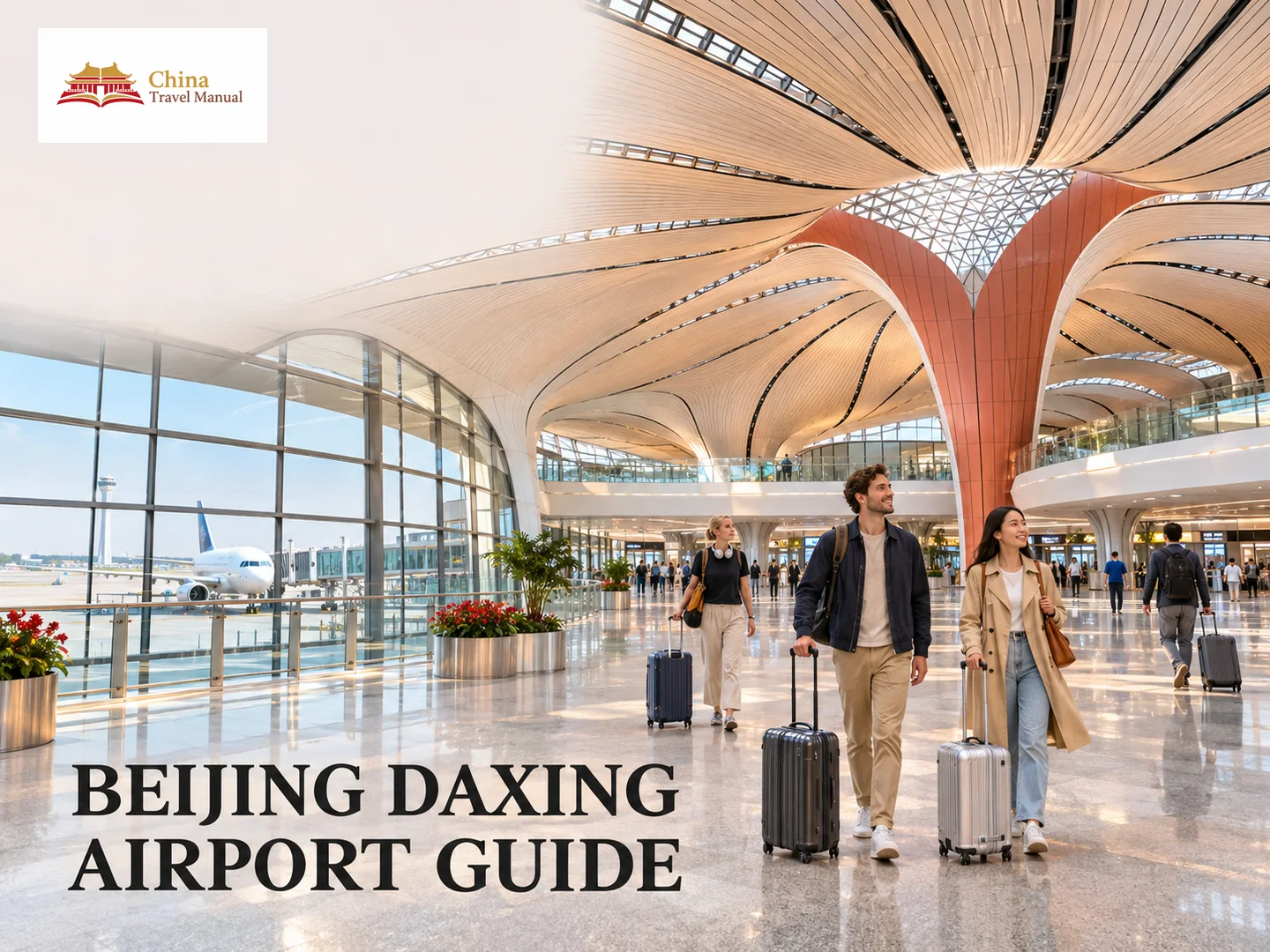
Quick Answer: Using Beijing Daxing Airport for the First Time
Beijing Daxing International Airport (北京大兴国际机场, PKX) is separate from Beijing Capital Airport (PEK). Confirm PKX on your ticket before booking a ride. Daxing uses one integrated passenger terminal, but domestic and international procedures occupy different levels and a distant gate can still require a long walk or bus ride. For a connection, first confirm whether the flights are on one protected ticket and whether your checked bag will reach the final destination.
- Confirm PKX: Never tell a driver only “Beijing Airport.”
- Check the flight area: Follow the ticket, boarding pass, and live airport screens.
- Budget the full journey: Include walking, queues, baggage, security, immigration, and ground transfers.
- Carry the original passport: Screenshots do not replace it for airline or border checks.
- Protect the connection: Separate tickets, checked bags, international formalities, and a PKX–PEK change need large buffers.
The terminal’s compact radial design reduces some distances, but “one terminal” does not make a rushed self-transfer safe. Recheck airline and PKX notices on the travel date.

Beijing Daxing International Airport (北京大兴国际机场, PKX) is a major gateway south of Beijing. Its striking single-terminal design is easier to understand than a multi-terminal airport, yet first-time travelers can still lose time by using the wrong floor, choosing the wrong railway, or treating a self-transfer as a protected connection.
This guide explains how foreign visitors should approach arrivals, departures, connections, city transport, and late-night plans. All time guidance is door to door: it includes walking, queues, document checks, baggage, security, and transfers rather than only the published train or driving time.
Understand the PKX Terminal Before You Travel
PKX vs Beijing Capital Airport (PEK)
Beijing has two major airports. Daxing uses the code PKX and the Chinese name 北京大兴国际机场. Beijing Capital uses PEK and 北京首都国际机场. They sit on different sides of the metropolitan area and use different rail links, roads, and pickup zones. A driver who sees only “Beijing Airport” may choose the wrong one.
Save the exact Chinese airport name and flight number offline. If your booking shows PEK, use the separate Beijing Capital Airport guide. Compare both gateways in the PEK vs PKX guide; for a same-day airport change, use the cross-airport transfer guide. Running to the other airport after a mistake can take several hours once baggage, traffic, and a new check-in deadline are included.
One Terminal, Multiple Levels and Concourses
PKX uses one integrated passenger terminal rather than separate buildings labeled T1, T2, or T3. That removes a normal terminal shuttle, but it does not remove navigation. Official descriptions divide the building vertically: international arrivals use Level 1, domestic arrivals use Level 2, domestic fast or self-service departure functions use Level 3, and the main check-in hall on Level 4 serves international departures and domestic checked-baggage passengers. Rail services connect below the terminal. [3]
| Area | Typical traveler task | Main planning risk |
|---|---|---|
| Level 4 | Main check-in and bag drop for many domestic and international flights | Old airline-counter lists may be wrong |
| Level 3 | Domestic fast check-in, security, and departure access | Special services may require another floor |
| Level 2 | Domestic arrivals and mixed transfer movement | Following another passenger can send you toward the wrong exit |
| Level 1 | International arrivals and inbound visitor services | Cars and buses may use designated doors or separate pickup areas |
| B1 and rail levels | Airport Express, railway connections, and some check-in services | A train platform is not the final hotel or departure gate |
Treat this table as an orientation, not a permanent counter map. Airlines can move counters, gates, and processing areas. Use the current boarding pass and screens. Travelers with wheelchairs, children, or several bags should ask for assistance early rather than assuming every shortcut or self-service route is suitable.
Arriving at Beijing Daxing Airport
International Arrivals
After an international flight, follow the bilingual Arrivals and Immigration signs. Do not follow another passenger without checking the route; some travelers may be connecting rather than entering China. A normal arrival has five stages:
- Reach immigration. A remote stand or long walk can add time before passport control.
- Complete the entry inspection. Present the original passport and any visa or transit documents required for your itinerary.
- Collect checked baggage. Confirm the carousel on the airport screen and keep the baggage-tag receipt.
- Pass customs. Use the correct channel and declare goods when required.
- Enter the public arrivals hall. Only then arrange a meeting point, communications, payment help, or onward transport.
China introduced online arrival-card submission for foreign travelers in November 2025. Daxing also provides passport-authenticated airport Wi-Fi and on-site alternatives for travelers who need to complete the form after landing. The arrival card is free, but it does not replace a visa, create transit eligibility, or serve as a customs declaration. [5]
For pickup planning, allow roughly 70–90 minutes from touchdown to the public hall and more during busy arrival banks, remote stands, detailed border checks, or delayed baggage. This is a planning range, not a guarantee. Do not book a fixed railway departure from central Beijing based only on the published landing time.
Domestic Arrivals and Meeting Your Ride
A domestic arrival normally means walking to Level 2 baggage claim, collecting checked bags, and entering the public hall. Before ordering a car, confirm your floor, exit, and pickup area. Official taxis, app-based ride-hailing, private pickup vehicles, airport buses, and rail services do not all leave from the same curb.
Do not wait in a random traffic lane or ask a driver to stop at the departures curb. Follow the airport’s live signs to the official taxi queue or designated ride-hailing point. Ignore anyone who approaches inside arrivals offering an unmetered private ride. Save the hotel name and full address in Chinese so the driver can verify the destination.
Departing from Beijing Daxing Airport
Check-In, Security and Border Formalities
For a domestic flight, the usual sequence is airport arrival, check-in or bag drop, security, and movement to the gate. For an international flight, add document checks, customs procedures where applicable, and exit immigration. Check-in desks do not share one universal closing time. A traveler who misses the airline’s bag-drop or document deadline can lose the flight even when security is still open.
| Flight setup | Conservative terminal arrival | Why the buffer matters |
|---|---|---|
| Domestic, carry-on only | About 2 hours before departure | Finding the correct level, security, and a distant gate still take time |
| Domestic with checked baggage | At least 2 hours; earlier in peaks | The bag-drop cutoff applies before boarding closes |
| International | About 3 hours before departure | Document checks, baggage, security, exit immigration, and gate movement |
| Special assistance or unusual baggage | Add 30–60 minutes | Manual handling and escort procedures take longer |
These are practical buffers, not airline rules. Recheck the operating carrier’s cutoff and arrive earlier during national holidays, severe weather, major events, or if you need a staffed counter. Some eligible travelers can check in at the Caoqiao city terminal, but airline coverage, operating hours, baggage restrictions, and deadline windows are conditional. Do not plan around it until your exact flight qualifies. [1]
Allow for Long Walks and Remote Gates
The radial terminal was designed to shorten the walk from the central hall to many gates, but an assigned gate may still involve a long corridor, a change of level, or a remote-stand bus. Passing security does not mean boarding is nearby. Check the gate immediately after security and again before entering a restaurant or shop.
- Read the boarding pass and live screens rather than relying on an old terminal map.
- Ask staff which direction and level to use if the gate letter or number is unclear.
- Be at the gate before boarding closes, not merely before the scheduled departure.
- Request mobility assistance from the operating airline before the travel date.
Connecting at Beijing Daxing Airport
Check Ticket, Baggage and Route First
PKX’s single-terminal layout removes a building-to-building transfer, but it does not create one universal connection process. Before paying for the itinerary, ask the airline four questions:
- Are both flights on one protected ticket? Separate bookings usually leave the traveler responsible for a missed onward flight.
- Will checked baggage be tagged to the final airport? Read the printed tag at origin.
- What is the route type? Domestic–domestic, domestic–international, international–domestic, and international–international use different controls.
- Does the airline offer the required transfer service? A fast path may be limited to particular airlines, routes, or through tickets.
Do not infer baggage handling from airline-alliance membership. Ask again when checking the bag. If the final airport code is absent from the tag, assume you may need to reclaim and recheck it unless the carrier gives a clear alternative procedure.
Domestic and International Connection Flows
Follow the Transfer signs and ask the operating airline before walking toward baggage claim. Airline-specific procedures at PKX show why the ticket and bag setup matter: some eligible through-ticket passengers use dedicated transfer counters, while a traveler without through baggage may have to enter China, collect the bag, return to check-in, and clear security again. [8]
| Connection | Typical controls | Baggage question | Main risk |
|---|---|---|---|
| Domestic to domestic | Transfer check and security as directed | Through-check usually simplifies the route | Distant gate or a nonparticipating ticket |
| Domestic to international | International transfer processing, security, and exit immigration | Recheck if the tag does not show the final foreign airport | Early bag-drop cutoff and border procedures |
| International to domestic | Entry immigration, customs, and domestic security unless a qualifying service changes the flow | Confirm whether baggage must be reclaimed | Entry approval, baggage time, and queues |
| International to international | Airside transfer when the route and airline qualify; otherwise follow border instructions | Through-check is critical | Assuming every traveler can remain airside |
An airport or airline minimum connection time is an operating threshold for an eligible itinerary, not a comfort recommendation. Delays, mobility needs, document questions, baggage, and gate changes can make the real journey longer. If the next flight is expensive or difficult to replace, choose a longer connection than the published minimum.
Separate Tickets and Self-Transfers
Two separately purchased tickets normally provide no protection if the first flight is late. Unless both airlines confirm a special arrangement, plan to enter China when required, collect checked luggage, reach the next counter before its cutoff, check in again, and clear the next security and border process.
| Self-transfer setup | Risk level | Practical rule |
|---|---|---|
| Domestic flights, carry-on only | High | Use a large buffer and complete the second airline’s check-in early |
| Any transfer with a checked bag | Very high | Budget baggage claim, recheck, and new security |
| International arrival followed by domestic departure | Very high | Entry approval and immigration time are additional variables |
| PKX to PEK | Extreme | Treat it as a cross-city trip, not an airport connection |
As a conservative independent-travel rule, avoid a self-transfer under four hours even in the same PKX building. Add more time for an international arrival, checked baggage, children, limited mobility, winter disruption, or a ticket that cannot be changed. This is not a guarantee. For a PKX–PEK change, a very long layover or overnight is safer.
Visa-Free Transit and Leaving the Airport
China does not have one universal “transit visa” for every connection. A traveler who remains in the restricted international transit area may qualify for the 24-hour direct-transit arrangement. Someone who needs to leave that area must obtain the appropriate temporary entry permission. Eligible nationals with a qualifying third-country itinerary may use the 240-hour visa-free transit policy and travel within its permitted area. Immigration makes the admission decision. [4]
Do not book a Beijing tour, hotel, separate domestic flight, or airport change on the assumption that entry is automatic. Nationality, passport validity, route, onward ticket, and any visa required by the next destination all matter. Consult the current National Immigration Administration policy first, then use the Beijing layover guide to decide whether leaving PKX is realistic.
Getting Between PKX, Central Beijing and Other Hubs
Airport Express, Intercity Rail and Road Transfers
No transport option is best for every arrival. The Daxing Airport Express is normally the most predictable city connection during operating hours. It runs from the airport’s B1 rail hall to Caoqiao, where travelers transfer to Beijing’s urban metro network. The advertised airport-to-Caoqiao ride is not a door-to-door hotel time. Add the walk from arrivals, ticketing, waiting, the city transfer, and the final walk or taxi. [2]
Intercity rail can be useful for Beijing West Railway Station or a longer rail journey, but its timetable and ticket process are different from the Airport Express. Airport buses may reduce transfers when a current stop is near the hotel. A metered taxi, Didi, or prebooked vehicle is easier with several suitcases, children, limited mobility, or a late arrival. The detailed PKX airport transfer guide covers current tickets, stops, and last services; the broader Beijing transportation guide explains city travel after the airport leg.
| Option | Best for | Time reliability | Main limitation |
|---|---|---|---|
| Daxing Airport Express | Solo travelers and hotels with a practical Caoqiao transfer | High during operating hours | Does not reach most hotels directly |
| Intercity railway | Beijing West or a confirmed onward rail connection | High when the timetable fits | Reserved train and station procedures differ from the metro |
| Airport bus | Travelers whose hotel is near a current stop | Medium | Road traffic and changing routes |
| Taxi or Didi | Groups, heavy bags, and door-to-door travel | Medium | Long distance, traffic, tolls, and pickup-zone navigation |
| Prebooked transfer | Late arrivals, families, and travelers needing a confirmed vehicle | High when reconfirmed | Highest price |
Beijing Railway Stations and PEK Connections
Do not book a train by adding a published rail travel time to the flight’s scheduled landing time. A rail connection begins after immigration or domestic deplaning, baggage, the walk to the station, ticket or identity checks, and the railway security queue. For Beijing South Railway Station, expect at least one city transfer rather than a direct airport train.
A transfer from PKX to PEK is a cross-city airport change. Even when an airport bus or road service is operating, the journey also includes entry permission when applicable, baggage, waiting, traffic, new check-in, security, and border formalities. Do not rely on a short same-day connection. Confirm the exact bus route on the travel date; a promotional free-bus campaign that ended on October 31, 2026, is not a permanent fare rule.
Late-Night Arrivals, Long Layovers and Airport Hotels
For a late arrival, check transport against the time you are likely to exit the public hall, not the scheduled touchdown. If the Airport Express and useful bus routes will be closed, use the official taxi queue, designated ride-hailing pickup, or a confirmed transfer. During a large late-night arrival bank, cars may take longer to reach the pickup area.
| Situation | Best decision | Why |
|---|---|---|
| Short protected connection | Stay in the transfer process | Immigration and city transport would consume the buffer |
| Overnight before an early flight | Use an airport-area hotel with a confirmed shuttle or rest at PKX | A central-Beijing round trip adds traffic and morning risk |
| Long daytime layover with entry permission | Consider one limited Beijing area | Only after protecting the return and new security buffer |
| PKX–PEK on separate tickets | Prefer a very long layover or overnight | It combines immigration, baggage, cross-city road travel, and new check-in |
PKX published expanded overnight facilities in 2026, including free and paid rest areas, charging facilities, selected 24-hour food options, and shower rooms in arrival baggage halls. Availability and eligibility can change, so verify the live airport guide. [7] If using a hotel, check its exact location, shuttle operating hours, advance-booking requirement, and the terminal door used for pickup. The Beijing accommodation guide is more useful only when the layover genuinely supports a city stay.
Practical Services and Assistance at PKX
The Beijing Service counter opposite the international arrivals exit is designed for inbound foreign visitors. Published services include communications, currency and payment help, transport tickets, BEIJING PASS support, and tourism information. It is a practical first stop for a traveler without a Chinese mobile number or local payment setup, but it cannot make an immigration decision or rebook an airline ticket. [6]
PKX also provides airport Wi-Fi, luggage assistance, lost-property services, accessible facilities, family services, medical help, and airline counters. English interpretation is available through airport support channels, while some additional languages have limited hours. Request a wheelchair or special assistance from the operating airline before travel; finding an accessible lift does not automatically create an escort booking.
Keep an offline travel folder on the phone and a paper backup in carry-on baggage. Include the passport identity page, airline record locator, boarding passes, baggage-tag receipt, onward ticket, hotel address in Chinese, insurance contact, and any transit evidence. A copy does not replace the original passport, but it can make communication faster when Wi-Fi or mobile data fails.
- Flight disruption: Contact the operating airline or handling agent for rebooking and baggage instructions.
- Lost item: Identify whether it was left on the aircraft, at security, on a train, or in the public terminal.
- Transport help: Use the official service counter, ticket machine, or marked transport desk rather than an unlicensed solicitor.
- Communication: Save PKX, 北京大兴国际机场, the flight number, and the hotel address offline.
FAQs About Beijing Daxing Airport
Is PKX the Same as Beijing Capital Airport?
No. PKX is Beijing Daxing Airport south of Beijing; PEK is Beijing Capital Airport in the northeast. They have separate rail links, roads, and processing areas. Always check the three-letter code and show the exact Chinese airport name to a driver.
Does Beijing Daxing Airport Have More Than One Terminal?
Passengers use one integrated terminal rather than separate T1, T2, and T3 buildings. However, domestic and international functions occupy different levels, and distant or remote gates can still require a long walk or bus ride. One building does not eliminate connection risk.
How Early Should You Arrive at PKX?
A useful planning baseline is about two hours before a domestic flight and three hours before an international flight. Arrive earlier for checked bags, holidays, special assistance, or an unfamiliar airline process. The airline’s check-in and bag-drop cutoff remains the hard deadline.
Do You Need a Visa for a Connection at PKX?
It depends on nationality, onward destination, ticket and baggage setup, and whether you must enter China. Some travelers remain airside; others need temporary entry permission or qualify for the 240-hour policy. Immigration decides admission at the border.
Can You Transfer Between PKX and PEK on One Layover?
Only with a very large buffer and confirmed permission to enter China. PKX–PEK is a cross-city airport change, not an internal transfer. Include immigration, baggage, waiting, traffic, new check-in, security, and possible disruption. An overnight is safer than a tight same-day connection.
Sources
[1] Beijing Daxing International Airport. Official Passenger Guide
[2] Beijing Daxing International Airport. Daxing Airport Express
[3] Beijing Municipal Commission of Major Station Areas Management. Beijing Daxing International Airport Overview
[4] National Immigration Administration. Visa-Free Transit Policies
[5] National Immigration Administration. Foreign Travelers May Submit Arrival Cards Online
[6] Beijing Municipal Government. Beijing Service Counters at Airports
[7] Beijing Municipal Government. Daxing Airport Overnight Services
[8] China Southern Airlines. Beijing Daxing Airport Transit Procedures





