

Quick Answer: How to Choose a China Itinerary
Choose your China itinerary by the full sightseeing days you actually have, the kind of trip you want, and your international arrival and departure airports—not by a list of famous attractions.
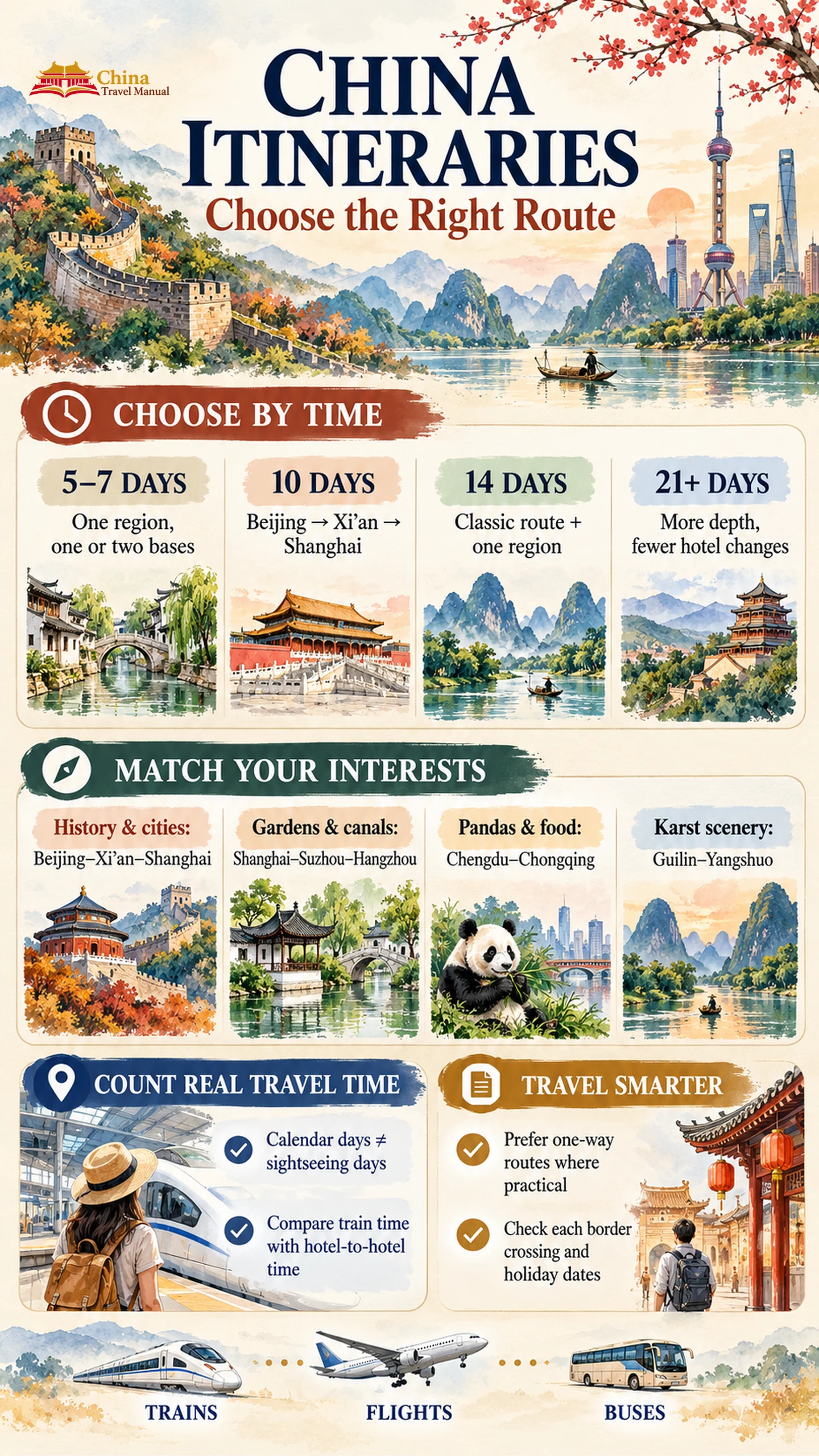
- Five to seven days: Stay within one region, usually with one or two accommodation bases. East China, Guilin–Yangshuo, or Chengdu and nearby sights work better than crossing the country.
- Ten to fourteen days: Beijing–Xi’an–Shanghai is a useful first-time route if history and cities appeal to you and you can devote substantial time to two long transfers.
- More than fourteen days: Add one distinctive region, such as Guilin or Sichuan, rather than collecting several distant additions.
- Interest-led trips: Choose Yunnan for highland towns, Guangxi for karst scenery, or Sichuan for pandas and food instead of following the classic route out of obligation.
The main mistake to avoid is treating a day spent changing cities as a full sightseeing day.
Planning a China trip starts with an uncomfortable question: how much of your vacation will you spend getting from one hotel to the next? A workable route groups compatible places, respects the scale of the country, and leaves time to enjoy each destination. This guide helps you choose a route; the seven-day China itinerary and other linked plans handle day-by-day details. For the wider preparation sequence, see how to plan a trip to China.
How Many Days Do You Need for a China Trip?
Count the calendar days you will spend in mainland China, including arrival and departure. On a straightforward trip, seven calendar days usually means six hotel nights; it does not mean seven full sightseeing days. Flight arrival times, intercity journeys, and departure logistics reduce usable time further. A train travel day can include a little exploring, but it should not carry another major excursion.
| Calendar days in China | Suggested overnight bases | Sensible route | Main trade-off |
|---|---|---|---|
| 5 | 1–2 | Shanghai with Suzhou or Hangzhou; Guilin–Yangshuo; Chengdu with a nearby excursion | Pick one compact area. |
| 7 | Usually 1–2 | Shanghai–Hangzhou with a Suzhou day trip; Guilin–Yangshuo; Chengdu–Chongqing | Protect arrival and departure time. |
| 10 | About 3 | Beijing–Xi’an–Shanghai | Two substantial intercity moves. |
| 14 | About 3–4 | Classic three-city route plus Guilin or Chengdu | One extra region increases transfer time. |
| 21 | About 4–6 | Classic route plus a longer stay in Sichuan, Guangxi, or Yunnan | More choices, but no need to change hotels constantly. |
| 28 | About 5–8 | A regional deep dive or two carefully connected regions | Longer travel should still include unplanned days. |
These are planning ranges, not limits. Three nearby places around Shanghai are different from three places separated by cross-country flights. If time is short, prioritize fewer overnight bases over a longer list of cities. Our seven-day, ten-day, fourteen-day, twenty-one-day, and twenty-eight-day guides develop the options in more detail.
Which China Route Fits Your Interests?
The best route is not necessarily the one with the most recognizable names. Start with what you want to experience, then check how expensive each transfer is in time and energy. Use the China destinations guide for a broader comparison of places rather than route logistics.
| Route family | Suggested minimum | Why choose it | Travel cost and best-fit traveler |
|---|---|---|---|
| Classic: Beijing–Xi’an–Shanghai | Around 10 days | Imperial history, the Terracotta Army, and a modern metropolis | Two long train journeys; ideal for history-and-city first-timers. |
| East China: Shanghai–Suzhou–Hangzhou | 5–7 days | Classical gardens, West Lake, canal towns, and shorter city hops | Frequent train services; strong choice for slower short breaks. |
| Sichuan and Chongqing | 7–10 days | Pandas, food, teahouses, river views, and urban culture | A convenient intercity rail link, but Chongqing’s slopes can be tiring. |
| Guilin and northern Guangxi | 5–7 days | Karst peaks, the Li River, Yangshuo countryside, and optional terraces | Rural road transfers take time; better for scenery than big-city history. |
| Yunnan: Kunming–Dali–Lijiang | 7–14 days | Old towns, lakes, mountain landscapes, and a gentler pace | Rail links make the main corridor possible; higher-altitude extensions need care. |
| Classic plus nature | Around 14 days | Beijing and Xi’an history with Guilin–Yangshuo scenery | Adds a long southwest transfer; worthwhile only if nature is a priority. |
Two practical distinctions can prevent the wrong choice. Suzhou can often be treated as a day trip from Shanghai rather than another hotel stop. Conversely, Longji Rice Terraces are a separate excursion from Yangshuo, not an effortless neighborhood visit. If you dislike transfers, stay in one base and visit nearby places; if you want a regional contrast, accept that one day may be primarily about traveling.
The Yunnan route has an especially useful update: a railway between Lijiang and Shangri-La opened in November 2023, with the fastest reported train journey around 1 hour 18 minutes. It is incorrect to assume that the extension has no railway connection, although reaching a high-altitude destination still calls for acclimatization and a realistic schedule.[4] The Kunming–Dali–Lijiang route and Shangri-La guide provide the deeper regional context.
For purpose-built combinations, explore Beijing, Xi’an and Shanghai or Shanghai, Hangzhou and Suzhou.
Sample China Routes for 7, 10, 14, and 21 Days
These are decision examples, not hour-by-hour schedules. Each trip includes the arrival and departure calendar days; overnight counts add up to one fewer night than the total days. They assume separate arrival and departure airports where helpful, but you should compare international airfares before committing.
| Trip | Overnight sequence | Main transfers | What you gain—and give up |
|---|---|---|---|
| 7 days / 6 nights | Shanghai 3 nights → Hangzhou 3 nights; Suzhou as a day trip | Short intercity train; depart via Shanghai only if the final return is comfortably buffered | Easy East China introduction; no Beijing or Xi’an. |
| 10 days / 9 nights | Beijing 4 nights → Xi’an 3 nights → Shanghai 2 nights | Train to Xi’an; train or flight to Shanghai | Classic heritage-to-modern route; two substantial travel days. |
| 14 days / 13 nights | Beijing 4 nights → Xi’an 3 nights → Guilin/Yangshuo 3 nights → Shanghai 3 nights | Train, then a long train or flight, then flight or suitable rail connection | Adds karst scenery; less time to recover between moves. |
| 21 days / 20 nights | Beijing 4 nights → Xi’an 3 nights → Chengdu 5 nights → Guilin/Yangshuo 4 nights → Shanghai 4 nights | Mix of high-speed rail and flights | Allows leisurely bases and nearby excursions; requires several cross-region transfers. |
The seven-day version deliberately stays in the lower Yangtze region. Suzhou works as a day trip from Shanghai, while Hangzhou rewards an overnight stay. If your flight leaves Shanghai, travel back with enough allowance for the airport; a final night in Shanghai is safer for an early departure.
In the ten-day version, do not treat both train days as fully available for attractions. The Xi’an–Shanghai train in particular can occupy most of the day, so compare it with a flight using your actual hotel and airport locations.[10] Travelers wanting a complete schedule can follow the 10-day China itinerary.
The fourteen-day example requires a genuine choice. Direct Xi’an–Guilin high-speed services exist, but journeys can run roughly ten hours on the train; flying may be more practical for this particular route. “No direct train” is not a sound reason to exclude rail outright.[11] Follow the 14-day China itinerary if you want to compare the daily pacing before committing.
The twenty-one-day route includes five Chengdu nights for flexibility: use them for the city, Leshan if it suits your interests, or simply rest. The extra time is meant to prevent continuous travel, not to justify adding another overnight base. A different choice, such as Yunnan instead of Guangxi, may serve your interests better.
How to Make Your Route Work in Practice
Count Nights, Arrival Days, and Hotel Changes
Separate four measures: calendar days, hotel nights, fully usable sightseeing days, and days partly or mostly consumed by transport. For a ten-day trip with nine nights and two cross-country transfers, you may have only about six or seven substantial sightseeing days after arrival and departure are accounted for. That is an illustration, not a fixed formula—flight and train times can change the total.
A flight scheduled to land in Beijing at 10 a.m. does not guarantee that you reach your hotel before lunch. Immigration, baggage, airport transport, and check-in could consume much of the day. Plan a flexible neighborhood walk that evening, not a Great Wall trip or another tightly timed excursion.
Beijing-to-Xi’an rail illustrates why exact stations matter. Many services run from Beijing West to Xi’an North, not Beijing South. Depending on the service, train time is roughly 4–7 hours; allowing station access, security, waiting, and onward transport makes the door-to-door transfer more like 6–9 hours for many travelers.[9] The times here are illustrative ranges, not a promise for a specific departure. Check China travel-time planning for a method to evaluate your own connections.
Plan a One-Way Route and Avoid Backtracking
A route that starts in Beijing and ends in Shanghai can avoid returning to Beijing just to catch the international flight home. Search multi-city or open-jaw airline tickets before buying a round trip. Price both plans with baggage, domestic transport, an extra hotel if needed, and the time spent backtracking; there is no reliable universal dollar threshold at which one option becomes better.
Direction matters at a regional scale too. Travel Shanghai → Suzhou → Hangzhou if the train times and onward flight favor that order; staying in Shanghai and taking day trips may be simpler if your arrival and departure airport are the same. Avoid reshuffling your entire holiday merely to force an aesthetically neat map. See building a flexible China itinerary for ways to keep choices open without losing key bookings.
Choose Trains or Flights by Door-to-Door Time
Train time is station-to-station; flight time is airport-to-airport. Neither tells you how long it takes to leave one hotel and check into another. Compare the complete sequence, including security, transfers, likely baggage handling, and the possibility of delays.
| Connection | Time on the train | Indicative hotel-to-hotel rail time | Practical choice |
|---|---|---|---|
| Beijing → Xi’an | Roughly 4–7 hours | About 6–9 hours | Reserve a large part of the day. |
| Xi’an → Shanghai | Roughly 6–9 hours | About 8–11 hours | Compare flights before fixing hotels. |
| Xi’an → Guilin | Around 10 hours on certain direct trains | About 12–14 hours | A flight may save substantial time. |
| Shanghai → Suzhou or Hangzhou | Often 30–90 minutes | Roughly 2–4 hours, depending on stations | Usually easier by train; consider a day trip. |
These hotel-to-hotel ranges are illustrative allowances for station travel, security, waiting, and onward transfers—not published service times or guarantees. Rail timetables and station assignments change. The official China Railway 12306 English service accepts valid foreign passports for ticket purchases, subject to its identification and booking procedures.[3] Use China by train, train versus flight, and the Beijing–Xi’an transfer guide for route-specific next steps. A six-hour door-to-door trip may favor rail; at eight or more hours, compare air—but do not rely on those thresholds without checking actual departures.
How Season and Travel Style Change Your Route
Spring and autumn can be comfortable for many classic and East China routes, but month labels alone are too broad for a country this large. Summer heat can make dense sightseeing in Xi’an or Chongqing exhausting, while rainfall may alter river activities in Guangxi. Yunnan can offer milder conditions in some places, but its rainy season and elevations introduce different constraints. Winter may favor southern city trips or a deliberately planned northern snow experience; it does not automatically make Beijing impossible.
Holiday crowding can change the right route more than ordinary weather. China’s published 2026 Labor Day holiday ran May 1–5, and National Day holiday October 1–7. Exact schedules vary by year, so check the relevant year rather than assuming those dates are always the full holiday period.[5] During major holidays, fewer intercity moves and fewer must-have reservations create a more resilient itinerary. See best time to visit China and China public holidays.
For families with young children, older travelers, and travelers who need accessible transport, fewer hotel changes are often more valuable than an additional city. A three-night minimum per base is a useful preference rather than a medical or accessibility rule. Chongqing’s steep terrain, mountain excursions, and high-altitude extensions deserve individualized assessment. Compare the China family itinerary with a slower Yangshuo or Dali stay.
What to Confirm Before Booking Your Itinerary
Once you have a route, review these five dependencies before committing to nonrefundable travel:
- Airports and sequence: Confirm the international airports, your first and last overnight bases, and whether an open-jaw ticket actually reduces backtracking.
- Connections and booking order: Check the specific rail stations, flights, transfer windows, and date-sensitive sights before fixing every hotel. Use what to book first to prioritize.
- Crowded dates: Check annual public-holiday schedules and each attraction’s own booking system. Do not assume all famous sites release tickets exactly seven days ahead.
- Entry rights: U.S. ordinary passport holders generally need an appropriate visa for an ordinary mainland sightseeing trip unless a specific exemption applies. China’s 240-hour visa-free transit is available to eligible U.S. nationals only when its third-country-or-region onward-travel, port, area, document, and ticket conditions are met; it is not blanket ten-day visa-free tourism.[1][2] Check the China visa guide, visa-free entry versus transit, and mainland/Hong Kong/Macau entry planning. Separate rules apply to Hong Kong and Macau.[7][8] Confirm each border crossing separately.
- Special regions and altitude: U.S. tourist visits to the Tibet Autonomous Region require a special permit in addition to the applicable Chinese visa, with arrangements commonly handled through an agent. This is different from visiting Tibetan cultural areas outside that region.[6] Plan altitude transitions individually and consult a clinician when relevant, rather than assuming high-elevation stops suit everyone. See Tibet permits and Tibet altitude planning.
FAQs About China Itineraries
What is a good China itinerary for a first-time visitor?
If you have about ten days and want history alongside a contemporary city, Beijing → Xi’an → Shanghai is a strong starting point. Choose Shanghai, Suzhou, and Hangzhou instead if you have a shorter holiday or want fewer major transfers.
Is seven days enough for a trip to China?
Yes—seven calendar days can work well for one region such as East China, northern Guangxi, or the Chengdu area. It is generally too compressed for a relaxed Beijing–Xi’an–Shanghai trip once arrival, departure, and long train journeys are included.
How many cities should I visit in two weeks?
Three or four overnight bases is often practical, but the distance between them matters more than the count. Adjacent East China cities can be day trips; widely separated regions may require a full transfer day each.
Can I travel between all my China itinerary stops by train?
Many popular combinations are possible by rail, including Beijing–Xi’an and the Yangtze River Delta. Some longer routes also have direct trains but take most of a day. Check the actual service and compare its full hotel-to-hotel time against flying before deciding.
Sources
[1] National Immigration Administration. Visa-Free Transit Policies
[2] Embassy of the People’s Republic of China in the United States. Requirements and Procedures for Chinese Visa Application
[3] China State Railway Group. 12306 China Railway — FAQ
[4] State Council of the People’s Republic of China. New Railway Links Lijiang and Shangri-La
[5] Beijing Municipal Government. Public Holidays in 2026
[6] U.S. Department of State. China Travel Advisory
[7] Hong Kong Immigration Department. Visit Visa and Entry Permit Requirements
[8] Macao SAR Government Portal. Immigration Clearance of Non-Residents
[9] TravelChinaGuide. Beijing–Xi’an High-Speed Train Schedules
[10] TravelChinaGuide. Xi’an–Shanghai High-Speed Train Schedules
[11] TravelChinaGuide. Xi’an–Guilin Train Schedules





