

Quick Answer: How Should You Visit Chengdu Panda Base?
For a first visit to Chengdu Panda Base, reserve an admission ticket in advance, choose a morning entry slot, and decide which gate fits your route before leaving the city. The animals are often easier to observe during cooler hours, although no individual panda sighting is guaranteed.
- South Gate: Start here for a shorter visit to the older panda villas and nursery areas, particularly if seeing He Hua is a priority.
- West Gate: Choose this entrance for the expanded park, Panda Creek Valley and the Panda Tower.
- Allow enough time: Budget roughly 2.5–3 hours for a focused visit or 4–6 hours for highlights across both areas, plus travel from the city.
- Consider the sightseeing vehicle: It is most useful for a longer cross-park route or a group that finds extended walking difficult.
- Check the day’s notices: No. 6 Giant Panda Villa normally closes on Mondays except statutory holidays, and animal areas may change availability.
You cannot reliably plan a sighting around a named panda, a feeding time, or an exact queue duration. Keep a flexible backup route.
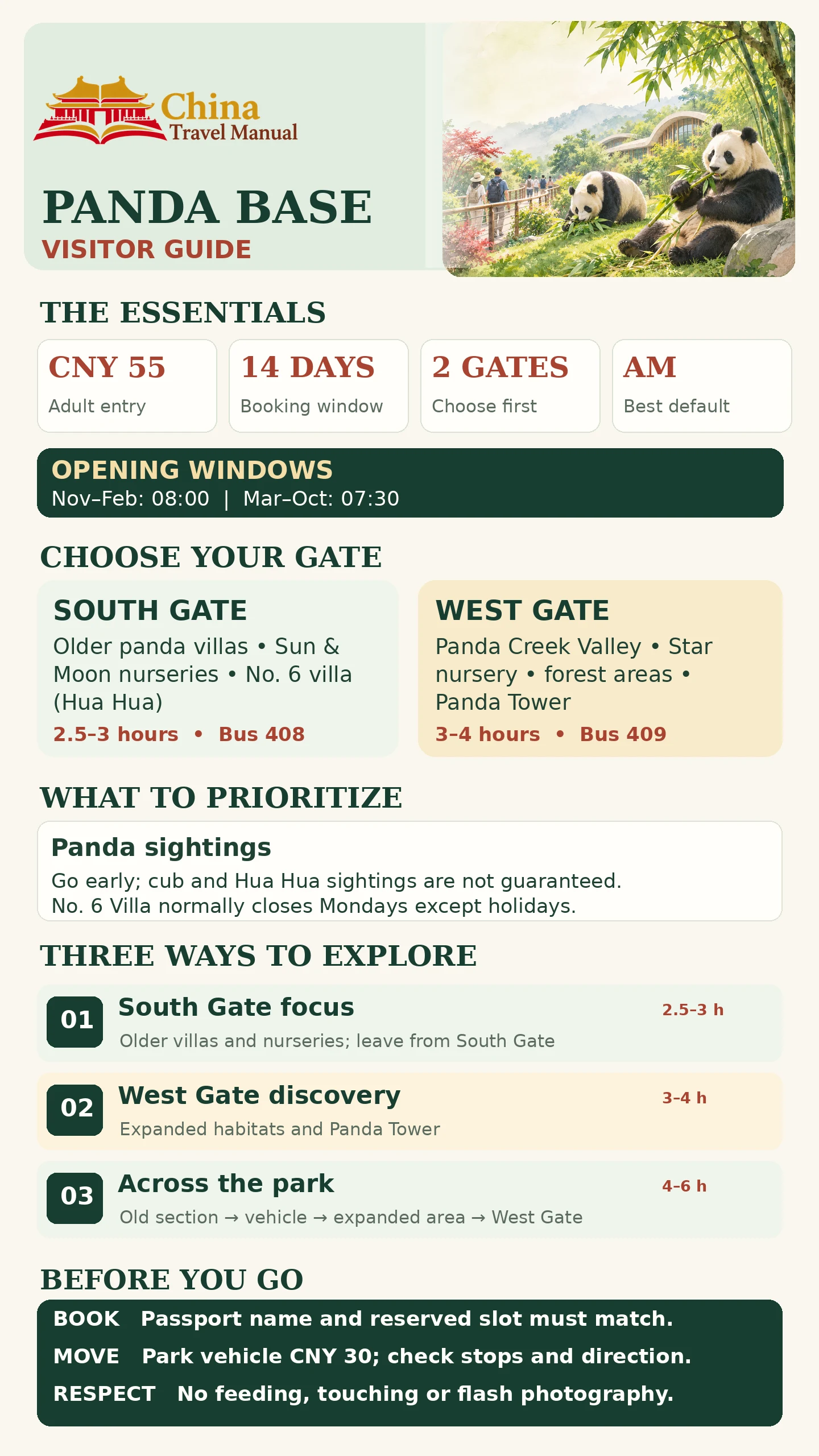
This guide covers the base on Panda Avenue in Chenghua District, Chengdu. Use this guide alongside the wider Chengdu travel guide if you are arranging other activities around the visit.
Chengdu Panda Base at a Glance
| Item | What to know |
|---|---|
| Official name | Chengdu Research Base of Giant Panda Breeding |
| Chinese name | 成都大熊猫繁育研究基地 |
| Address | 1375 Panda Avenue, Chenghua District, Chengdu (成都市成华区熊猫大道1375号) |
| Standard adult admission | CNY 55; reduced student admission CNY 27 for eligible visitors |
| Reservation | Real-name booking, normally available up to 14 days ahead |
| Gates | South Gate (南大门) and West Gate (西大门) |
| Short visit | About 2.5–3 hours for selected older-area exhibits |
| Full highlights visit | About 4–6 hours with substantial walking and possible queues |
| Best starting period | Near morning opening, especially during warmer months |
| Official site | panda.org.cn |
The base’s admission rules, operating hours and daily notices take precedence over any visitor itinerary.[1][2]
Chengdu Panda Base Tickets and Opening Hours
Ticket Prices, Free Entry and Booking Rules
A standard adult ticket costs CNY 55. A CNY 27 reduced ticket is offered to visitors who meet the published student or age conditions and can present the required documents. Seniors aged 60 or above and qualifying young children can enter free under the base’s published policy; the current official booking guidance also exempts these groups from making the usual reservation. Free admission does not eliminate document checks. Do not assume an overseas student card alone proves eligibility for the discount.[1]
Most visitors must make an online real-name reservation and enter once on the selected date and morning or afternoon slot. Tickets can be booked up to 14 days in advance, subject to the daily allocation. A sold-out calendar is not a reason to buy an unofficial “fast entry” ticket. For international visitors, use your passport information exactly as it appears on the document you will bring; the original passport is the safest identification to carry.[1]
How Foreign Visitors Can Book Tickets
The base lists its official WeChat account and mini program alongside authorized channels including Trip.com and Meituan. An authorized English-language booking interface can be helpful if you do not use WeChat or cannot complete payment through the official mini program.[1]
- Open a listed official or authorized ticket channel and select Chengdu Research Base of Giant Panda Breeding, not Panda Valley.
- Choose your visit date and the morning or afternoon entry period before paying.
- Enter each visitor’s passport name and document number carefully; check children’s documentation separately.
- Complete payment, retain the confirmation and check whether the booking requires any additional instructions for passport holders.
- Bring the original passport to the gate and follow the staff’s document-verification lane. An order screenshot alone is not a substitute for matching identification.
Ticket refund rules have changed in 2026 and some official language pages may retain older wording. Before canceling, follow the refund conditions shown on your specific original booking channel, and distinguish the admission ticket from the separate sightseeing-vehicle ticket.
For broader booking issues at Chinese attractions, see how to book attraction tickets in China.
Opening Hours and Morning vs Afternoon Entry
| Season | Morning ticket entry | Afternoon ticket entry | Park clearance starts |
|---|---|---|---|
| March–October | 07:30–12:00 | 12:00–17:00 | 18:00 |
| November–February | 08:00–12:00 | 12:00–16:30 | 17:30 |
The November 2026 schedule follows the winter rules: entry begins at 08:00, with afternoon entry closing at 16:30. These slots control when you may enter; they are not an instruction to leave at noon. An afternoon ticket does not permit early admission.[2]
Leave enough time for the metro, connecting bus or taxi and the final security and entry process.
Best Time to Visit Chengdu Panda Base
What Time of Day Are Pandas Most Active?
Giant pandas generally prefer cooler conditions. A morning visit gives you a better chance of observing eating, exploring or climbing before the day’s warmth builds, but it does not guarantee a scheduled feeding, a baby panda or a particular animal at a viewing window.
If the queue at a headline exhibit is already longer than you want to wait, make a deliberate choice: join it because that animal is your main objective, or see several other enclosures and return only if the conditions improve. Waiting until late afternoon does not ensure that a queue will shrink.
Visiting in Summer, Winter and Rainy Weather
In hot weather, pandas may be moved to shaded or indoor spaces. In a July 2026 notice, the base identified indoor viewing at selected panda villas, the Sun, Moon and Star nursery houses, Panda Reception Hall and indoor areas of Panda Forest and Panda Creek Valley.[7]
Winter brings a later 08:00 opening and can be a comfortable time for walking, but dress for a chilly morning. Cubs are shown only when breeding and veterinary conditions permit, regardless of season.
South Gate vs West Gate: Which Entrance Should You Choose?
The choice matters because the park has an older area and a geographically wider expansion. South Gate is the practical default for a short first visit centered on the older panda villas and nurseries. West Gate is better if you want the expanded-area enclosures and Panda Tower without first crossing the older park.
| Decision | South Gate | West Gate |
|---|---|---|
| Most suitable for | Focused first visit and older panda exhibits | Expanded park and a longer, varied walk |
| Typical highlights | Older villas, Sun and Moon nurseries, No. 6 villa | Panda Creek Valley, Star nursery area, Panda Tower |
| Planning time | About 2.5–3 hours | About 3–4 hours |
| Metro connection | Line 3 to Panda Avenue, then bus 408 or 408 short-turn | Line 3 to Junqu General Hospital, then bus 409 |
| Main trade-off | Popular viewing points can have long queues | Wider grounds, hills and longer walks |
South Gate — Best for a Short First Visit
Start at South Gate (南大门) if the older nursery houses and villas are the heart of your visit. Before committing to any one queue, confirm which displays are operating and whether No. 6 villa is open. You can then choose the Moon and Sun nursery area, other panda villas, red panda viewing where available, and a quieter stop around Swan Lake or the museum.
Because many people arrive with the same short list, entering at South Gate does not guarantee a fast visit. The best use of a three-hour slot is to prioritize two or three important areas rather than insist on every headline enclosure.
West Gate — Best for the Expanded Park
West Gate (西大门) puts you nearer the expanded area’s Panda Creek Valley, forest-themed enclosures, Star nursery area and Panda Tower.
Expect more ground to cover, including slopes. If you use a wheelchair or stroller, inspect the official map and confirm current accessible routes with staff rather than assuming every path works. Buy a sightseeing vehicle ticket if it meaningfully reduces your walking burden, but remember that the shuttle stops at designated stations, not every exhibit entrance.
What to See Inside Chengdu Panda Base
Giant Panda Nurseries and Panda Villas
The Sun Giant Panda Nursery House and Moon Giant Panda Nursery House are among the best-known locations in the older area. They are associated with the base’s breeding program, but the public display changes with the pandas’ health, developmental stage and keeper decisions. Seeing a newborn cub is not an entitlement included in a ticket. An exhibit may feature an adult or be temporarily unavailable instead.
The villa areas offer a different experience: rather than treating one nursery as the only destination, move between viewing windows and look for feeding or resting adults when keepers have made them available. Follow the posted queue direction, keep voices low and avoid blocking the view for others.
How to See Hua Hua at No. 6 Panda Villa
He Hua, popularly called Hua Hua (花花), draws many visitors to the older No. 6 Giant Panda Villa. The base’s current visitor notice states that No. 6 villa is closed to the public on Mondays except national statutory holidays under a trial rotational-rest arrangement intended to improve animal welfare.[3]
Check the date before reserving a journey focused on Hua Hua. On an open day, verify the same-day notice at the base before queuing. A villa can be open while a particular panda is indoors, asleep or unavailable to public view. There is no official paid skip-the-queue guarantee for seeing Hua Hua; treat anyone selling privileged viewing as a warning sign.
Panda Creek Valley, Panda Forest and Red Pandas
The expanded area’s Panda Creek Valley and Panda Forest combine panda habitats with longer woodland paths, offering a different atmosphere from the older, busier viewing compounds. The base has both giant pandas and red pandas, which are distinct species with different habits and appearance.
Some habitats include indoor viewing spaces used during hot conditions.[7] At red panda walk-through spaces and around free-roaming animals, the base asks visitors to maintain more than three meters’ distance; never follow, feed or try to pose with an animal for a photograph.[3]
Giant Panda Museum and Panda Tower
The Giant Panda Museum gives useful background on panda biology, conservation and breeding. It is a good flexible stop when you want a break from a queue or heavy outdoor walking, provided it is open. Allow a short but unhurried visit rather than assuming you need to study every display.
Panda Tower, also called Bamboo Tower in some English material, is a landscape viewpoint in the expanded park. On April 1, 2026, the base removed the former regular Tuesday closure. The stated daily opening period is 09:00–17:00, with last entry at 16:30; bad weather, maintenance and crowd controls can still interrupt access.[6] When you reach the area, check the actual admission or queue instructions and make room for a substitute exhibit.
Best Routes Through Chengdu Panda Base
These are flexible route frameworks, not turn-by-turn trail maps. Use the official park map and the day’s open-exhibit notices to sequence nearby stops.
Route A — South Gate Focused Visit: About 2.5–3 Hours
Best for: First-time visitors, families and anyone combining the base with another Chengdu activity later that day.
- Enter at South Gate soon after your booked entry window begins; check the day’s announcements.
- If Hua Hua matters, assess the No. 6 villa opening status and queue before deciding to commit to it.
- Visit selected Moon and Sun nursery displays and nearby older-area panda villas in a workable walking sequence.
- Add a red panda exhibit if open, or use Swan Lake and the museum as lower-intensity alternatives.
- Return toward South Gate, allowing time for the 408 connecting bus or your pre-arranged ride.
Do not assume the nursery houses show cubs or that two famous exhibits will both have short queues. A focused route is successful if you see active, well-cared-for pandas at the available displays, not only if you tick off every social-media-famous name.
Route B — West Gate Expanded-Area Visit: About 3–4 Hours
Best for: Visitors interested in the expanded habitats, wooded scenery, Panda Creek Valley and Panda Tower.
- Enter at West Gate and check the direction of the available viewing areas.
- Explore Panda Creek Valley and nearby expanded-area exhibits; substitute indoor viewing on hot days.
- Continue toward the Star nursery or Panda Forest area according to open routes and walking ability.
- Consider Panda Tower if it is operating and queues fit your schedule; take a rest and refill water.
- Return to West Gate for bus 409 or a confirmed car pickup.
If a member of your group is tired, visit fewer exhibits well rather than using the last hour to cross the park in haste.
Route C — South-to-West Full Visit: About 4–6 Hours
Best for: Travelers with half a day or more who want highlights from both old and expanded sections.
Begin at South Gate and choose two or three older-area exhibits, such as the Moon or Sun nursery and a panda villa. Before leaving the older section, decide whether any remaining queue is truly worth the time. Then take the south-to-west sightseeing vehicle as a practical cross-park connection when appropriate: the published direction serves the older villas, Sun nursery area, Panda Reception Hall, Panda Tower, Star nursery and Panda Creek Valley before reaching West Gate.[4]
Finish with available expanded-area exhibits and, if open, the tower. Exit at West Gate only after verifying the return bus or pickup arrangement. Buying the vehicle ticket can reduce the long inter-area transfer, but it is still a choice rather than a legal or physical requirement for every traveler.
For a wider itinerary combining the base with city sights, consult three days in Chengdu rather than forcing too many attractions into one morning.
Is the Sightseeing Bus Worth It?
Inside the base, the paid electric sightseeing vehicle links major points and the two gates. As of November 2026, the base lists the sightseeing vehicle’s normal full fare as CNY 30 per person, with eligible small children riding free without their own seat. The ticket is for the named holder and day, and buses stop only at designated stations.[4]
The official south-to-west direction differs from west-to-south; for example, the southbound route serves No. 1 villa and Swan Lake, while the westbound route includes the Panda Reception Hall stop. Once a vehicle reaches a gate terminal, anyone boarding again must queue and present the ticket anew.
| Your plan | Is the internal sightseeing vehicle useful? |
|---|---|
| Two or three older-area exhibits near South Gate | Often unnecessary if you can walk comfortably |
| Old section plus expanded park | Often worthwhile for the long inter-area transfer |
| Young children, older companions or limited walking stamina | Compare vehicle stop locations and access needs first |
| One exhibit only, with flexible timing | Usually decide after checking queues and distance |
Refer to the latest terms of the particular ticket and the base’s sightseeing vehicle guidance, especially if you may change your plans.
How to Get to Chengdu Panda Base
By Metro and Local Shuttle Bus
Public transport usually involves Metro Line 3 plus a bus rather than a metro stop at the entrance. Match the line to your chosen gate.
- South Gate: Take Metro Line 3 to Panda Avenue (熊猫大道). The November 5, 2026 winter update distinguishes bus 408 from Exit D and the 408 short-turn service from Exit A. Follow the route signage for the specific vehicle you intend to board, rather than blindly following an older instruction that all 408 buses use A.[5][8]
- West Gate: Take Metro Line 3 to Junqu General Hospital (军区总医院), leave by Exit B, and transfer to bus 409 for the West Gate. The base also lists alternative local buses, but 409 is the simpler default when operating.[5]
For help with city transit payment, see getting around Chengdu and the separate Chengdu metro guide.
By Tourist Shuttle Bus from Central Chengdu
Tourist direct buses can replace the metro-and-local-bus combination when their route and timing suit your plans. For the winter schedule announced on November 5, 2026, Direct Shuttle Line 2 connected Chunxi Road with the South Gate, with departures from Chunxi Road starting at 09:00 and a listed CNY 9.9 fare. That departure is too late for an 08:00 opening-time arrival. The same update described some other attraction shuttles running only on weekends and statutory holidays.[8]
Check the Chengdu Bus or official scenic-shuttle channel again on your travel day for the live stop and schedule; do not assume this winter fare and timetable apply in later seasons.
By DiDi or Taxi
A DiDi or licensed taxi is the easiest point-to-point option for a family, a group with luggage or visitors whose hotel is poorly placed for Metro Line 3. Enter the exact gate name in Chinese—成都大熊猫繁育研究基地南大门 or 成都大熊猫繁育研究基地西大门—rather than only the general base name. Confirm the assigned public drop-off and pickup area before heading to the car.
Compare the live app estimate with the metro-plus-bus journey, including waiting and walking. Our DiDi guide for tourists explains the wider ride-booking process.
Practical Tips for Visiting Chengdu Panda Base
Visiting with Children or Limited Mobility
Both the South and West Gate visitor centers list free luggage storage and the loan of strollers, wheelchairs, umbrellas and walking aids, subject to availability and on-site procedures.[2] Some routes include slopes, longer paths and stretches with little seating; ask staff which accessible route is practical on the day.
For young children, prioritize fewer exhibits, water and shaded breaks; see Chengdu with kids for a wider family plan. An adult should supervise children closely around barriers and crowded windows. If using a wheelchair, confirm boarding access before purchasing an internal vehicle ticket—do not make a paid booking on the assumption that all equipment can be loaded.
Food, Water, Restrooms and Audio Guides
The park has visitor services including food outlets, toilets, rest areas and information points, but their exact opening and location should be checked on the official map.
Audio-guide availability and language choices may change by service point. Ask the visitor center about an English guide and its current price instead of expecting a device to be available at every gate.
Photography Rules and Animal Welfare
Visitors must not feed, touch, tease or disturb animals, knock on viewing glass or use flash photography where prohibited. Drones and unauthorized commercial filming are prohibited under the park’s visitor rules.[3] There is no ordinary-admission package that lets visitors hold a giant panda. Keep the camera quiet and respect barriers and staff instructions.
Around free-roaming animals and walk-through red panda habitats, the base specifies a distance of more than three meters. If you see unsafe behavior, alert staff rather than intervening around the animal. Conservation and animal welfare take precedence over getting a closer photograph.
Chengdu Panda Base vs Dujiangyan Panda Valley
The Chengdu Research Base of Giant Panda Breeding on Panda Avenue and Dujiangyan Panda Valley are separate destinations, with different locations, admission tickets and practical travel requirements. The main Chengdu base is an easier choice for a half-day visit from the central city; Panda Valley belongs to a different excursion. A ticket for one should not be presented at the other.[1]
If you are still choosing where to see pandas, compare them in Panda bases near Chengdu and the separate Dujiangyan Panda Base visitor guide. For additional activities on the same trip, see day trips from Chengdu.
FAQs About Chengdu Panda Base
How Many Hours Do You Need at Chengdu Panda Base?
Allow roughly three hours for a focused South Gate visit and four to six hours to explore highlights across both older and expanded areas. These are itinerary estimates, not minimum or maximum admission periods. Queues, walking pace, heat and changing enclosure availability can make a visit considerably shorter or longer.
Can You See Hua Hua at Chengdu Panda Base?
He Hua, known as Hua Hua, is associated with No. 6 Giant Panda Villa. Under the base’s current trial rest policy, this area closes on Mondays other than statutory holidays. On other days, the villa may be open without Hua Hua being visible. Check current notices and do not buy claims of guaranteed access.
Can You See Baby Pandas All Year Round?
No. Although the base has nursery facilities, cub displays are determined by births, health and husbandry needs. Visiting a Sun, Moon or Star nursery house does not guarantee a newborn cub on view. Plan to enjoy the pandas that are available rather than scheduling around an assumed birth or feeding event.
Can Visitors Hold or Feed Pandas?
No. Ordinary visitors may observe pandas only in permitted areas. Feeding, touching or hugging giant pandas is not a normal ticketed activity, and attempts to approach animals can put both visitors and pandas at risk. Follow the posted photography and animal-welfare instructions and maintain distance from red pandas in walk-through areas.
Is Chengdu Panda Base the Same as Dujiangyan Panda Valley?
No. They are different attractions in different places, and their tickets are not interchangeable. Dujiangyan Panda Valley requires its own admission and travel arrangements; double-check the Chinese attraction name before booking a taxi or buying a ticket.
Sources
[1] Chengdu Research Base of Giant Panda Breeding. Official ticket and reservation rules
[2] Chengdu Research Base of Giant Panda Breeding. Seasonal opening times and visitor services
[3] Chengdu Research Base of Giant Panda Breeding. Visitor notices and animal-welfare rules
[4] Chengdu Research Base of Giant Panda Breeding. Internal sightseeing vehicle service
[5] Chengdu Research Base of Giant Panda Breeding. South Gate and West Gate public transport
[6] Chengdu Research Base of Giant Panda Breeding. April 1, 2026: Removal of Panda Tower Tuesday closure
[7] Chengdu Research Base of Giant Panda Breeding. July 16, 2026: High-temperature indoor viewing guidance
[8] GoChengdu. November 5, 2026: Panda Base winter shuttle updates





