

Quick Answer: Can Tourists Use Alipay in China?
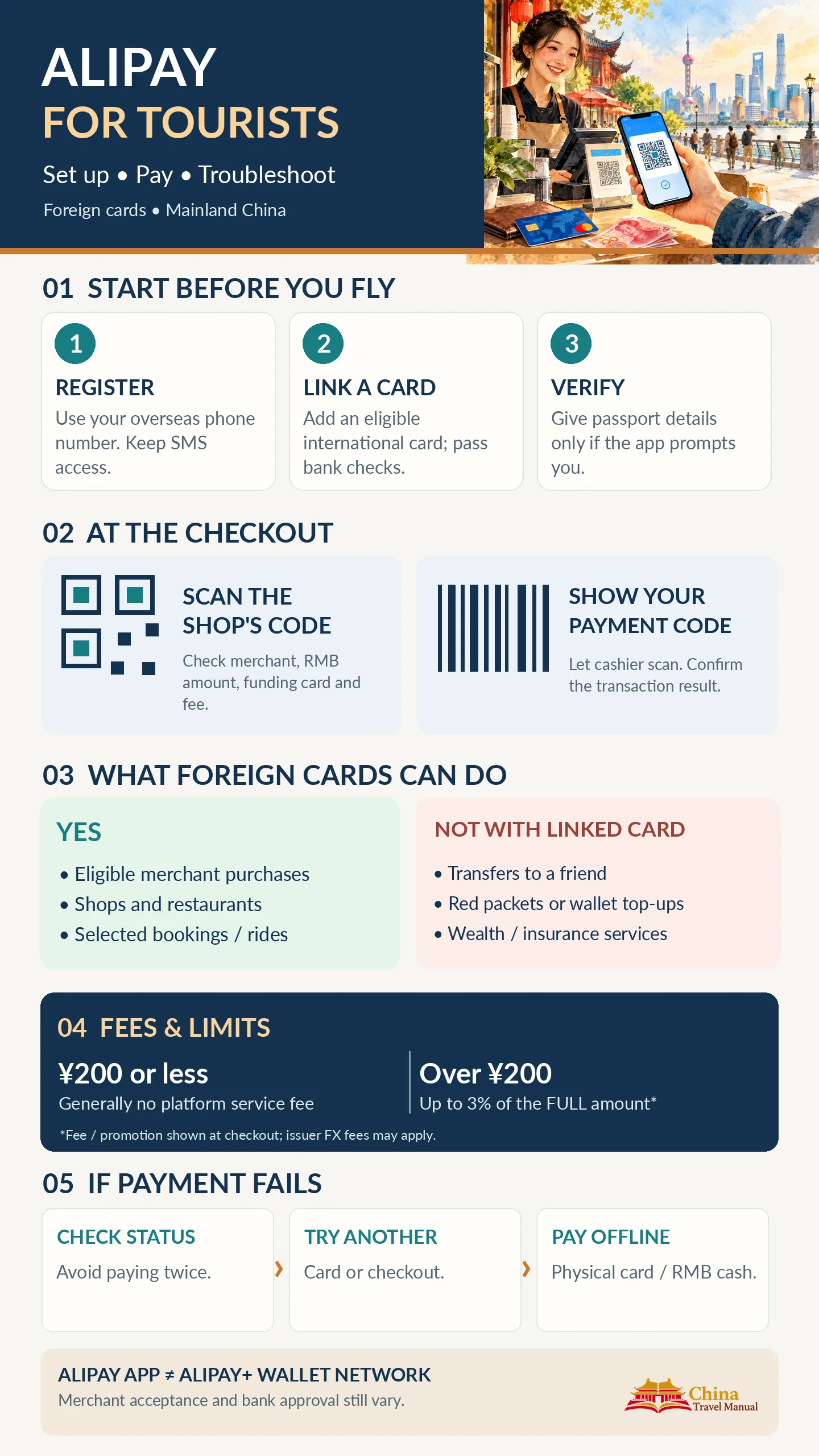
Yes. Visitors can register the Alipay app with an overseas phone number, link an eligible international credit or debit card, and pay participating merchants in mainland China without opening a Chinese bank account. A mainland Chinese SIM card is not a general requirement.[1][2]
- Download the official Alipay app and register with a number that can receive verification messages.
- Add an eligible Visa, Mastercard or another supported card; complete issuer checks.
- Provide passport details if the app requests identity verification.
- Pay by scanning a merchant QR code or showing your own payment code.
- Keep RMB cash or another working payment method: linking a card does not guarantee every transaction.
An overseas card linked to Alipay supports eligible merchant purchases, not person-to-person transfers or red packets.[1]
Many U.S. travelers find mobile payments unfamiliar at first. In China, the practical challenge is usually not downloading Alipay; it is getting the account, the foreign bank card and the particular merchant transaction to work together. Set up what you can before leaving home, and do not make a single app your only way to pay.
What Do You Need Before Setting Up Alipay?
| Prepare | Why it matters | Before departure |
|---|---|---|
| Overseas mobile number | Receives signup, security or recovery codes | Check you can receive verification SMS even after switching data SIMs |
| International bank card | Funds eligible merchant purchases | Bring a second card from another issuer if possible |
| Passport | May be requested to verify your identity | Have the valid document and its exact name and number available |
| Internet-enabled phone | Needed to sign in, manage cards and authorize most transactions | Install the app and test your connection while still at home |
| Payment backup | Covers unsupported QR codes, outages and issuer declines | Carry a modest amount of RMB cash and a physical card |
A U.S. +1 number can be used to register. Keep access to that number while traveling: a travel eSIM may provide data but not receive SMS for your home number. If messages fail, check your carrier’s international-text and spam-blocking settings rather than immediately buying a Chinese SIM.[2][6]
Cards issued outside mainland China can be eligible even if they are debit rather than credit cards. The card network logo alone is not a guarantee; the issuing bank must allow the verification and subsequent transaction. You can ask the issuer whether international online payments and extra security checks are enabled, but many issuers no longer require a separate travel notice.[2]
Use the identity details shown on your passport when Alipay asks for passport verification. For card verification, follow the issuer’s instructions for the name and billing information attached to that card; capitalization or the appearance of a middle name is not by itself proof that a card will fail.
How to Set Up Alipay with a Foreign Bank Card
The steps below follow the current official setup sequence. Button names can vary by app version, country and account status, so follow the prompts shown on your own screen.[1][6]
Download Alipay and Register with Your Phone Number
- Find the official Alipay app in your device’s app store; do not confuse it with AlipayHK or an unrelated app. You normally do not need to switch to a Chinese app-store region.
- Open the app, start registration, select your international calling code (for example, +1 for the United States) and enter your mobile number.
- Complete the SMS or other verification requested, then set up the available login and security options. If offered, select English or the international interface.
If you receive no code, verify the number and country code first. Then check mobile reception, SMS restrictions and carrier filtering. Avoid repeatedly registering new accounts with multiple numbers while a security review is underway.
Add a Visa, Mastercard, or Other Eligible Card
- Open the card-management area (often under Me or Bank Cards) and select the option to add a bank card.
- Enter the card details requested by Alipay, including its number, expiry date and security information. Never share a verification code with a shopkeeper or an unsolicited caller.
- Complete any challenge requested by the issuing bank, which might use its banking app, a one-time passcode or another authorization method.
- Confirm that the card appears among your available payment methods.
Official visitor guidance lists Visa, Mastercard, American Express, JCB, Discover, Diners Club and UnionPay among supported networks, subject to specific products and issuers. Eligible American Express support was expanded in 2025. The exact card you hold may still be refused at registration or checkout.[2][5]
Complete Identity Verification and Check Account Readiness
Some visitors can add a card and make smaller purchases without immediately uploading a passport; others may see an identity-review request before their first payment or after a risk check. Complete the process when prompted, using the passport details and image requirements displayed by Alipay. Do not assume that skipping a prompt now means verification will never be required.[4]
Before boarding your flight, confirm that you can sign in and see the linked card, that the account is not restricted, and that you still control the registered phone number. This verifies setup—not whether a real merchant purchase in China will be approved. A foreign-card purchase remains subject to the merchant’s acceptance rules and your bank’s decision.
How to Make Your First Alipay Payment in China
There are two common ways to pay at a checkout. The Chinese government’s visitor guide describes both scanning the merchant’s code and having the merchant scan yours.[2]
Scan a Merchant’s QR Code
- Ask the cashier whether you can pay with Alipay, then select the app’s Scan function.
- Scan the merchant’s displayed QR code. Depending on the setup, the merchant may already have entered the amount, or you may need to enter it yourself.
- Check the merchant or payee name, the RMB amount, your chosen linked card and any service fee before authorizing.
- Approve the payment using the security method requested and look for the completed transaction in Alipay’s history.
A personal collection QR code may not accept an international-card-funded payment even when the same shop accepts other Alipay payments. A failed scan does not prove that your card is defective; the recipient’s account type can be the limiting factor. Ask the merchant for another supported checkout option instead of repeatedly submitting the same payment.
Show Your Payment Code to the Cashier
At a staffed checkout, select the app’s Pay or payment-code function and check that the correct card is selected. Let the cashier scan the dynamic code; then confirm the result before leaving. Protect that code as a payment credential; see our travel account security advice—do not post a screenshot of a live payment code online.
For example, a traveler arriving in Shanghai might buy an ¥18 drink at a convenience store that accepts their linked card. Under the general overseas-card fee schedule, this amount would not incur the platform’s 3% service fee; the final approval still depends on the card and the transaction.[3]
The ordinary merchant payment code is not the same as a metro or bus ride code. Transport options may require a separate activation, city selection or verification; the DiDi visitor guide covers the ride-hailing side. The detailed differences belong in our China mobile payments guide.
Where Can You Use Alipay with an International Card?
International cards linked to the Alipay app are intended for everyday purchases at eligible merchants in mainland China. They do not unlock every function available to a domestic Alipay wallet.[1]
| Activity | What tourists should expect |
|---|---|
| Chain stores, supermarkets and restaurants | Often a good place for a first card-funded Alipay purchase; acceptance still varies by checkout |
| Hotels and attraction tickets | Frequently possible through an eligible merchant, but some booking pages and deposits use other payment channels |
| Taxis, ride-hailing, metro and buses | Separate services or travel codes may require additional setup and may not accept the same funding card |
| Small stalls and personal collection codes | Card-funded payment may be unavailable when a private collection code is used |
| Sending money to another individual | Not supported through the linked overseas card |
| Red packets, financial products and insurance | Not supported through the linked overseas card |
| Mini programs, deposits and specialty services | Acceptance depends on that service’s payment channel and verification rules |
A crucial distinction: Alipay is the app in which you link your foreign card, while Alipay+ also connects a range of overseas home e-wallets to participating Chinese merchants. An Alipay+ sign is not a universal prerequisite for an Alipay-app transaction, nor proof that every foreign card will work.[1]
If a merchant only accepts another funding source, use a backup rather than assuming a sign showing a QR code means foreign-card acceptance. The separate foreign bank cards guide covers card-network acceptance beyond Alipay.
Alipay Fees, Exchange Rates, and Payment Limits
When Does Alipay Charge an International Card Fee?
According to the Shanghai government’s September 2026 payment guidance, an eligible payment of ¥200 or less is generally exempt from the platform service fee. Above ¥200, a 3% fee may apply to the entire transaction, not just the part over ¥200. Promotions and account-specific terms can change the charge, so the app’s payment confirmation is the final check.[3]
| Purchase amount | Example platform fee at the stated general rate | Total before any bank fees |
|---|---|---|
| ¥100 | ¥0 | ¥100 |
| ¥200 | ¥0 | ¥200 |
| ¥300 | ¥9 | ¥309 |
| ¥500 | ¥15 | ¥515 |
These are illustrative RMB calculations—not quotes for a particular card or merchant. A U.S. card issuer may independently charge a foreign-transaction fee or use its own foreign-exchange terms. A ¥300 restaurant bill could therefore display a ¥9 platform fee and produce an additional issuer charge on the card statement. Check both, rather than treating the final U.S.-dollar amount as a fixed conversion.
How Do Exchange Rates and Spending Limits Work?
The merchant charges RMB. For an international card added to Alipay, the exchange rate is supplied through the card network and issuing bank; check your bank-card statement for the final amount in dollars or your card’s billing currency. Do not assume Alipay always performs one currency conversion and Visa or Mastercard then performs a second conversion.[1]
The published overseas-bank-card mobile-payment ceilings are up to US$5,000 per transaction and US$50,000 cumulatively per year, but the actual account limit can be lower. Card issuer risk controls, daily spending limits, merchant rules and identity checks can stop a transaction well below the public ceiling.[3][4]
Before a high-value purchase, check the fee and card funding source on screen. For a larger hotel deposit or tour charge, ask whether direct payment by a physical international card is available; it may have different costs and acceptance conditions.
Why Is Alipay Not Working? Common Problems and Fixes
Troubleshoot the stage where the failure happens. Registration, adding a card and paying a merchant involve different systems, so repeatedly scanning the same code is rarely a useful diagnosis.
Registration, Verification, and Card Linking Problems
If an SMS code never arrives, first check the +1 country code, roaming/SMS availability and the carrier’s message filtering. If Alipay asks for passport details, use the document information it requests and submit a clear image; a rejected verification may also reflect image quality, account review or inconsistent records rather than a missing middle name alone.
When a card will not link, check its expiry, billing details and whether the bank needs to approve an authentication challenge. Contact the issuer through the number on the card or banking app; explain that you are adding the card to Alipay for mainland-China merchant payments. If the bank does not support that use, another eligible card may be more practical than repeatedly retrying. Official guidance advises consulting the issuer or payment provider when binding verification fails.[2]
Payment Declined, Wrong Payment Method, or Unclear Payment Status
| Symptom | Likely explanations | First action | Backup |
|---|---|---|---|
| Linked card is declined at checkout | Merchant channel, issuer block, verification or limit | Read the exact error; ask whether the merchant can use a supported checkout | Different card or RMB cash |
| Same card works at one shop but not another | The shops use different receiving-account or payment channels | Ask for another Alipay payment option or another tender | Physical card, WeChat Pay or cash |
| Payment screen freezes after authorization | Network interruption or delayed status update | Inspect Alipay’s transaction history and the merchant’s order status before retrying | Ask cashier to confirm receipt |
| Refund is marked initiated but card is not credited | Merchant, processor and issuer posting periods differ | Keep the order/reference number and check with the merchant | Ask issuer to trace a pending refund |
| Amount or fees look wrong | Different funding card, platform fee or issuer currency conversion | Check the bill details and card statement separately | Contact official Alipay support and issuer |
A Mastercard that succeeds at a large chain but fails at a food stall does not, by itself, prove the stall’s code is private or that the issuer blocked it. Only the transaction error, merchant setup or bank response can establish the cause. The systematic payment troubleshooting guide covers broader card and wallet failures.
Refund posting is variable; do not promise a universal 7–30-day timetable. If the app shows a refund has been processed but the bank does not, retain the merchant refund reference before contacting the issuer. Our China payment refunds guide explains the next steps.
What to Do If Alipay Stops Working During Your Trip
At the checkout counter, prioritize finishing the purchase without being charged twice:
- Check the previous transaction: Open the payment history and ask the merchant whether payment was received. Do not immediately scan or submit again if the status is unclear.
- Switch to a ready backup: Try a second linked card or an already-configured WeChat Pay account if the merchant accepts it.
- Pay without the app: Use a physical international card if accepted, or RMB cash. Keep small notes available for restaurants and stalls that cannot process your foreign card.
- Get help safely: Use support inside the official Alipay app or the issuer’s official contact channel. Never disclose a one-time code or payment password to someone offering to “fix” your account.
In mainland China, digital payments are widespread, but visitors can also use supported cards and cash. If you need cash replenishment, see cash and ATMs in China.[4]
FAQs About Alipay for Tourists in China
Can I Use Alipay in China Without a Chinese Bank Account?
Yes. You can link an eligible overseas-issued bank card to Alipay for supported merchant purchases. A mainland Chinese bank account is not generally needed for this visitor setup.
Can I Register Alipay with a US Phone Number?
Yes. Select +1 during registration and use a U.S. number that can receive security messages. Keep access to the number while abroad in case Alipay requests another code.
Does Alipay Accept US Credit and Debit Cards?
Eligible U.S.-issued credit and debit cards on supported networks can be linked. Approval is not universal: the issuing bank, account verification, merchant channel and individual transaction still matter.
Can I Use Alipay Before Arriving in China?
You can usually download the app, register and try linking a card before departure. Complete identity verification if prompted. Whether you can make a test purchase outside China depends on the merchant and service; you do not need to make an unnecessary purchase just to test the app.
Can Tourists Send Money to Friends with Alipay?
Not using the visitor’s linked international card. It is meant for supported merchant payments and does not fund personal transfers or red packets. Other Alipay account features depend on separate eligibility and should not be assumed available.
Sources
[1] Alipay+. Pay in the Chinese Mainland
[2] State Council of China. Guide to Working and Living in China: Mobile Payment
[3] Shanghai Municipal Government. Pay with Overseas Bank Cards
[4] State Council of China. Payment Service Guide for Overseas Visitors to China
[5] Ant Group. American Express and Alipay Partner to Enable Payments for International Travelers
[6] Shanghai Municipal Government. How to Use Alipay





