

Quick Answer: How Should You Plan a First Trip to Beijing?
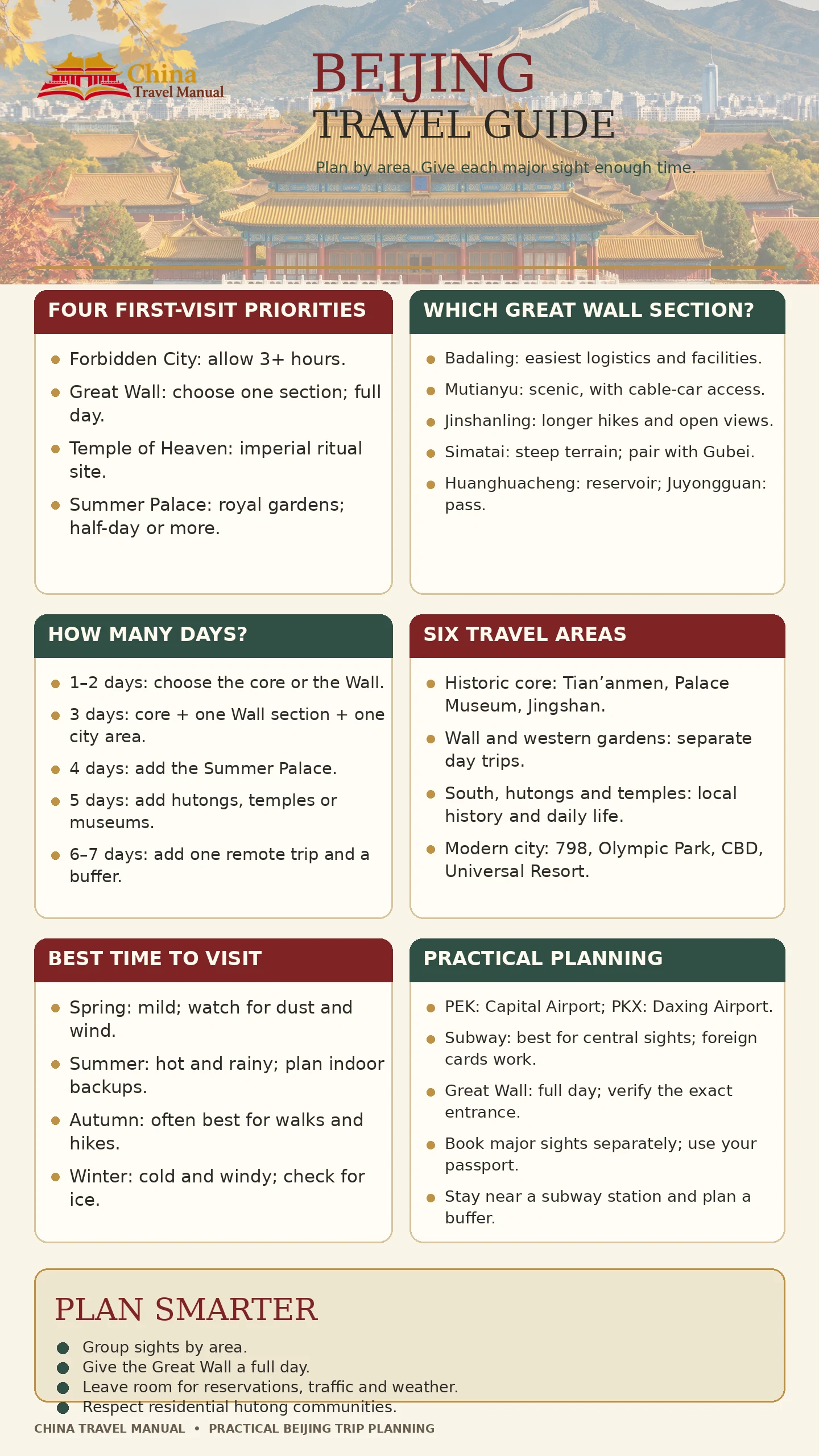
For most first-time visitors, allow four days in Beijing. Build the trip around the Forbidden City, one Great Wall section, the Temple of Heaven and the Summer Palace, then add hutongs or modern districts if time permits.
- Best first-visit priorities: Forbidden City, Great Wall, Temple of Heaven and Summer Palace.
- Best trip length: Three days is compact; four days is a better baseline; five to seven days allow a slower pace.
- Great Wall choice: Compare Badaling for mature facilities with Mutianyu for scenery and visitor infrastructure; choose only one section for a day trip.
- Best overall season: Autumn is generally comfortable for walking and hiking, but avoid the National Day holiday rush.
- Getting around: Use the subway for central sights and a dedicated transfer or private car for the Great Wall.
- Book ahead: Check official reservation systems for the Palace Museum, Tian’anmen Square and National Museum, using the same passport at entry.
The main planning rule: group sights by area, give the Great Wall a full day and leave room for reservations, weather and long walking distances.
Beijing rewards travelers who give its history, landscapes and neighborhoods enough time. The capital is home to imperial palaces, ceremonial temples, classical gardens, living hutong communities and several very different sections of the Great Wall. The challenge is not finding things to do; it is choosing a realistic combination across a large city where travel time, reservations and walking distances matter.
Beijing at a Glance: What Makes the City Worth Visiting?
Beijing is a rewarding first stop in China for travelers drawn to imperial history, monumental architecture, the Great Wall and the scale of a historic capital. Its strongest experiences are not concentrated in one walkable district: the Forbidden City and central historic core sit far from several mountain attractions, while the western royal gardens and modern cultural districts require their own time. The key to a satisfying visit is to group sights by area and resist treating every landmark as a quick photo stop.
For a first visit, build around four priorities: the Forbidden City, one carefully chosen Great Wall section, the Temple of Heaven and the Summer Palace. Add hutong neighborhoods and a food-focused evening if time allows. Beijing is less suitable for a rushed one-day checklist or a low-effort city break built around short walks; distances, security checks, reservations and long indoor or outdoor visits all affect the pace.
If Beijing is part of a longer China trip, use this city guide alongside the broader China Travel Guide, China Itineraries and China Transportation Guide. They cover country-level planning; this page focuses on choosing and combining Beijing experiences.
Understand Beijing’s Six Travel Areas
Central Imperial Beijing is the first-visit anchor. Tian’anmen Square, the Palace Museum (Forbidden City), Jingshan Park, Beihai Park, Zhongshan Park and the National Museum of China sit in or around the historic center. Allow a full day for the central axis and palace visit; a serious museum visit may need another half-day. The Palace Museum alone commonly involves several kilometers of walking, so it should not be squeezed between distant appointments.
The Great Wall region is a separate full-day excursion. The main choices around Beijing include Badaling, Mutianyu, Jinshanling, Simatai, Huanghuacheng and Juyongguan. They are not interchangeable entrances to one compact attraction: access, restoration, crowds, terrain and transport differ. Choose one section based on the experience you want, then arrange the day around that section.
The Western Royal Gardens area centers on the Summer Palace, the Old Summer Palace (Yuanmingyuan) and Fragrant Hills. The Summer Palace is a large, functioning imperial garden with lakes, hills, bridges and buildings; the Old Summer Palace is primarily an archaeological and historical-ruin landscape; Fragrant Hills is best known for autumn foliage. Choose one or two according to your interests rather than trying to cross the city repeatedly.
Southern Beijing combines the Temple of Heaven with Qianmen, Dashilan and nearby traditional commercial streets. It works well as a half-day or full-day district and is a natural complement to the central imperial area, but it is not simply an extension of the Forbidden City visit.
The hutong and temple district includes Shichahai, the Drum and Bell Towers, Nanluoguxiang, the Lama Temple (Yonghe Temple) and residential lanes. This is where visitors can see how old-city neighborhoods function beyond their shops and visitor-facing streets. Keep voices low, avoid blocking doorways and do not photograph residents at close range without permission.
Modern Beijing includes the 798 Art District, Olympic Park, the Bird’s Nest, the Water Cube, the CBD and Universal Beijing Resort. These places show a different side of the capital, but they are optional additions for many first-time visitors. Universal Beijing Resort deserves a full day on its own; it is not a convenient add-on to a packed historic-sight itinerary.
Best Places to Visit in Beijing: What Should You Prioritize?
The Forbidden City is the highest-priority historic site for most first-time visitors. The former imperial palace is now the Palace Museum and forms part of the Imperial Palaces of the Ming and Qing Dynasties World Heritage property. Plan at least three hours inside, more if you read displays carefully or visit special galleries. Its scale and one-way visitor flow make it a substantial visit rather than a brief stop.
The Great Wall is the other essential experience for many travelers, but select one section instead of trying to see several in a day. Mutianyu is a strong all-round choice for many international visitors because of its mountain setting and developed visitor facilities. Badaling is often the easiest choice for transport and facilities. Jinshanling appeals to hikers and photographers seeking longer walks and broad views; Simatai is steeper and more rugged; Huanghuacheng pairs wall scenery with a reservoir landscape; Juyongguan emphasizes a historic mountain pass.
The Temple of Heaven is a high-value visit for its ceremonial architecture and landscape design. The Summer Palace is equally important for travelers who enjoy classical gardens and can give it half a day or longer. Jingshan Park offers a memorable elevated view over the Forbidden City, while Shichahai is better understood as a lakeside historic neighborhood than a single-ticket attraction.
The Lama Temple is a worthwhile addition for visitors interested in Tibetan Buddhist architecture and living religious spaces. The Old Summer Palace adds context to the destruction and memory of the imperial garden landscape. The 798 Art District and Olympic Park are more interest-dependent: prioritize them if contemporary art, architecture or modern Chinese urban life matters more to you than another imperial site.
Beijing’s UNESCO World Heritage: Five Distinct Listings
Beijing’s heritage story is broader than the Forbidden City and the Great Wall. The city contains several distinct UNESCO World Heritage properties, each with a different scope and visitor meaning. The Imperial Palaces of the Ming and Qing Dynasties includes the Palace Museum in Beijing; the Great Wall is a separate transregional property; the Temple of Heaven and Summer Palace each have their own listing; and the Beijing Central Axis was inscribed in 2024. Do not describe the latter four as parts of the Forbidden City listing.
The Beijing Central Axis is an urban heritage ensemble running through the historic city. It brings together palaces, gardens, sacrificial buildings, ceremonial and public structures, city-management facilities and road remains. It is not another name for the Forbidden City and is not one single ticketed attraction. Visitors encounter its components across different sites and public spaces. UNESCO’s description explains how the ensemble expresses historic capital planning and the imperial city’s spatial order. [1]
The Great Wall’s UNESCO property is not limited to the visible sections closest to Beijing. The Beijing-area sections are accessible examples within a much larger defensive system. The Temple of Heaven represents imperial sacrificial ritual, while the Summer Palace represents a large designed landscape of water, hills, gardens and architecture. Each deserves its own visit and should be understood on its own terms. [2][3][4][5]
How Many Days Do You Need in Beijing?
One or two days are enough only for a tightly selected introduction. With one day, choose either the central imperial core or the Great Wall; attempting both usually creates a rushed day with little time to understand either. With two days, devote one to the central axis and one to a Great Wall section if the Wall is a priority.
Three days can cover the central historic core, one full Great Wall excursion and a southern or garden experience. It is a compact first visit, not a comprehensive tour. A practical version is: Day 1, Tian’anmen Square, the Palace Museum and Jingshan; Day 2, one Great Wall section; Day 3, the Temple of Heaven and Qianmen, or the Summer Palace instead. Choose the third day based on whether ritual architecture or royal gardens matter more to you.
Four days is a better baseline for many first-time visitors. Add the Summer Palace to the three-day framework and keep the Great Wall on its own day. Five days allows a more balanced pace and room for a hutong walk, the Lama Temple, the National Museum or 798. Six or seven days make sense for slower travelers, families needing rest breaks, museum-focused visitors or those adding one outer-area excursion.
Count usable sightseeing days, not just hotel nights. Arrival after a long-haul flight, immigration, airport transfers and departure check-in can each consume a meaningful part of a calendar day. Also leave flexibility for ticket availability, weather, traffic and fatigue. A day with the Palace Museum or a Great Wall hike may be physically demanding even if it contains only one headline attraction.
Suggested Beijing Itineraries for 1 to 7 Days
For a classic three-day visit, spend the first day around the central axis: Tian’anmen Square, the Palace Museum and Jingshan Park. The second day belongs to one Great Wall section, with enough time for transport and walking. On the third day, choose the Temple of Heaven with Qianmen and Dashilan, or substitute the Summer Palace if gardens are your priority. Do not add the Summer Palace, 798 and Olympic Park to the same third day.
For four days, keep the first three days above and give the fourth day to the Summer Palace. If you have energy and time, the Old Summer Palace can be a separate addition, but do not assume that the two gardens are a quick combined visit. The dedicated 3 Days in Beijing itinerary provides a more detailed day-by-day route.
For five days, add a half-day or full-day for the Lama Temple, Drum and Bell Towers, Nanluoguxiang and Shichahai. Another option is to choose the National Museum or 798 according to your interests. For six or seven days, add one outer-area destination such as the Ming Tombs, Gubei Water Town with Simatai, or Universal Beijing Resort. Keep each remote excursion distinct and protect at least one flexible block for rest or a weather change.
Choosing the Right Great Wall Section near Beijing
The best Great Wall section depends on your priorities, not on a universal ranking. Badaling has mature facilities and is often the simplest first-time logistics choice. Mutianyu combines a scenic mountain setting with established visitor infrastructure and is a frequent recommendation for international independent travelers. Both can be busy, particularly on weekends and public holidays.
Jinshanling is better for travelers who value longer hiking routes, broad views and a more rugged walking experience. It requires more careful transport planning and is not the default choice for visitors with limited mobility or little hiking experience. Simatai has steeper terrain and is commonly paired with Gubei Water Town; verify which wall sections and visitor services are open before travel.
Huanghuacheng is distinctive because the wall meets a reservoir landscape. Juyongguan is a historic pass with a strong military-geography story and a more enclosed mountain setting. These are alternatives for travelers with a specific interest, not mandatory additions to a short Beijing trip. [12][13]
Choose one section and build a full day around it. Check the exact entrance, current open sections, shuttle arrangements, cable-car operations and return transport shortly before departure. Wear supportive shoes, carry water, follow marked paths and never enter closed or unrestored sections. For transport and tickets, see the Mutianyu guide or Badaling guide, and use the general Great Wall travel guide for wider context.
Best Time to Visit Beijing
Spring, roughly March to May, brings milder temperatures and is suitable for walking through historic sites, parks and hutongs. Weather can change quickly, daily temperature swings are common and dusty or windy conditions may affect outdoor comfort. Check local forecasts and air-quality or dust alerts rather than assuming every spring day is clear. [14]
Summer, from June to August, is hot, humid and rainy, with much of Beijing’s annual precipitation falling during this period. Gardens are green, but long exposed walks on the Great Wall can be uncomfortable in midday heat. Sudden thunderstorms can disrupt outdoor plans, so keep an indoor museum or flexible city activity as a backup.
Autumn, especially September through early November, is often the most comfortable overall season for sightseeing and hiking. Days are generally cooler and drier than midsummer, making the Great Wall and long walks more pleasant. Foliage timing varies by year; Fragrant Hills and the city’s gardens are popular for autumn color. Avoid assuming that the National Day holiday period will be quiet: crowds, accommodation demand and reservation pressure can be intense.
Winter, from December through February, is cold, dry and sometimes windy. It can be rewarding for museums, indoor cultural visits and atmospheric views of historic buildings after snow, but snow is not guaranteed. Great Wall paths may be icy and exposed to wind, so check conditions and closures, wear layers and grippy footwear, and do not treat winter hiking as a casual stroll.
For any season, plan around the actual forecast and attraction notices. Spring dust, summer storms, autumn holiday crowds and winter ice are practical constraints, not reasons to promise a particular view or event.
How to Get to Beijing: Airports and Railway Stations
Beijing is served by two major airports. Beijing Capital International Airport (PEK) is the established airport northeast of the city and handles many international services. Beijing Daxing International Airport (PKX) is south of the center and serves a mix of domestic and international flights. Neither is automatically better: choose based on the flight you can book, your hotel location and your onward transport plans.
From Capital Airport, options include the Airport Express, airport buses, taxis and app-based ride-hailing. From Daxing, the Daxing Airport Express, intercity rail services where relevant, buses, taxis and ride-hailing connect passengers with the city. Check the operating hours and the last available connection if you land late. Official airport guidance is available for Capital Airport transfers and Daxing Airport transfers. [6][7]
Beijing’s railway stations serve different corridors and are not interchangeable. Beijing South is a major high-speed rail hub for routes including Shanghai and Tianjin; Beijing West serves many western and southern routes; Beijing Railway Station handles conventional and some other services; Beijing North and Qinghe serve the Beijing–Zhangjiakou corridor; and Beijing Fengtai is another major interchange. Always check the full station name on your ticket. A ticket that says Beijing does not mean the stations are close together. For onward travel, use the Beijing South Station guide and the national China Trains guide.
Getting Around Beijing: Subway, Taxi and Private Transfers
The subway is usually the most dependable way to move between central attractions. Stations and trains have English-language signage, and the network covers most major visitor districts. As of the latest official guidance checked for this article, Beijing’s rail network supports contactless payment with major overseas-issued card networks, including Visa, Mastercard, JCB and American Express, alongside UnionPay and local QR-code options. Check the current station signage and your card issuer’s foreign-transaction settings before relying on one payment method. [8]
Taxis and ride-hailing are useful for luggage, late arrivals, groups and destinations not well served by rail. Save the hotel name and destination address in Chinese, and confirm the vehicle and pickup point in the app. Road congestion can make a short map distance take much longer than expected, especially around major attractions and during holidays.
Public buses can be useful for short routes and local exploration, but route planning may be less intuitive for a first-time visitor. Private transfers are most useful for a Great Wall day, a family group or a route involving several remote stops. They are rarely necessary for every central-city journey, where subway travel is often simpler and less exposed to traffic.
Walking is rewarding in the historic core, but distances inside large attractions are substantial. The Palace Museum, Summer Palace and Great Wall all involve extended walking. Do not estimate the day solely from the distance between entrance gates on a map. For broader transport choices and local details, see Getting Around Beijing and the China Transportation guide.
Where to Stay in Beijing: Match Your Base to Your Route
For a first visit, Dongcheng is a practical starting point because it combines central access, subway connections, historic neighborhoods and a range of accommodation. Wangfujing suits travelers who want convenient access to the central sights, restaurants and shopping. Qianmen offers a strong old-city atmosphere and access to the southern Central Axis, although some lanes and historic blocks can be less convenient for large suitcases or vehicle drop-offs.
Xicheng is worth considering if you want to be near Shichahai, Beihai and the western side of the historic center. Chaoyang fits travelers who prefer modern business districts, international dining and nightlife. Haidian can make sense for longer stays focused on the Summer Palace, Old Summer Palace or university area, but it is less convenient as a general base for a short first visit.
Prioritize a hotel within a manageable walk of a subway station over a cheaper property far from rail. If you have an early flight or train, consider the final night’s location. If you have booked a Great Wall excursion, check the pickup location before choosing a hotel. Compare room conditions, elevator access, luggage handling and the property’s passport check-in process directly before paying. For a detailed neighborhood and accommodation comparison, use Where to Stay in Beijing.
Food, Hutongs and Cultural Experiences
Beijing’s food culture is worth exploring, but this city hub should not become a restaurant directory. Start with the broad categories: Peking duck, zhajiangmian (noodles with fermented soybean paste), jianbing-style breakfast pancakes, copper-pot lamb hotpot and traditional snacks. The dedicated Beijing food guide can handle dish selection, ordering and dining details; the national Chinese food guide provides wider context.
Hutongs are traditional lanes and neighborhood networks, often associated with courtyard houses. Some streets are heavily commercialized, but many nearby lanes remain residential. Walk slowly, keep noise down, respect private entrances and avoid treating every courtyard doorway as a photo opportunity. A focused Beijing hutongs visitor guide and hutong walking route can help you choose a route that balances visitor interest with neighborhood life.
For a broader cultural day, combine a temple visit with traditional architecture or a performance, then balance historic sites with a contemporary experience such as 798. Beijing is not only an imperial museum: its present-day art, design, university and business districts are part of the city’s identity too.
Reservations, Passports and Practical Travel Tips
Treat reservations as part of itinerary design, not as a last-minute administrative detail. The Palace Museum requires advance online booking and asks foreign visitors to provide passport numbers; the museum states that it does not sell same-day tickets. Bring the original passport used for the reservation and follow the entry instructions for your selected visit. The official multilingual visitor page is the final authority for booking rules and temporary changes. [9]
Tian’anmen Square has its own reservation arrangements. Official guidance has described a WeChat mini-program route for visitors whose international phone numbers cannot be verified on the web portal, and it also describes facilitated entry in some cases when a visitor holds a same-day reservation for another designated site. These procedures can change. Confirm the current route close to your travel date and enter the name and passport details exactly as shown on the document. [10]
The National Museum of China also requires real-name reservations. Its English visitor information describes reservations through official channels, with passport or other valid ID checks at entry. Rules, release windows and time slots can change, so check the museum’s own visitor page rather than relying on an old screenshot or a third-party summary. [11]
Carry the same original passport used for bookings. Keep confirmation messages accessible offline, allow time for security screening and do not assume that a reservation for one attraction automatically covers another. For the Palace Museum, Tian’anmen Square and the National Museum, check each official system independently before fixing your daily route.
Prepare at least two payment methods. Alipay or WeChat Pay can be convenient for many daily purchases, while international contactless cards now work on Beijing’s subway network. Small vendors and some local businesses may not accept foreign bank cards directly. Carry a modest amount of RMB cash as a backup and review the broader China mobile payments guide before arrival.
Keep your passport available, use official ticketing channels, and check current weather and attraction notices. During National Day and Lunar New Year holiday periods, expect higher demand, crowd controls and heavier traffic. Avoid building a tightly timed day around multiple distant reservations.
Common Beijing Travel Planning Mistakes
The most expensive mistake is trying to combine the Great Wall with the Forbidden City, Summer Palace or another major central attraction on the same day. The Wall is a separate excursion with travel time at both ends and substantial walking. Give it a full day.
Another common error is assuming all Great Wall sections offer the same experience. Match the section to your fitness, preferred scenery, transport tolerance and interest in restored versus rugged stretches. Confirm the exact entrance and current operations rather than navigating to a generic Great Wall pin.
Do not book a hotel based on room price alone. A distant location can cost time and money every day, and a property inside a hutong may have limited vehicle access or stairs. Check the nearest station, walking route with luggage and passport check-in arrangements.
Do not confuse PEK and PKX, or assume Beijing’s railway stations are clustered together. Verify airport codes and the complete rail-station name before purchasing onward tickets. Also avoid treating a reservation policy from a previous year as current: recheck the official booking channel before travel.
FAQs About Traveling in Beijing
How many days should I spend in Beijing?
Four days is a practical first-visit baseline. Three days can cover the central historic core, one Great Wall section and one additional major area, while five or more days allow a more balanced pace and optional cultural or modern-city visits.
Is Beijing worth visiting on a first trip to China?
Yes, especially if you are interested in imperial history, monumental architecture, the Great Wall and traditional urban culture. It is a less suitable choice for a very short, low-walking, resort-style break.
Which Great Wall section is best for first-time visitors?
Compare Badaling and Mutianyu first. Badaling has mature facilities and straightforward visitor infrastructure; Mutianyu offers a scenic setting and developed facilities that appeal to many international visitors. Choose based on your transport plan and preferred experience.
Do foreign visitors need to reserve Forbidden City tickets?
Yes. The Palace Museum requires advance online booking and passport details for foreign visitors. Bring the original passport used for the booking and check the official visitor page for current availability and entry instructions.
Can I visit the Great Wall and Forbidden City in one day?
It is not recommended. The two experiences are far apart, and each needs substantial time. Give the Great Wall a separate full day.
Sources
[1] UNESCO World Heritage Centre. Beijing Central Axis: A Building Ensemble Exhibiting the Ideal Order of the Chinese Capital
[2] UNESCO World Heritage Centre. Imperial Palaces of the Ming and Qing Dynasties
[3] UNESCO World Heritage Centre. The Great Wall
[4] UNESCO World Heritage Centre. Temple of Heaven: an Imperial Sacrificial Altar in Beijing
[5] UNESCO World Heritage Centre. Summer Palace, an Imperial Garden in Beijing
[6] Beijing Municipal Government. PEK Transport Between Airport and City Guide
[7] Beijing Municipal Government. PKX Airport to City
[8] Beijing Municipal Government. Beijing Subway Introduces Tap-and-Go Payments with Five Major Card Networks
[9] The Palace Museum. Visit
[10] Beijing Municipal Government. Tian’anmen Square Reservation Guidance
[11] National Museum of China. Visit
[12] Beijing Municipal Government. Mutianyu Great Wall
[13] Beijing Municipal Government. Badaling Great Wall
[14] Beijing Municipal Government. Demographic Geography and Climate





