

Quick Answer: How to Plan a Trip to China
Plan your first China trip in this order so one booking does not undermine the next:
- Check entry eligibility: Confirm whether your passport and itinerary require a tourist visa or qualify for another entry arrangement before buying nonrefundable travel.
- Choose dates and days: Check weather by region and avoid major domestic travel peaks; allow for arrival and transfer days.
- Build one connected route: Pick two to four destinations that suit your interests, rather than trying to cross the whole country.
- Price the complete trip: Include accommodation, meals, attractions, city transport, intercity legs, and a contingency reserve.
- Book in sequence: Compare international flights, reserve suitable rooms, then track railway and attraction ticket-release dates.
- Prepare for arrival: Arrange mobile data, payment backups, Chinese-language addresses, and essential documents.
For most first-time visitors, a focused 8–14-day route is more enjoyable than an ambitious checklist of distant cities.
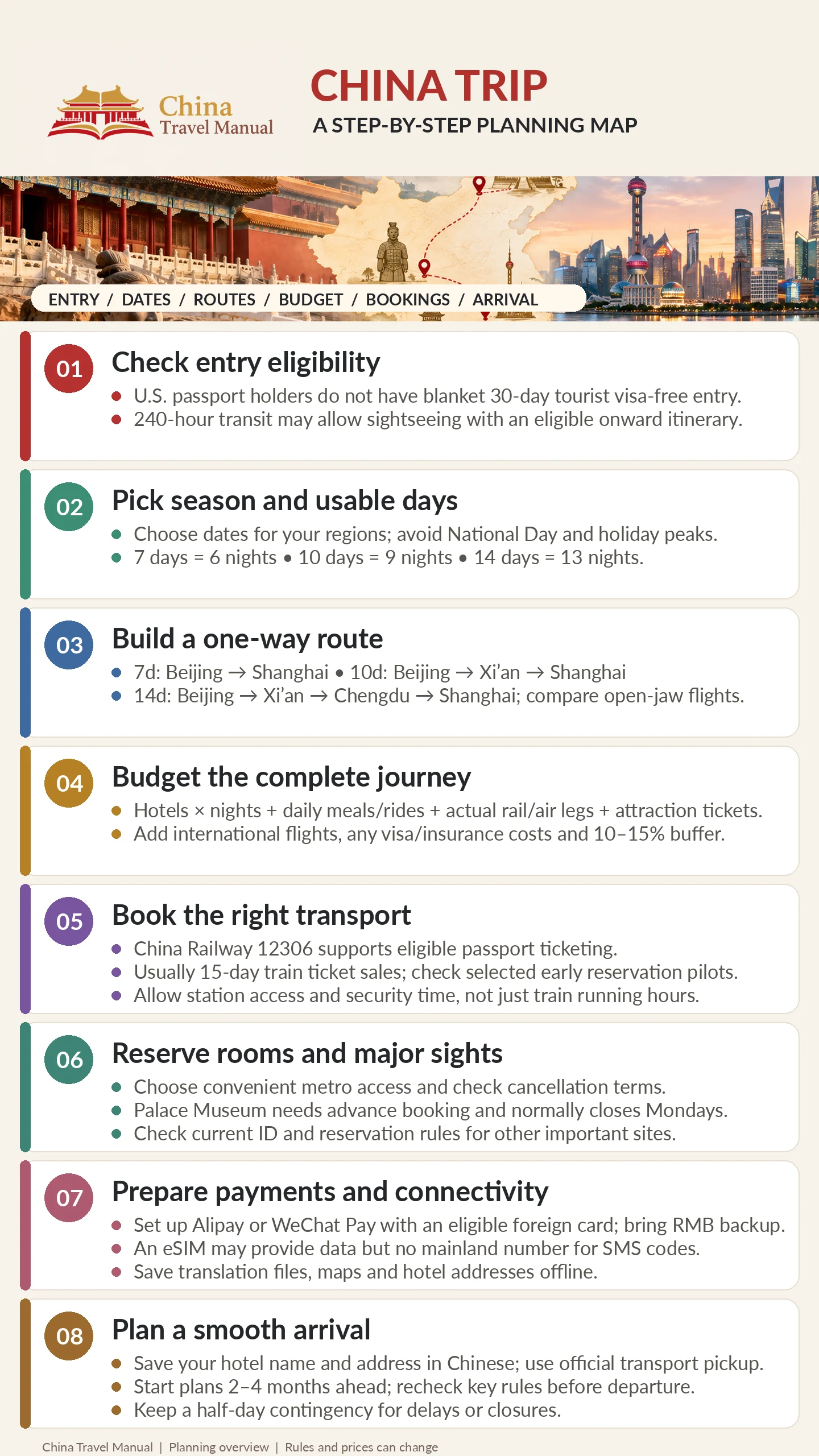
China is straightforward to explore independently once the major decisions are made in the right order. For a first visit from the United States, the biggest planning traps are assuming a visa exemption applies, underestimating city-to-city travel, and arriving without reliable mobile payments or directions.
This guide turns those challenges into seven practical decisions, with route examples, indicative costs, and a booking timeline. Use the linked specialist guides when you need instructions for a particular city, train, visa, or app.
Step 1: Check Entry Requirements Before You Book
Check entry requirements for your passport nationality, intended activity, entry and exit points, and travel dates—not simply the country where you live. The three common arrangements are different:
| Entry arrangement | When it may apply | Main planning test |
|---|---|---|
| Ordinary visa-free entry | Citizens of countries covered by a current exemption | Check the nationality list, permitted purpose, duration, and policy end date. |
| 240-hour visa-free transit | Eligible travelers continuing to a third country or region | Check the onward itinerary, 65 designated ports, permitted areas, and confirmed onward ticket. |
| L (tourist) visa | Travelers whose trip does not qualify for an exemption | Apply through the responsible Chinese embassy or consulate and check the specific visa’s permitted stay. |
As of October 25, 2026, U.S. ordinary passport holders are not covered by China’s nationwide unilateral 30-day tourism visa exemption. A conventional U.S.–mainland China–U.S. vacation generally requires a suitable visa unless another valid exemption applies. The U.S. applicant procedures for an L visa no longer universally require flight and hotel bookings; review the current embassy instructions before applying.[1][3]
The 240-hour transit arrangement does allow sightseeing within the authorized areas, but is not a replacement for a round-trip tourist visa. For example, a qualifying itinerary going from the United States through mainland China to Japan can be considered; returning directly from mainland China to the United States does not satisfy the third-country/region requirement. Eligibility and admission remain subject to the immigration authorities.[2]
Hong Kong, Macao, and mainland China have separate immigration arrangements. Being admitted visa-free to Hong Kong does not automatically authorize entry into the mainland. Check every crossing in a multi-region route. For more detail, see the China visa guide.
Foreign visitors who must complete an arrival card can submit it free through the official National Immigration Administration service before arrival or use the available arrival options at the port. Avoid paid imitation websites.[4]
Step 2: Choose Your Dates and Trip Length
Choose the season for the specific places you want to see, then set the number of usable days. There is no single ideal season for all of China.
When Is the Best Time to Visit China?
| Season | Good starting points | Planning trade-off |
|---|---|---|
| March–May | Beijing, Xi’an, gardens and many eastern-city trips | Southern rain and Qingming or May holiday crowds can affect plans. |
| June–August | Selected higher-altitude destinations and northern escapes | Many major cities are hot; summer vacations and rain raise demand or disrupt outdoors. |
| September–November | Beijing, Xi’an, many city routes and selected landscapes | Early October’s National Day holiday can mean heavy crowds and scarce transport seats. |
| December–February | Winter activities in the north; milder experiences in parts of the south | Northern cold and Lunar New Year travel demand require special preparation. |
For a Beijing–Xi’an–Shanghai route, spring and much of autumn are often comfortable choices. Avoid assuming October 1–7 will be quiet: National Day travel demand can make tickets and hotels difficult to secure. Lunar New Year presents a different peak; its dates move each year.
How Many Days Do You Need for a First Trip?
| Calendar trip length | Practical scope | Planning note |
|---|---|---|
| 5–7 days | One city plus excursions, or two connected cities | Expect approximately four or five substantial sightseeing days in a week. |
| 8–10 days | Two or three destinations | A strong first-time choice if you accept one or two long transfer days. |
| 12–14 days | Three destinations, or four with an active pace | Allows a different region such as Chengdu without sacrificing every free afternoon. |
| 15+ days | More regions or slower exploration | Prefer extra nights to a constantly changing hotel itinerary. |
An arrival day and a train-transfer day are not automatically full sightseeing days. Treat each additional city as roughly half a day to a day of logistics, depending on distance, station access, and departure time. Your usable sightseeing days matter more than the headline trip length.
Step 3: Choose Destinations and Build a Logical Route
Start with distinct travel experiences—imperial history, contemporary city life, food culture, or landscapes—then choose a route that moves broadly in one direction. Avoid choosing four cities first and discovering later that every transfer crosses half the country.
Which Places Should First-Time Visitors Prioritize?
| Destination | Why it belongs on a shortlist | Suggested nights |
|---|---|---|
| Beijing | Forbidden City, Great Wall, major museums and imperial history | 3–4 |
| Xi’an | Terracotta Warriors, ancient city wall and regional food | 2–3 |
| Shanghai | The Bund, contrasting architecture and modern urban China | 2–3 |
| Chengdu | Pandas, Sichuan cooking, teahouses and a slower city atmosphere | 2–3 |
| Guilin and Yangshuo | Li River scenery, karst hills and countryside | 3 |
| Zhangjiajie | Mountain landscapes, walking and scenic transport | 2–3 or more |
Beijing and Xi’an both appeal to history lovers, but they are not interchangeable: imperial Beijing and the archaeological sites around Xi’an serve different interests. A first visit need not include every famous destination. Travelers especially interested in landscapes might choose Guilin or Zhangjiajie instead of adding another large city. Explore the China destinations guide to compare regions.
Sample China Routes for 7, 10, and 14 Days
These are calendar-day examples, with accommodation nights adding up correctly. They assume arrival on Day 1 and departure on the final day; actual flight schedules may change how much sightseeing fits.
| Length | Nights by destination | Suggested movement |
|---|---|---|
| 7 days / 6 nights | Beijing 3; Shanghai 3 | Arrive Beijing, take a Beijing South–Shanghai Hongqiao high-speed train, depart Shanghai. |
| 10 days / 9 nights | Beijing 4; Xi’an 2; Shanghai 3 | Arrive Beijing; train to Xi’an; train or flight to Shanghai; depart Shanghai. |
| 14 days / 13 nights | Beijing 4; Xi’an 3; Chengdu 3; Shanghai 3 | Train Beijing–Xi’an; train Xi’an North–Chengdu East; consider flying Chengdu–Shanghai. |
For the 7-day route, faster Beijing–Shanghai trains run around 4.5–5 hours, but the full hotel-to-hotel transfer often absorbs much more of the day. Beijing–Xi’an trains generally require several hours; Xi’an–Shanghai can take roughly 6–9 hours on high-speed rail. Xi’an–Chengdu is much shorter—often around 3–4.5 hours on the train—not an eight-hour rail journey. Check the exact service before committing to activities on either end.
An open-jaw flight—arriving in Beijing and departing Shanghai—is worth comparing with a round trip. It can eliminate backtracking. If a same-city international round trip is much cheaper, budget for the return transfer and potentially an extra overnight stay. See the China itineraries guide for more route options.
Independent Travel or Guided Tour: Which Is Better?
For Beijing, Xi’an, Shanghai, and central Chengdu, many visitors can arrange hotels, trains, city transport and major sights themselves. Translation apps and English-language station signs help, although English service is not universal. A local guide is useful when deeper museum interpretation or a complicated excursion is the main goal.
Remote border areas, permit-controlled destinations, mobility needs, or limited local transit may justify specialist support. Check the actual access rules instead of assuming all foreigners must join a group—or that every remote location is easy to visit independently.
Step 4: Set a Realistic China Trip Budget
Build the budget from nights, days, and individual transport tickets. A hotel price quoted per room is not the same as a per-person cost when two travelers share it, and intercity transport can be a major expense even if food is inexpensive.
The following illustrative RMB ranges, based on the trip-planning assumptions used for this guide, are not current booking quotations. They represent a solo traveler using a private room and averaging intercity travel costs across the journey.
| Cost component | Budget (CNY) | Mid-range (CNY) | Higher comfort (CNY) |
|---|---|---|---|
| Hotel, per night | ¥220–350 | ¥450–700 | ¥850–1,400 |
| Meals, per day | ¥80–130 | ¥180–280 | ¥350–550 |
| City transport, per day | ¥40–70 | ¥80–130 | ¥150–250 |
| Attractions, daily average | ¥60–120 | ¥130–220 | ¥250–400 |
| Intercity transport, averaged per day | ¥120–220 | ¥250–400 | ¥450–700 |
For an accurate total, add hotel cost × nights, food and local transport × calendar days, chosen attraction tickets, and actual train/flight fares. Then add international flights, any visa fees, insurance, and a 10–15% local-expense contingency. Do not add intercity tickets a second time if you have already included them in a daily estimate.
Beijing and Shanghai often cost more than Xi’an or Chengdu, while scenic-area hotels may command their own premiums. Prices and even railway fares can vary by travel date or service, so don’t rely on a fixed holiday surcharge percentage. Compare bookable quotes for your intended dates and keep the China transportation guide nearby when assessing whether an extra stop is worthwhile.
Step 5: Book Flights, Trains, Hotels, and Major Attractions
The right order is to confirm your route and entry arrangements, compare international flight options, reserve suitable accommodation, and then monitor tickets that are only released closer to departure. Early planning does not mean every train or attraction can be booked months ahead.
Choose Arrival and Departure Airports
For the classic route, compare arrival at Beijing Capital (PEK) or Beijing Daxing (PKX) with departure from Shanghai Pudong (PVG). Shanghai Hongqiao (SHA) is another airport, primarily useful for domestic and some regional services; it is not interchangeable with the adjacent Shanghai Hongqiao railway station.
Compare the full journey, including checked baggage, arrival time, transfer to the hotel and any return positioning flight. A cheaper international ticket can be poor value if it forces a full day of travel back to your starting city.
Compare High-Speed Trains and Domestic Flights
A high-speed train is often convenient where the city-pair rail journey is a few hours. Flights deserve closer comparison for longer cross-country legs such as Chengdu–Shanghai, but include travel to distant airports, check-in, security, baggage and the final transfer.
China Railway’s official 12306 booking service supports real-name ticketing using eligible foreign passports. Standard advance sales generally cover 15 days including the travel date, subject to railway changes; separate earlier reservation-request pilots exist on selected Beijing–Shanghai services. A reservation request is not automatically an issued train ticket. Confirm the release and fulfillment rules for your journey.[5][6]
Always confirm the station name printed on your ticket—Beijing South is not Beijing West, and Xi’an North is not central Xi’an station. Bring the original passport used for booking and allow time for station access and security checks.[7]
Choose Well-Located Accommodation
Choose a hotel by realistic metro or station access, not merely distance on a map to one attraction. A room several metro stops from a busy sightseeing district may cost less and still save time, while an isolated inexpensive property can add daily taxi costs.
Check recent guest reviews, cancellation terms, the complete Chinese address, and acceptance of the traveler’s identification. Hotels register foreign guests with the authorities; a visitor staying in a private home or other non-hotel accommodation normally needs the required registration within 24 hours. Nationwide online registration for non-hotel stays became available in September 2026; online availability does not make registration optional.[8]
Our Where to Stay in China guide addresses location choices in more detail.
Reserve Attractions That Require Advance Booking
Prioritize any major visit whose unavailable ticket would undermine your itinerary. The Palace Museum (Forbidden City) requires advance real-name reservation, normally releases tickets from seven days ahead, and generally closes on Mondays except certain holidays. Foreign travelers should use the official international reservation channel and bring the passport used for booking.[9]
For the Terracotta Warriors, popular museum exhibitions, and busy Great Wall sections, check each attraction’s current booking policy and visitor identification requirements. Free entry does not always mean walk-in entry; on the other hand, ordinary parks and neighborhoods should not be treated as if every visit requires a timed ticket. Our Forbidden City travel guide is the relevant deeper guide for that visit.
Step 6: Prepare Payments, Internet, and Travel Apps
Set up the phone before departure, not while standing at an airport taxi queue. Maps, ride-hailing, bank security checks and booking confirmations can all depend on reliable connectivity.
Set Up Mobile Payments and Backups
Visitors can register for Alipay or WeChat with supported foreign mobile numbers and link eligible overseas bank cards. The official visitor guidance lists major international card networks, but individual cards, identity checks, transaction categories and merchant acceptance may still limit what works.[10]
Set up at least one payment app, confirm that your issuing bank permits foreign transactions, and carry a second usable card plus some Chinese yuan. Cash is a valuable backup, although making change or using a particular merchant service may require patience. If a QR payment fails, try the other payment method instead of assuming the merchant or your whole account is permanently unusable. For the detailed setup process, use the China mobile payments guide.
Choose Connectivity and Essential Apps
| Option | Main advantage | Important limitation |
|---|---|---|
| International roaming | Keep your usual number | Pricing and network behavior depend on your carrier. |
| Travel eSIM | Data can be arranged before landing, with a compatible device | Many products do not provide a mainland Chinese phone number for SMS verification. |
| Mainland Chinese SIM | Local calls, data and often a local number | Activation generally requires identity verification with a passport. |
| Hotel Wi-Fi | Useful backup for larger downloads | Not dependable as your only arrival connection. |
China’s official visitor guidance confirms that foreign travelers can obtain a local SIM through telecom operators using a passport and an appropriate service plan.[11]
Prepare Alipay/WeChat for payments, 12306 for trains, a domestic mapping app such as AMap or Baidu Maps, a ride-hailing service such as DiDi, and a translation app with offline Chinese files. Test your essential international apps beforehand: access can differ from what you experience at home. Download booking screenshots and offline addresses. More detail is in our China travel apps guide.
Step 7: Prepare for Arrival and Avoid Common Problems
The first day is easier when your route to the hotel is already decided. Leave the arrival evening light, especially after an overnight international flight.
Plan Your Airport-to-Hotel Transfer
Save your hotel name and complete address in Chinese characters as an offline screenshot. Check the terminal and whether the airport train or metro will still run after your actual landing and immigration time. Late arrivals may require a licensed airport taxi, arranged transfer, or authorized ride-hailing pickup zone rather than a street-level pickup outside the terminal.
Use official transport signs and pickup queues; decline unsolicited rides offered inside arrival halls. If mobile service fails, show the saved Chinese address to staff or a licensed taxi driver. Our China airports guide can help with the airport decision before departure.
Check Documents, Insurance, and Travel Essentials
- Travel documents: Keep your passport, applicable visa or entry evidence, accommodation details, and onward/return booking available offline.
- Money and phone: Bring a physical payment backup, local cash, adapter, charger, and your mobile-data activation instructions.
- Health preparations: Pack required medication in suitable original packaging and check restrictions for controlled medicines; select appropriate travel insurance.
- Support information: Save the local emergency numbers 110 (police) and 120 (ambulance), plus your embassy or consulate’s current emergency contact.
- Safety check: Read the latest official travel advisory for your nationality, destination and activities. The U.S. Department of State’s October 19, 2026 advisory rates mainland China Level 2 and identifies legal-enforcement and wrongful-detention risks.[12]
Build a half-day of slack somewhere into a multi-city route. An inconvenient delay, missed attraction booking or unexpected weather should not destroy the next three reservations.
China Trip Planning Timeline
| When | Priority action |
|---|---|
| 2–4 months before departure | Check entry eligibility, choose dates, compare route and international flights; start any visa process with suitable lead time. |
| 1–2 months before | Reserve flexible accommodation, settle the city sequence and identify limited-capacity attractions. |
| 2–3 weeks before | Review current railway reservation and ticket-release dates, payment verification, mobile connectivity and travel insurance. |
| In the final week | Confirm all bookings; use official attraction releases when they open; download offline addresses and documents. |
| 24–48 hours before | Recheck airline, immigration, weather and transport notices and applicable arrival-card requirements. |
Treat this as a sequence, not a guarantee that every visa, railway ticket or museum can be obtained on the same schedule. Bookings remain subject to the relevant operator’s current rules.
FAQs About Planning a Trip to China
How Far in Advance Should I Plan a Trip to China?
Start around two to four months ahead for an independent multi-city vacation, especially when a visa may be needed. Book flights and refundable rooms once your route is credible, but check each railway and attraction booking window rather than assuming you can purchase those tickets months in advance.
Can I Visit China Without Speaking Chinese?
Yes, particularly on major city routes. English signs, offline translation, Chinese-language hotel addresses and advance bookings help. Service in English varies, so prepare screenshots and do not depend on being able to explain complex problems verbally at every station or small business.
Is China Easy to Travel Independently?
Many popular city routes are workable without a full-time guide. Rail links, metro networks and ride-hailing help, provided you arrange your documents, phone and payments. Remote areas, special permits and accessibility needs may warrant additional planning or specialized support.
Can Foreign Tourists Use Alipay or WeChat Pay?
Many can link supported foreign-issued bank cards and pay through these apps, but eligibility and individual transactions can differ. Complete verification before departure and carry another card and some RMB cash in case a merchant, card issuer or account verification blocks a payment.
Sources
[1] National Immigration Administration. Countries Covered by Unilateral Visa Exemption Policies
[2] National Immigration Administration. Visa-Free Transit Policies
[3] Embassy of the People’s Republic of China in the United States. Requirements and Procedures for Chinese Visa Application
[4] National Immigration Administration. Beware of Fraudulent Websites for Arrival Card Filling
[5] China Railway. Railway Passenger Ticket Presale Regulations
[6] Beijing Municipal Government. Update on Train Ticket Booking: Advance Reservation Period
[7] China Railway. Official 12306 Frequently Asked Questions
[8] National Immigration Administration. Nationwide Online Accommodation Registration Notice
[9] Palace Museum. Official Ticket Reservation
[10] Travel China. Mobile Payment Guidance
[11] Travel China. SIM Cards and Networks
[12] U.S. Department of State. China Travel Advisory





