

Quick Answer: How Do You Travel by Train in China?
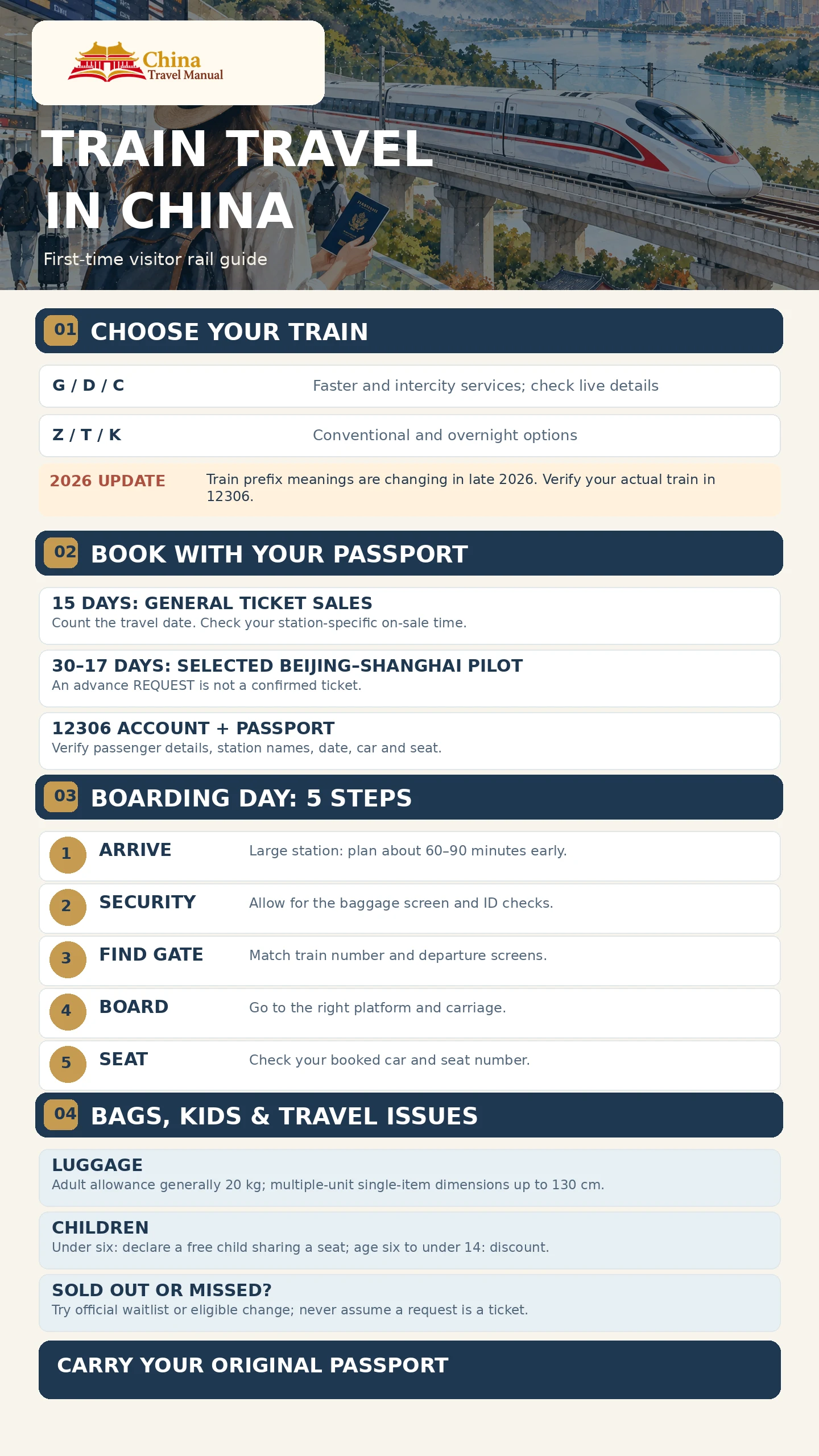
Foreign visitors can travel by train in mainland China using a valid passport. For most first-time trips between major cities, a high-speed train is a practical starting point. China’s official booking platform is Railway 12306, which supports passport-based ticketing and identity verification.[1][2]
- Choose the exact stations: Beijing South and Beijing West, for example, are not interchangeable.
- Select the service and seat: Compare actual journey time, stops and class—not just a train’s letter prefix.
- Book with your passport: Most tickets enter general sale 15 days before travel, including departure day.
- Arrive with time to spare: Pass security, complete identification checks and locate your departure gate.
- Board the assigned carriage: Match your train number, carriage and seat to the confirmed booking.
Your ticket is generally electronic, but you still need the original passport used to buy it. An advance booking request or waitlist is not the same as a confirmed seat.
Train travel is one of the easiest ways to connect Beijing, Xi’an, Shanghai and many other destinations without adding airport transfers to every journey. The process becomes straightforward once you distinguish four things: the service you select, the precise station, a confirmed ticket and the identity document needed at boarding. This guide covers that full journey; detailed screens, fare rules and station layouts belong to their specialist guides.
What Types of Trains Run in China?
High-Speed G, D and C Trains
As of October 2026, travelers commonly encounter G, D and C prefixes on faster passenger services. A G train is generally a high-speed multiple-unit service, a D train can cover several kinds of multiple-unit service, and C is commonly associated with intercity trains. These labels help with orientation but do not replace checking the timetable, stopping pattern and facilities for the actual train.
| Traditional prefix | Common use in October 2026 | What matters when choosing |
|---|---|---|
| G | High-speed service on major corridors | Total duration, stations and stops |
| D | Multiple-unit services, including some overnight services | Actual equipment, speed and sleeper availability |
| C | Intercity routes, often connecting neighboring cities | Frequency, precise station and trip length |
| Z, T, K | Conventional long-distance and express services | Longer duration, fare and possible sleeper berths |
Important 2026 update: China Railway announced a phased train-numbering overhaul for late November and late December 2026, including a new X prefix and changes to the roles of some established prefixes. This table describes commonly understood categories at the research date, not a permanent definition for departures after the change. Search the real train number and amenities in 12306 instead of inferring equipment or speed from one letter.[3]
Conventional and Overnight Sleeper Trains
Conventional services can still suit travelers who value lower fares, intermediate stops or an overnight journey. A sleeper may save a daytime transfer and potentially a hotel night, but you are sleeping on a moving train rather than in a hotel; comfort and privacy vary by carriage.
Traditional hard sleepers usually have more berths per compartment and less privacy. Soft sleepers generally have fewer berths in a compartment and a door. Some D services also offer overnight sleeper accommodation. Not every conventional train carries sleepers, and not every D train is an overnight sleeper. Compare the actual class inventory before choosing. A sleeper can be especially useful when the schedule aligns with your arrival plans, but a restless night or a very early arrival can reduce its value. If you have mobility limitations, check which berth you can safely reach before paying. Our China sleeper trains guide covers the berth layout and overnight trade-offs.
When Should You Take a Train Instead of Flying?
Match the Train to Your Route and Travel Time
Compare hotel-to-hotel time, not just the flight’s scheduled time in the air. A flight also requires airport access, check-in, security and travel from the arrival airport; a train requires station access and boarding procedures. Prices and schedules change, so the examples below are planning patterns rather than live quotations.
| Route | Typical rail decision | Key trade-off |
|---|---|---|
| Beijing–Shanghai | High-speed rail commonly takes around 4.5–6 hours and is often competitive door to door | Check which Beijing and Shanghai stations serve your departure |
| Beijing–Xi’an | Roughly 4.5–6 hours on suitable faster services | Compare station location against flight and airport transfers |
| Shanghai–Hangzhou | Fast intercity services can take roughly an hour or less | Rail is usually simpler than an airport journey |
| Guangzhou–Shenzhen | Frequent short-distance rail connections | Several station pairs exist; the wrong pair can waste time |
A train may also be attractive when summer storms disrupt air travel. However, rail services can also be delayed or cancelled during severe weather. For long routes across western China, air travel may save substantial time. Use China train vs flight for a fuller comparison and China high-speed trains for the network overview.
Choose the Right Railway Station
A city name is not an adequate station name. Beijing South (北京南), Beijing West (北京西) and Beijing Railway Station (北京站) are different terminals. Shanghai Railway Station (上海站) and Shanghai Hongqiao (上海虹桥) are not substitutes either. Their locations, Metro access and available services differ substantially.
Suppose your ticket reads Shanghai Hongqiao → Beijing South. Traveling to Shanghai Railway Station because a map simply says “Shanghai Station” may mean missing the train. Immediately after booking, copy the full departure station name into your map and verify the travel time from your accommodation. When an itinerary includes more than one city, also save each arrival station: a train arriving at Shanghai Hongqiao may place you conveniently near an airport or Metro interchange, but not necessarily near your hotel. Factor in that last urban transfer before comparing two trains with similar journey times. See China railway stations, Beijing South Station and Shanghai Hongqiao Railway Station for station-specific orientation.
Cross-border journeys to Hong Kong West Kowloon deserve a separate check. The high-speed station uses a cross-border immigration process, so a valid train ticket alone does not establish permission to enter mainland China or Hong Kong. Confirm the correct passport and entry eligibility before purchasing. See the Hong Kong West Kowloon Station guide and mainland China, Hong Kong and Macau entry planning rather than applying ordinary domestic-station assumptions.
Which Train Seat or Sleeper Class Should You Book?
Second Class, First Class and Business Class
| Class | Typical experience | Usually suits |
|---|---|---|
| Second class | Standard reclining seat, the usual value choice | Most short and medium-length journeys |
| First class | Wider seat and more space; extras depend on service | Travelers wanting room on longer trips |
| Business class | Premium seating and service on equipped trains | Travelers prioritizing comfort over price |
| Sleeper berth | Lying-flat accommodation on eligible services | Overnight journeys where timing is useful |
Second class is sufficient for most first-time visitors. For a journey of five hours or more, first class may be worth comparing if you value additional space. Business class is substantially more expensive and is not installed on every train. Seat layouts, included refreshments and power outlets vary by train set, so do not assume one universal arrangement.
Sleeper Berths and What Fares Include
For overnight services, examine whether you are booking a hard sleeper, soft sleeper or a sleeper on a multiple-unit train. Upper berths are less convenient to access and may have less headroom; a more private berth generally costs more. Bedding, storage and other facilities depend on the service. A daytime high-speed seat and an overnight sleeper are different travel products—not simply cheaper and more expensive versions of the same seat. The train classes guide and seat selection guide go into the specific options.
How to Buy Train Tickets in China as a Foreigner
Official Ticket Sales and the 15-Day Window
For ordinary ticket sales, the general advance booking window is 15 days, counting the day of travel. For a train departing April 16, that normally means sales open April 2, although the actual release time depends on the station and the railway’s current schedule. Plan routes months ahead if helpful, but do not mistake early planning for a confirmed booking.[1][4][9]
A separate pilot for selected Beijing–Shanghai high-speed and conventional lines allows booking requests from the 30th through the 17th day before departure, effective October 27, 2026. The request must still be fulfilled; it is not a nationwide 30-day confirmed-sales window. The pilot’s details and availability can change.[4]
During Chinese New Year travel peaks, the May Day holiday and the October National Day holiday, prioritize the exact on-sale date and prepare alternative services. A 12306 waitlist can help when tickets are sold out, but confirmation is not guaranteed.
Book with Your Passport on 12306
Foreign visitors can use valid passports through the English 12306 website or app. Complete real-name verification with the required identity details; some users may be asked for a passport-information-page image or verification at a station counter. Online ticket purchases can use supported payment methods, including eligible overseas bank cards.[2]
Choose both stations, travel date, train, passenger and seat class. Use your name and passport number as required by the booking system, checking spelling and document validity carefully. Do not assume capitalization or spacing alone always causes failure; follow the identity-verification prompts. For a family or group, verify every passenger separately and confirm any free child has been declared before checkout. Replacing a passport after booking may require assistance: do not assume the document number can always be edited online after payment. Keep the original confirmation and contact the operator promptly if passenger details or the travel document change. If you are unfamiliar with the platform, follow How to book China train tickets or 12306 for foreign visitors.
Confirmed Tickets vs Booking Requests
A successfully issued ticket appears as a confirmed travel booking for a specific passenger, train, date and seat or berth. An advance reservation request, unfulfilled waitlist or third-party “pending confirmation” notification is not the same thing. Check the actual ticketing status before finalizing a nonrefundable hotel or onward connection.
China uses electronic railway tickets. An itinerary sheet or reimbursement receipt is not a ticket on its own. Bring the original passport used for purchase, even if your phone displays the booking details. The government guide says foreign passengers may use compatible automatic or staffed gates for identity checks; ask station staff if a passport is not recognized at a particular automated gate.[1][2]
How to Board a Train in China Step by Step
Arrive at the Correct Station and Pass Security
For a first trip from a large station, arriving about 60–90 minutes before departure is a sensible planning allowance, especially with luggage or during a holiday. It is travel advice, not a nationwide required check-in deadline. Allow additional time for travel from your hotel and for any passport-verification queue.
- Check the station name: Confirm the full Chinese or English name on the ticket and map.
- Enter the departure hall: Follow signs for departures, not arrivals or a neighboring terminal.
- Complete security screening: All passengers and belongings are subject to station security checks.
- Pass identity verification: Use a working automatic gate or staffed lane with your original passport.
- Locate your waiting area: Find your train number and boarding gate on the screens, then monitor any update.
If you arrive early but a screen has not yet shown a gate, stay near the main departures display and keep watching for updates; the platform and boarding gate may not be available when you first enter. At very large stations, an announcement in Chinese may come before you understand an English translation, so rely on the train number as well as the destination.
Ticket checks stop before scheduled departure, according to the station’s own notices. Do not treat the train departure time as the time you can still begin security screening.[1]
Find Your Gate, Carriage and Seat
Wait for the gate display or announcement to show boarding. After passing the ticket check, follow platform signs and locate the carriage number on the platform markers or train body. Your ticket might say Car 05, Seat 08A; that means carriage 5, seat 8A—not platform 5 or gate 8. Seat-letter layouts vary, so use the labels on the actual train rather than assuming every A seat has identical placement.
Example: Beijing South → Shanghai Hongqiao. A first-time visitor has booked a second-class G service and checks that both stations match the hotel plans. After arriving approximately 75 minutes early, they pass security, show their passport if requested, find the train on the board, board carriage 05 and settle into seat 08A. On arrival, they follow Exit (出站) signs rather than getting off at an intermediate stop. The train time and seat in this example are illustrative, not a live timetable.
For a connection between two different Beijing or Shanghai railway stations, treat that as a separate urban journey. The train transfer guide covers the larger risks.
Luggage, Food and Facilities Onboard
Luggage Limits and Station Security
Under the current 12306 carriage rules, the ordinary adult free carry-on allowance is 20 kg per passenger; an individual item must not weigh more than 20 kg. The sum of an item’s external length, width and height is generally limited to 130 cm on multiple-unit trains; conventional trains have a different size rule. Children have a 10 kg free allowance. Measure your actual suitcase, including protruding parts, rather than assuming every “28-inch suitcase” fits.[5]
Use the dedicated large-luggage racks for larger cases if available, smaller overhead racks for compact luggage, and never block doors or aisles. Restricted items include certain sharp tools, aerosols and batteries. A clearly labeled power bank rated at no more than 100 Wh per unit is generally allowed under the rail rules; do not confuse this with airline rules about certification and checked baggage.[5][6]
Food, Toilets, Power and Connectivity
Bringing your own food and drinks is usually practical for a long trip. Many high-speed services sell meals, snacks and beverages, but availability and prices vary. Toilets are provided; accessible facilities and the exact carriage layout depend on the train. Power outlets are common on modern high-speed services, but type and location are not identical on every train or in every class.
Do not rely on uninterrupted onboard Wi-Fi or mobile reception; tunnels, mountains and remote routes can interrupt connectivity. Download essential booking details and the Chinese station names before boarding. For exact permitted items, see China train luggage rules.
What If Your Train Is Sold Out, Delayed or You Miss a Connection?
Sold-Out Trains, Waitlists and Changes
A popular train being sold out does not always mean the route is impossible. Try 12306’s official waitlist, consider earlier or later trains, or evaluate another date or station pair. Split tickets can sometimes help, but they create more opportunities for missed connections and should not be treated as guaranteed replacements. Do not pay an unofficial seller for a supposed guaranteed seat.
Multi-city example: You plan Beijing → Xi’an → Shanghai two months ahead. Research both rail segments, check the correct stations and identify acceptable departure windows. When each segment reaches its own 15-day sales window, attempt the purchase. If Beijing → Xi’an sells out, use the official waitlist and compare alternatives before allowing a nonrefundable hotel change to trigger additional losses.
Transfers, Delays and Missed Departures
| Problem | Best first action | Important limitation |
|---|---|---|
| Sold-out train | Official waitlist or another service | Waitlist is not a confirmed ticket |
| Service delayed | Check station announcements and official status | Onward independent travel may also be affected |
| You miss departure | Ask immediately about an eligible change | Timing, availability and fees matter |
| Connection requires a different station | Recheck travel time across the city | You may need to exit and clear security again |
| Train cancelled | Follow the operator’s change or refund process | The remedy depends on the notice and booking details |
Under the current 12306 change rules, a passenger may normally make one change; in eligible cases, a missed train can be changed before midnight on its original departure day, with fees depending on the new journey date. A train that departs does not automatically mean all options disappear—but a seat on another train is not guaranteed.[7]
A train and an international flight booked independently usually are not a protected connection. Allow a substantial buffer rather than scheduling a long intercity trip to arrive just before an overseas flight. For the full rules, see train refunds and changes, missed train departures and cancelled train service.
Traveling by Train with Children or Accessibility Needs
China Railway bases ordinary child fares on age, not height. A ticketed adult may normally accompany one child under six free of charge without a separate seat, but that child’s details must be declared at booking. Children aged six to under fourteen generally need a child-discount ticket; those fourteen and older need a full-price ticket. Children who need their own seat require the appropriate paid ticket, and the discount varies by class.[8]
For example, a five-year-old sharing a parent’s seat must still be declared; the family should not simply arrive with an undocumented extra traveler. A 28-inch suitcase must also satisfy the actual dimension and weight rules rather than its retail size label. Foldable strollers and necessary mobility aids have specific provisions.[5][8]
Passengers who use wheelchairs or need boarding assistance should check services offered at the exact station and request support as appropriate. Do not assume every small station or train has identical accessible facilities. See trains with children and China train accessibility for dedicated planning.
FAQs About Train Travel in China
Can I Buy China Train Tickets with a US Passport?
Yes. A valid US passport can be used for real-name ticket purchases through the supported 12306 channels. Complete any required identity verification, and carry the same original passport when traveling.
How Far in Advance Can I Book China Train Tickets?
Most tickets enter ordinary sales 15 days ahead, counting the day of travel. Selected Beijing–Shanghai trains have a separate 30-to-17-day reservation-request pilot, which is not confirmed ticket issuance.
Do I Need a Printed Train Ticket in China?
Generally, no. Most travel uses electronic tickets and the original ID used to book. A printed itinerary or reimbursement document does not replace that identity check.
How Early Should I Arrive at a Chinese Railway Station?
For a first visit to a large station, allow around 60–90 minutes. This is practical advice; follow the actual boarding and gate-closure notices for your train.
Can I Bring a Large Suitcase on a Chinese High-Speed Train?
Yes, if it meets the applicable rules and can be stored safely. For ordinary adults, the free allowance is generally 20 kg, with a 130 cm sum-of-dimensions limit per item on multiple-unit trains and no item heavier than 20 kg.
Sources
[1] China Railway 12306. English Ticketing FAQ
[2] State Council of China. Guide to Working and Living in China — Rail Travel
[3] Beijing Municipal Government. China’s Railways to Introduce New Train Numbers with X-Prefix
[4] China Academy of Railway Sciences. Ticket Reservation Pilot Window Adjustment, September 2026
[5] China Railway 12306. Passenger Luggage Rules
[6] Beijing Municipal Government. Power Banks on High-Speed Trains
[7] China Railway 12306. Ticket Change Rules
[8] China Railway 12306. Child Tickets and Free Travel Declarations
[9] MTR High Speed Rail. 12306 Ticket Sales Window





