

Quick Answer: Do U.S. Tourists Need a Visa for China?
Yes, usually. A U.S. citizen taking an ordinary round trip to visit Beijing, Xi’an and Shanghai generally needs a valid Chinese tourist (L) visa. Check special visa-free policies before applying, because they have route and geographic restrictions.[1][2][3]
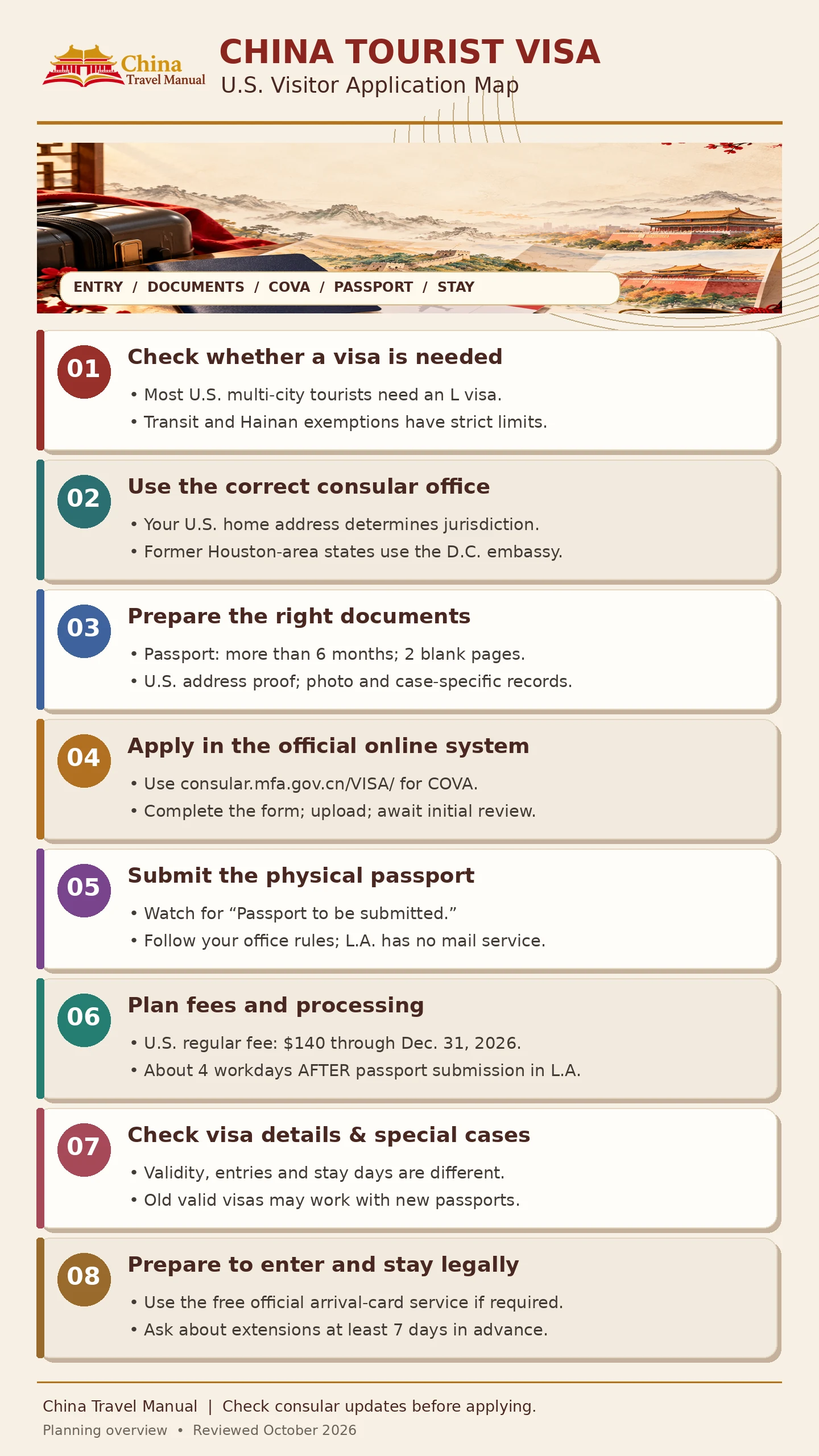
- Check entry eligibility: See whether you already hold a usable visa or qualify for a specific exemption.
- Find your consular jurisdiction: Apply through the Chinese embassy or consulate assigned to your U.S. residence.
- Prepare documents: Have your passport, digital photograph and applicable supporting materials ready.
- Apply online: Complete the official China Online Visa Application and wait for preliminary review.
- Submit your passport: After the required status appears, deliver the passport and specified originals following that office’s instructions.
- Inspect the result: Check the issued visa’s personal details, entries, validity and permitted stay.
U.S.-based L-visa applicants generally do not have to buy flight tickets or reserve hotels to prove their itinerary, so avoid irreversible bookings merely to complete an application.[4]
Most U.S. passport holders planning a conventional sightseeing trip through mainland Chinese cities need a tourist (L) visa before leaving home. The United States is not covered by China’s general 30-day unilateral visa waiver, although qualifying transit itineraries and Hainan-only visits may be eligible for separate exemptions.[1][2]
This guide follows the actual U.S. application sequence: check eligibility, prepare documents, use China’s online visa system, submit your physical passport and inspect the visa before traveling. Rules below were reviewed on October 28, 2026. Confirm the instructions of the Chinese embassy or consulate serving your home address before applying.
Who Needs a China Tourist (L) Visa?
Eligibility depends on the passport you hold, your purpose of travel and the precise route. Being physically in the United States does not make a non-U.S. passport eligible for U.S.-citizen rules.
When an L Visa Is the Right Entry Document
An L visa is issued for tourism in mainland China. It is the usual choice for a U.S. citizen visiting cities such as Beijing, Shanghai, Xi’an or Chengdu for sightseeing, without qualifying for a separate entry exemption. The L category is not a substitute for permission to work, study or undertake activities requiring another visa category.[5]
Before applying, check whether you already have a valid Chinese visa in your current or former passport. Also confirm that your proposed route does not meet a specific exemption. A visa application is not automatically necessary for every possible U.S.-passport trip to mainland China.
Visa-Free Transit and Hainan Exceptions
| Entry arrangement | Main conditions | Geographic and time limits |
|---|---|---|
| Tourist L visa | Visa issued for an appropriate tourism trip | Follow the entries, validity and duration shown on the issued visa |
| 240-hour visa-free transit | Eligible nationality, designated entry port and confirmed onward journey to a third country or region | Up to 240 hours in permitted mainland areas, not unrestricted nationwide travel |
| 30-day Hainan visa exemption | Eligible passport, permitted entry through an open Hainan port and qualifying visit | Up to 30 days within Hainan Province only |
U.S. citizens are included in both the 240-hour transit scheme and the separate Hainan exemption. Sightseeing is permitted on qualifying transit visits, but the onward journey and permitted region are decisive. A straightforward United States–Shanghai–United States holiday does not become visa-free transit simply because it lasts less than ten days. Similarly, Hainan-only visa-free entry cannot be treated as permission to continue to Beijing or Shanghai.[2][3]
China Tourist Visa Requirements and Documents
The official list for your particular consular office controls. Below are the common U.S.-based application requirements, separated from documents needed only in particular circumstances.
Passport, Photo and Proof of Residence
| Document | What to check |
|---|---|
| Passport | More than six months’ remaining validity and at least two blank visa pages; upload the information and required blank-page images |
| Visa photograph | A recent compliant digital image for the online form; bring a printed photograph if your office or the system requests one |
| U.S. address evidence | Proof such as a driver’s license, utility bill or bank statement showing residence in the chosen consular jurisdiction |
| Previous Chinese visa or permit | Upload the latest one, if applicable; an old passport containing a currently valid visa may need to be presented |
| Additional identity records | Proof of lawful U.S. residence for non-U.S. citizens, or name-change, naturalization or parent/child documents when applicable |
The Chinese embassy’s published application requirements specify passport validity, blank pages and the address and previous-visa evidence. The exact digital files and originals can differ by applicant and office.[5]
Do not assume every applicant must bring an extra paper photograph or undergo an interview. Follow the current status page and the specific consulate’s physical-document list. If you have changed your name or previously held Chinese nationality, read the special-case section before submitting.
Are Flight, Hotel and Invitation Documents Required?
For L-visa applicants applying within the United States, Chinese embassies and consulates removed the routine requirement for round-trip flight reservations, hotel confirmations, a travel itinerary and an invitation letter effective January 1, 2024. Consular officers may still request supplementary information in an individual case.[4]
That distinction matters: booking a nonrefundable international flight is not a standard prerequisite for filing an ordinary U.S.-based tourist visa application. When your visa is settled, our China trip planning guide can help organize the remaining travel arrangements. This simplification applies to the U.S. application process; do not assume that the document lists published by Chinese visa centers in other countries are identical.
How to Apply for a China Tourist Visa in the United States
China’s official online system handles form completion and document review, not the entire issuance process. An applicant must still follow the selected consular office’s instructions for submitting a physical passport.[6]
Choose the Correct Chinese Embassy or Consulate
Choose the office based on where you live in the United States, not where your international flight departs. The official jurisdiction map separates northern California from southern California and assigns the states formerly under Houston to the Chinese Embassy in Washington, D.C.; the Houston consulate is not a current U.S. visa application office.[7]
| Consular office | Examples of covered locations |
|---|---|
| Embassy in Washington, D.C. | D.C., Maryland, Virginia, Texas, Florida, Georgia and other former Houston-area states |
| New York | New York, New Jersey, Pennsylvania and much of the Northeast |
| Chicago | Illinois, Michigan, Minnesota and several Midwestern states |
| San Francisco | Northern California, Washington, Oregon, Nevada and Alaska |
| Los Angeles | Southern California, Arizona, Colorado, Hawaii and designated Pacific islands |
This is not a complete state-by-state jurisdiction list. Use the official consular jurisdiction directory to identify the correct office before creating the application.
Complete the Online COVA Form and Upload Documents
- Open the official China Online Visa Application portal, create an account and choose the correct embassy or consulate.
- Select the tourist L category and accurately enter your passport details, personal information, address, work and education history, intended visit and previous travel details.
- Upload the photograph and supporting records requested by the portal. Its image-format and photo checks may require you to crop or replace files.
- Review names, passport numbers, dates and office selection carefully; submit the application for preliminary online review, then check the status regularly.
The embassy’s portal guidance identifies nine main form sections and specifically instructs applicants to verify automatically recognized passport details. Online-upload materials may need to be supplied as image files rather than PDFs. If the system asks for amendments or supplementary materials, respond through the online account.[6]
Submit Your Passport After Preliminary Review
When your application displays Passport to be submitted, print the status page showing the barcode, then take the original passport and any required physical records to the correct visa office. Online preliminary clearance does not mean the visa has been issued.[8]
For Los Angeles, the consulate says applicants or authorized representatives may submit materials and collect passports without appointments. It does not accept mailed applications or mail passports back. It also states that fingerprints are not currently required for its visa applications, although a consular interview or extra documentation may be requested in particular cases. Other offices’ handling arrangements must be checked separately.[8][9]
A Los Angeles application can be automatically cancelled if the requested passport is not submitted within 30 days of the relevant status change, or if required online corrections are not supplied within 30 days. Do not leave the approved preliminary application unattended.[8]
Collect Your Passport and Inspect the Visa
Follow your consular office’s collection instructions. In Los Angeles, the system identifies when a passport is ready for collection and the applicant or representative brings the pickup slip. Check the finished visa immediately for the correct name, passport number, L category, number of entries, last entry date and duration allowed for each stay.[9]
If a printed detail is incorrect, contact the issuing office before travel. Consular authorities determine whether a visa will be issued and its conditions; asking for a longer-validity or multiple-entry visa does not guarantee that result.
China Tourist Visa Fees and Processing Times
An application includes a separate online preliminary review and the passport-submission stage. Budget time for both, plus holidays, supplementary requests and return travel to the consular office.
How Much Does a China Tourist Visa Cost?
The announced regular-service fee for a U.S. citizen applying at a Chinese embassy or consulate in the United States is US$140, regardless of whether a single-, double- or multiple-entry visa is issued. This reduced-fee schedule is presently published through December 31, 2026. For some non-U.S. nationals the rate differs; expedited services and private agency fees are additional.[10]
A published standard express-service surcharge is US$25 where available. Verify payment methods with your own consular office: do not assume every office accepts cash, checks, mail or an online payment.[10]
How Long Does Visa Processing Take?
The Los Angeles consulate describes approximately four working days for final processing after online preliminary review and physical passport submission. This figure does not include the initial online review, time waiting for corrections or transport of documents. An individual case can take longer.[8]
Its September 2026 FAQ recommends applying roughly one to two months before departure. Treat that as a planning window, not a promise of issuance. If your travel date is near, check office holidays, current status and approved expedited-service rules directly; do not build a trip around the assumption that a visa will arrive within four days of starting the online form.
Tourist Visa Validity, Entries and Length of Stay
These three fields are separate. Confusing them can lead to a missed entry date or an overstay.
What Validity, Entries and Duration of Stay Mean
| Visa field | What it means | Common mistake |
|---|---|---|
| Enter Before / validity | The last date on which the visa permits entry, subject to its conditions | Assuming this is the last day of the permitted stay |
| Entries | How many times the visa can be used to enter mainland China during validity | Believing a single-entry visa can cover two separate mainland entries |
| Duration of Each Stay | The maximum stay allowed after each admission, as printed on the visa | Treating a long-validity visa as permission to live in China continuously |
For an ordinary Chinese visa, the duration of stay is generally counted from the day after entry. For example, a ten-year, multiple-entry L visa marked with a 90-day duration of each stay permits eligible entries during its validity, but normally no more than 90 days per visit—not a ten-year continuous visit.[11]
Can U.S. Citizens Get a 10-Year Multiple-Entry Visa?
Eligible U.S. citizens can apply for a long-validity multiple-entry tourist visa. However, the Chinese issuing authority decides its actual validity, number of entries and permitted duration of each stay. A ten-year visa is not guaranteed, and one expiring passport or changed identity details may affect future use.[9]
Keep your visa and the admission stamp or immigration record available during travel. Having a still-valid visa does not override a border officer’s authority to decide whether entry is permitted under the applicable rules.
Special Cases and Common Application Problems
Some applicants need additional evidence even when the basic tourist itinerary is straightforward.
Using a Valid Chinese Visa in an Expired Passport
An undamaged, still-valid Chinese visa in a cancelled or expired passport can generally be used together with a valid new passport when the holder’s relevant personal details remain unchanged and the purpose of travel matches the visa. Carry both original passports.[9]
If your name, nationality or other key identity details changed, or the old visa is lost or damaged, ask the responsible consulate whether a new visa is required. The Los Angeles consulate specifically cautions against making an unnecessary fresh application when an existing visa remains usable.[9]
Minors, Former Chinese Nationals and Non-U.S. Residents
Children may need birth records, parent or guardian documentation, and documents concerning parental nationality or immigration status. People who formerly held Chinese nationality may need their previous Chinese passport and naturalization certificate. A non-U.S. passport holder living in the United States may need proof of lawful U.S. residence and will be assessed under their own nationality’s rules.[5]
For children born in the United States to Chinese parents, citizenship status and the appropriate travel document can require a separate assessment. Do not assume every child of Chinese heritage is eligible for the same ordinary L-visa process. Ask the assigned consular office about the individual case.
After Your Visa Is Issued: Entry and Extensions
Entry Checks and the Arrival Card
For more on destinations and lodging, see our China destinations guide and accommodation guide. Carry your current passport, usable visa (and old passport if the valid visa is in it), plus a simple record of your accommodation and onward travel details. A valid visa is not an unconditional guarantee of admission.
China introduced a free online foreigner arrival-card service on November 20, 2025. Travelers who need to complete an arrival card can use the official National Immigration Administration form; paper and on-arrival options remain available, and certain travelers are exempt. Beware of third-party sites charging for the form.[12]
What If You Need to Extend Your Stay?
If you cannot leave before the authorized stay expires, contact the local public security exit-entry administration promptly. China’s Exit and Entry Administration Law states that a request to extend a visa’s duration of stay should be filed seven days before the authorized period expires, with supporting information. Approval is not automatic, and refusal means you must depart within the allowed period.[13]
Do not confuse an L visa’s multi-year validity with permission to remain beyond its per-entry duration. Overstaying can lead to legal penalties and future immigration difficulties.
China Tourist Visa Application Checklist
- Confirm whether your trip needs an L visa or qualifies for a specifically applicable exemption.
- Check existing visas, including any in an old passport.
- Select your embassy or consulate using your U.S. home address.
- Prepare a passport with more than six months of validity and two blank visa pages.
- Collect the photograph, address proof and any case-specific identity records.
- Complete and review the official online application before submitting it.
- Wait for the proper status, then submit the original passport and required paper records.
- Confirm fee, pickup arrangements and processing updates with your office.
- Inspect the issued visa’s name, category, entries, validity and stay duration.
- Recheck arrival-card and entry requirements shortly before departure.
FAQs About China Tourist Visas
Can U.S. Citizens Get a Chinese Visa on Arrival?
Do not assume an ordinary U.S. tourist can arrive in Beijing or Shanghai and receive an L visa at the border. Mainland port visas have separate qualifying circumstances, while 240-hour visa-free transit is an exemption rather than a tourist visa issued on arrival. Check eligibility for the actual route before boarding.[2]
Do I Need to Book Flights Before Applying for an L Visa?
No routine round-trip airline booking, hotel reservation, itinerary or invitation letter is required for a U.S.-based L-visa application under the 2024 document simplification. A consular officer may still seek extra evidence in a particular case. Avoid making nonrefundable bookings solely to satisfy an obsolete checklist.[4]
How Early Should I Apply for a Chinese Tourist Visa?
The Chinese consulate in Los Angeles recommends roughly one to two months before travel. Allow for online preliminary review, any corrections, physical passport submission and retrieval. Its approximately four-working-day standard processing estimate starts after physical submission, not when you first begin the online application.[8]
Does a Mainland China Visa Cover Hong Kong and Macau?
Mainland China, Hong Kong and Macao have separate entry arrangements. U.S. passport holders may be eligible for visa-free visits to Hong Kong and Macao under those jurisdictions’ rules, but returning from either one to mainland China is another mainland entry. Check that you have a suitable multiple-entry visa or an independent entry exemption before making that route.[14][15]
Sources
[1] National Immigration Administration. List of Countries Covered by Unilateral Visa Exemption Policies
[2] National Immigration Administration. Visa-Free Transit Policies, August 2026
[3] National Immigration Administration. Regional Visa-Free Entry Policies for Foreign Nationals, August 2026
[4] Chinese Embassy in the United States. Tourist Visa (L-Visa) Application Documents to be Simplified
[5] Chinese Embassy in the United States. Requirements and Procedures for Chinese Visa Application
[6] Chinese Embassy in the United States. Guidelines for China Online VISA Application
[7] Chinese Embassy in the United States. The Consular Jurisdiction of Chinese Embassy and Consulates General in the United States
[8] Chinese Consulate-General in Los Angeles. Frequently Asked Questions on Chinese Visa Applications, September 2026
[9] Chinese Consulate-General in Los Angeles. Apply for Ordinary Visas, updated March 2026
[10] Chinese Embassy in the United States. Notice on Extension of Visa-Fee Reduction
[11] National Immigration Administration. How to Identify and Calculate Validity Period and Duration of Permitted Stay of Foreigners’ Visas
[12] National Immigration Administration. Beware of Fraudulent Websites for Arrival Card Filling
[13] National Immigration Administration. Exit and Entry Administration Law of the People’s Republic of China, Article 29
[14] Hong Kong Immigration Department. Visit Visa / Entry Permit Requirements
[15] Macao Government Tourism Office. Entry Requirements





