

Quick Answer: Planning Your First Trip to Chengdu
Plan three full sightseeing days for your first trip to Chengdu: two for city highlights and one for a separate day trip to Dujiangyan, Mount Qingcheng or Leshan. Reserve the giant panda base in advance and aim for a morning visit. Stay near Chunxi Road, Taikoo Li or Tianfu Square if you want easy dining and metro access.
- Top sights: Panda base, Wuhou Shrine and free-to-walk Jinli, Kuanzhai Alleys, People’s Park and Du Fu Thatched Cottage.
- Airports: Tianfu (TFU) and Shuangliu (CTU) are different airports with different transit routes.
- Food: Try hot pot, mapo tofu, noodles and teahouse culture; not every Sichuan dish is spicy.
- Day trips: Choose one main destination per day instead of compressing distant sites together.
Allow separate time for airport transfers and hotel check-in. Confirm current admission rules and carry the identification used to book your tickets.
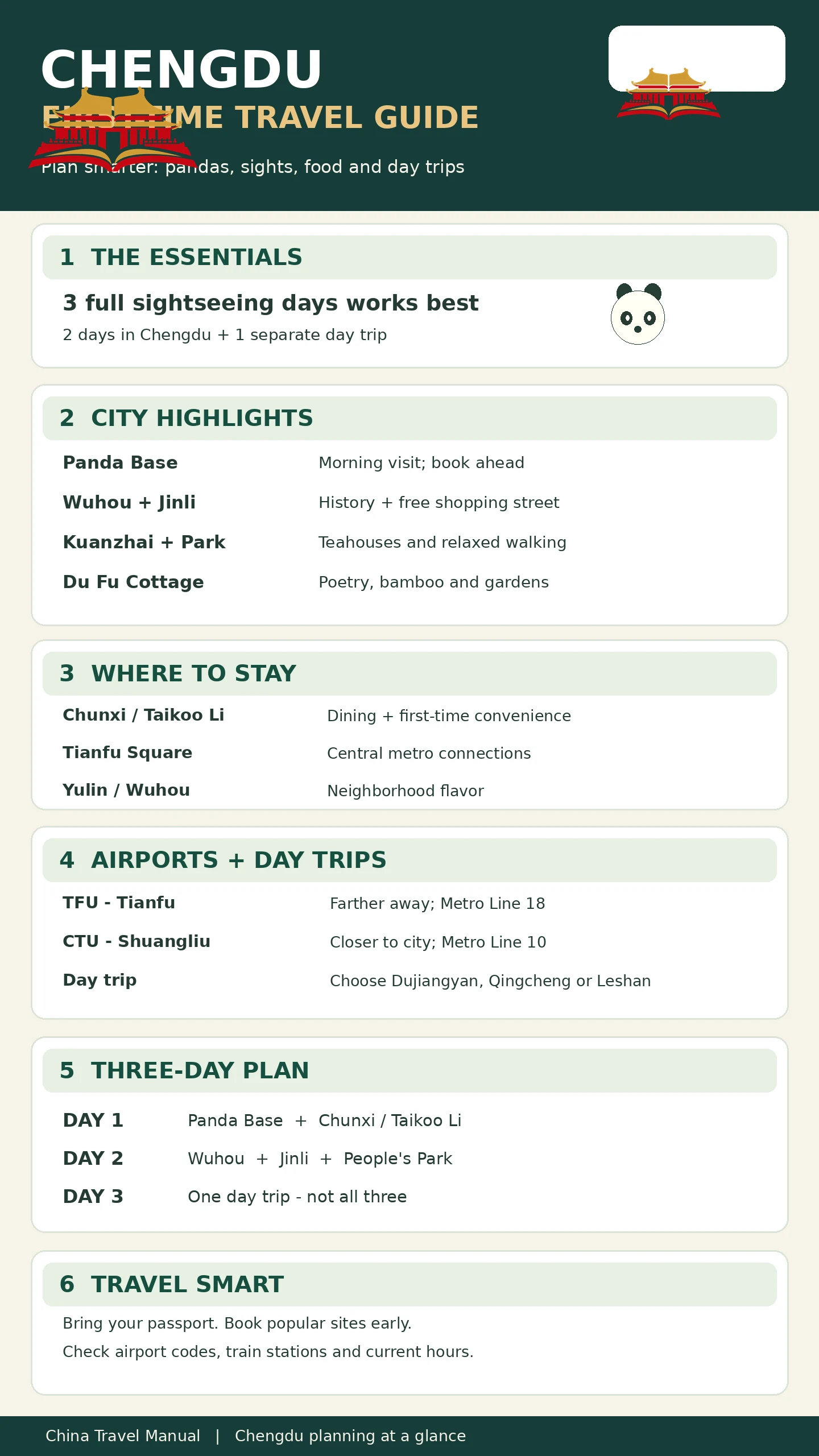
Chengdu, the capital of Sichuan Province in southwest China, combines giant pandas, Three Kingdoms history, teahouses and distinctive food with practical access to remarkable nearby landscapes. This guide helps first-time independent travelers choose the experiences that fit their interests, decide where to stay and build a realistic schedule. For a broader regional plan, pair it with your Sichuan travel research rather than treating every nearby attraction as a downtown stop.
Chengdu at a Glance
Where Is Chengdu?
Chengdu lies on the western side of the Sichuan Basin and operates on China Standard Time (UTC+8). It is a major starting point for journeys toward western Sichuan, Jiuzhaigou, Mount Emei and other destinations. For short visits, the city itself offers enough to fill two days without leaving the metropolitan area. Longer visits benefit from one dedicated day outside the city.
The city has two different airports, Tianfu International (TFU) and Shuangliu International (CTU). They should never be treated as interchangeable. Check the airport code, the name printed on your flight reservation and the railway station printed on any train ticket before arranging transport.
Why Visit Chengdu?
For many travelers, the immediate draw is seeing giant pandas in a research and breeding setting. Yet the city is also a rewarding place to explore the history of the Shu-Han kingdom, encounter everyday teahouse traditions and try Sichuan food beyond hot pot. The combination of heritage sites, contemporary shopping districts and slower neighborhood life gives Chengdu a broader appeal than a single-attraction destination.
Use Things to Do in Chengdu for a wider attraction shortlist; the recommendations here prioritize experiences that fit comfortably into a first visit.
How Many Days Do You Need?
| Time available | What it can reasonably cover | Best choice |
|---|---|---|
| One full day | Panda base in the morning and one central-city cluster | A rushed stopover |
| Two full days | Pandas, Wuhou Shrine and Jinli, plus a teahouse or central neighborhoods | Short first visit |
| Three full days | Two city days and one day trip to Dujiangyan, Mount Qingcheng or Leshan | Most first-time visitors |
| Four or five days | A slower city rhythm and another separate day trip | Travelers interested in history, food and nature |
These are full sightseeing days, not arrival and departure days. A flight landing, baggage collection, a long transfer from Tianfu Airport and hotel check-in can consume a substantial part of a calendar day. For a detailed version of the three-day plan, see 3 Days in Chengdu.
Best Things to Do in Chengdu
Chengdu Giant Panda Base
The Chengdu Research Base of Giant Panda Breeding is the most common first stop for panda-focused visitors. Allow approximately three to four hours for the visit, plus transfers. Try to enter in the morning, particularly in warm weather, when cooler temperatures can improve the chance of seeing pandas outdoors. Animal activity varies, however, and no visit guarantees an encounter with a particular panda.
The base uses real-name ticket reservations, with reservations ordinarily offered up to 14 days ahead and separate morning and afternoon entry sessions. Its published entry timetable starts at 7:30 a.m. in March–October and 8:00 a.m. in November–February. The official ticket page also describes limited reservation exemptions for qualifying older visitors and young children; check the applicable conditions rather than assuming they apply universally. Carry the identification used for your booking. [1]
The Chengdu base and Panda Valley near Dujiangyan are separate places with separate admission arrangements. For entrance choice, ticket platforms, accessibility and on-site routes, use the dedicated Chengdu Panda Base Visitor Guide.
Wuhou Shrine and Jinli Ancient Street
Wuhou Shrine is a ticketed museum and garden devoted to the history of the Three Kingdoms, including Zhuge Liang and Liu Bei. Allocate roughly 90 minutes to two hours if you enjoy historic courtyards, inscriptions and the stories associated with the Shu-Han kingdom. It is better approached as a cultural site than as a quick photo stop.
Adjacent Jinli is a traditional-style shopping and snack street that visitors can walk through without buying a general street admission ticket. Restaurants, shops and activities have their own charges. The reconstructed commercial atmosphere is different from the museum next door. Visit the shrine first, then spend 45–90 minutes exploring Jinli, especially toward evening when the lanterns are illuminated.
Kuanzhai Alleys and People’s Park
Kuanzhai Alleys refers to a group of historic-style lanes with teahouses, courtyards, shops and cafés. Walking the public streets is free, while individual businesses charge for their services. The architecture has undergone restoration and commercial redevelopment, so the district should not be presented as an untouched Qing-era neighborhood. Crowds can be substantial on holidays.
People’s Park offers a different kind of experience: local residents sitting over covered-bowl tea, strolling gardens and meeting friends. Park entry is generally free, but tea, snacks and activities such as ear cleaning cost extra. Put the park and Kuanzhai Alleys in the same part of your day; you will get a useful contrast between daily leisure culture and a more commercial visitor district. Explore the Chengdu People’s Park Visitor Guide for a dedicated visit.
Du Fu Thatched Cottage
Du Fu Thatched Cottage is a ticketed museum and landscaped memorial to the Tang-dynasty poet Du Fu. It combines reconstructed architectural settings, poetry-related exhibits, bamboo gardens and quiet paths. Plan around 90 minutes to two hours. It suits visitors who appreciate literature, classical garden design and places that reward a slower pace. It can be paired with another west-side city attraction, but do not assume all central Chengdu sights are within a short walk of one another.
Chunxi Road, Taikoo Li and Evening Chengdu
Chunxi Road and Taikoo Li form one of central Chengdu’s most convenient shopping and dining areas. The public streets and shopping district can be explored without an attraction ticket. Expect restaurants, modern retail, cafés and a strong contrast with the city’s heritage sites. For many first-time visitors, it is an easy place for dinner after a day at the panda base.
If shopping is not your priority, keep the stop short. Yulin and other residential neighborhoods can give you a different evening atmosphere, with smaller restaurants and local streets. For activities after dark, see Chengdu at Night.
Best Day Trips from Chengdu
The main excursions are well outside downtown Chengdu. Treat each as a substantial trip that requires transport planning and suitable weather; none is a casual metro stop a few minutes beyond the city center. UNESCO recognizes both Mount Qingcheng with the Dujiangyan Irrigation System and the Leshan Giant Buddha within its corresponding World Heritage listings. [2][3]
Dujiangyan and Mount Qingcheng
The Dujiangyan Irrigation System demonstrates ancient water engineering on the Min River. It is a good choice for visitors interested in history, hydraulic engineering and scenery, with roughly three hours as a starting point for the main site. Mount Qingcheng adds forested trails and Taoist heritage. Its front mountain emphasizes temples and more established tourist paths, while the back mountain can require more extensive walking.
The two destinations are often combined, but seeing both thoroughly in one day can be tiring once transfers and uphill sections are included. If you prefer an unhurried visit, choose one. Start with the Dujiangyan Irrigation System Visitor Guide or Qingcheng Mountain Visitor Guide depending on your interest.
Leshan Giant Buddha
Leshan’s monumental cliff-carved Buddha offers a very different day from Chengdu’s urban attractions. Visitors may be able to view the statue from land routes or from a sightseeing boat, but walking access and cruise operations depend on water levels, weather, maintenance and crowd controls. Allow a dedicated day and check arrangements before departure. [3]
Because Leshan is farther away, avoid combining it with Dujiangyan or Mount Qingcheng on a first-time one-day excursion. The Leshan Giant Buddha Visitor Guide covers the on-site choices.
Panda Valley and Other Alternatives
Panda Valley near Dujiangyan is an alternative panda-focused park rather than a second gate of Chengdu Panda Base. It may appeal to visitors already planning the Dujiangyan area or seeking a different environment. Tickets and reservation conditions are separate. A typical first-time visitor who mainly wants to see pandas can choose one panda destination without feeling obliged to visit both. For more options, consult Day Trips from Chengdu.
Where to Stay in Chengdu
For a two- to four-day first visit, choose a neighborhood with a metro station within comfortable walking distance. A slightly more central room often saves repeated transfers, whereas an airport-adjacent hotel may be a poor base for sightseeing. The best choice depends on whether you value restaurants, quiet streets or an early train departure.
| Area | Good for | Trade-off |
|---|---|---|
| Chunxi Road / Taikoo Li | First-time visitors who want food, shopping and evening options | Busy streets and potentially noisy hotel locations |
| Tianfu Square | Travelers planning multiple metro journeys in different directions | Less neighborhood atmosphere than the dining districts |
| Kuanzhai Alleys / People’s Park | Teahouses, heritage-style streets and walking | Crowds, narrower roads and busier visitor accommodation |
| Wuhou Shrine / Yulin | Local restaurants and a more residential rhythm | Longer journeys to some major sites |
| Chengdu East Railway Station | Early departures or very short rail stopovers | Less convenient as a base for classic downtown sightseeing |
For most newcomers, Chunxi Road or Tianfu Square is the simplest starting point. Travelers spending four or five nights may enjoy the slower character of Yulin. Neighborhood-level accommodation choices are developed in Where to Stay in Chengdu.
Getting to and Around Chengdu
Tianfu Airport vs. Shuangliu Airport
Chengdu has two major airports. Tianfu International Airport (TFU) is farther from the city center and is particularly important for international services; Shuangliu International Airport (CTU) is closer to established central districts and serves many domestic flights as well as some international routes. Their locations, metro connections and transfer times differ considerably.
| Airport | Main metro connection | Planning note |
|---|---|---|
| Tianfu (TFU) | Line 18, with other airport-area rail links including Line 19 | Allow for a longer journey and at least one additional transfer for many hotels |
| Shuangliu (CTU) | Line 10, with connecting network services | Often a shorter ground trip to central Chengdu, but not direct to every hotel |
An airport-to-hotel journey includes walking out of the terminal, reaching the metro, waiting for trains, transfers and the final walk or taxi ride. The train running time alone is not an honest door-to-door estimate. See Chengdu Tianfu Airport Guide or Chengdu Shuangliu Airport Guide for airport-specific orientation.
Chengdu Railway Stations
Chengdu East is a major high-speed rail hub, but it is not the only station serving regional and longer-distance trains. Chengdu South and Chengdu West have distinct roles, while railway service patterns may also change at other urban stations. The name printed on the 12306 booking is decisive. A train to another Sichuan city may depart from a station different from the one used for an earlier journey.
For transfer and boarding specifics, see Chengdu East Railway Station Guide. Check the timetable for the exact travel date rather than trusting a static citywide station list.
Metro, Taxis, DiDi and Walking
Metro is usually the most predictable choice for longer cross-city trips, while walking suits compact central clusters such as People’s Park and nearby streets. Chengdu added the first phases of Metro Lines 13 and 30 in December 2025, making some older online network diagrams outdated. Look up the current route and exit rather than navigating from a saved historic map. [4]
Taxis and ride-hailing are particularly useful with luggage, children or late-night plans, but rush-hour road traffic can be slow. Confirm the Chinese destination and pickup location. A foreign-issued card may work through some payment services, but do not assume every overseas card can tap directly at the metro gates. The Getting Around Chengdu page compares the practical choices in more detail.
What to Eat in Chengdu
Hot Pot and Classic Sichuan Dishes
Sichuan hot pot is an experience as much as a meal, with richly seasoned broth, vegetables, mushrooms and a range of meats or tofu. Depending on the restaurant, visitors can order a divided pot with spicy and milder sections. The sensation called málà (麻辣) combines chili heat with the tingling effect of Sichuan peppercorns. It is not simply a synonym for extreme spiciness.
Other recognizable dishes include mapo tofu, dan dan noodles, Zhong dumplings dressed in sweet-spicy chili oil and Sichuan-style wontons known as long chaoshou. Chuan chuan xiang involves ingredients served on skewers, sometimes priced by skewer count or category. Ask about the pricing system before ordering several rounds. For preparation and choices, use What to Eat in Chengdu.
Street Food, Snacks and Teahouses
Chengdu is closely associated with leisurely tea drinking. A covered-bowl tea, or gaiwan cha (盖碗茶), in a public park or neighborhood teahouse can be just as memorable as an elaborate restaurant meal. Tea, snacks and additional services are charged separately even when access to a park is free.
The streets around Jinli, Chunxi Road and Yulin offer different food environments, from visitor-focused snacks to everyday neighborhood meals. Sichuan opera face-changing performances are another option, but individual showtimes, ticket packages and venues change. The Chengdu Teahouse Guide helps readers choose a style of tea experience.
Spice Levels and Dietary Considerations
Not all Sichuan dishes are spicy, and not every sauce can simply be made mild. Ask before ordering if you avoid chili, pork, sesame, peanuts or animal-based stock. Mapo tofu often includes minced meat, and hot-pot bases may contain animal fat. A visually meat-free dish is not necessarily vegetarian. Restaurants should confirm ingredients and cross-contact risks for serious allergies; if they cannot, choose a safer option.
Chengdu Itineraries: 1 to 4 Days
One or Two Days in Chengdu
With one full day, put the panda base first and choose only one meaningful central-city cluster for the afternoon. Wuhou Shrine with Jinli works well for history; People’s Park with Kuanzhai Alleys works for teahouse culture and walking. Add dinner near the hotel rather than crossing the city again just to fit one more attraction.
For two full days, make the first day pandas followed by Chunxi Road or Taikoo Li. On the second, visit Wuhou Shrine and Jinli, then enjoy tea at People’s Park or browse Kuanzhai Alleys. This covers the city’s key themes without requiring a day trip.
Three Days in Chengdu
| Day | Morning | Afternoon / evening |
|---|---|---|
| Day 1 | Chengdu Giant Panda Base | Chunxi Road or Taikoo Li; Sichuan dinner |
| Day 2 | Wuhou Shrine and Jinli | People’s Park and Kuanzhai Alleys |
| Day 3 | One main day-trip destination | Return to Chengdu; keep the evening flexible |
On the third day, choose Dujiangyan, Mount Qingcheng or Leshan according to your interests. Combining Dujiangyan and a short Mount Qingcheng visit is possible for energetic travelers with a carefully planned route, but it should not be treated as an easy default. Do not combine Leshan with the other two in the same day.
Four Days or More
Add Du Fu Thatched Cottage, a slower Yulin neighborhood afternoon or another separate out-of-town trip. Four days creates breathing room for rainy weather, a delayed transport connection or simply a long teahouse lunch. Five days lets you devote one day to each of two nearby destinations instead of compressing them into a single excursion.
Best Time to Visit Chengdu
Weather and Seasons
| Season | Typical conditions | What to prioritize |
|---|---|---|
| Spring (March–May) | Generally mild, with occasional showers | Pandas, gardens and city walking |
| Summer (June–August) | Humid, warm and often rainy | Early panda visits and indoor breaks |
| Autumn (September–November) | Often comfortable, but cloud and rain remain possible | Teahouses, museums and day trips |
| Winter (December–February) | Cool, damp and frequently gray | Warm layers and careful seasonal opening checks |
Pandas may be easier to see outdoors during cooler periods, but temperature and animal routines affect individual behavior more than a simple seasonal promise. In summer, a morning reservation improves your odds without guaranteeing an outdoor encounter.
Holidays, Crowds and Panda Viewing
Chinese public holidays can bring heavy visitor traffic to the panda base, Dujiangyan and major city attractions. Popular train seats and time-slot tickets may sell out. Reserve important admissions once your dates are firm, and leave extra travel time around major holidays. Recheck the panda base’s official information because entry windows, capacity controls and limited facility closures can change. [1]
Practical Chengdu Travel Tips for Foreign Visitors
- Keep documents ready: Carry the passport used for reservations and check your visa or applicable visa-free entry conditions before travel.
- Set up payment: Activate a payment option usable in mainland China and keep some yuan cash for contingencies; direct international-card acceptance varies.
- Save Chinese names: Keep hotel addresses, attraction names and airport codes on your phone for drivers and station staff.
- Plan for distance: TFU, the panda base and major railway stations can be far apart; include station walks and waiting time in your schedule.
- Check accessibility: Elevators and step-free routes vary by entrance, and transport hubs may involve long walks.
- Protect the itinerary: Confirm opening notices, day-trip access and major bookings a few days before departure.
For day-by-day adjustments, leave room for weather, spontaneous neighborhood meals and the pace that makes Chengdu enjoyable. An independent traveler does not need to fill every hour to make a three-day stay worthwhile.
FAQs About Traveling to Chengdu
Is Chengdu worth visiting?
Yes. Chengdu combines giant pandas, Three Kingdoms heritage, Sichuan food, teahouse culture and access to day trips such as Dujiangyan and Leshan. It suits both a short city break and a longer Sichuan journey.
How many days should I spend in Chengdu?
Three full sightseeing days are a strong first-trip choice: two for the city and one for a day trip. One day is rushed, while four or five allows a slower pace and another excursion.
Where is the best area to stay in Chengdu?
Chunxi Road and Taikoo Li are convenient for restaurants and shopping; Tianfu Square is practical for metro-based sightseeing. Yulin and the Wuhou area suit visitors seeking a more residential atmosphere.
Do I need to book Chengdu Panda Base tickets?
Ordinary visitors should book a real-name admission ticket in advance. The official booking window is generally up to 14 days, and morning and afternoon entry sessions have seasonal hours. Check current exceptions and carry the booking ID document.
Which Chengdu airport should I use?
Check the airport on your ticket: TFU is Tianfu International Airport, farther from downtown, while CTU is Shuangliu International Airport, closer to central Chengdu. Their ground-transfer routes differ.
Can I visit Leshan or Dujiangyan on a day trip?
Yes, each can work as a separate day trip. They are in different directions, so trying to include both in a single day is not a sensible default for first-time travelers.
Sources
[1] Chengdu Research Base of Giant Panda Breeding. Official Tickets and Reservations
[2] UNESCO World Heritage Centre. Mount Qingcheng and the Dujiangyan Irrigation System
[3] UNESCO World Heritage Centre. Mount Emei Scenic Area, including Leshan Giant Buddha Scenic Area
[4] CRRC. Chengdu Metro Lines 13 and 30 Open





