

Quick Answer: How to Get Around China
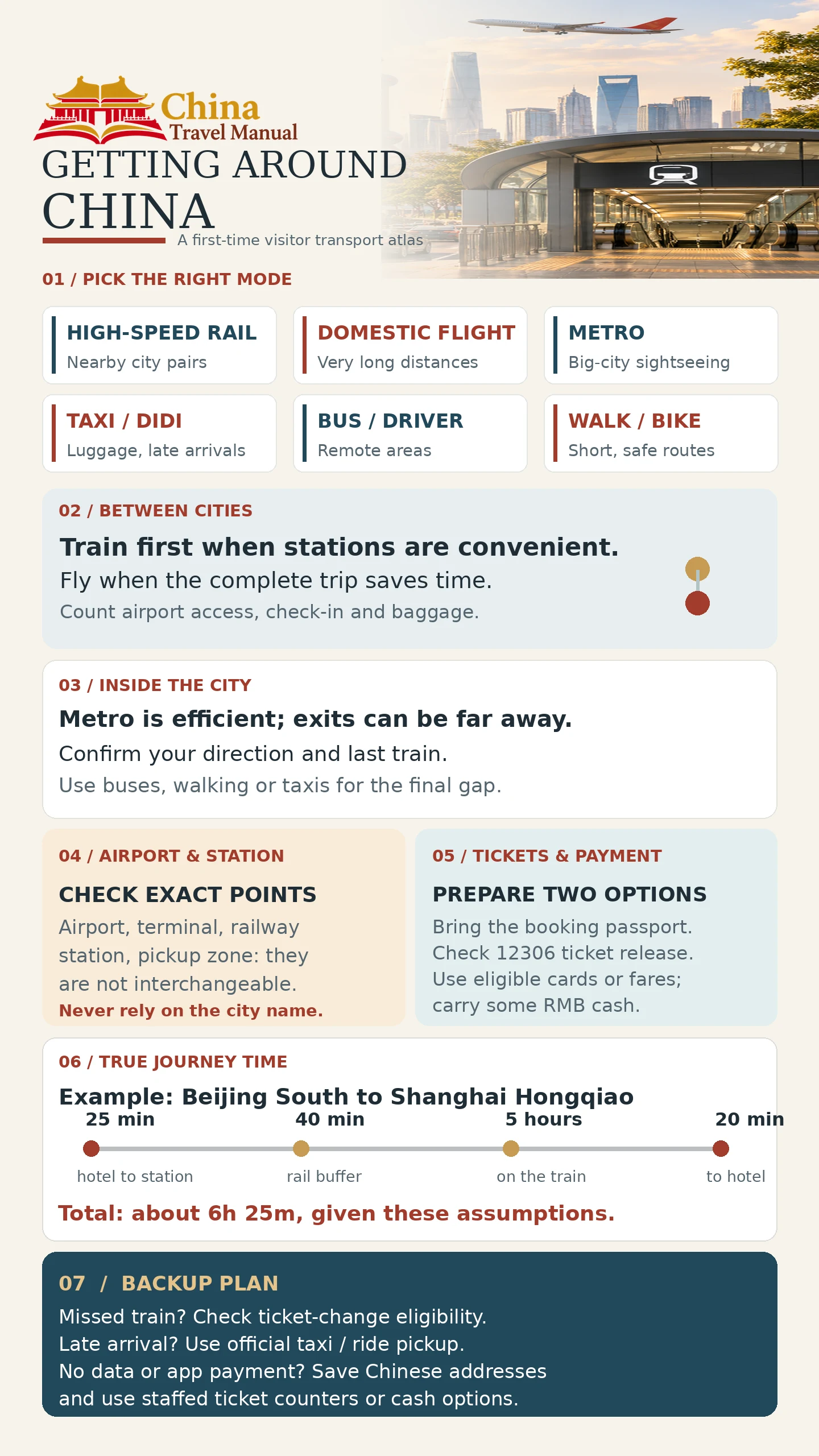
For a first trip to China, choose transport by your actual start and end points, travel time, luggage and arrival hour—not distance alone. The practical starting choices are:
- Nearby cities: High-speed trains, particularly around Shanghai–Hangzhou, Guangzhou–Shenzhen and Beijing–Tianjin.
- Very long cross-country routes: Domestic flights, after comparing total door-to-door time.
- Big-city sightseeing: Metro for most journeys, with buses or walking for the final stretch.
- Late arrivals or bulky luggage: DiDi or a licensed, metered taxi from an official pickup point.
- Remote towns and attractions: Scheduled buses or a prearranged, licensed transfer; walk or cycle only where practical.
Carry the original passport used for rail and flight bookings, keep the booking name consistent with it, arrange reliable mobile data, and bring a compatible international card plus some renminbi (RMB) cash as backup.
China’s extensive rail and urban transit systems make independent travel feasible, but the hardest part is often the connection between them. A five-hour train journey might consume more than six hours once you include the hotel, station and exit transfer. This guide explains how to choose and connect transport nationwide; use the linked route and booking guides for detailed instructions. Operational guidance below reflects information checked in October 2026, and timetables or payment acceptance can change.
Choosing the Best Transport for Each Journey
Use this table as a starting point, then compare the exact station, airport, hotel and departure time. There is no reliable national rule that a journey of a certain number of miles must be by train or plane.
| Journey | Start with | What could change the decision |
|---|---|---|
| Nearby or mid-distance cities | High-speed train | Outlying stations, frequency, station-to-hotel travel |
| Long cross-country journeys | Flight or overnight sleeper train | Whole-trip duration, airport access, baggage charges |
| Major-city sightseeing | Metro | Transfers, walking after the exit, last service |
| Hotel or attraction transfers | DiDi or licensed taxi | Congestion, price, designated pickup area |
| Rural towns or remote attractions | Bus or licensed private transfer | Limited schedules, total group cost, final access |
| Short urban distances | Walk, bike or bus | Weather, road conditions, luggage and safety |
For example, Shanghai Hongqiao–Hangzhou East is generally a straightforward rail journey: the train ride often takes roughly 45–60 minutes, depending on the service. By contrast, Beijing–Sanya is typically a flight decision for time-limited visitors, even after airport transfers. For the trip-planning consequences of route length, see China trip distance planning.
Traveling Between Cities in China
High-Speed Trains and Conventional Rail
High-speed rail is often the easiest choice where both cities have convenient stations and the scheduled journey takes a few hours. It is especially useful in the Yangtze River Delta, Pearl River Delta and Beijing–Tianjin region. Beijing South–Shanghai Hongqiao services commonly take around 4.5–6 hours, while Shanghai Hongqiao–Hangzhou East is much shorter. Always check the departure date’s actual schedule rather than booking around an illustrative duration.
Station names matter more than a city’s name on a map. Beijing South (北京南站) is different from Beijing West (北京西站); Shanghai Hongqiao (上海虹桥站) is well west of Shanghai Railway Station (上海站). A cheaper train from the wrong terminal can turn a simple departure into a long transfer. Compare high-speed rail with station guides before choosing.
Conventional trains are slower but can make sense on a flexible budget. An overnight sleeper may replace a hotel night, though sleep quality, arrival hour and onward travel also count. Neither service type is automatically better for every city pair. For a focused comparison, read train versus flight in China.
Domestic Flights
Flights become attractive across very long distances—such as between Beijing and Sanya or Chengdu and Urumqi—where rail can occupy most of a day or longer. Compare hotel-to-airport transport, check-in and security, flight time, arrival baggage collection and the last transfer. A roughly 3.5–4-hour flight can easily require six or seven hours door to door, depending on traffic and your location.
Treat a two-hour predeparture airport arrival as a conservative planning starting point, not an airline-wide rule; airline check-in deadlines and terminal requirements take priority. Budget and promotional fares may restrict checked baggage, so compare the total fare rather than the headline price. Severe weather and air-traffic disruptions can affect flights, but rail services can also be delayed. More detail is in domestic flights in China.
Intercity Buses and Private Transfers
For mountain towns, county-level destinations and attractions far from rail stations, scheduled coaches or a booked driver may be the realistic final connection. Some remote routes run infrequently or sell tickets locally; do not assume a late return coach will exist. Check the operating terminal and both directions before committing to a day trip.
A private transfer is usually more flexible for families, wheelchair users or groups with luggage, but confirm vehicle size, pickup point, tolls, waiting charges and the driver’s legal service status in advance. Use intercity bus guidance for operators and route-specific considerations. Island journeys may additionally involve ferries; treat their departures as separate connections rather than assumed extensions of the rail network.
Getting Around Chinese Cities
Metro and City Buses
In cities such as Shanghai, Beijing, Guangzhou and Shenzhen, a metro journey usually avoids road congestion. The trade-off is walking: a destination may be 500–1,500 meters from the nearest suitable exit, and a large station may have long interchange corridors. Check both the exit and the walking route, especially with children or luggage.
Do not treat “the metro runs until 11 p.m.” as a national timetable. First and last trains differ by route, direction, weekday and special event. Check the last useful departure for your full journey, not just the closing time of your starting station. City buses can fill transit gaps but may involve Chinese-only stop information and road delays. Compare a city-specific plan through the Beijing transportation guide or Shanghai transportation guide.
For suburban sites such as Mutianyu Great Wall, a metro-only plan is not sufficient: expect a bus, shuttle or licensed road transfer after the city section.
Taxis, DiDi, Walking and Shared Bikes
Use DiDi or a licensed metered taxi when the destination is far from a station, the weather is poor, or a direct trip saves several transfers. At airports, railway stations and major attractions, follow signs to authorized taxi ranks or the specific ride-hailing pickup area. A car cannot necessarily stop at the pin you select. Government guidance confirms that international phone numbers and bank cards can be used with DiDi’s China service, but account checks and individual card transactions can still fail.[1][7]
Walk for short sightseeing hops in dense historic or lakeside districts, where car traffic can be slower. Shared bikes are useful on permitted flat routes but unsuitable for heavy luggage, young children or hazardous conditions; city parking geofences can also trigger additional fees. See DiDi for tourists for the platform-specific setup.
Airport, Railway Station and Hotel Transfers
Check the Exact Airport, Station and Terminal
Beijing Capital (PEK) and Beijing Daxing (PKX) are different airports with substantial transfer time between them. Shanghai Hongqiao Airport’s Terminal 2 shares a convenient hub with Hongqiao Railway Station, whereas Terminal 1 is a separate transfer: Metro Line 10 serves both terminals. Never book a connection based solely on “Beijing,” “Shanghai” or “Hongqiao.”
Guangzhou Baiyun is a clear example of why older guides age badly. Its Terminal 3 opened in 2025; Terminal 1 ceased operating in May 2026 as flights moved, and access to its adjacent Airport South station was suspended. Verify your airline’s current terminal rather than following an old T1–T2 instruction.[6] For route-specific layouts, begin with China’s airports and railway stations.
Complete the Last Mile to Your Destination
In daylight with one light bag and a hotel close to a transit stop, an airport rail link or metro is often sensible. With multiple suitcases, older companions, a stroller or a late arrival, a licensed taxi or prearranged ride may be worth the higher fare. Airport buses can be economical but may drop you well short of the hotel.
Always check the last connection before you arrive; late-night services vary by airport, terminal and date, and some airports offer overnight buses or other options. Save the hotel name and full address in Chinese before boarding the last vehicle. See the broader airport transfer guide instead of assuming every airport uses the same arrangements.
Booking Tickets, Paying Fares and Using Maps
Booking Trains and Domestic Flights
China Railway’s official 12306 service for foreign travelers accepts valid passports for real-name booking and verification. Use the passport details consistently; keep the original document available for station inspection and flight identity checks. English 12306 channels, rail station ticket counters, official airline channels and established booking platforms are possible purchase routes.[1]
Ordinary train ticket presales are generally 15 days including the travel day, subject to operator changes.[2] However, as of October 2026, a selected Beijing–Shanghai railway trial allows advance reservation requests 17–30 days before departure. A request is not a confirmed ticket, and eligibility and fulfillment timing differ from normal sales.[3] The trial also illustrates why claims that “all China train tickets can only be booked 15 days ahead” are now incomplete. For purchase details, compare train booking options.
Paying for Metro, Buses and Ride-Hailing
Alipay and WeChat Pay are useful but are not legal prerequisites for every transit ride. Beijing’s metro accepts eligible major international contactless card networks across its system; Shanghai also supports eligible Visa, Mastercard, American Express and other specified contactless cards at metro gates. Card capability and transaction approval still depend on the card and service conditions.[4][5]
Other cities and bus operators may have different rules. Alternatives can include a single-journey ticket, staffed ticket desk, local transport card, QR fare code or RMB cash where accepted; card payments at a ticket counter are not identical to tapping a foreign bank card at a gate. Carry a small cash reserve and a second supported payment method. For preparation, consult mobile payments in China.
Navigation Apps and Chinese Addresses
Amap (Gaode Maps) and Baidu Maps are generally more useful for current mainland transit and pickup-point information than relying only on Google Maps. Interface language, offline functions and overseas phone compatibility can change by app version. Test the maps with your actual destinations while you still have reliable connectivity.
Save the precise hotel entrance, attraction gate or ride-hailing pickup area and the full Chinese address—not only the English hotel brand. A screenshot can help when the driver speaks little English or mobile data fails. For address conventions and navigation choices, use Chinese addresses and China travel apps.
Planning Realistic Travel Time, Luggage and Accessibility
A train’s advertised journey time is not the total time you should reserve. Count travel to the station, arrival buffer, the scheduled journey, time to exit and the final connection. Compare the equivalent total for a flight, especially when the airport is far from downtown.
Illustrative Beijing–Shanghai rail day: 25 minutes from hotel to Beijing South, 40 minutes for station security and boarding, five hours on the train and 20 minutes from Shanghai Hongqiao to a nearby hotel. That is about 6 hours 25 minutes door to door, before unusual congestion or disruption. These are example assumptions, not a guaranteed itinerary.
- Rail departures: Aim to reach a large station around 30–40 minutes early under routine conditions; allow longer for holidays, unfamiliar layouts or mobility needs.
- Domestic flights: Plan around two hours before departure unless the airline or airport sets a different requirement.
- Connections: Leave generous margins; 40 minutes for a same-station rail interchange and several hours for a cross-station or cross-airport move are planning buffers, not official minimum connection times.
- Luggage and accessibility: Confirm elevators, step-free routes, train baggage provisions and airport support ahead of time; accessibility varies by station, entrance and vehicle.
Holidays such as Lunar New Year and the October National Day period increase crowding and booking risk. If a mobility aid, stroller or oversized case determines your route, use traveling with luggage in China and the individual station or operator’s accessibility information before purchasing.
Common Transport Problems and Backup Options
Once something goes wrong, prioritize the next workable connection rather than forcing the original schedule:
- Train sold out or missed: Check later services and the station ticket office; ask whether your ticket remains eligible for a change. Conditions, fees and same-day options depend on the ticket and departure status, so do not assume an automatic refund or that every missed ticket can be changed.[1][9]
- Flight delay breaks a train connection: Confirm the airline’s rebooking options, then immediately check whether the separate rail ticket can be changed; budget for an overnight stay if necessary.
- Last metro missed: Go to an official taxi rank or verified ride-hailing pickup. Decline unsolicited drivers approaching travelers at exits.
- Wrong DiDi pickup pin: Confirm the signed pickup area in the platform, message the driver if practical and use the app’s cancellation/rebooking tools rather than paying off-platform.
- No data or payment failure: Show a saved Chinese address, use an offline reference map when available and switch to an accepted cash or card option. Cash alone will not fix an in-app prepaid ride, so use a legitimate taxi or staffed counter instead.
For recovery steps that vary by operator, see handling travel delays in China.
FAQs About Getting Around China
Is It Better to Take a Train or Fly in China?
Compare the entire hotel-to-hotel journey, not the train or flight duration alone. High-speed rail often wins on medium-distance routes with convenient stations; flights can save time on very long journeys. Check the actual station, airport, baggage terms and arrival time before deciding.
Can Foreign Tourists Use China’s Metro with International Bank Cards?
Yes, on eligible services. Beijing and Shanghai support direct contactless payment with specified foreign card networks across their metro systems, subject to card requirements. Other cities differ, so keep a backup such as a single-journey ticket or local transit payment method.[4][5]
Can I Use DiDi in China with an Overseas Phone Number?
Chinese government guidance says foreign travelers can register for DiDi’s China service using an international phone number and payment card. Successful verification and individual transactions are not guaranteed; check the account before travel and keep a licensed taxi option available.[7]
How Far in Advance Can I Buy China Train Tickets?
Standard China Railway ticket sales generally open 15 days ahead, including the travel day. A limited Beijing–Shanghai trial additionally accepts advance reservation requests 17–30 days ahead as of October 2026, but a submitted request is not a confirmed seat. Always check the actual train’s release details.[2][3]
Can Tourists Drive in China with a US Driver’s License?
A US driver’s license or International Driving Permit alone is not enough for legal driving in mainland China. An eligible short-term visitor may apply for a Chinese temporary driving permit using a valid foreign license and other required documents; local approval is essential.[8] See driving in China.
Sources
[1] State Council of China. Guide to Working and Living in China
[2] China Railway 12306. Railway Passenger Ticket Sales Rules
[3] Beijing Municipal Government. Update on Train Ticket Booking: Advance Reservation Period to Be Gradually Adjusted from 60 to 30 Days
[4] Beijing Municipal Government. Beijing Subway Introduces Tap-and-Go Payments with Five Major Card Networks
[5] Shanghai Municipal Government. How to Take Metro in Shanghai
[6] Guangzhou Municipal Government. A Temporary Goodbye to T1: Guangzhou Baiyun International Airport Completes Airlines’ Shift to T3
[7] Hunan Provincial Government. How to Book Online Ride-hailing Services
[8] Beijing Municipal Government. FAQs from 12345 Online: Temporary Driving Permit
[9] China Railway 12306. Ticket Change FAQ





