

Quick Answer: What Is the Best Way to Leave an Airport or Train Station in China?
There is no single best transfer for every airport, railway station or hotel in mainland China. Choose an airport express or metro when service is running, you can manage your luggage and your hotel is a short, manageable walk from the final stop. Compare an official taxi, DiDi or a pre-booked vehicle for late arrivals, several heavy bags, limited mobility or an awkward last mile. A scheduled airport bus may be a good middle ground if its stop suits your destination.
Before deciding, check when you will actually exit the terminal, where the official boarding or pickup point is, and how you will reach your hotel’s front door. Then compare the entire journey—not just the advertised train or driving time. Keep a second option ready if your phone, payment method or last train fails.
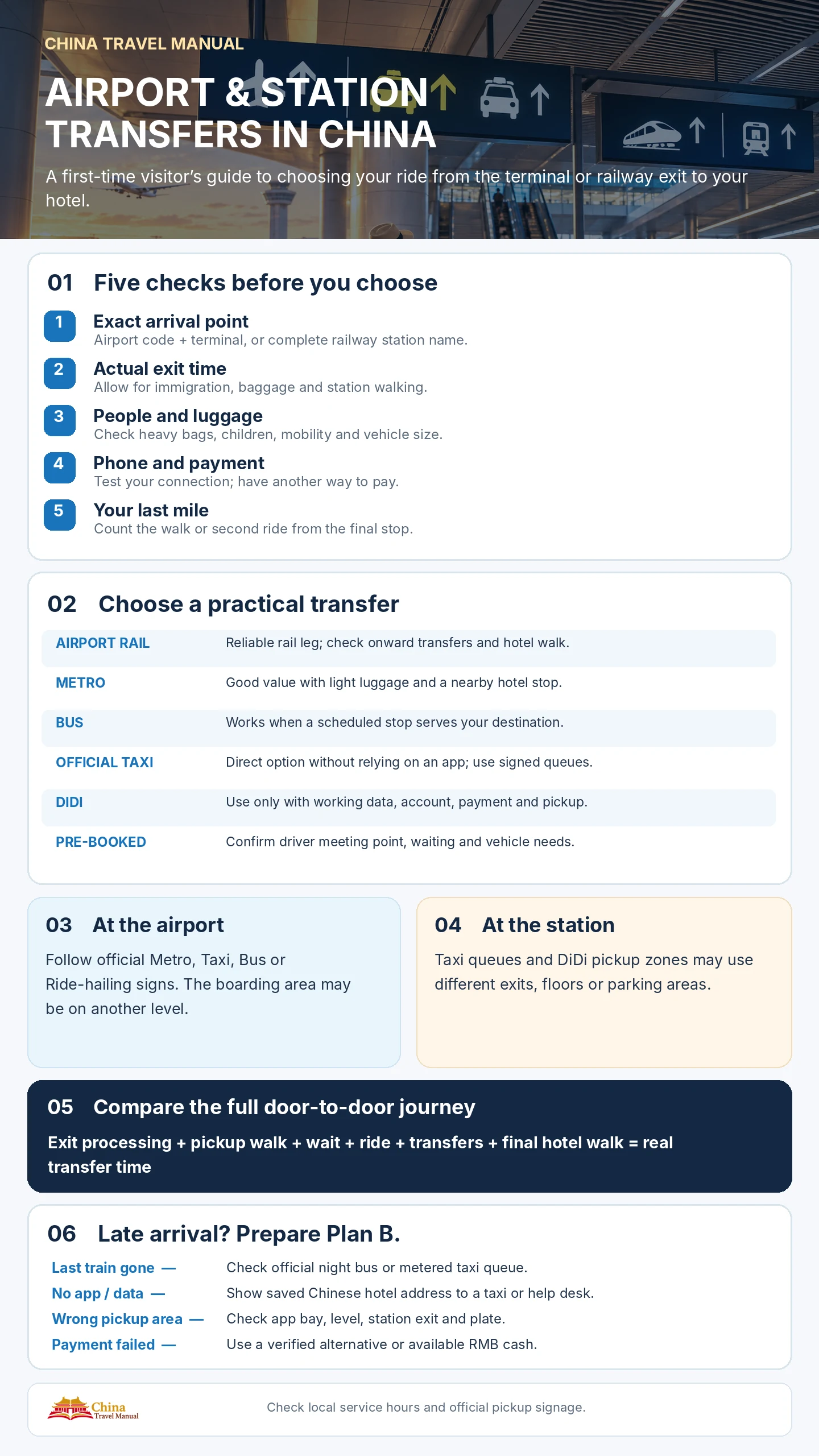
Choose Your Transfer in Five Checks
A good transfer starts with five checks, in this order. They work for major international airports and high-speed rail stations, but the exact facilities differ from place to place.
Check Your Exact Arrival Point and Destination
Record the airport’s three-letter code and terminal, such as PVG Terminal 1 for Shanghai Pudong, or the complete railway station name. Beijing South is not Beijing West; Shanghai Hongqiao Railway Station is not Shanghai Railway Station. The city name alone is not enough for a transfer booking. Check the exact hotel branch, its address in Chinese and a contact number. Save a screenshot so you can show it without relying on translation or mobile data.
Check When You Will Actually Be Ready to Leave
An aircraft’s landing time is not the time you reach the metro platform or taxi queue. International arrivals may still need immigration processing, baggage collection and a walk through the terminal. A train’s scheduled arrival similarly comes before you leave the carriage and follow the station exit route. These stages vary by flight, terminal, station and crowd level. Make transfer decisions using your expected time outside the arrivals hall or railway exit, with extra margin if you are relying on the last service of the day.
Check Luggage, Walking, Transfers and Connectivity
Count the bags you must physically carry, not just the people in your group. An otherwise efficient metro route may involve a lengthy station walk, escalators, changes of level or a final journey on foot. If you are traveling with children, a stroller or someone who needs step-free access, verify the specific route rather than assuming every exit has an elevator.
An app-based ride also depends on a usable data connection, a working account and an accepted payment method. If any one fails, know where to find the official taxi queue or other local alternative. Use this checklist:
- Arrival point: airport, terminal or exact railway station and exit.
- Ready-to-leave time: after immigration or exiting the train, not scheduled arrival.
- Passengers and baggage: luggage, children, mobility and vehicle-space needs.
- Connectivity and payment: active phone service, working ride account and backup funds.
- Last mile: distance, walkability and transfers between the final stop and your hotel.
Compare Airport Express, Metro, Bus, Taxi, DiDi and Private Transfers
No option wins every category. Use the comparison to shortlist a practical route, then confirm live operating hours and the station or airport’s own instructions.
| Transfer option | Best when | Main advantage | Check before choosing |
|---|---|---|---|
| Airport express / airport rail link | Rail service is running and the line connects conveniently | Road congestion does not affect the train journey | Platform access, onward transfers, ticketing and last-mile walk |
| Metro / subway | You travel relatively light and stay near a station | Usually economical for one or two travelers | Transfers, elevators, service hours and fare-payment rules |
| Airport or station bus | A scheduled stop suits your hotel or interchange | May reduce changes at a modest cost | Stop location, departure frequency, actual night service and luggage allowance |
| Official metered taxi | You want a direct trip without depending on a ride-hailing app | Uses an officially designated queue | Wait times, traffic, meter rules and acceptable payment methods |
| DiDi / ride-hailing | Your phone, account and payment work and the pickup is clear | Destination entered in the app and a fare estimate | Assigned pickup zone, floor, car details and surge pricing |
| Pre-booked private transfer | You need a larger vehicle, accessibility arrangement, child seat or arranged meeting | Vehicle and meeting terms can be agreed in advance | Total price, waiting period, delays, cancellations and actual vehicle features |
Airport shuttle is ambiguous in English. It can mean a public airport bus, a hotel-operated shuttle or a commercial private transfer. Ask which service is being offered, its route and whether you must reserve a seat. A hotel’s shuttle is never safe to assume without confirmation.
For the wider picture of traveling around the country, see Getting Around China.
From a Chinese Airport to Your Hotel
What to Do Before Leaving the Arrivals Hall
Open your saved hotel address and confirm that your mobile connection and a backup payment method are available. Look for official Metro / Airport Express, Taxi, Bus or Ride-hailing / 网约车 signs rather than following someone who approaches you with an unsolicited car offer. The relevant area may be outside the arrivals hall, on a separate level or within a parking facility. Airport names, terminals and layouts vary, so check China Airports Guide before your arrival.
How to Judge an Airport Rail Connection
A fast airport train is only one leg of your journey. Add the walk to its station, any ticket purchase, waiting time, transfers, the final station exit and the distance to your hotel. Shanghai’s Airport Link Line connects Pudong Airport and Hongqiao Airport in roughly 40 minutes of onboard travel, according to Shanghai’s official guide. That is not a promise of a 40-minute trip from Pudong Terminal 1 or 2 to a hotel—or to a high-speed train platform at Hongqiao. You still need to confirm the airport station location and onward journey. [1]
For local routing details, use the separate Shanghai Pudong Airport to the City guide rather than relying on generalized transfer times.
When to Choose a Direct Vehicle Instead
If you are leaving the terminal close to rail service shutdown, traveling with multiple large suitcases, managing a stroller or heading to a hotel far from rail, a direct vehicle may offer a better overall trip. Compare the official taxi queue with a DiDi estimate; a pre-booked vehicle can be useful when you require a confirmed meeting point or special equipment. Check car capacity before committing—neither a standard taxi nor a basic ride-hailing category guarantees room for every bag.
From a Chinese Railway Station to Your Hotel
Identify the Station Exit and Public Transport Level
Large stations can separate the taxi queue, ride-hailing pickup and subway entrance across different exits, levels or parking areas. Beijing’s official guide to seven major railway stations describes different arrangements at Beijing Railway Station, Beijing West and Beijing South. There is no single nationwide rule that taxis are upstairs and DiDi cars are downstairs. Follow the signs for the mode you have chosen. [2]
Shanghai Hongqiao Railway Station illustrates why you should check current pickup instructions. An August 2026 city notice describes signs guiding travelers to four ride-hailing pickup points, including one on the B1 level of Parking Lot 10 (P10). It does not say that every ride-hailing pickup is at P10. [3] For station-by-station orientation, see China Railway Stations.
Choose Metro, Taxi or Ride-Hailing After a Train Arrival
A metro can be ideal when it runs directly toward a hotel with a convenient final exit. But a route with multiple transfers, extensive platform walks and luggage handling may be slower or more tiring than the timetable suggests. At busy stations, consider how far the taxi or ride-hailing pickup point is from your actual exit—not merely whether the app reports a car nearby. If the station is crowded, moving to the correct signed pickup area before ordering may save confusion.
Avoid Wrong-Station and Wrong-Pickup Mistakes
Shanghai Hongqiao, Shanghai Railway Station and Shanghai South are separate railway stations. The same applies to Beijing South, Beijing West and Beijing Railway Station. Confirm the Chinese station name before booking and before giving a driver a destination. For an arrival at Beijing South Railway Station, check whether the app directs you to an e-hailing pickup rather than the official metered-taxi queue. Those are not interchangeable.
How to Find a Legal Taxi or Your Ride-Hailing Pickup Point
Follow Official Taxi Signs and Queues
Use the airport or railway station’s signed taxi line or designated dispatch area. Avoid unsolicited vehicle offers inside arrivals halls or station concourses. Show your destination address in Chinese and confirm the metered or officially displayed fare arrangement before setting off. Retain your receipt or an electronic journey record, which can help if you leave something behind or need to report a problem. A licensed taxi is a useful fallback when an app is unavailable, but you should still confirm how that particular vehicle accepts payment.
Find the Correct DiDi Pickup Zone
The pickup point named in a ride-hailing app may refer to a parking lot, floor, exit or designated bay rather than the curb outside the main door. Check the location after selecting your actual terminal or station. Follow on-site signs, then match the license plate and vehicle details with the app before boarding. If the driver and passenger cannot find each other, first compare exact pickup zones instead of assuming the reservation failed.
China’s official visitor guidance says DiDi-Greater China can support registration with a foreign phone number and international credit card; successfully arranging a ride still depends on your account, connection and payment setup. [4] Detailed installation and ordering steps belong in How to Use DiDi in China.
What to Confirm With a Pre-Booked Driver
Give the operator the flight or train number, local arrival date, exact terminal or station, hotel address, passenger count and baggage count. Ask in writing where the driver will meet you, how delays are tracked, when waiting time begins, what waiting is included and the cancellation or no-show rules. Request a child seat or accessible vehicle explicitly where needed; do not assume the standard booking includes either. Verify the operator’s contact channel still works after you land.
Late-Night Arrivals and Last-Train Decisions
Why Scheduled Arrival Time Can Be Misleading
Suppose a flight is scheduled to land at 10:30 p.m. and the last relevant train leaves at 11:00 p.m. You cannot infer that the train is reachable: immigration, baggage collection and the terminal-to-platform walk may consume the remaining time. This is an illustrative scenario, not an operating timetable. Check the last departure from the correct airport station and allow a sensible buffer; avoid planning a transfer that only works if everything is unusually fast.
What to Use When Rail Service Has Ended
First check whether the airport operates a night bus serving a useful stop. Beijing’s July 2026 notice, for example, describes expanded airport bus schedules and two round-the-clock routes; this is not a nationwide service guarantee. [5] If a suitable bus is unavailable, compare the official taxi queue and any ride-hailing service you can actually use, or follow the arrangements of a confirmed private pickup. Nighttime waiting, traffic and app availability can all affect the choice.
Create a Backup Plan Before Landing
Plan A and B should be workable without the same weak point. If Plan A requires mobile data and an app, Plan B might be a signed official taxi queue with your hotel address saved offline and access to local currency. For a late arrival, also confirm that your accommodation can check you in at the expected hour. Your First Day in China covers the broader arrival-day sequence.
Transfers Between Airports and Railway Stations
Airport to Railway Station
An airport-to-train connection includes more than the road or rail leg. Budget for any immigration and baggage formalities, leaving the airport, finding the transfer, reaching the correct railway station, security screening and walking to the correct gate. China Railway’s official advice says ticket checks stop before departure; it does not provide a universal 15-minute cutoff for every station, so follow the actual station announcement. [6] A short scheduled airport link alone is not proof that you can catch a particular train.
Airport to Airport
Different airports serving one city are not different terminals of the same building. Transfers between Shanghai Pudong (PVG) and Shanghai Hongqiao (SHA), or between Beijing Capital (PEK) and Beijing Daxing (PKX), need an independent surface journey. Shanghai offers an Airport Link Line between its airports, but you must still factor in baggage procedures, station access and the next airline’s requirements. [1] Look up the actual airports when comparing flights; do not assume a same-city connection is easy.
When a Connection Is Too Risky
A separately booked onward service is particularly vulnerable to flight delays, checked-baggage collection, traffic, late-night service changes and long station walks. Check whether a missed connection is protected or whether you would need to buy a replacement ticket. Allow more time than a maps app’s theoretical minimum; if a booking only works under perfect conditions, consider changing it. Use a dedicated airport or station guide for the exact route and latest service details.
Calculate the Real Door-to-Door Cost and Time
True transfer time = arrival processing and exit + walk to pickup + queue or wait + main journey + changes + final walk or vehicle to the hotel.
The cheapest first ticket is not always the cheapest total route. Add a later taxi fare or extra tickets if the rail line stops short of your accommodation. For a group, compare the combined public-transport fares with the total vehicle price; for a solo traveler, compare both price and physical effort rather than judging by driving time alone.
Example A — Shanghai Pudong Airport: the advertised airport-rail travel time does not include getting to the rail platform, waiting, changing services or reaching a hotel far from the final stop. Rail may win on consistency, while a direct vehicle may win on convenience with heavy bags.
Example B — Beijing South Railway Station: a traveler with a backpack and a hotel beside a metro exit has a different optimal choice from a family with three large suitcases and a long final walk. The right question is not simply which vehicle moves faster, but which complete route is easier and more dependable.
Payment, Maps, Luggage and Accessibility
Have a Payment Backup for Your First Ride
Do not assume a foreign bank card works directly at every subway turnstile or inside every taxi. Beijing’s official guidance describes supported contactless foreign-card payments across its metro network; Shanghai also publishes eligible card-network details for its metro. Other cities and operators may use different rules, and your particular card must qualify. [7][8] Prepare a modest amount of renminbi cash for situations in which the local transport provider accepts it, as well as any payment app you have already tested. For setup details, see How to Pay in China, and for troubleshooting see Payment Problems in China.
Save Your Destination and Route Offline
Before departure, save your hotel’s Chinese name, complete address, phone number and map screenshot. Keep your confirmed arrival point and backup route accessible offline. A downloaded map may not provide every live function while disconnected, but a saved address and screenshot can still help a taxi driver or service-desk employee. Review Best Map Apps for China Travel and Offline Preparation for Travel in China; check your connection options in Internet Access in China.
Plan for Heavy Luggage, Children and Reduced Mobility
Step-free routes, elevators and accessible pickup facilities vary. A complex interchange may be unsuitable for a traveler with a wheelchair, stroller or heavy luggage, even if its train ride is short. A standard ride-hailing car does not guarantee a child safety seat or enough space for a wheelchair; ask the operator about the specific vehicle and assistance available. Pre-arrange specialized transport when necessary, and confirm that hotel access and the unloading point meet your needs.
What to Do When Your Transfer Plan Fails
| Problem | Practical next step |
|---|---|
| The last rail service has gone | Check the airport’s current night-bus options, then use the signed official taxi queue or a confirmed pickup. |
| You cannot find your DiDi driver | Recheck the app’s terminal, exit, parking area and level; contact the driver through the app if possible. Cancel only in accordance with the app’s rules and fees, then use another option. |
| Your phone has no data | Show the Chinese hotel address you saved offline. Ask an official information counter for directions to the taxi area. |
| Your card or payment app is declined | Try a confirmed alternative or available RMB cash. Use authorized exchange or ATM facilities when appropriate. |
| You reached the wrong terminal or railway station | Stop following the old pickup directions. Verify the actual location, assess the extra journey and notify the hotel or onward operator. |
| Your booked driver has not appeared | Contact the booking company through its agreed channel; check the waiting-point instructions and fall back to the official taxi area if needed. |
Keep any disagreement about fares or pickup locations in an official, staffed area. Do not accept unsolicited rides from people approaching passengers in the concourse.
Arrival Transfer Checklist
- ☐ Exact airport code and terminal, or complete railway station name and exit.
- ☐ Hotel’s name and full address in Chinese, plus its phone number.
- ☐ Estimated time outside the arrivals hall or rail station.
- ☐ Primary route and a separate fallback route.
- ☐ Current last departure and the correct boarding or pickup location.
- ☐ Working phone and ride-hailing account, if required.
- ☐ Accepted payment method plus a backup, including local cash where useful.
- ☐ Offline addresses, route screenshots and booking confirmations.
- ☐ Appropriate bag space, child seating or accessible assistance if needed.
Frequently Asked Questions
Is it better to take the metro or a taxi from a Chinese airport?
Choose the metro or airport rail when the line operates at your arrival time and your hotel is easy to reach from the final stop. Choose an official taxi when bags, children, mobility needs or a long final walk make transfers difficult. Compare the entire route, not just rail versus road running time.
Can foreign visitors use DiDi without a Chinese phone number?
Yes, the Chinese government’s visitor guidance describes a DiDi-Greater China option that supports registration using foreign numbers and international credit cards. That does not guarantee every account or card will work immediately. Complete registration and payment checks before travel, and follow your specific app pickup instructions. [4]
Are airport trains and buses available late at night in China?
There is no nationwide timetable. Most rail services have defined operating hours, while some airports offer dedicated night buses. Beijing announced two round-the-clock airport bus routes in its 2026 service update, but that does not apply to every airport. Check the correct terminal and service for your date. [5]
How do I find the taxi or DiDi pickup point at a Chinese train station?
Follow the signs for Taxi / 出租车 or Ride-hailing / 网约车 as appropriate. Those services may use different exits, parking areas or floors. Compare the pickup location in the app with station signage; do not wait at the general exit unless the instructions explicitly direct you there. [2][3]
Can I pay for airport or station transfers with a foreign credit card?
Sometimes, depending on the city, fare system, card and operator. Beijing and Shanghai publish foreign-card tap-to-ride options for eligible metro riders, while individual taxis and bus services may use other arrangements. Have a separately verified payment method and some local cash rather than depending solely on card acceptance. [7][8][9]
Should I book a private transfer before arriving in China?
Consider it for a late arrival, a larger group, several suitcases, child-seat requirements, accessibility needs or a confirmed meet-and-greet. For an ordinary daytime arrival with light luggage, an official taxi, public transport or a working ride-hailing account may be simpler and cheaper. Always review waiting, delay and cancellation terms.
Sources
- Shanghai Municipal Government — How to Take the Airport Link Line (service background; check current operating information).
- Beijing Municipal Government — Taxi and E-Hailing at Seven Major Railway Stations (October 11, 2025).
- Shanghai Municipal Government — Hongqiao Railway Station E-Hailing Upgrade (August 2, 2026).
- State Council of China — Guide to Working and Living in China (ride-hailing and foreign-traveler arrangements).
- Beijing Municipal Government — Airport Shuttle Bus Service Adjustments (July 27, 2026).
- China Railway 12306 — Frequently Asked Questions (train boarding and ticket checks).
- Beijing Municipal Government — Contactless Payments on Metro (March 26, 2026).
- Shanghai Municipal Government — How to Take the Metro (August 13, 2026).
- State Council — Payment Service Guide for Overseas Visitors (cash and card access).





