
Quick Answer: What Is the Best Way to Get Around Beijing?
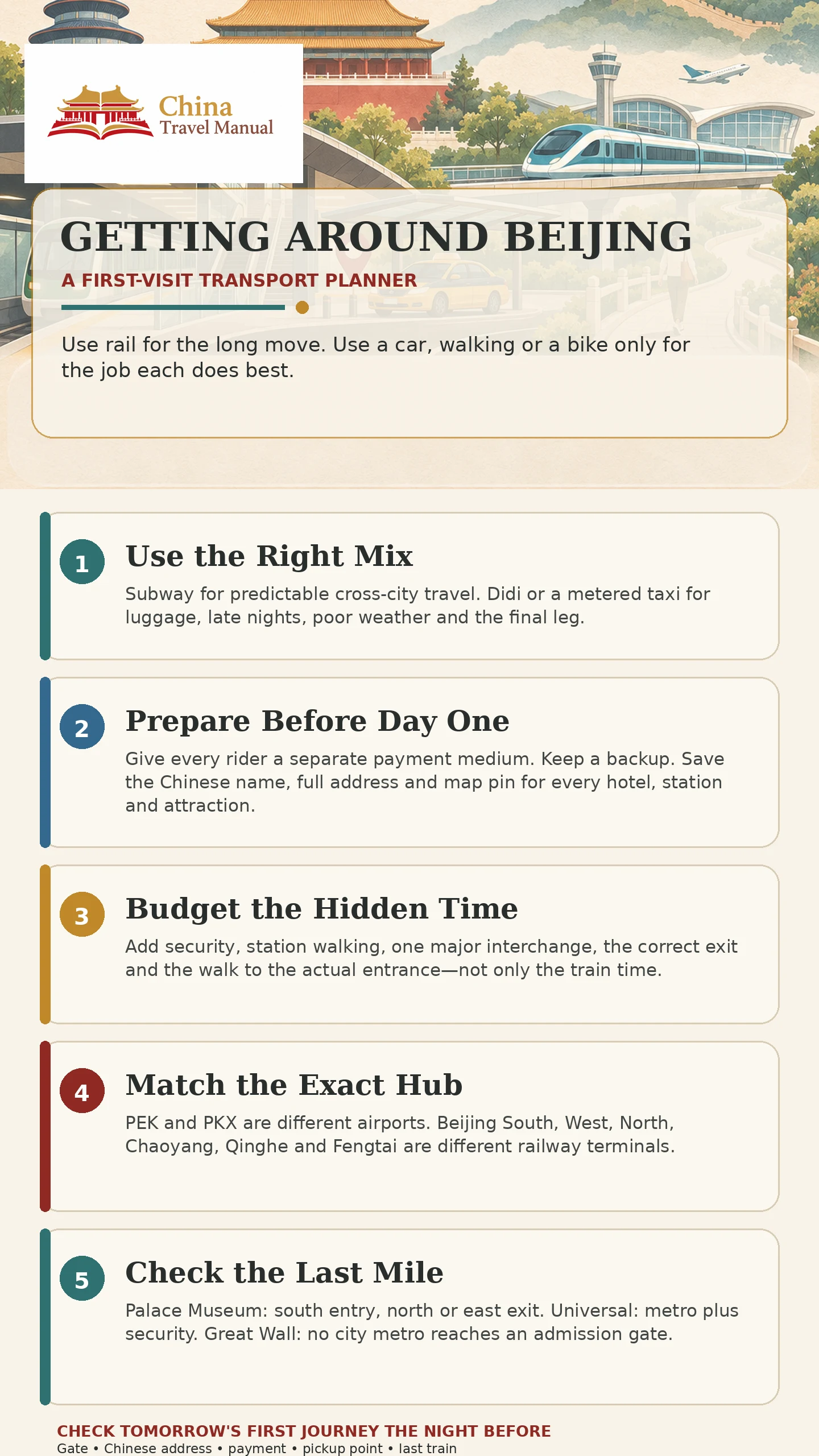
Use the subway for sightseeing days, then use Didi or a metered taxi for luggage, late nights, bad weather and the final leg from a station. Walk within compact hutong and park areas; use shared bikes for short, flat links.
- Best default: Subway for predictable cross-city travel.
- With luggage or limited mobility: Use Didi, an official taxi rank or a pre-booked transfer.
- Best for short local links: Walking or a shared bike, not a cross-city journey.
- Avoid road travel in peak traffic: A taxi can be slower than the subway across central Beijing.
- Plan door to door: Add security, station walking, the correct exit and the walk to the actual entrance.
No city metro reaches a Great Wall admission gate. The Palace Museum also has different arrival and departure sides.
Beijing’s transport network is extensive, but the city’s physical scale makes simple map estimates misleading. A route that looks short can include a ten-minute station transfer, security screening, the wrong exit and another kilometer of walking. The best plan is not to commit to one mode. Combine reliable rail for the long section with a carefully chosen last-mile option.
This guide explains those decisions. Use the separate Beijing metro guide for line-level operations, the Didi guide for visitors for app setup and the Beijing travel guide for the wider itinerary.
Choose the Right Transport by Situation
| Mode | Best use | Reliability | Cost level | Main limitation |
|---|---|---|---|---|
| Subway | Daytime sightseeing and cross-city trips | High | Low | Security, long transfers, crowded peaks and exit choice |
| Didi | Luggage, families, late nights and final-mile trips | Medium | Medium | Traffic, surge pricing and designated pickup points |
| Metered taxi | Official airport or station ranks; travelers who prefer a physical queue | Medium | Medium | Limited English and traffic; street hailing can be difficult |
| Bus | Low-cost local links and metro gaps | Low to medium | Very low | Chinese-heavy stop information and road delays |
| Walking | Hutongs, parks and adjacent sights | High | Free | Large blocks, barriers, heat, cold and security detours |
| Shared bike | A short, flat link from a metro exit | Medium | Very low | App registration, parking zones and mixed traffic |
| Airport express | PEK or PKX to a rail interchange | High | Medium | It does not usually end at the hotel |
| Pre-booked transfer | International arrivals, groups and multiple large bags | High | High | Expensive for routine sightseeing |
The subway is usually the most predictable choice between districts. It is not automatically the easiest choice with a wheelchair, stroller or oversized suitcase: the route must have a usable elevator path at the specific station and exit. If that path is confirmed, rail can still work well. If it is not, use a vehicle for that leg.
Didi and taxis are most valuable when they remove a difficult walk or transfer. They are least valuable for a weekday cross-city journey in heavy commuter traffic. A 30-minute road estimate can expand sharply, while the subway continues to run at a regular interval.
Walking works inside a defined area, not as the default way to join landmarks that merely look close. Roads, walls, underpasses and security zones change the real route. Shared bikes solve some short links only when the road and weather are suitable.
Set Up Payment, Maps and Chinese Addresses
Do this once before the first sightseeing morning:
- Choose a primary subway payment method. A contactless overseas Visa or Mastercard can be used at Beijing subway gates. Each traveler needs a separate card or device, and the same medium must be used to enter and exit.[1]
- Prepare a backup. Options include an Alipay transport code, a physical BEIJING PASS or a single-journey ticket. The BEIJING PASS requires a passport at a designated sales point and has a CNY 20 non-refundable card cost; the Alipay code requires identity verification and a bound payment channel.[2]
- Install a current local map. Amap (Gaode) generally has the most current local exits, road access and transit routing. Apple Maps in mainland China can also be useful. Do not rely on Google Maps as your only live Beijing transport planner; save offline screenshots as a communication backup.
- Save every destination in Chinese. Keep the Chinese name, full address, district and map pin for the hotel, attraction, airport and railway station. A screenshot is valuable when the network is weak or a driver cannot identify the English name.
Direct foreign-card gate entry is simple because it does not require a Chinese phone number. Enable contactless overseas transactions, check foreign transaction fees and keep a second card or single-ticket option.
The BEIJING PASS suits travelers who want a physical stored-value card for subway and bus services. It can be topped up at designated counters and machines, but a lost card cannot be replaced or have its balance recovered.[2] Complete Alipay verification before a busy sightseeing day rather than at the gate.
For ride-hailing, save the destination pin and address. Beijing Station, South, West, North, Chaoyang, Qinghe and Fengtai are different terminals. Match the Chinese characters on the ticket before ordering a car.
Use the Subway as Your Main Network
Beijing’s ordinary subway uses distance-based fares, starting at CNY 3 for trips within six kilometers. The Capital Airport Express and Daxing Airport Express use separate fare systems.[3] For normal sightseeing, the more important cost is time inside the system.
Every passenger and bag goes through security screening.[4] At a quiet station this may be quick; at a major interchange, railway hub or holiday peak it can become a queue. Some transfers require long corridors and several levels. Add roughly 15 to 20 minutes when a trip includes security, a large interchange and the walk to the street.
Exit choice matters as much as line choice. A station can have exits on opposite sides of a wide road or beside different gates of a large park. Check the destination’s official entrance first, then choose the exit. Travelers who need step-free access should verify the elevator exit rather than assume every exit has one; station staff can assist, but the accessible path may differ from the shortest walking route.
Avoid moving large luggage during the weekday commuter peaks when possible. Central interchange lines become crowded, boarding may take more than one train and elevators can have queues. If you must travel then, move earlier, allow extra time and keep bags compact enough not to block doors.
Last-train times vary by line, direction and station. A published terminal departure time is not the time the train reaches your station. Check the exact journey in the official subway information or a current local map on the day, especially when the route requires a late transfer. See the dedicated Beijing metro guide for line-by-line planning and the China city transport card guide for stored-value options.
Use Taxis and Didi for Specific Jobs
Use a car for airport or station luggage, a party of three or four, a stroller, poor weather, a late return after rail service, or a final kilometer that would otherwise involve stairs and an awkward walk. Do not use cars as the automatic choice for every sightseeing transfer.
At airports and railway stations, follow signs to the official taxi queue or the app-based ride-hailing pickup zone. Decline people who approach inside an arrivals hall offering an unmetered private ride. A legitimate taxi from the official rank uses the meter; a Didi trip shows the vehicle and destination in the app.
Didi supports foreign mobile numbers and has an English interface, reducing the need to explain the destination verbally.[5] Set it up before the first essential trip, test the payment method and keep a second way to travel. For a complete setup walkthrough, use Didi for tourists and the guide to Didi pickup locations.
The main difficulty is the pickup point. Vehicles cannot stop at every entrance. Stations, Tian’anmen-area roads and attractions may route passengers to a numbered zone or side street. Follow the app pin, confirm the plate and send a screenshot if needed.
Rain, snow and peak traffic increase both wait time and price. If the road route is long, compare it with the subway before accepting. For short trips, a regular metered taxi from a staffed official queue can be simpler than locating a remote app pickup point. Show the destination in Chinese and retain the trip record or receipt.
Use Buses, Walking and Shared Bikes Selectively
Beijing’s bus network is extensive and inexpensive, but less forgiving for a first visit. Stops and on-board information can be Chinese-heavy, while congestion makes arrival time uncertain. Use buses for a known link or subway gap, not as the default cross-city network. Schedules vary by route; check the one you need. The China city bus guide explains the basics.
Walking is excellent within the hutongs around Dongsi, Gulou and Shichahai, inside the Olympic Park, and within large palace or temple grounds. It is poor for connecting districts. A map’s straight line may cross a fenced road, compound wall or security perimeter. In summer heat, winter wind or pollution, even a planned 20-minute walk can become the most tiring part of the day.
Shared bikes are useful for a flat, short link along a calm street or river corridor. Registration rules and foreign-document support can change, so test the service before depending on it. Ride only where you feel confident in mixed traffic, avoid bad weather and park inside the marked zone to end the rental. Do not plan a first ride on a major arterial road or use a bike as a substitute for an hour-long subway journey.
Plan Airports and Railway Stations Door to Door
Choose the correct hub before comparing transport. Beijing Capital International Airport (PEK) and Beijing Daxing International Airport (PKX) are on different sides of the metropolitan area. PEK is often more convenient for Dongzhimen, Liangmaqiao and northeastern Beijing. PKX connects efficiently to Caoqiao on the Daxing Airport Express and can suit south-central stays, but the onward transfer still matters. Flight schedule and hotel location are more important than a blanket rule that one airport is “better.”
| Hub | Main rail connection | Planning implication |
|---|---|---|
| PEK | Capital Airport Express to Sanyuanqiao and Dongzhimen | Add immigration, baggage and the transfer from the express to the hotel. Use the Capital Airport transfer guide. |
| PKX | Daxing Airport Express to Caoqiao | Do not treat Caoqiao as the historic center. Continue by metro or car. See the Daxing Airport transfer guide. |
| Beijing South | Lines 4 and 14 | Strong for Shanghai and Tianjin trains; large halls and taxi queues. Use the Beijing South Station guide. |
| Beijing West | Lines 7 and 9 | Roads around the station can be slow; rail is often more predictable. See the Beijing West Station guide. |
| Beijing Railway Station | Line 2 | Convenient for the eastern historic core, but confirm the train does not depart from another Beijing terminal. |
| Beijing Chaoyang | Line 3 | Useful for northeastern high-speed rail; the station complex still involves a substantial internal walk.[6] |
| Beijing North | Xizhimen interchange | Useful for selected northbound and Badaling high-speed trains. See the Beijing North Station guide. |
| Qinghe | Line 13 and Changping Line | Useful for the Beijing–Zhangjiakou corridor and some Badaling trains. See the Qinghe Station guide. |
| Beijing Fengtai | Lines 10 and 16 | Southwest of the historic core; allow a longer urban connection. Use the Beijing Fengtai Station guide. |
Do not schedule a timed attraction immediately after an international arrival. Immigration, baggage, the walk to rail or pickup and hotel check-in vary. A pre-booked transfer can help groups with large cases or a late arrival; otherwise use the airport express plus a final metro or taxi leg.
For departure, plan backward from the airline or rail operator’s cutoff, not from the vehicle’s advertised run time. At an unfamiliar Beijing railway station, reaching the correct entrance 45 to 60 minutes before departure is a sensible working target, with more time during national holidays. For flights, follow the airline’s current check-in guidance and add the full city transfer plus a traffic or interchange buffer.
Plan the Last Mile to Major Sights and the Great Wall
The nearest station name is not the attraction entrance. Start with the official gate, then plan the exit and walking route.
The Palace Museum is the clearest example. Visitors enter through Meridian Gate on the south and leave through the Gate of Divine Prowess on the north or East Prosperity Gate. The museum is one-way, so the afternoon journey begins in a different place from the morning arrival.[7] Roads and pedestrian approaches around Tian’anmen also have security controls. Do not order a car to an imaginary “Forbidden City front door”; use the official approach in the Forbidden City guide and plan the exit separately.
The Summer Palace and Temple of Heaven have multiple gates. Match the gate to the internal route and metro exit. The Summer Palace guide and Temple of Heaven guide explain useful combinations.
Universal Beijing Resort is genuinely rail-accessible: Line 7 and the Batong Line serve Universal Resort Station, and the resort says exits B, C or D are about a seven-minute walk from the CityWalk security area.[8] That is not the same as being inside the theme park. Add walking, security and ticket scanning. Use the Universal Beijing guide for a complete park-day plan.
No Beijing city metro train reaches a Great Wall gate. The practical options differ by section:
- Badaling: High-speed trains run from Beijing North or Qinghe to Badaling Great Wall Station. The suburban S2 service is a separate product using Huangtudian Station to Badaling Station; do not confuse the two.[9]
- Mutianyu: Use a current tourist bus, a road connection via Huairou or a pre-booked vehicle. Check the actual boarding point and final shuttle arrangement in the Mutianyu guide.
- Jinshanling: It is farther from central Beijing and scheduled options vary. A verified seasonal bus or private vehicle is usually required.
Read the broader Great Wall travel guide before choosing a section. Do not combine a Wall day or Universal day with a tight international flight or long-distance train. Both trips have enough road, queue and weather uncertainty to make that connection fragile.
Budget Time for Rush Hour, Security and Long Transfers
Use ranges rather than a single universal buffer:
- Normal city trip: Add 15 to 20 minutes to the app’s train time for security, station walking and the final exit. Add more for a large interchange or controlled attraction entrance.
- Weekday commuter period: Avoid large luggage and add 20 to 30 minutes if the route uses central interchanges. For a road journey, leave an even larger traffic margin.
- Airport or railway departure: Build the full door-to-terminal route first, then add the airline or railway check-in and security margin. Do not subtract the buffer because the vehicle is “only” 40 minutes away.
- Reduced mobility, children or several bags: Increase the displayed journey time by about 30 percent and confirm elevators, vehicle pickup points and walking surfaces.
Rain and snow push more passengers into the subway while making cars harder to book. Major holidays, exhibitions and security operations can also change station access. Keep one fallback: if a vehicle fails, locate the nearest useful metro; if a metro route is disrupted, use an official taxi or Didi; if both are overloaded, remove the distant attraction rather than risk a flight or train.
The most useful habit is to check tomorrow’s first journey the night before. Confirm the destination gate, Chinese address, first train or pickup point, current operating notice and the time at which you must turn back. That small check prevents most expensive Beijing transport mistakes.
FAQs About Getting Around Beijing
Is the Beijing Subway Easy for Foreign Visitors?
Yes. Signs and announcements use English, foreign bank cards can be tapped at gates, and fares are low. The real challenges are security queues, long transfers, crowded peaks and choosing the correct exit. Save the destination in Chinese and allow extra time with luggage. Travelers needing step-free access should verify the exact elevator route rather than assuming every exit is accessible.
Can You Tap a Foreign Visa or Mastercard on the Beijing Subway?
Yes. Beijing’s official guidance says all subway stations accept eligible overseas Visa and Mastercard products for ticket purchase and direct gate entry.[1] Each passenger needs a separate card or NFC device, and the same medium must be tapped on entry and exit. Enable contactless overseas transactions and keep a second payment method in case the bank declines the tap.
Should You Use a Taxi or Didi in Beijing?
Use Didi when you want the destination and price estimate recorded in the app; use the metered taxi queue at an airport or station when that is simpler than finding an app pickup zone. Both are appropriate for luggage, late travel and short final-mile trips. Neither is a good default for crossing central Beijing in peak traffic. Never accept an unmetered ride from a person soliciting inside an arrivals hall.
How Early Should You Leave for a Beijing Airport or Railway Station?
Work backward from the operator’s current cutoff. Add the full hotel-to-terminal journey, road or interchange risk, security and the time needed to find the correct hall. Reaching an unfamiliar railway station 45 to 60 minutes before departure is a practical baseline; holidays, children, reduced mobility or large luggage justify more. For a flight, follow the airline’s check-in instruction and avoid scheduling a distant attraction before departure.
Can You Reach the Great Wall by Beijing Subway?
No city metro line reaches a Great Wall admission gate. Badaling has high-speed rail and the separate S2 suburban service; Mutianyu normally needs a tourist bus or road transfer; Jinshanling requires a longer verified bus or private-vehicle plan. Choose the Wall section first, then build the correct transport chain for that section.
Sources
[1] Beijing Municipal Government. Which payment methods are available for taking the subway in Beijing?
[2] Beijing Municipal Government. How Can Foreigners Obtain Public Transportation Card/Code?
[3] Beijing Municipal Government. About Subway Fares
[4] Beijing Municipal Government. Security Checks at Beijing Subway Stations
[5] Beijing Municipal Government. Taxis & Ride-Hailing
[6] Beijing Subway. Line 3: Chaoyang Railway Station
[7] The Palace Museum. Visit the Palace Museum
[8] Universal Beijing Resort. Getting Here
[9] Beijing Municipal Culture and Tourism Bureau. Transportation Information for Badaling Great Wall





