
Quick Answer: How to Get Around Shanghai
For most visitors, the Shanghai Metro is the best everyday choice because it connects major sights and avoids road traffic. Use SH MaaS / Suishenma if you can activate its integrated QR code for the metro, regular buses and public ferries. Eligible contactless international bank cards can also be tapped at metro gates, but do not assume the same card works on every bus or ferry.
- Metro: best for central sightseeing and predictable travel.
- Bus: useful for neighborhoods beyond metro coverage.
- Taxi or DiDi: best for luggage, groups and late-night trips.
- Public ferry: a low-cost Huangpu River crossing, not a sightseeing cruise.
- Maglev: a fast link between Pudong Airport and Longyang Road, with separate ticketing.
If you do not have a mainland China phone number, prepare a contactless bank card or Shanghai Pass as a backup. Check current fares, service hours and app requirements before travel.
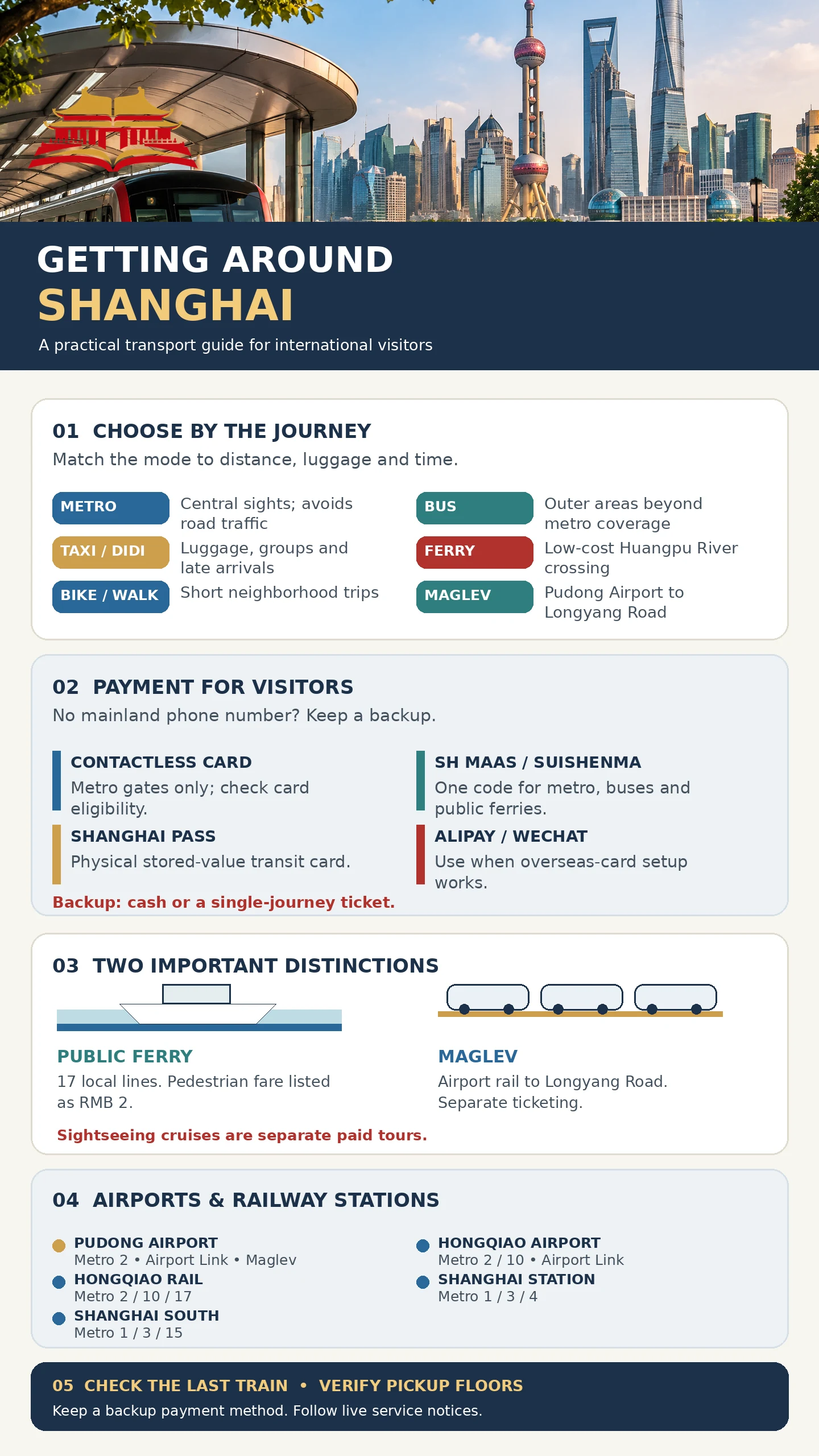
Shanghai is easy to explore once you know which transport option fits each trip. This guide focuses on practical choices and payment methods for visitors without a mainland phone number or local transit card.
What Is the Best Way to Get Around Shanghai?
For most first-time visitors, the metro is the easiest starting point. It avoids road traffic and connects many of the city’s best-known areas, including People’s Square, Nanjing East Road, Yu Garden, Lujiazui and Xujiahui.[1]
Think about distance, luggage, time of day and payment before choosing. A short walk or shared-bike ride may be easier than entering a large station for a trip of one or two kilometers.
| Travel situation | Good first choice | Why |
|---|---|---|
| Central sightseeing, about 2–10 km | Metro | Frequent service and less exposure to traffic |
| Short trip in a walkable neighborhood | Walk or shared bike | Less time spent entering and leaving stations |
| Area beyond convenient metro coverage | Bus | Reaches more local streets and outer districts |
| Large bags, children or late-night arrival | Licensed taxi or DiDi | Door-to-door travel and less carrying |
| Crossing the Huangpu River | Public ferry | Low-cost local transport with river views |
| Pudong Airport to Longyang Road | Maglev | Fast airport link, but separate ticketing |
Shanghai is part of a wider transport network across China. If you are planning your first stay, start with the Shanghai travel guide, then choose transport based on where you are staying and which districts you plan to visit.
How to Use the Shanghai Metro
Understand the network and the station you need
The metro is the most useful everyday transport option for many visitors. Stations serving major visitor areas include People’s Square, Nanjing East Road, Yu Garden, Lujiazui and Xujiahui.[1]
Some rail services in Shanghai are not ordinary metro lines. The Airport Link Line is a suburban railway with its own fare structure, while the Maglev is a separate service. The Airport Link Line connects Pudong and Hongqiao airports in about 40 minutes, but it is not an ordinary metro line and requires its own fare. Do not assume a regular metro ticket or pass covers every rail service. For line-by-line information, use our Shanghai Metro guide.[1][6][9]
Choose a ticket or payment method
The latest official fare guidance reviewed lists a standard metro fare of RMB 3 for trips up to 6 km, plus RMB 1 for each additional 10 km. Eligible contactless UnionPay, Visa, Mastercard, American Express and JCB cards can also be tapped at metro gates, subject to card and chip requirements. A fare-adjustment consultation followed in August 2026; its proposed options are not the current fare schedule. Check the station display for the fare in force on your travel date.[1][8]
You can also use an eligible transport QR code, a Shanghai Public Transportation Card or a Shanghai Pass. Keep a backup instead of relying on one phone app for every trip.[7]
Allow time for transfers and the last train
Large interchange stations can involve long walks, stairs, escalators and security or fare-gate areas. Follow the signs for the line number and direction, not just the station name. If you need an elevator, check the station map before entering the paid area because the accessible route may be farther from your platform.
There is no single last-train time for the whole network, and the metro does not run all night. The final departure varies by line, direction, station and date, and holiday or event schedules may change. Check the official metro information or SH MaaS before setting out. If you miss the last train, use a licensed taxi or a night bus that serves your destination.[1]
Taking Buses in Shanghai
When a bus makes sense
Buses reach residential neighborhoods, outer districts and streets that are not close to a metro station.[1][3]
Find the route, stop and payment method
Use SH MaaS or a reliable map app to check the route, direction, stop name and expected arrival. Save the Chinese name of your destination and the bus stop so you can compare it with the signs.[3]
Shanghai’s public-transport QR code and stored-value transport cards can be used on regular buses. Official visitor guidance also lists foreign bank cards among bus payment options, but acceptance can depend on the card and validator; do not assume every route will accept yours.[3]
Taxis and Ride-Hailing in Shanghai
Take a licensed taxi
Official taxis are useful for direct trips, especially when you have luggage or are traveling with other people. Check that the meter is running and ask for a receipt at the end.[4]
Prepare your destination in Chinese on your phone. A driver may not be comfortable discussing a long address in English, and translated place names can be ambiguous. Qiangsheng, a major local taxi operator, lists an English-language booking hotline at 62580.[4]
Never accept a ride from someone who approaches you inside an arrival hall or outside a station and offers an unofficial fixed price. Use the official queue or a recognized booking platform.
Use DiDi and other ride-hailing services
DiDi, Xiangdao and Gaode are among the ride-hailing options listed by Shanghai’s visitor information services. Ride-hailing can be easier than explaining an address because the destination and route appear in the app.[4]
At airports and railway stations, the pickup point may be in a designated parking area or on a different floor from the taxi queue. Follow the pickup instructions shown in the app rather than waiting at the nearest curb. For a fuller explanation, see using DiDi in China and our guide to taxis in China.[4]
How to Pay for Public Transport in Shanghai
Tap an eligible international bank card
For a short visit, contactless bank-card payment can be the simplest metro option because it does not require a local phone number or a transport app.[1]
This is a metro-gate option, not a promise that the same card will work on every city bus, ferry or taxi. If you plan to use several transport modes, choose a second payment method before you need it.[1][3][4][5]
Alipay and WeChat Pay
Alipay and WeChat Pay are widely used in China, and eligible foreign visitors can link supported overseas bank cards. They may also provide access to transport services or QR-code ticketing.
SH MaaS and the Suishenma code
Shanghai’s SH MaaS platform, also known as Suishenxing, is designed to bring local transport information and payment into one place. The English-language Easy Go service provides access to the SH MaaS mini program for international visitors. Official guidance describes one-, three- and seven-day unlimited-ride passes and the ability to add up to two companions’ codes to one phone. The platform lists international bank-card linking, but check whether your specific card and account can complete setup. Check whether the pass is available to your account, which transport services it covers and whether your overseas payment method is accepted before buying.[2]
For an international visitor, this may be the most convenient integrated option if the setup and payment steps work on your phone. If setup fails, use a contactless bank card for the metro or buy a single ticket.[1]
Shanghai Pass and multi-day tickets
Shanghai Pass is a physical stored-value card aimed at overseas visitors who prefer not to rely on a phone. It is accepted on buses, subways, taxis and ferries, and can be purchased or reloaded at designated transport hubs and service points.[7]
Shanghai Pass is a stored-value card, not an unlimited-ride pass. Separate one-day, three-day and seven-day unlimited-ride products are available through SH MaaS, subject to account and payment eligibility. A stored-value card or single tickets may be better if you will walk often or only take a few rides. For wider payment preparation, read how to pay in China as a visitor.
| Payment option | Best use | What to check |
|---|---|---|
| Contactless international bank card | Simple metro entry | Eligible card, contactless setting and issuer approval |
| SH MaaS / Suishenma | Integrated metro, bus and public-ferry code | Account access, identity and payment setup, pass coverage |
| Alipay or WeChat Pay | App-based payment and eligible transport codes | Foreign-card linking and mini-program availability |
| Shanghai Pass | Phone-free stored-value travel | Purchase location, balance, refund terms and acceptance |
| Single-journey ticket | Occasional metro trips or backup | Buy at a station machine or service center |
Taking the Huangpu River Ferry
Public ferry or sightseeing cruise?
A public ferry is part of Shanghai’s local transport network. It carries pedestrians and, on eligible routes, bicycles across the Huangpu River.[5][10]
Useful routes and operating hours
Shanghai’s official visitor information lists 17 ferry lines. Three useful visitor routes are Taigong Line for a scenic crossing, Dongfu Line for evening views and Dongjin Line for a daytime crossing near the Bund and Lujiazui. Dongjin is for pedestrians only.[5]
Check the ferry operator’s latest route notice on the day you travel. Strong wind, heavy rain, poor river conditions or operational changes can affect service.[5]
Shared Bikes and Walking
Rent a shared bike
Shared bikes from services such as Meituan, Hello Bike and Qingju can be convenient for short trips around a compact neighborhood. Visitors generally unlock a bike through the operator’s app or a supported Alipay or WeChat mini program. Registration, identity checks and overseas payment acceptance vary by provider, so test the setup before relying on a rental, especially if you do not have a mainland China phone number.[10]
Where cycling makes sense
A short ride between nearby streets, a metro station and a hotel, or around a neighborhood such as the Former French Concession may save time. Use designated bicycle lanes where available and obey signals.[1][10]
Park correctly
End the ride in a permitted parking area shown by the operator. Parking outside a designated zone can trigger a relocation charge or prevent the trip from closing correctly.
Using the Shanghai Maglev
Pudong Airport and Longyang Road
The Maglev connects Pudong International Airport with Longyang Road. The train ride is very short—about eight minutes—and the line reaches a top operating speed of up to 300 km/h.[6]
When is it worth choosing?
Choose the Maglev if you want the fast airport-to-Longyang Road link or are interested in the high-speed experience. Eligible Visa, Mastercard, American Express and JCB cards can tap at Maglev gates under a separate payment arrangement. It is not automatically the fastest door-to-door route to the Bund, Hongqiao or another distant district once you include station access and transfers. See the Shanghai Maglev guide for detailed ticket and route information.[6][11]
Getting Between Airports, Railway Stations and the City
Pudong International Airport
Pudong Airport has several options: Metro Line 2, the Airport Link Line, Maglev, airport buses, taxis and ride-hailing. The best choice depends on your terminal, destination, arrival time and luggage. For terminal-level directions and current transfer choices, use the Pudong Airport transfer guide and Pudong Airport guide.[1][3][4][6][9]
Hongqiao International Airport
Hongqiao is close to the Hongqiao transport hub. Metro Lines 2 and 10 serve Terminal 2, while Line 10 serves Terminal 1. The adjacent Hongqiao Railway Station has additional metro connections, including Line 17. The Airport Link Line also connects the airport area with Pudong. Check which terminal your flight uses before choosing a station entrance. See the Hongqiao Airport transfer guide and Hongqiao Airport guide.[1][9]
Shanghai’s main railway stations
Shanghai Hongqiao Railway Station, Shanghai Railway Station and Shanghai South Railway Station are separate facilities in different parts of the city. For station-specific access, see the Hongqiao Railway Station guide, Shanghai Railway Station guide and Shanghai South Railway Station guide. If you need to move between Pudong and Hongqiao airports, check the dedicated Pudong-to-Hongqiao transfer guide.[9]
| Transport hub | Useful rail connections | Planning note |
|---|---|---|
| Pudong Airport | Metro Line 2, Airport Link Line, Maglev | Different services have separate fares and stations |
| Hongqiao Airport | Metro Lines 2 and 10; Airport Link Line | Terminal 1 and Terminal 2 have different access |
| Hongqiao Railway Station | Metro Lines 2, 10 and 17; Airport Link Line | Separate railway facility beside the airport complex |
| Shanghai Railway Station | Metro Lines 1, 3 and 4 | Not the same as Hongqiao or Shanghai South |
| Shanghai South Railway Station | Metro Lines 1, 3 and 15 | Check current station access before departure |
Your hotel location also changes which transport option makes sense. Compare neighborhoods and station access before booking accommodation with our guide to where to stay in Shanghai. If you are following a short sightseeing plan, our three-day Shanghai itinerary helps connect the main areas. For a family day at Shanghai Disneyland or a visit to the Bund, check the final station exit and return service before you leave.
Practical Tips for Foreign Visitors
Travel with luggage or children
The metro is efficient, but a transfer can involve long corridors and crowded platforms. Use a taxi or ride-hailing car when you have several large suitcases, a stroller, or a group that would struggle with multiple transfers.[1][4]
Plan for rush hour and late nights
Weekday morning and evening peaks can make trains and roads crowded. The metro may still be more predictable than a taxi during heavy traffic, but allow more time to board and change lines.[1][4]
Save Chinese addresses and navigation details
Save the Chinese name and address of your hotel, airport terminal, railway station and major destinations. A screenshot is useful if mobile data becomes unreliable.
Keep a backup payment method
Do not rely on a single app, card or QR code. Carry a small amount of RMB cash, keep a second eligible bank card if possible, and know where to buy a single-journey ticket.
Common Mistakes to Avoid
- Confusing the Maglev with the metro: the Maglev is a separate service with separate ticketing.
- Assuming every foreign card works everywhere: metro gates, bus validators, ferries and taxis have different acceptance arrangements.
- Mixing up a public ferry and a sightseeing cruise: they are different services with different fares and routes.
- Taking an unofficial ride: use a marked taxi rank or a verified ride-hailing booking.
- Ignoring long station transfers: allow time to walk between lines and exits.
- Missing the last train: check the exact line, direction and station before staying out late.
- Parking a shared bike anywhere: finish the rental in a designated area.
- Treating a fare proposal as current policy: use the fare displayed by the official operator at the time of travel.
FAQs About Getting Around Shanghai
What is the easiest way to get around Shanghai?
For most central sightseeing, the metro is the easiest and most predictable option. Use buses for areas beyond metro coverage, and choose a licensed taxi or ride-hailing car when you have heavy luggage or need a direct trip.[1][3][4]
Can foreigners use international credit cards on the Shanghai Metro?
Yes. Eligible contactless cards from major networks can be used at Shanghai Metro gates. Card acceptance depends on the card’s chip and settings, so keep another payment method or buy a single-journey ticket if a tap is declined.[1]
Can I use one QR code for the metro, buses and ferries?
The city’s SH MaaS / Suishenma transport code is described as a unified code for the metro, regular buses and public ferries. Check that your account is activated and the payment method works before relying on it.[1][2][3]
Is the Shanghai Maglev included in a regular metro ticket?
No. The Maglev has separate ticketing. Some specific combination passes include both a metro product and a Maglev ride, but an ordinary metro ticket or transport code should not be assumed to cover it.[1][6]
Is it better to take a taxi or the metro in Shanghai?
The metro is usually better during busy traffic periods and for trips between central districts. A taxi or ride-hailing car is more convenient for groups, large bags, late-night arrivals or destinations far from a station.[1][3][4]
Sources
[1] Shanghai Municipal Commission of Transport. How to Take the Metro
[2] Shanghai Municipal Commission of Transport. A Guide to Shanghai’s All-in-One Transport App
[3] Shanghai Municipal Commission of Transport. Taking a Bus in Shanghai
[4] Shanghai Municipal Commission of Transport. Taking a Taxi in Shanghai
[5] Shanghai Municipal Administration of Culture and Tourism. Exploring Shanghai by Boat
[6] Shanghai Airport Authority. Maglev
[7] Shanghai Municipal Government. City Pass Makes It Easier for Overseas Visitors to Make Payments
[8] Shanghai Municipal Government. Shanghai Seeks Public Opinion on Metro Fare Adjustment
[9] Shanghai Municipal Government. Pudong Airport Opens Check-In Counter for Hongqiao Flights
[10] Shanghai Municipal Government. Getting Around Shanghai: Transport Options and Fares
[11] Shanghai Municipal Government. Tap and Go: Shanghai Maglev Now Accepts Bank Card Payment





