
Quick Answer
Chinese addresses usually run from larger areas to smaller ones, such as city, district, road, number and building. Copy the name and address in Chinese from the venue or booking, then check the map pin for the exact branch. Add the entrance, floor or pickup area if you need to meet someone. Keep the Chinese text and a backup you can open offline.[1][2][3]
| Characters to recognize | Address detail |
|---|---|
| 市 and 区 | City and district |
| 路 or 街 and 号 | Road or street and the property number |
| 栋 or 幢 and 单元 | Building and unit or entrance within a complex |
| 层 and 室 | Level and room |
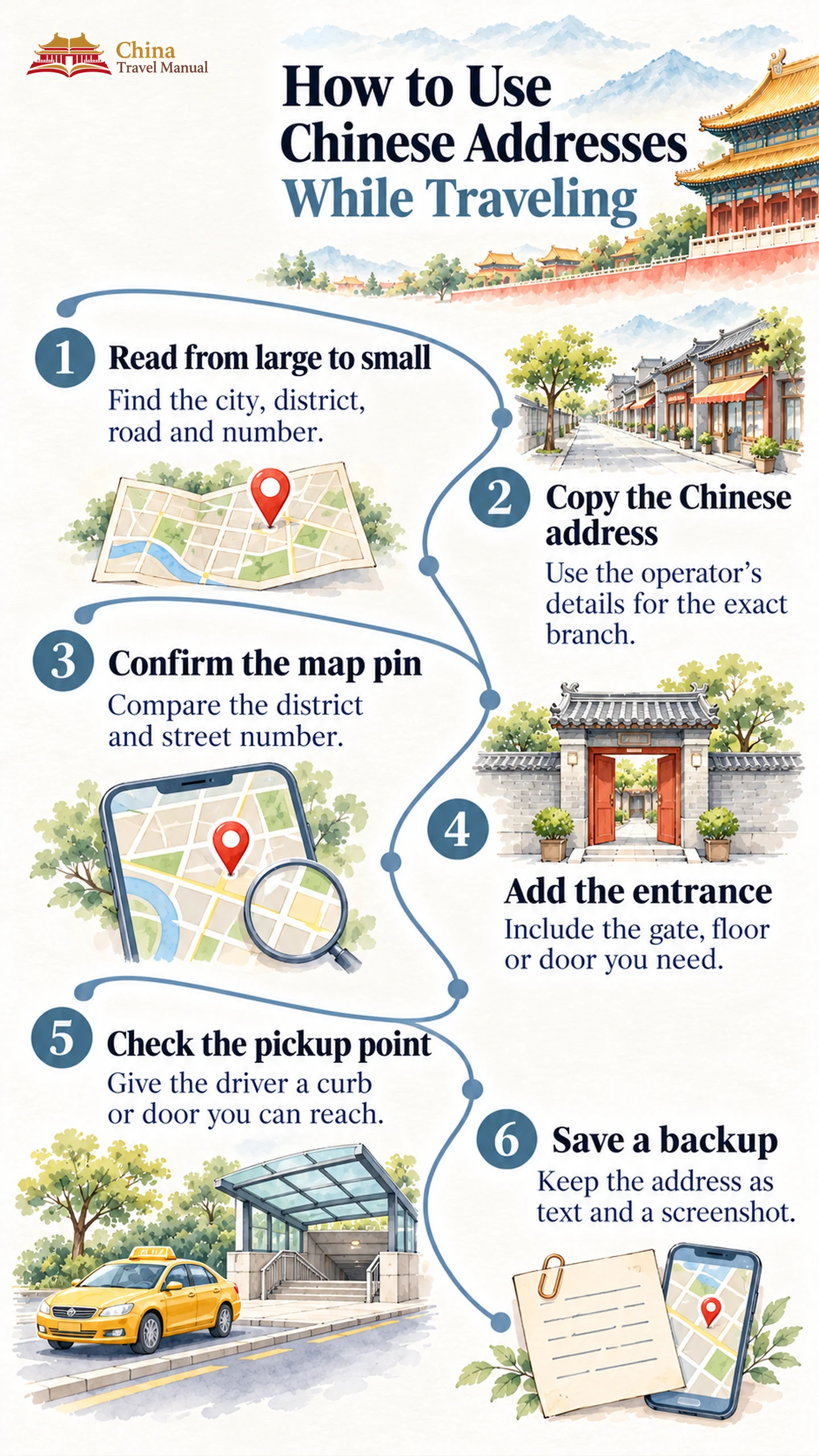
Get two details right before you set off. Find the correct property in Chinese and identify the door where you can enter or meet the driver. The street address can take you to the property even when its visitor entrance is on a different side.
Read a Chinese Address From Large to Small
In Chinese script, an address usually moves from the largest geographic area down to the site or premises. In an English booking confirmation, the same elements can appear in another order. Read through the original characters and numbers in groups. The city or municipality and the district identify the area. Then look for the road or street name, the property number and any later detail for a building or room.[1]
| Markers | What to look for |
|---|---|
| 省 (shěng), 市 (shì), 区 (qū) | Province, city and district. A municipality together with a district can be enough to identify the city without a separate province. |
| 路 (lù), 街 (jiē), 巷 (xiàng), 弄 (lòng) | Road, street, alley or lane. Keep the whole name, including any direction word or lane number. |
| 号 (hào) | A number whose meaning depends on what follows. A street number and a numbered building can both contain this character. |
| 栋 (dòng), 幢 (zhuàng), 单元 (dānyuán) | Building or block and the unit or section within it. |
| 层 (céng), 室 (shì) | Level and room. Keep any basement marker or letter. |
For a practice example, “上海市浦东新区世纪大道1952号” is the published street address of Shanghai Museum East. It reads Shanghai, Pudong New Area, Century Avenue, No. 1952. The museum’s current Chinese page says individual visitors use the B1 East Gate near Dingxiang Road. Copy both details if you visit. The Shanghai Museum East guide provides the destination context.[2]
How to Make a Destination Card
- Copy the official Chinese name and address. Use the property’s website, confirm the text with the host or copy it from the local booking details. Include the city and branch name.
- Match the district and street number. Search the Chinese text in your map app. Compare the district and road with your booking before trusting the pin.[3]
- Add the door or pickup point. Include the exact gate, level, entrance name or landmark and the operator’s contact. Ask the host if you are unsure.
- Save a text copy and a screenshot. Keep the address easy to paste into an app and easy to show without a connection. Save the name of the metro exit if it helps.
For larger destinations, the first address line can identify the site while a later note directs you to an entrance. Copy the most specific official directions for the trip you will make. See the AMap guide for how to compare possible pins and routes.
Show the Destination to a Driver
Show the Chinese name and street address together. At a hotel, the chain name alone can bring up several branches. Confirm which district the driver sees and which door you can use. If an alley is closed to cars or an entrance is inside a compound, ask the property for a point a taxi can actually reach. The hotel location checklist explains which clues to verify before booking.[3]
A ride pickup needs your present location rather than your destination. At an airport or a mall, give the floor, door number and designated pickup zone. Read road-side instructions and use the pickup point the operator can legally reach. The ride pickup guide gives examples of these last few steps.
If the pin lands on a different building, compare the original text with nearby house numbers and ask a staffed desk. A translation can change the way a proper name looks. Keep the Chinese characters and the original reservation visible when a translated result disagrees with the text. The translation apps guide can help you read a sign without changing the address you show.
FAQs About Chinese Addresses for Travel
Why does the Chinese address look reversed?
The Chinese-script order generally puts larger geographic areas first, followed by local details. An English address often starts with the local details. Compare the actual elements and numbers even if their order changes.[1]
What if my hotel booking shows only an English address?
Ask for the full name and address in Chinese, including the branch and entrance. Save them together with the booking reference or map pin.
Does the street address identify the entrance?
It identifies the destination property or premises. A separate door, level or road can be the right place to enter. Check the venue’s visitor instructions.[2]
What should I store offline for a taxi?
Keep the Chinese name, precise address, entrance or nearest reachable curb and an operator contact. A map screenshot is helpful when you cannot paste the address.
Sources
[1] Universal Postal Union. Addressing guide for mainland China
[2] Shanghai Museum. Shanghai Museum East address and entry instructions
[3] Shanghai Municipal Government. A guide to using AMap in English





