

Quick Answer: Essential China Travel Tips
A first trip to mainland China is easier when you prepare for the moments when a booking, phone, or payment does not work as expected. These China travel tips focus on practical decisions—not on installing every available app.
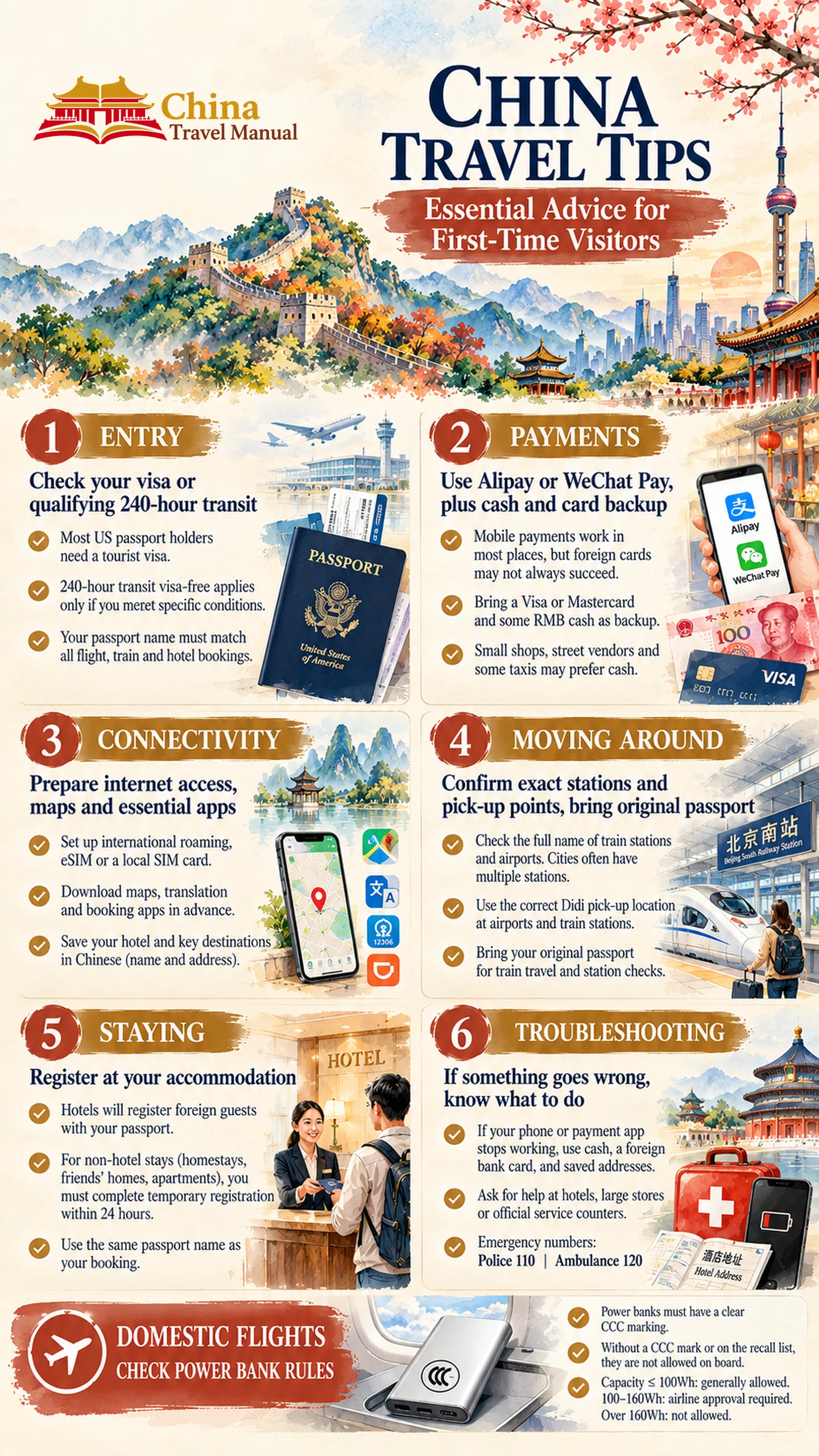
- Entry: Check your passport’s visa or qualifying transit status before booking nonrefundable travel.
- Payments: Set up Alipay or WeChat Pay, but carry a bank card and some renminbi (RMB) cash.
- Connectivity: Test your data plan, maps, translation, and essential accounts before departure.
- Identity: Use passport-consistent details for tickets and reservations, and carry the original passport where required.
- Transport: Confirm the full station or airport name and the designated ride-hailing pickup point.
- Accommodation: Make sure any stay outside a hotel is registered within the required period.
- Backup: Save Chinese addresses and important bookings offline so a dead phone or failed app does not strand you.
China is highly navigable for independent visitors, but no single app, card, or English-language service works everywhere. Build in an alternative.
The points below explain where that backup matters most and what to do when something breaks. For complete booking and setup instructions, follow the linked topic guides rather than trying to manage every detail from one article.
The points below explain where that backup matters most and what to do when something breaks. For complete booking and setup instructions, follow the linked topic guides rather than trying to manage every detail from one article.
Check Your Entry Documents Before Traveling to China
For most U.S. passport holders making an ordinary trip to mainland China, obtaining the appropriate visa in advance remains the starting point. China’s 240-hour visa-free transit is a different route into the country: eligible travelers, including U.S. citizens, must meet specific nationality, onward-ticket, designated-port, and permitted-area conditions. Qualifying transit visitors may sightsee during their approved stay; a conventional U.S.–China–U.S. round trip is not automatically an eligible third-country transit.[1][2]
| Document or issue | What to check | Why it matters |
|---|---|---|
| Passport and entry permission | Valid passport plus the visa or qualifying exemption for your precise itinerary | An onward ticket by itself does not establish transit eligibility |
| Flight, rail, and hotel bookings | Names, passport number where requested, and document type agree with the passport used | Mismatches can delay check-in or identity verification |
| Arrival card | Whether an arrival card applies to you and how you will submit it | Online filing is optional; qualifying travelers can use airport facilities or a paper card |
| Hong Kong or Macau connections | Entry rules for each jurisdiction and re-entry to the mainland | Admission to Hong Kong or Macau is not permission to enter mainland China |
Since November 20, 2025, eligible travelers can submit China’s arrival-card information through official online channels before departure. The online option is not mandatory: arrival-port kiosks, QR submission, and paper cards remain available where applicable. Do not pay unofficial sites for this government filing.[3]
A passport name written with different spacing or system-imposed formatting is not necessarily an error; the safer rule is to enter the same name and document information shown in your passport and resolve discrepancies with the carrier or booking provider before travel. For the actual rules, see entry requirements for U.S. passports, visa-free transit conditions, and the China arrival card guide.
Set Up Payments and Keep a Backup Way to Pay
Alipay and WeChat Pay are convenient for restaurants, shops, and transport, and both can support eligible international bank cards. But card linking is subject to the issuing bank’s approval, identity checks, merchant acceptance, and platform-specific limits. A successful setup at home does not guarantee every transaction in China will go through.[6]
| Situation | Practical first choice | If it fails |
|---|---|---|
| Restaurant, chain store, major attraction | Alipay or WeChat Pay; a card terminal if available | RMB cash or a different card |
| Small shop or street stall | Ask whether the QR payment accepts your linked card | Offer RMB cash; do not assume a foreign card works with every QR code |
| Hotel | Confirm accepted cards before arrival | Use an alternate card or RMB cash where accepted |
| Ride-hailing | Payment method accepted in the app | Select another supported in-app method, or use a licensed taxi with an agreed accepted method |
| Metro or local bus | Local transit code, supported contactless option, or ticket machine | Buy a ticket at a service counter or machine using an accepted method |
The crucial distinction: mobile payment is popular, not legally the only way to pay. Chinese authorities have directed merchants and major visitor-facing venues to support more payment options, including cash and cards, although actual acceptance and change availability may differ at an individual checkout.[11]
Bring a modest supply of smaller RMB notes, not your whole travel budget in cash. Keep at least one physical card separate from your phone. If a payment is declined, first switch funding cards or payment methods rather than repeatedly scanning; the bank may be blocking the transaction. See the detailed visitor payment guide, payment-problem fixes, and cash and ATM options.
Prepare Internet Access, Maps, and Essential Travel Apps
Choose a Reliable Way to Stay Online
International roaming is usually the least disruptive option if your U.S. carrier supports China, but it may cost more. A travel eSIM can be convenient on an unlocked, eSIM-compatible phone; coverage, routing, data allowances, and whether it provides an SMS-capable phone number depend on the product. A mainland SIM may offer local mobile service, but purchasing it after arrival does not solve your need for data during the first hour at the airport.
Do not assume an eSIM includes a Chinese number or can receive the verification texts required by every service. Keep access to your U.S. number if your accounts use it for authentication. Also check how your chosen connection handles apps and websites that may not operate normally on mainland networks. Set up connectivity before leaving the airport; see roaming versus eSIM and internet access in China.
Test Maps, Translation, and Booking Apps
Test each tool for the specific task you need—not just whether its icon opens. Amap (Gaode) is useful for local navigation; Apple Maps may be another option depending on device and location. Google Maps may have gaps in mainland directions and transit information, so do not make it your only navigation method. Save translation language resources available for offline use and verify whether the map app you choose actually offers offline downloads for the relevant area.
Register or test 12306 for rail bookings and DiDi for ride-hailing where practical. If a service requires document review or an SMS code, allow for that before departure rather than waiting until the railway platform. Screenshot your hotels’ Chinese names and addresses, train station names, and key reservations. If you lose internet service, you can still show a destination to a taxi driver or hotel clerk. For the fuller toolkit, use essential China travel apps.
Avoid Common Train, Taxi, and Local Transport Mistakes
In China, a city’s name is not a sufficient station name. Beijing South and Beijing West are different stations; Shanghai Hongqiao Railway Station and Hongqiao Airport are adjacent but serve different journeys; Pudong Airport is a separate, more distant hub. Check the full Chinese and English name on your ticket and allow time for the actual door-to-door journey, not only time aboard the train.
Chinese trains use real-name ticketing. Foreign passengers can use eligible passports, and the traveler must present the valid identity document associated with the ticket for relevant checks. An image of the passport is not a reliable substitute for the original at the boarding gate.[7]
For DiDi or other ride-hailing pickups at large terminals, follow the app’s labeled meeting area instead of standing outside the nearest exit. If your driver cannot find you, confirm the terminal, level, and numbered pickup bay; walking toward an ordinary taxi queue will not necessarily get you closer. Dedicated DiDi pickup guidance is more useful here than guessing where a car can stop.
Avoid universal claims that a 20-minute train connection or a two-hour airport-to-rail transfer is always safe. Minimum connection time depends on the station, transfer arrangement, immigration, baggage, traffic, and whether the next train departs from the same terminal. Choose generous buffers when tickets are independent. Further details belong in the China transportation hub, train booking guide, and train passport-check guide.
Book Hotels and Popular Attractions Without Surprises
Confirm Hotel Check-In and Accommodation Registration
A hotel should verify the guest’s identity, usually using their original passport, and register the foreign guest with the authorities. Before booking a small property, confirm that it accepts international guests and can check in a traveler using the passport you hold; do not rely on vague listings or assumptions about English-speaking staff.
A stay outside a hotel has a different registration responsibility. Under Article 39, the foreign guest or host must register the accommodation with the local public security authority within 24 hours of arrival. Since September 21, 2026, the National Immigration Administration has offered nationwide online registration through its official government site, the NIA 12367 app, and associated mini-programs, while in-person registration remains available. The registration requirement is legal; the choice between online and offline filing is a service option.[4]
This applies to a private home or other non-hotel accommodation, not only to a few former pilot regions. Read the accommodation registration guide and hotels for foreign travelers before reserving an unusual stay.
Do Not Assume Major Attractions Accept Walk-Ins
Some high-demand museums, palaces, and heritage sites use advance booking, real-name admission, timed slots, or restricted opening days. There is no single nationwide seven-day release rule for attractions. Check the site’s official booking channel, valid passport requirements, and current schedule before you commit to a train or hotel; a tour or third-party ticket listing may not replace the venue’s official entry procedure.
If an attraction is sold out, adjust the order of your visits rather than arriving and expecting the gate to sell you a ticket. Our attraction ticket guide covers the more detailed booking decisions.
Food, Drinking Water, and Everyday Comfort
Do not drink untreated tap water in mainland China, including major cities. Bottled or properly boiled water is a practical choice; check that any drinking-water dispenser is intended for potable water. The CDC specifically cautions that tap water is not drinkable in China.[8]
If you have allergies, are vegetarian, or need to avoid specific ingredients, save a clear Chinese explanation on your phone before a restaurant visit. A dish’s English menu name may not reveal sauces, stock, or cooking oils. Ask staff to confirm ingredients rather than assuming a dish is safe from its appearance.
Public restrooms vary widely. Keep tissues and hand sanitizer accessible; some stalls do not provide toilet paper. Both squat and seated toilets are common, so look for the facility that works for you. Some restaurants offer serving utensils for shared plates, but do not assume every table does. For specific situations, see China drinking water, public toilets, and food and drink in China.
Language, Etiquette, and Local Customs
You can travel independently without speaking Mandarin, particularly along popular routes such as Beijing, Xi’an, Chengdu, and Shanghai. English signs and assistance become less consistent in smaller towns, local bus terminals, and family-run businesses. Showing the destination in written Chinese is often more dependable than trying to pronounce a translated English place name.
Local etiquette is contextual rather than a collection of nationwide prohibitions. Follow signs at temples and religious sites; ask before photographing individuals; and respect queues and designated no-photography areas. Tipping is generally not expected in ordinary mainland restaurants, local taxis, or hotels, although special services and international settings may differ. These are customs, not an additional legal entry requirement. Explore travel etiquette and tipping in China for specific situations.
Plan Around Crowds, Weather, and Packing Rules
Spring Festival, the early-May Labor Day holiday period, and China’s National Day holiday period can bring substantial competition for rail tickets, hotels, and attraction reservations. Their exact holiday and adjusted working-day dates vary by year; check the current official calendar instead of assuming a fixed multi-day break. A route with fewer hotel changes is usually more resilient during peak crowds. See China’s public holidays before fixing travel dates.
China’s climate varies by region: a comfortable Beijing autumn tells you little about humid southern summers or high-elevation nights in Yunnan. Compare the actual forecast at each stop, not a single nationwide “best season.” Pack suitable layers, a compatible power adapter, and medication in original packaging as appropriate. A US device rated for 100–240V typically needs only a plug adapter; equipment rated for 120V only may need a suitable voltage converter. Check each device’s label rather than assuming every US appliance is dual-voltage.
Domestic-flight power-bank rules are especially easy to miss. Since June 28, 2025, mainland domestic flights have prohibited power banks without a clear China Compulsory Certification (CCC/3C) mark and recalled models or batches. Power banks travel in carry-on baggage, not checked baggage; usual energy limits are up to 100 Wh, or over 100 through 160 Wh with airline approval, with anything over 160 Wh not permitted. A familiar “20,000 mAh” label alone does not establish compliance. Airline rules may add operational conditions.[9][10]
Review the dedicated power-bank rules, packing list, and best time to visit China before departure.
Stay Safe and Know What to Do in an Emergency
Many visitors experience ordinary city travel without serious incidents, but use licensed, metered taxis or the ride-hailing app’s confirmed booking rather than accepting an unquoted offer outside an airport. Decline pressured purchases and verify prices before paying at tourist markets. The travel scam guide covers recognizable patterns and what to do before handing over money.
If your passport is lost, move to a safe place, contact local police to report the loss, and contact the nearest U.S. embassy or consulate for emergency travel-document advice. Ask Chinese immigration authorities what replacement or exit documentation is required for your circumstances; a new U.S. passport may not itself resolve every exit formality. Keep passport copies and consular contacts stored separately as a backup, not as a replacement for the original. See lost passport in China.
For immediate assistance, call 110 for police, 119 for fire, or 120 for an ambulance. Have your hotel name and Chinese address ready, and ask nearby staff for translation help if needed. Consider insurance covering medical care and disruption, and check the policy’s exclusions and emergency contact process before departure.[2]
As of October 19, 2026, the U.S. Department of State has a Level 2: Exercise Increased Caution advisory for mainland China, citing arbitrary enforcement of local laws, exit bans, and wrongful detention risks. Recheck the current advisory rather than treating the level in any travel article as permanent.[2] The China travel safety guide and emergency help guide go deeper.
FAQs About China Travel Tips
What Should I Prepare Before My First Trip to China?
Resolve your entry status first, then verify booking identity details and test one working combination of mobile data, navigation, payment, and translation. Keep a second payment method and offline Chinese addresses. Use the dedicated China travel checklist for the full pre-departure sequence.
Can I Travel Around China Without Speaking Chinese?
Yes, particularly in major tourism corridors. Expect more self-service tools and uneven English coverage away from major stations and large hotels. Saving destinations and dietary requirements in written Chinese helps when spoken English is unavailable.
Do I Need Cash When Traveling in China?
Not for every purchase, but a modest RMB cash reserve is valuable when a linked foreign card is declined, a QR code does not support foreign funding, or your phone battery runs out. Carry smaller notes and ask about accepted methods before receiving a service.
Do I Need to Carry My Passport Every Day in China?
Yes, generally. Article 38 of China’s Exit and Entry Administration Law requires foreigners aged 16 or older to carry their passport, other valid international travel document, or qualifying stay/residence permit and present it for police inspection. A photo or photocopy helps with recovery but does not replace a required original document. Carry the passport securely; you will also need the ticket-linked identity document for many rail and hotel checks.[5]
What Should I Do if My Phone or Payment App Stops Working?
Try your backup connection, then a different card or RMB cash. Use saved Chinese addresses, hotel names, and reservation screenshots to reach a staffed hotel desk, transport counter, or large store. If your passport or personal safety is involved, seek official help rather than accepting unsolicited assistance from a stranger.
Sources
[1] National Immigration Administration. Visa-Free Transit Policies
[2] U.S. Department of State. China Travel Advisory and Travel Requirements
[3] Embassy of the People’s Republic of China. Notice on Online Completion of Foreigner’s Arrival Card
[4] National Immigration Administration. Nationwide Online Accommodation Registration for Foreigners in Non-Hotel Residences
[5] National Immigration Administration. Exit and Entry Administration Law of the People’s Republic of China, Article 38
[6] State Council of the People’s Republic of China. Guide to Working and Living in China—Payments
[7] China Railway 12306. Real-Name Ticketing and Valid Identification
[8] U.S. Centers for Disease Control and Prevention. China—Traveler View
[9] Civil Aviation Administration of China. Power Banks Without CCC Markings Banned on Domestic Flights
[10] China Eastern Airlines. Regulations on Safe Transportation of Lithium Batteries
[11] State Council of the People’s Republic of China. Payment Service Guide for Overseas Visitors





