

Quick Answer
Choose your own venue, use a licensed taxi or a ride booked through an official app, and verify the price and recipient before paying. Decline invitations that come with pressure to follow someone or pay without a clear price. If you are threatened or prevented from leaving, prioritize your safety and get police help.[1][2][3][5]
| Warning sign | What to do |
|---|---|
| A stranger insists you follow them to a tea house or bar | Decline and choose a venue independently. |
| Someone offers an airport ride away from the official pickup area | Use the marked taxi rank or an app with vehicle details. |
| A caller asks for money or verification codes | End contact and verify through an independently obtained number. |
| A payment link or QR code comes unexpectedly | Open the official app and verify the merchant and amount yourself. |
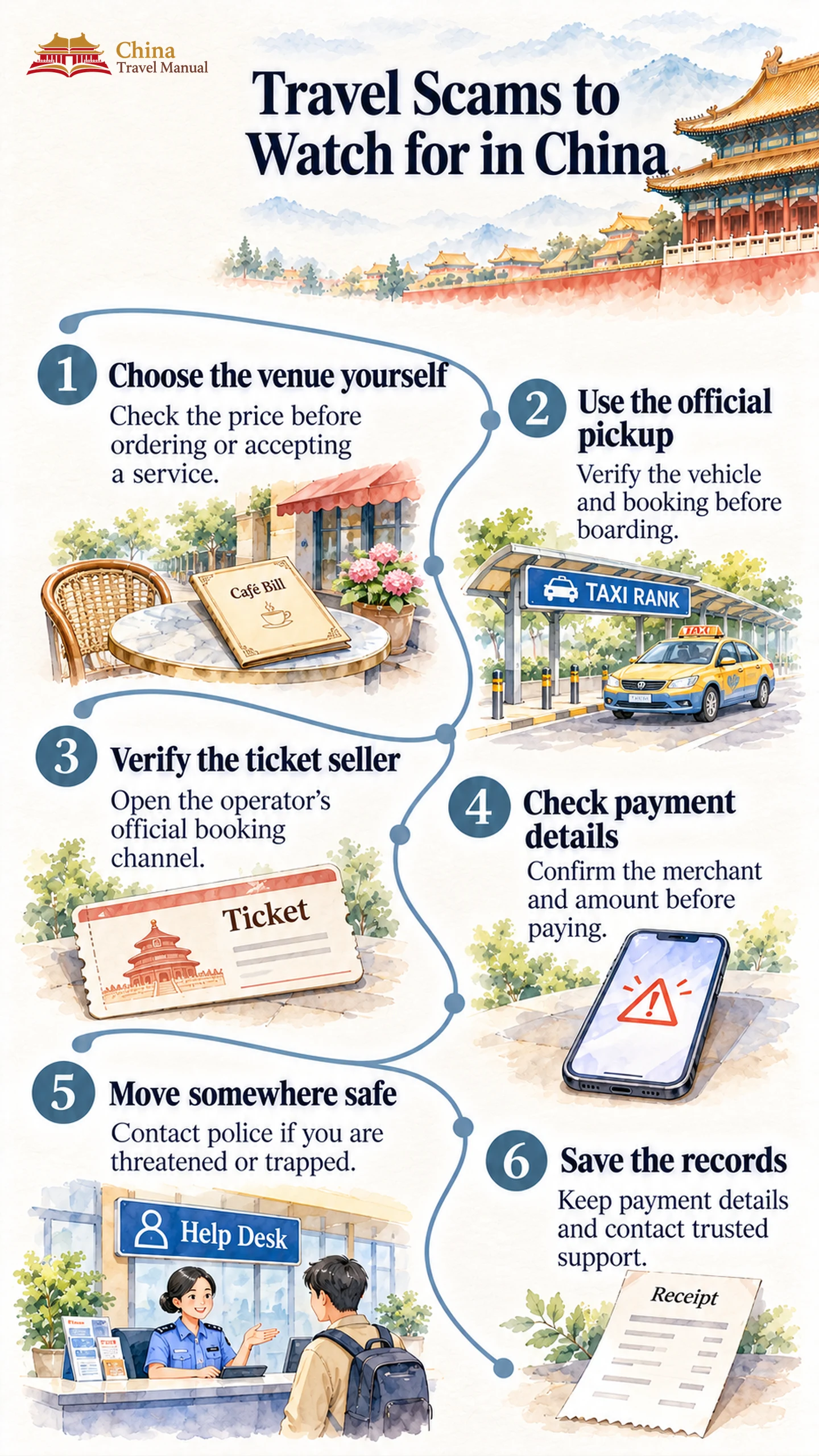
Pressure is often a clearer warning sign than how friendly someone sounds. Verify the place, price and payment channel independently. If the situation changes from a price dispute to a safety concern, leave when you safely can and ask for help.
Invitations With an Unexpected Bill
Australian, UK and Canadian travel advisories warn about unsolicited invitations to tea houses, bars, cafés or other services followed by unusually high bills. You can thank someone for the invitation and choose where to go yourself. At any new venue, read the menu and check the price, units and any minimum charge before ordering. Ask for an itemized bill if a total is unclear.[1][2][3]
Look at how the person responds if you pause or suggest another place. Leave when it is safe if you are pressured to buy, prevented from checking the price or told to pay before you can go. Move toward a staffed public spot and seek help if anyone threatens you. The China emergency help guide explains how to give your location and contact the right service.[1][2][3][5]
Unlicensed Rides and Pickup Confusion
At an airport or station, follow signs to the official taxi rank or an authorized app pickup zone. Confirm the vehicle registration and pickup point against the booking before you get in. At a licensed taxi, check whether the meter or a posted fixed fare applies. Read any official surcharge information and keep the ride receipt. See the China taxi guide for routine fare expectations.[1][4]
If someone offers a car before you reach the queue, continue to the proper pickup area. For an app ride, ask the operator before moving to an unfamiliar off-app location or replacing an existing trip with a private agreement. A driver may ask you to follow legitimate pickup instructions at a terminal. Verify the floor, door and vehicle identity in the app or with airport staff. The China airport transfer guide helps you identify the official options.[4]
Booking, Payment and Impersonation Attempts
Find an attraction or railway ticket link through the operator’s own website, verified account or staffed desk. Check whether a seller is issuing a real ticket, selling a tour with admission, or submitting a request for you. Read the issue and refund terms before paying, and check that any date, entrance and passport details match. Use the China ticket booking guide for foreign numbers if a local form does not accept your details.
Check the merchant’s name and total in the app before confirming a QR payment. If a code or refund link arrives unexpectedly, open the service from its normal app or website and check the request there. Use a bank or wallet’s official support channel if someone claims they need a code to complete a refund. Keep your one-time authentication codes private. See the payment problems guide for separating a pending payment from a confirmed charge.[3][6]
Scam callers can pose as police or another authority. Do not send money or share account details in response to an unexpected call. End the call when safe and contact the organization using a number you obtain independently. If someone claims to need you to take a parcel or a suitcase across a border, decline. Keep control of your luggage.[4][6]
What to Do if You Think You Were Scammed
- Get to a safer place. If you face immediate danger, call 110 for police in mainland China. Ask hotel, station or venue staff for help if you cannot communicate your location.[3][5]
- Keep any records you already have. Save the receipt, venue address, time, names shown in the app and transaction reference. Put safety first if collecting evidence would prolong a confrontation.
- Use verified support channels. Contact the bank or wallet through its official number or app. Ask how to secure the account and dispute a charge. Contact the actual booking or ride provider separately if relevant.[3][6]
- Report the incident where appropriate. A police report may help document what happened and a bank or insurer may ask for one. Ask what paperwork can be provided. Report a missing passport or payment card promptly.[3][4]
If you paid under pressure, write down what happened once you are safe. Use the lost wallet or bank card guide if you no longer control a card. Keep information about the payment and about any security incident in the same private note for your bank, insurer or consular office.
FAQs About Travel Scams in China
Is every invitation to drink tea a scam?
No. Choose venues independently when you do not know the person, and check the price if you accept an invitation in a commercial setting. Pressure to follow someone, order or pay is a reason to pause.[1][2]
What if my ride driver’s plate differs from the app?
Stay at the pickup point and check the booking with the app or its official support. Only board when the vehicle identity matches your confirmed ride.[4]
Should I pay if I think the bill is inflated?
Ask for an itemized bill and verify the agreed price if you can do so safely. If you are threatened or cannot leave, prioritize getting help. Save the receipt or transaction detail after you reach safety.[1][2][3]
Can I recover money after a QR or card scam?
Tell your bank or wallet provider promptly and ask about its dispute process. Save payment and merchant records and ask whether it needs a police report. The outcome depends on the provider and circumstances.[3][6]
Sources
[1] Australian Department of Foreign Affairs and Trade. China travel advice and safety
[2] UK Foreign, Commonwealth & Development Office. China safety and security travel advice
[3] Government of Canada. China travel advice and advisories
[4] U.S. Department of State. China travel advisory
[5] Shanghai Municipal Government. Public service and emergency numbers
[6] U.S. Federal Trade Commission. Unexpected QR codes and account risks





