
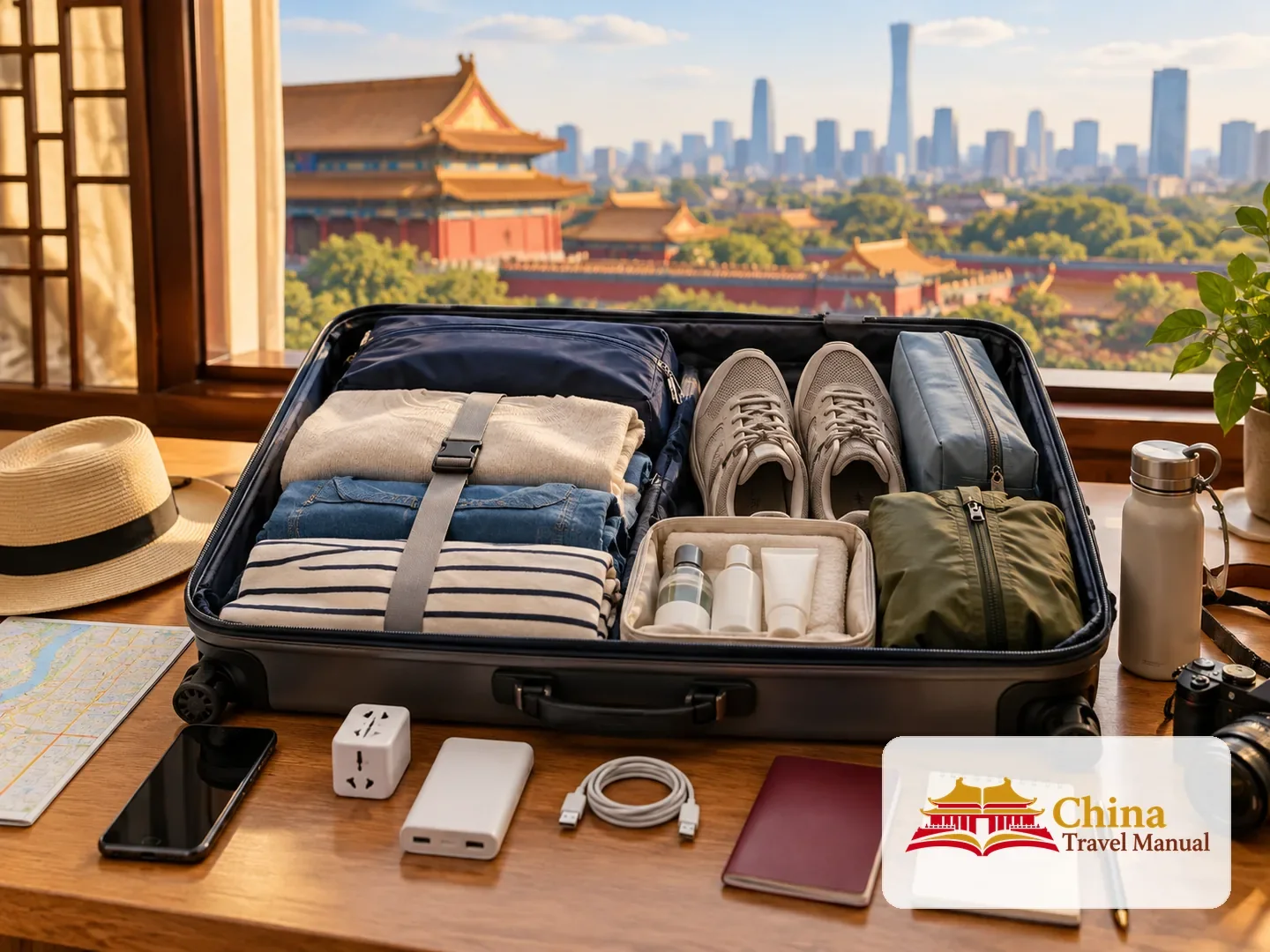
Quick Answer: What Should You Pack for China?
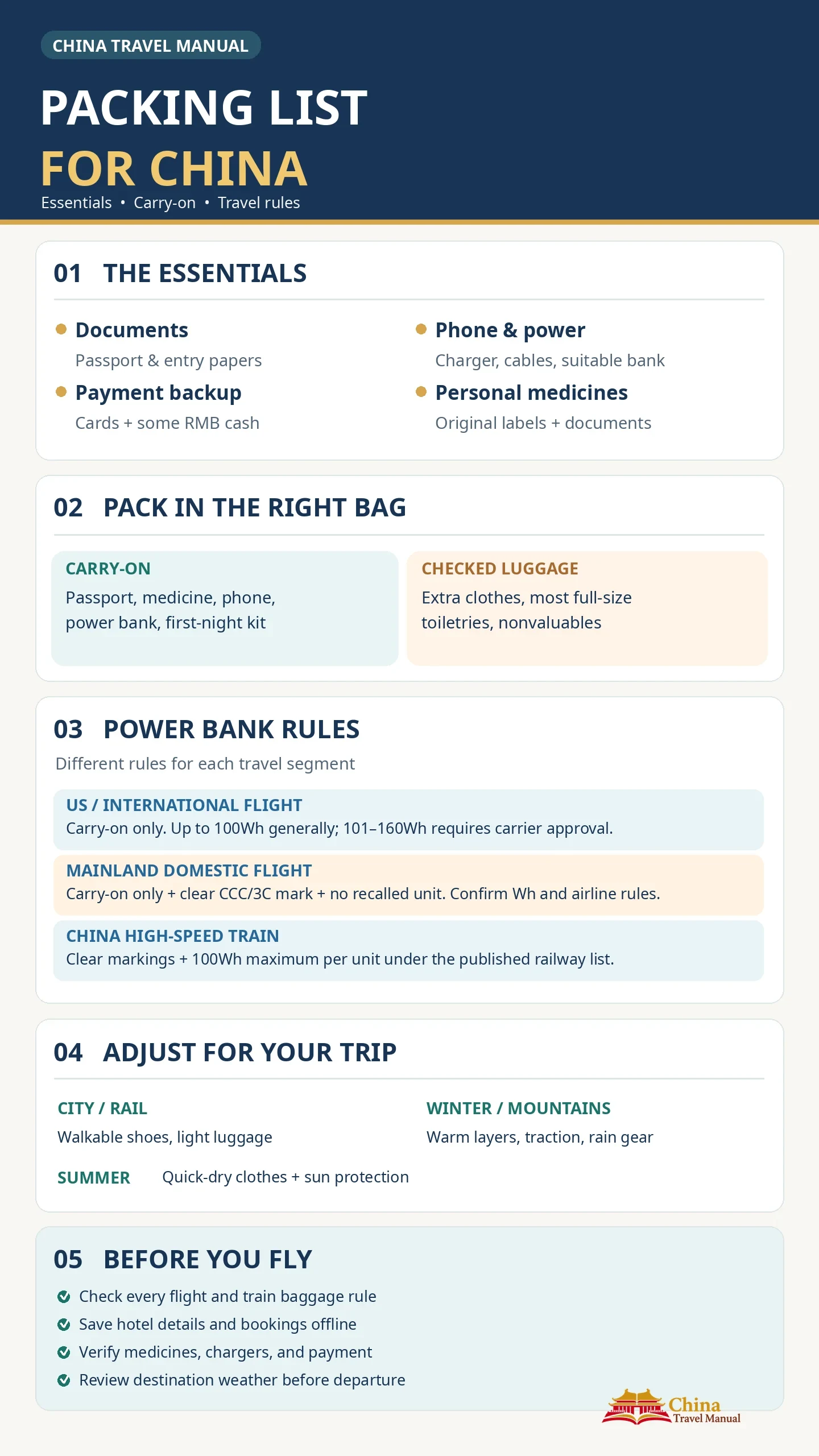
Pack the essentials you cannot easily replace in mainland China: your passport and applicable entry documents, prescription medicines, a phone and compatible charger, a payment backup, comfortable walking shoes, clothing for your actual destinations, and an offline copy of your hotel’s Chinese address. Keep documents, medicines, valuables and power banks in your carry-on rather than checked baggage.
- Must bring: Passport, necessary entry papers, personal medicines, working phone and payment options.
- Keep accessible: Offline hotel details, a charging cable and a first-night change of clothes.
- Adjust to the trip: Weather layers, luggage size, and battery or liquid limits for every flight and train.
Check each transport segment separately. A power bank acceptable on your flight from the United States may be refused on a later mainland domestic flight if it lacks a compliant CCC/3C mark.[1][2]
A useful packing list should leave room for essentials without filling your suitcase with products you can buy locally. The decisions below focus on what to carry, where to put it and which rules change during the journey.
Essential China Packing Checklist at a Glance
Use this table as your single overview. The sections that follow explain the few items for which packaging or transport rules matter.
| Category | What to pack | Where and why |
|---|---|---|
| Documents | Passport, entry documents, booking details, insurance contacts | Carry-on; store offline copies separately from originals |
| Money | Usable payment card, backup card, modest amount of RMB cash | Separate secure places; confirm your China payment options |
| Electronics | Phone, charger, cables, suitable travel adapter, power bank | Valuable equipment in carry-on; power banks must not be checked |
| Health | Essential prescriptions, supporting medical records, personal supplies | Carry-on, in labeled packaging where possible |
| Clothing | Weather-appropriate layers, underwear, socks, broken-in walking shoes | Most in luggage; one change in carry-on |
| Personal care | Travel toiletries, sunscreen, contact-lens supplies, hygiene products | Check liquid rules for each flight |
| Arrival backup | Hotel name and address in Chinese, contact number, offline route | Download to phone and keep a paper fallback |
Think of these as three groups: items to bring from home, optional items dependent on your needs, and ordinary goods you can buy after arrival. Your broader China travel checklist covers booking and departure tasks rather than packing individual objects.
What to Keep in Your Carry-On Bag
Documents and Irreplaceable Essentials
Carry your passport, entry paperwork and essential prescriptions where you can access them during the trip. Your passport should not travel in a checked suitcase; immigration checks happen before you collect checked baggage. Keep booking confirmations, an emergency contact and your hotel address available offline. A paper passport copy stored separately is useful if the original is lost, but is not a substitute for it. For document requirements, see the China travel documents guide.
Carry spare payment cards separately, and keep your phone, camera or other valuable electronics in your cabin bag when practical. Spare lithium batteries and power banks belong in carry-on baggage under applicable aviation rules; if your cabin bag is gate-checked, remove those batteries first.[1]
Prepare for Delayed Checked Baggage
Pack a small first-night kit: one change of underwear and clothing, essential daily medication, glasses or contact-lens supplies, a charging cable and a few travel-size toiletries. If a checked bag arrives a day late, you can still reach your hotel, sleep and continue with basic activities. Keep cabin-liquid limits in mind and avoid bringing full-size bottles through security.
If you will arrive late or transfer directly to another city, put a printed hotel address and a simple arrival transport plan alongside your documents. These take little space but remain useful if your phone temporarily loses data access.
Electronics, Phone Access and Charging in China
Phone, Charging Cables and Offline Backups
A phone can handle maps, translation, transport, reservations and mobile payment, but it depends on electricity and connectivity. Bring a reliable wall charger and charging cable, plus a spare cable if you use your phone heavily. Save your hotel name, Chinese address, phone number and station or pickup location in an offline album. Download important booking confirmations before departure. For setup details rather than packing decisions, consult Internet Access in China and the China travel apps guide.
Power Adapters and 220V Compatibility
Mainland China generally uses 220V, 50Hz electricity. Different sockets may accept different plug shapes, so a compact travel plug adapter is sensible. Read each device’s input label. Chargers marked 100–240V are designed for that voltage range and may only need a plug adapter; an appliance marked only 120V is not made compatible by changing the plug.[9]
Leave a US-only high-wattage hair dryer or curling iron at home unless you have a properly rated voltage solution. Do not confuse an adapter, which changes the plug connection, with a voltage converter. Pack a power bank only after checking the separate battery rules below.
Packing Rules for Flights, Trains and Chinese Customs
International Flights and Carry-On Liquids
At US Transportation Security Administration checkpoints, the usual 3-1-1 rule limits liquids, gels and aerosols to containers of 3.4 US fluid ounces (100 mL) or less inside one quart-size bag, subject to permitted exceptions such as some medications. A later airport, airline or domestic Chinese flight may apply different rules, so check each segment rather than assuming your first security check governs the whole trip.[3]
Power Banks on China’s Domestic Flights
A power bank is a spare battery: carry it in the cabin, not in checked luggage. Under US FAA guidance, lithium-ion batteries up to 100Wh are generally permitted, while larger units above 100Wh and up to 160Wh require airline approval and are limited in quantity. Airlines may impose tighter conditions.[1]
Mainland China’s domestic flights have an additional rule effective June 28, 2025: a power bank without a CCC/3C mark, with an unclear mark, or belonging to a recalled model or batch cannot be carried aboard. The applicable Wh and airline rules still apply. A label showing 100Wh or less does not excuse a missing CCC mark on a mainland domestic flight.[2]
| Transport segment | Power bank decision before departure |
|---|---|
| US departure or international flight | Carry-on only; check Wh rating, carrier approval for larger allowed batteries and any airline-specific limits |
| Mainland Chinese domestic flight | Carry-on only; check Wh, a clear CCC/3C mark, recall status and airline conditions |
| Mainland Chinese train | Clear capacity labeling, no more than 100Wh per unit under railway rules; CCC is not currently checked as an additional railway requirement |
China Railway has clarified that its train power-bank rule is different from the domestic-airline CCC rule. Still verify the current rules for your specific transport before leaving.[4][5]
High-Speed Train Luggage and Batteries
China Railway’s published free carry-on allowance is 20kg in total for an ordinary adult traveler. On EMU or high-speed trains, the sum of an item’s length, width and height must generally not exceed 130cm, and an individual item may weigh no more than 20kg. Foldable wheelchairs used by disabled travelers have stated exemptions; ask about stroller and special-item arrangements rather than assuming every item is unrestricted.[6]
A suitcase cleared for airline check-in may exceed the rail limit. Measure its exterior, including wheels and handles, and consider whether you can lift it through crowded stations. Some sprays, sharp tools and other items also have their own railway restrictions; see the railway station guide and official restricted-items list.[5]
Customs Restrictions on Items Entering China
Do not pack fresh fruit, meat products, eggs, live plants, seeds or other potentially restricted animal and plant materials without checking China’s entry rules. A factory-sealed snack is not automatically permitted or prohibited: ingredients and product type matter. Medication restrictions are a separate issue. Use the China customs guide for declaration requirements and exceptions; this packing guide does not replace a customs determination.[7]
Medicines, Toiletries and Personal Care
Prescription Medicines and Documentation
Carry essential prescriptions in their labeled original packaging with the prescription and, when useful, a medical letter identifying the drug and its active ingredient. Bring quantities appropriate to personal needs, but do not assume every US-prescribed medication may enter China. The US Department of State specifically warns about restrictions affecting some medications common in the United States, including certain stimulants.[8]
For narcotic or psychotropic substances, China’s rules can require medical documentation and impose quantity limits. A foreign prescription alone is not a blanket exemption. Check the exact ingredient and requirements before travel, especially for some ADHD, pain or sleep medicines.[10] The China health preparation guide covers broader medical planning.
Toiletries, Hygiene Products and Basic First Aid
Bring the personal-care products you need immediately: a toothbrush and toothpaste, sunscreen, tissues, menstrual products, contact-lens solution or small first-aid items as appropriate. Disposable hotel amenities vary by property; do not assume every room provides the same supplies. Most everyday products can be purchased in cities, but specialized brands or prescriptions may be hard to replace in smaller places. Keep flight liquid limits in mind for anything you bring in the cabin.
What Clothes Should You Pack for China?
Spring and Autumn: Pack Flexible Layers
Spring and autumn can vary widely by region and altitude. A breathable base layer, long-sleeved top and light wind-resistant jacket make it easier to adjust through the day. Take a packable rain layer or small umbrella where wet weather is likely. Choose layers you can reuse rather than an outfit for every day.
Summer: Heat, Humidity and Sun Protection
Southern and eastern cities can be hot and humid in summer. Lightweight, breathable clothing, a sun hat and rain protection are useful; mountain and plateau routes may require a warm layer even in summer. A fast-drying shirt and spare socks are often more useful than bulky extras. Match the forecast to each destination, not just the city where your flight lands.
Winter: Northern and Southern China
Harbin and other northeast destinations may require insulated boots with good traction, thermal layers, gloves, a warm coat and face protection. Guangzhou generally calls for much lighter layers, although damp or cool weather can still be uncomfortable. For more detailed regional conditions, see China weather and seasons.
Whichever month you travel, prioritize comfortable, broken-in walking shoes. City sightseeing can involve long station corridors, museum visits and uneven old-town streets. Serious mountain hikes require footwear suited to the trail rather than ordinary fashion sneakers.
Adjust Your Packing for Your Actual Itinerary
Use this table to adjust the common essentials; it is not a fixed suitcase-size prescription.
| Trip style | Additional packing focus |
|---|---|
| Classic city trip | Supportive shoes, compact daypack, light weather layers |
| Multi-city rail trip | Liftable, compact luggage within rail limits; fewer heavy extras |
| Nature and hiking | Trail-appropriate traction, rain protection, dry spare socks |
| Northeast winter | Insulated footwear, warm layers and exposed-skin protection |
| High-altitude travel | Sun protection, wind-resistant layers and clinician-advised medical supplies |
| Family travel | Child necessities, change of clothes, agreed medication and stroller planning |
| Accessible travel | Essential mobility aids, spare parts, chargers and confirmed transport access |
For a frequent high-speed-rail itinerary, choose luggage you can handle independently. A nominal 20-inch suitcase is not a legal rule; actual outside dimensions and weight are what matter. If you depend on medical or mobility equipment, check arrangements with airlines, rail operators and accommodations before trying to minimize that equipment.
What Not to Pack and What You Can Buy in China
Keep three decisions separate:
- Prohibited or restricted: Avoid items that fail customs or transport rules, including certain fresh foods, prohibited sharp objects, noncompliant batteries, dangerous materials or unapproved controlled medicines. Requirements differ by checkpoint.
- Allowed but impractical: Leave bulky spare outfits, oversized train luggage or a 120V-only high-power appliance unless it is essential and properly supported.
- Usually replaceable locally: Bottled water, ordinary toiletries, tissues, umbrellas, basic snacks and everyday clothing are readily available in many cities. Do not rely on local shops for specialized personal or medical supplies, especially late at night or in remote places.
Something permitted through one airport is not necessarily permitted on a later mainland domestic flight or high-speed train.
Final Packing Check Before Departure
Check this list against every flight, train and destination on your itinerary:
- Keep your passport, required entry papers, prescriptions and offline copies in your carry-on.
- Move power banks and other spare lithium batteries out of checked luggage; confirm capacity and any CCC/airline requirement.
- Measure and weigh luggage for onward trains and confirm cabin-liquid limits for flights.
- Save your hotel’s Chinese address, contact number and transport directions offline.
- Place a payment backup and modest RMB cash separately, and keep a first-night kit accessible.
- Check current weather for each destination and adjust your footwear and layers.
FAQs About Packing for China
What are the most important things to pack for China?
Bring your passport and applicable entry papers, essential prescriptions, a usable phone and charger, a backup payment method, and an offline hotel address in Chinese. Add comfortable walking shoes and clothing suited to your route. Keep anything difficult to replace in carry-on baggage.
Do I need a travel adapter for China?
You may need a plug adapter depending on the socket and your device’s plug. China generally uses 220V, 50Hz power. Check the device’s input rating: a 100–240V charger usually needs only an adapter, but a 120V-only high-wattage appliance is not made safe by an adapter.[9]
Can I bring a power bank to China?
Usually yes, if it complies with every segment’s rules and stays in carry-on baggage for flights. Mainland domestic flights additionally require a clear CCC mark and exclude recalled units. China’s train rule instead specifies clear labeling and a maximum of 100Wh per unit; it does not currently add the airline CCC check.[1][2][4]
What medications can I bring into China?
Many ordinary personal-use medicines can be brought in reasonable quantities, but ingredients matter. Keep original labels and supporting prescriptions. Narcotic and psychotropic medications may require specific documents and have strict limits; check with Chinese authorities before departure rather than assuming a US prescription is sufficient.[8][10]
Can I take a large suitcase on Chinese high-speed trains?
China Railway publishes a 20kg total free allowance for most adults, a 130cm sum of dimensions for each item on high-speed trains, and a 20kg maximum per item. Certain mobility aids have exemptions. Measure your suitcase with wheels and handles, and check any special-item arrangements.[6]
Sources
[1] Federal Aviation Administration (FAA). PackSafe: Lithium Batteries
[2] Civil Aviation Administration of China (CAAC). Power Banks Without CCC Markings on Domestic Flights
[3] Transportation Security Administration (TSA). Liquids, Aerosols, and Gels Rule
[4] Beijing Municipal Government. Power Banks on High-Speed Trains
[5] National Railway Administration. Prohibited and Restricted Items for Rail Passengers
[6] China Railway 12306. Frequently Asked Questions: Cabin Luggage
[7] Guangzhou Baiyun Airport / Tianhe District Government. Inspection and Quarantine
[8] US Department of State. China Travel Advisory: Prescription Medications
[9] Aerospace Information Research Institute, Chinese Academy of Sciences. Electricity in China
[10] Shanghai Customs. Bringing Psychotropic Medications into China





