

Quick Answer
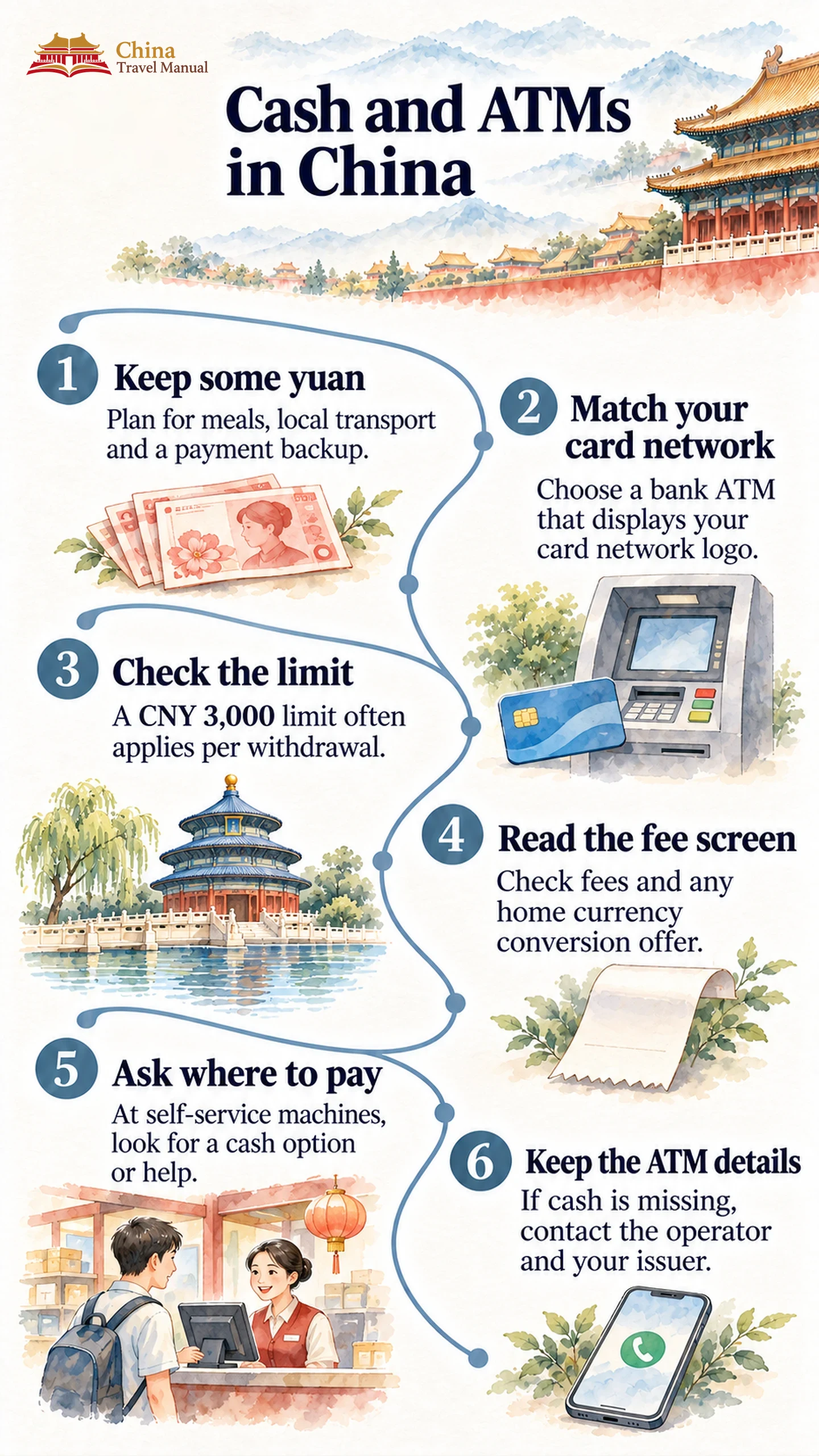
Carry some yuan in small notes for your first day in mainland China and as a backup if your phone or card payment fails. To withdraw yuan with a foreign card, look for a bank ATM that displays your card’s network logo. Check how much the machine allows you to take out and what the ATM and your card issuer will charge.[1][2]
- Before arrival. Confirm your card can withdraw cash overseas and that you know the PIN.
- At the ATM. Choose a yuan withdrawal and read any fee or currency conversion offer before confirming.[4]
- Away from major cities. Refill your cash before traveling if you are unsure where your card will work.[6]
If you need to obtain cash without using a card, look for an authorized currency exchange outlet or a bank branch that offers the service.[5]
Cash can get you through a late arrival, a meal where the payment app fails, or an afternoon in a small town. Plan for those purchases before the first withdrawal. That gives you a reason to decide how much to carry and how often you need to look for a machine.
How Much Cash to Keep on Hand
Estimate what you would need if your phone stopped working. Include a meal, ordinary transport and a ride back to your hotel. If the first leg is a late airport transfer or your next stop is rural, price that before deciding how much cash to withdraw. Keep a second payment method available for bills that would require more money than you want to carry. Cash amounts in this guide refer to Chinese yuan (CNY), the unit of renminbi.[5][6]
For a city example, if you estimate CNY 120 for two meals, CNY 80 for transport and CNY 50 for other purchases, a CNY 250 reserve covers those assumptions. Substitute the fares and prices from your own route. Keep a few smaller notes accessible while storing the rest separately. A CNY 100 note can be inconvenient for an inexpensive item if the seller has little change.
Get a manageable amount before leaving the airport or city when you can. If you are deciding between bank withdrawal and exchanging notes you brought from home, check the currency exchange in China guide for which quote and fees to compare.[5][6]
How to Withdraw Yuan at an ATM
- Choose a bank ATM with a matching logo. Check the machine for the network shown on your card. When practical, choose a branch location during opening hours so you can ask for help. Bank of China lists several international networks among its supported cards.[1][2]
- Select the language and withdrawal function. Use the card and PIN that your issuer enables for overseas cash. If the menu requests an account type, choose the account the card issuer told you to use.
- Enter a yuan amount and check the terms. Look for the withdrawal fee and any option to bill your account in its home currency. Review the exchange rate and the total before accepting or declining that offer.[4]
- Collect your card, cash and receipt. Pause until the machine finishes its prompts. Check the cash discreetly and keep the receipt or transaction reference in case you need to ask about the debit.
Contact your issuer before departure if you only have a credit card. An ATM withdrawal on a credit card may be treated as a cash advance under your card terms. Ask what fees and interest apply, which PIN you need and how much the card lets you withdraw. The guide to using foreign bank cards in China explains the separate choices for merchant payments.[1][2]
Withdrawal Limits, Fees and Conversion
Bank of China and Shanghai’s visitor guidance cite CNY 3,000 per transaction for foreign-card ATM withdrawals. An ATM or issuer may allow less and your issuer can set a separate daily limit. If a machine declines a large amount, check your balance and limits, then consider a smaller request or another bank’s compatible machine. Never keep guessing the PIN.[1][2]
Compare three possible costs. Your issuer may charge for an overseas cash withdrawal. The ATM may disclose an operator fee before payment. If the ATM offers to display and charge the amount in your home currency, the offered conversion can also include a markup. Compare the quoted total with what you know about your issuer’s rates and fees. Selecting the transaction in yuan declines the ATM’s currency conversion, while any issuer charges still apply.[1][4]
For example, if your issuer charged a fixed CNY 30 equivalent per withdrawal, taking CNY 600 once would incur one such fee and taking CNY 300 twice would incur two. The example just shows how a flat fee changes the total. Balance that against your actual fees, how much cash you want to carry, and where your next dependable ATM is.
Where Cash Works
China’s cash payment rules generally require businesses using staffed collection or providing face-to-face service to accept renminbi cash, subject to legal exceptions. The rules also address orders made online when payment can be taken on the spot. At a staffed counter, ask where to pay in cash and use a small note when possible.[3]
Fully online transactions have different disclosure requirements. Self-service systems are expected to provide ways to meet cash needs in relevant circumstances, but the cash option may use a nearby desk or another arrangement. If a kiosk only displays an app code, look for payment instructions or ask staff where cash is collected. Use the China mobile payments guide to plan a way to pay for bookings that require an app.[3]
What to Do if an ATM Withdrawal Fails
If the machine declined the withdrawal and your account shows no debit, verify the network logo, the amount and the issuer’s cash settings. Try a bank ATM that matches your card. Use cash you already hold or another payment method if you need to pay before you can reach the issuer.
If your account shows a debit and you received no cash, save the machine’s location, bank name, amount, time and transaction reference. Keep any slip and contact both the ATM operator and your card issuer promptly. Start with your issuer’s official app or the contact number you saved before the trip. Check whether the transaction is pending, reversed or already posted before requesting the same amount again.
If the ATM keeps the card, record the ATM location and contact the branch or operator. For Bank of China, its published customer number in mainland China is 95566. Tell your issuer as well, and ask whether to freeze the card and how to obtain a replacement if you cannot collect it. See the lost wallet or bank card guide if you need a way to keep paying while the card is unavailable.[1]
FAQs About Cash and ATMs in China
Can I use a foreign debit card at a Chinese ATM?
Yes, if the machine supports the card’s network and your issuer enables overseas cash withdrawals. Check the logo, your PIN and the issuer’s limits first.[1][2]
Can I withdraw more than CNY 3,000?
CNY 3,000 is a commonly published limit for a single foreign-card ATM withdrawal. Your machine or issuer may allow less. If you need more cash overall, check the daily limit and the fee for each withdrawal.[1][2]
Can I pay cash if the checkout is self-service?
Look for the machine’s payment instructions, a service number or a staffed alternative. The cash rules address self-service payments, but they do not require every machine to have a banknote slot.[3]
Where can I get small yuan notes?
Ask at a bank counter that provides cash services or an authorized currency exchange counter. Ask whether they can provide smaller notes or a mix of denominations. Keep your receipt when exchanging currency.[5]
Sources
[1] Bank of China. ATM service for cards issued overseas
[2] Shanghai Municipal Government. Overseas bank card payments and ATM limits
[3] Ministry of Commerce legal database. Renminbi cash payment and service rules
[4] Visa. Dynamic currency conversion and your options
[5] State Council of the People’s Republic of China. Payments and exchange services for visitors
[6] Government of Canada. China travel advice and money





