

Quick Answer: How Do You Plan for Altitude in Tibet?
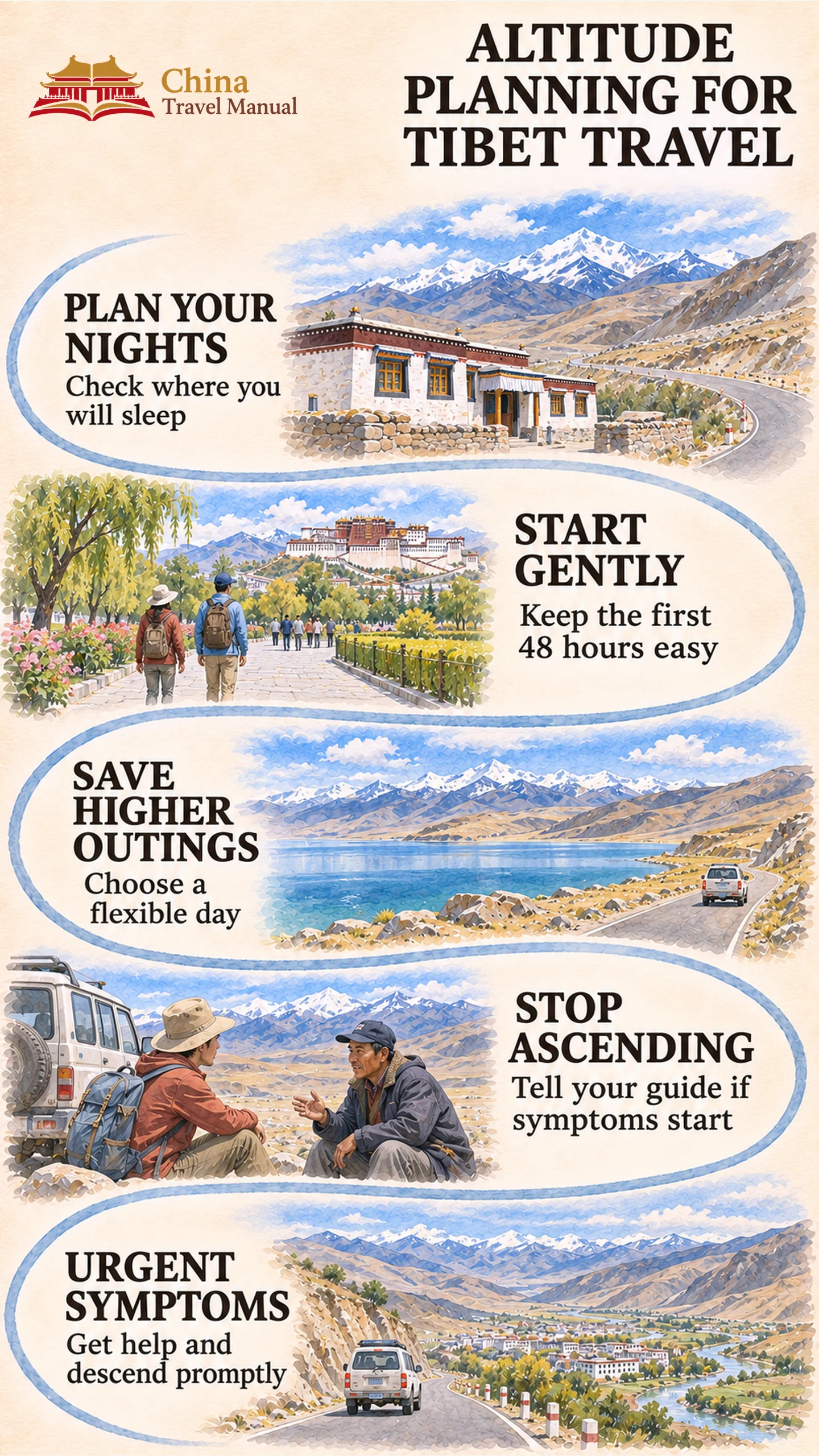
Build your itinerary around where you sleep, how fast you ascend and how you feel each day. For the first 48 hours at high altitude, keep physical activity mild and avoid alcohol. Review how everyone feels and the route conditions before each higher outing.[1][2]
- Start with easy days in Lhasa: Leave the arrival day and the next day flexible, with short outings, rests and an easy way back to your hotel.[1][2]
- Move high excursions later: Save remote lakes, high passes and overnight stays above Lhasa for later in the trip. Ask your guide about the high point of the road and the elevation of the next hotel.[1][3]
- Act early if you feel ill: Tell your guide and stop ascending if symptoms of altitude illness appear. Confusion, trouble walking straight or shortness of breath at rest call for urgent medical help and prompt descent.[1][4]
Two days of easy activity are a useful starting point for a schedule. Your symptoms and the next ascent determine whether the plan should move forward.[1][3]
Lhasa sits at roughly 3,700 m above sea level. Arriving there from a low-elevation city is already a substantial ascent, even when your first outing is a short walk. Give yourself time in the city and make higher excursions movable so new symptoms can change your plan.[1][2]
Put Overnight Elevation Into the Itinerary
| Situation | What it means for the plan |
|---|---|
| First night in Lhasa after low altitude | A substantial sleeping ascent. Plan an early night and a light next day.[1][2] |
| A higher viewpoint with a return to Lhasa | Your overnight elevation stays the same. The road can still expose you to considerably higher altitude.[1][3] |
| A hotel above the last night’s elevation | Treat this as a sleeping ascent and account for the increase before booking.[1][3] |
| A higher trip with few ways to turn back | Confirm an alternative and how to get medical help before setting off.[1][4] |
Once you are above 3,000 m, travel medicine guidance recommends keeping sleeping-elevation gains to about 500 m per day or less, with extra acclimatization days. The Wilderness Medical Society recommends a day without gaining sleeping elevation every three to four days of ascent. On a route with large jumps, discuss alternatives with a travel medicine clinician before you leave.[1][3]
The Namtso Lake visitor guide explains why a lake day can be demanding even without an overnight stay. The lake surface is about 4,718 m, and roads may take you higher. A brief visit at altitude can still cause illness.[1][5]
A Flexible First Two Days in Lhasa
After the airport or station transfer, focus on checking in, eating and recovering from the journey. A short walk close to the hotel is an option if you feel well. Keep the next morning flexible so you can reassess after the first night.[1][2]
Put the steep and prolonged visits later. The walk through the gardens in the Norbulingka guide can be a lower-effort option than the stairs and standing involved in a typical Potala Palace visit. Ask your guide what you can shorten. A fixed reservation should leave room for a change if anyone becomes ill.
Build your first few days from the Lhasa itinerary and mark one higher excursion as optional. A city day can fill that slot when the group still needs time to adjust.[1][2]
Symptoms That Change the Plan
A new headache after ascent, especially with nausea, dizziness or unusual fatigue, may indicate acute mountain sickness. Stop going higher, tell your guide and seek medical advice when needed. If symptoms worsen or do not improve, arrange descent and medical assessment.[1][4]
Confusion, trouble with balance or walking, and shortness of breath at rest are emergency signs. Get emergency medical help and arrange prompt descent. Stay with the affected person and have your guide coordinate transport. Severe altitude illness can worsen quickly.[1][3][4]
How to Build a Tibet Altitude Plan
- List each sleeping elevation. Ask the operator for the altitude of each hotel or overnight stop, along with any particularly high road section.[1][3]
- Make the early days easy. Keep the first 48 hours light, and allow time to change a strenuous or higher outing.[1][2]
- Discuss the retreat plan before travelling. Confirm where to get medical help and how the group would arrange descent from a remote stop. Confirm any altitude or evacuation limitations in your travel cover.[1][4]
- Reassess before gaining altitude. Hold at the current elevation if symptoms develop and get immediate help if urgent signs appear.[1][3][4]
FAQs About Altitude Planning for Tibet
Should I fly or take the train for acclimatization?
Choose based on the actual elevations and time before each sleeping ascent. A flight can raise your elevation quickly, and a train can cross very high sections in a single journey. Review the routes into Tibet for the travel options, and keep arrival plans flexible whichever one you choose.[1][2]
Is two days in Lhasa enough before Namtso?
The right timing varies with recent ascent and how you feel. Consider the day’s peak elevation, length and options for returning. Postpone the trip if anyone has symptoms or needs medical assessment. Ask your guide to confirm a short, lower-effort option for that day.[1][3][5]
When should I speak to a travel medicine clinician?
Get advice before travel if you have a relevant medical condition, past severe altitude illness or an itinerary with unavoidable rapid ascent. Bring your planned sleeping elevations. Ask about prevention and how to adapt the itinerary to your health.[1][4]
Sources
[1] US Centers for Disease Control and Prevention. High-Altitude Travel and Altitude Illness, Yellow Book
[2] US Centers for Disease Control and Prevention. Travel to High Altitudes
[3] Wilderness Medical Society. 2024 clinical practice guidelines for acute altitude illness
[4] National Travel Health Network and Centre. Altitude illness
[5] Damxung County Government. Namtso geography and altitude





