

Quick Answer
For a ten-day China trip by train, start in Beijing and end in Shanghai, with stops in Nanjing and Suzhou. Three train days connect four bases. Only the first leg needs most of a half-day or more once you include the station rides.
| Days | Base | Nights |
|---|---|---|
| 1–3 | Beijing | 3 |
| 4–5 | Nanjing | 2 |
| 6 | Suzhou | 1 |
| 7–10 | Shanghai | 3 |
Book direct trains where the timetable suits you. Compare hotel-to-station rides, verify the exact station on the ticket and bring the passport used to book. Stay in Shanghai the night before flying home.
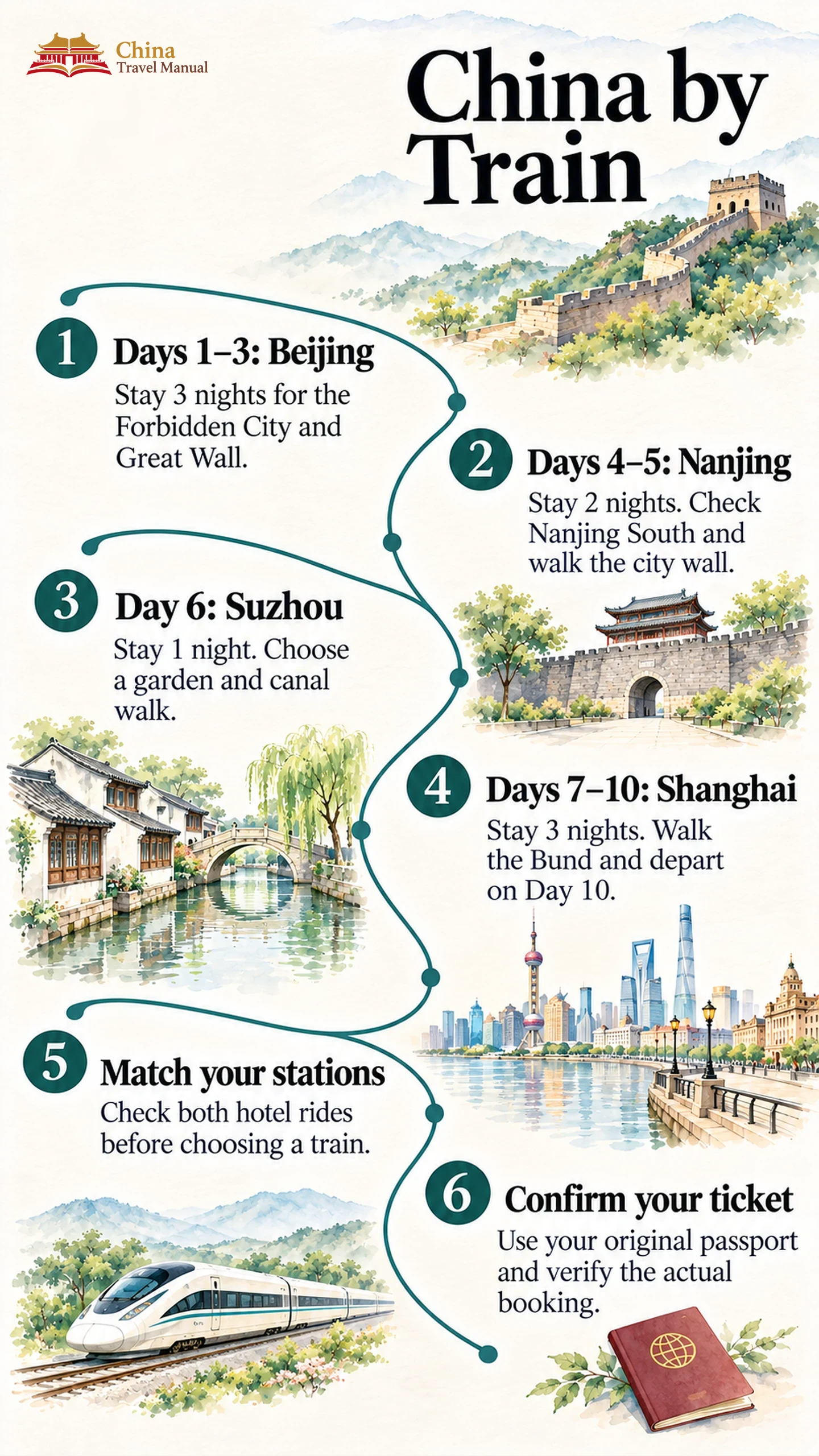
A trip by train in China works best when the route follows connected rail lines and the station rides fit your hotels. The main itinerary below runs from Beijing to Shanghai, with two shorter stays on the same corridor. If you would rather see the Terracotta Warriors, pandas and Chongqing’s rivers, use the inland alternative.
Both routes use trains for intercity travel. Count international arrival and departure within the days shown, and add metro, taxi or local road transport between stations, hotels and attractions.
A 10-Day China by Train Itinerary
Use nine hotel nights across four cities. Nanjing and Suzhou break up the corridor. The Nanjing-to-Suzhou and Suzhou-to-Shanghai legs leave time for a nearby outing after you reach your hotel. The dated services in 12306 are the final check before fitting your sightseeing days around each train.[1]
Days 1–3: Beijing
- Day 1 — Arrive and check in. Book a hotel with a straightforward route to Beijing South Railway Station if your train leaves there. Have dinner near your hotel.
- Day 2 — Visit the Forbidden City and leave time for a nearby walk. Check the museum’s opening calendar and advance booking. If a regular Monday closure falls on Day 2, rearrange the two Beijing outings around the confirmed reservation.[9]
- Day 3 — Give the Mutianyu Great Wall its own outing. You will need local transport to the wall, even with a rail itinerary between cities. Keep the evening free for getting ready to move hotels.
Days 4–5: Nanjing
- Day 4 — Take the train from Beijing to Nanjing. A service from Beijing South to Nanjing South is a good search starting point. Spend the evening near the hotel so the major attractions stay on a full day.[5][6]
- Day 5 — Choose a section of the Nanjing City Wall, such as Zhonghua Gate, and a walk in the Qinhuai area. If you prefer a museum or a quieter visit, spend the day in one part of the city. The Nanjing travel guide can help route the day around your hotel.[10]
Day 6: Suzhou
Take the train between Nanjing and Suzhou in the morning. Check that the Suzhou station is convenient for the old city. Leave bags at the hotel, see one classical garden and save time for a canal-side walk. Book one garden that suits your arrival time. The different gardens are separate places, so check the right ticket before the trip.[5][8]
Days 7–10: Shanghai
- Day 7 — If you have time, walk near the hotel before the train from Suzhou to Shanghai. Check which station you reach. After arrival, choose dinner and an unhurried evening near your base.[7]
- Day 8 — Walk the Bund and choose one neighborhood for a museum, garden or long lunch. If you’re crossing to Pudong, keep the day flexible so you can use the clearest part for the skyline.
- Day 9 — Spend a second day in Shanghai. Choose a different historic or modern neighborhood, or use the day for the activity the weather interrupted.
- Day 10 — Depart. Plan the ride to the airport on your ticket. Put any final stop near your hotel so it does not depend on another train.
Two Other All-Rail Routes
| Route | Nights | Best use |
|---|---|---|
| Seven days, Beijing and Shanghai | Beijing 3, Shanghai 3 | One hotel move, with an optional Suzhou day trip. |
| Twelve days, northern and inland cities | Beijing 3, Xi’an 2, Chengdu 3, Chongqing 3 | Imperial sites, archaeology, Sichuan food and a river city. |
For seven days, leave Beijing on Day 4 on the Beijing to Shanghai train. Keep Day 5 in Shanghai. Use Day 6 for Suzhou if you want a garden day. Keep your luggage in one hotel and depart from Shanghai on Day 7. Dropping Nanjing and the Suzhou overnight preserves the main trip without three hotel moves.
For twelve days, use Beijing to Xi’an on Day 4, Xi’an to Chengdu on Day 6 and Chengdu to Chongqing on Day 9. Reserve the full day in Xi’an for the warriors. In Chengdu, choose either a city day after the pandas or one regional excursion. Give Chongqing two full days and depart there on Day 12. This is easier if your onward train or flight leaves from Chongqing. Returning to Beijing by rail adds a long move and may need another night.
How to Plan the Stations and Transfer Days
Write the station name next to each hotel date. In Beijing, West and South are distinct stations. Nanjing South handles many high-speed services, and some Shanghai–Nanjing trains use Nanjing Railway Station. Check the actual boarding point before calling a ride. In Suzhou, compare Suzhou Railway Station and Suzhou North with the garden area or the hotel. In Shanghai, check Shanghai Hongqiao and other stations against your destination.[5][6][7]
Hotel checkout, metro or taxi, station security and the ride after arrival can change which train suits you. If a shorter train uses a far-away station, it might take more of your day. Decide when you can leave the first hotel and when the next one will hold your bags. Plan for walking from the correct entrance through the station as well as to the building.
Use direct trains when practical. If a change is required, confirm that both trains use the same station. A station change includes the ride across town and a second station entry. Even for a same-station transfer, check the current signage and options so you know whether to use the internal transfer corridor or re-enter through public access. The train transfer guide covers both situations.
How to Book Trains for a Multi-City Trip
- Match the itinerary to dated station pairs. Use the China train travel guide to find the official booking channels. Confirm your origin, destination, date and train before relying on the schedule. Select a seat class that suits the time on board and check luggage rules before you pack.
- Set a reminder for each ticket release. China Railway’s standard online sale period is 15 days including the travel date, with some adjustments and different release times. That generally puts the opening date 14 calendar days before departure. For example, a standard ticket for May 15 would normally go on sale May 1, at the departure station’s release time. A separate pilot accepts reservation requests 17 to 30 days before departure on covered Beijing–Shanghai corridor services. A request has a different status from a confirmed ticket. Check 12306 for the exact train and date, including the released ticket status.[2][3]
- Enter the passport details and save the booking. Use the original document you plan to carry and enter the name and number as required by 12306. Save the station names, train, date and coach details where you can read them offline. Bring the passport used to book on the day.[1]
- Have a backup when the best train sells out. Search other departures or station pairs first. If the 12306 waitlist is available to you, check the fulfillment deadline and watch the actual order status. A waitlist request may expire without a ticket. Keep lodging flexible on a day with an unconfirmed transfer.[4]
If you want an overnight sleeper for a longer route, put the berth night on the calendar and check the next morning’s time. An early arrival is easier if your hotel can store your luggage. Before replacing a hotel night, compare what you gain in free time with how well you expect to sleep on board.
Keep the last rail move a day away from an important flight when possible. For a return to Beijing or a late change of route, move the hotel night to your flight gateway and drop a sightseeing stop if needed. This can make the return feasible even when trains you prefer are full.
FAQs About a China by Train Itinerary
Can I do this without domestic flights?
Yes. The ten-day route uses trains between the four cities. You still need local rides to sightseeing areas, including the Great Wall, and transport to and from your international airport.
How early can I buy the train tickets?
The standard online sale window is 15 days including the travel date, subject to adjustment. Some trains on the Beijing–Shanghai pilot have an earlier reservation request option. Check the dated official sale and the status of your request before treating the seat as confirmed.[2][3]
Should I choose an overnight sleeper?
The main itinerary works with daytime trains. Consider a sleeper for a longer leg only if the departure, arrival and berth suit you. Count the travel night, and plan mornings around hotel check-in and luggage storage. The right train can save a hotel night but can also leave you tired early in the day.
What if the direct route is sold out?
Search earlier and later trains or a different station before adding a connection. If you are waitlisted, keep a workable fallback and check the status. Leave margin in the itinerary if a change means switching stations or travelling the next day.[4]
Sources
[1] China Railway 12306. Ticketing FAQs
[2] China Railway 12306. Standard Ticket Presale Period
[3] Beijing Municipal Government. Update on the Beijing–Shanghai Advance Reservation Pilot
[4] China Railway 12306. Waitlist Booking Rules
[5] Nanjing Municipal Transport Bureau. Railway Transport in Nanjing
[6] Beijing Municipal Government. Popular Tourist Destinations from Beijing’s Seven Railway Stations
[7] Meet in Shanghai. Railway Stations
[8] UNESCO World Heritage Centre. Classical Gardens of Suzhou
[9] Palace Museum. Tickets and Visit Information
[10] Nanjing Foreign Affairs Office. Nanjing City Wall Museum at Zhonghua Gate





