

Quick Answer: How Do You Build a Flexible China Itinerary?
- Confirm your calendar days, arrival and departure cities, hotel nights, and number of intercity transfers.
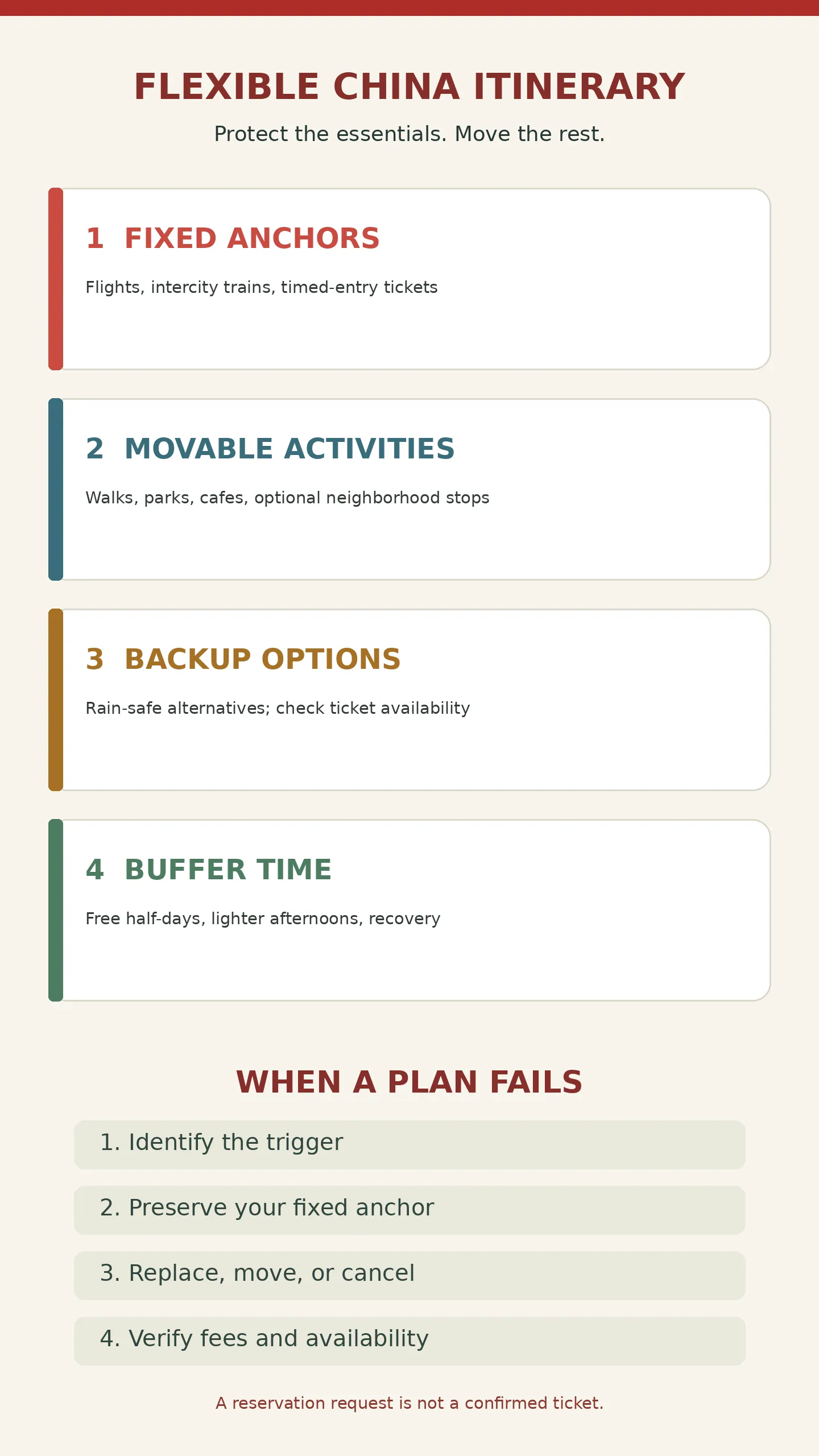
- Protect fixed anchors: international flights, important intercity bookings, and scarce timed-entry attractions.
- Keep most days to one main activity, with nearby extras that you can drop.
- Reserve buffer time, such as a free half-day every three or four days, especially near long transfers or weather-dependent plans. This is a planning guideline, not an official rule.
- Prepare backup options for bad weather, unsuccessful ticket reservations, and transport disruption; check whether each backup needs its own booking.
A flexible China itinerary is not a trip with no reservations. It is a plan in which the bookings that hold the journey together are protected, while sightseeing, rest, and lower-priority activities can change without wrecking everything else. That distinction is particularly useful in China: high-speed rail links distant cities efficiently, but some major attractions require timed, passport-based reservations, and holiday crowds can make last-minute changes difficult.
This guide assumes you already have a rough route and know how long you will be in mainland China. If you have not chosen your destinations, start with our China itineraries guide or step-by-step trip planning guide. Here, the goal is to make your existing plan survive a rainy day, a sold-out train, or an unexpectedly exhausting afternoon.
Start With the Parts of Your China Trip That Cannot Easily Move
Fix Your Arrival, Departure and City Sequence
Before buying attraction tickets, distinguish four measures: calendar days are the dates you are in the country; hotel nights are overnight stays; usable sightseeing days are days not consumed primarily by arrival, departure, or transfers; and door-to-door transport time includes getting from the hotel to the station or airport, security, waiting, the ride or flight, leaving the terminal, and reaching the next hotel.
A four-hour train does not create a four-hour transfer day. Depending on station locations, check-in, baggage, and traffic, most of the day may be spoken for. Treat transfer days as transportation commitments first; sightseeing is optional only if everything goes smoothly.
Consider an open-jaw flight: arriving in Beijing and flying home from Shanghai may avoid a long return journey to Beijing. But compare the real airfare, flight schedule, luggage conditions, and onward connections before deciding. Once you have booked your international flights and hotels, reversing the city order may trigger several costly changes.
Identify Your Must-Do Experiences
Give each proposed experience one of three rankings: must do, would like to do, or easy to skip. A must-do is meaningful to you and difficult to replace, perhaps because its visiting date is limited or it has strict reservations. Do not label ten attractions as indispensable: then every disappointment threatens the whole trip.
The Forbidden City is a useful example. The Palace Museum says it does not sell same-day tickets, opens reservations seven days before the visit at 8 p.m. Beijing time, and generally closes on Mondays except public holidays. Foreign visitors can reserve with their passports. These restrictions make the ticketed visit a fixed anchor once confirmed, while an optional nearby walk is not. [1][2] For operational details, see our Forbidden City booking guide.
Build Flexibility Into Your Daily Schedule
Plan One Main Activity Per Day
One main experience is usually enough to give a sightseeing day shape. For example, put the Palace Museum first on a Beijing day and treat Jingshan Park or a relaxed walk around Qianmen as optional. Do not schedule the museum and the Mutianyu Great Wall as two non-negotiable highlights on the same day: travel distances and walking effort leave little recovery room.
A movable activity is easy to postpone, shorten, or remove. It might be a neighborhood walk, a city square, an unreserved café stop, or time in a public park. However, movable does not mean admission-free or reservation-free. Confirm opening hours and ticket requirements before promoting any named museum or attraction into your last-minute backup list.
Leave Space Around Transfers and Arrival Days
Allow your arrival day to absorb immigration, baggage collection, onward transit, hotel check-in, and jet lag. If you have to resolve phone connectivity or payment issues, those jobs take additional time. Avoid timed-entry sights until you have settled in.
On intercity days, count travel from one hotel door to the next, not only the train or flight duration. Leave enough time to find the correct station, complete security, and reach the next hotel. The getting around China guide discusses the broader train-versus-flight choice.
On international departure days, protect a generous airport margin. Arriving roughly three hours before an international flight is a conservative planning target, not an airport-wide guarantee or substitute for airline instructions; add the journey to the airport and allow more time when conditions require it. Don’t plan a distant attraction that morning.
Place Buffer Time Where It Can Actually Help
Buffer time is an uncommitted window, not necessarily a full rest day. A flexible half-day after three busy sightseeing days is more useful than tiny unused gaps that cannot accommodate a moved activity. Put it after a long transfer, near a weather-exposed outdoor experience, or before a particularly expensive onward connection.
Imagine three full Beijing days booked wall to wall: rain wipes out a Great Wall visit, and there is nowhere to put it. With an uncommitted afternoon or a lighter day, you can see whether rescheduling is possible without disturbing your onward train. If rescheduling is impossible, use the gap for rest or another suitable activity rather than chasing an impossible replacement.
What Should You Book in Advance, and What Can Wait?
| Booking or activity | Planning priority | Can it usually wait? | What to check |
|---|---|---|---|
| International flights | Very high | Usually no | Date-change rules and actual arrival/departure airports |
| Intercity train or flight tied to a hotel move | High | Not wise during peaks | Availability, station/airport, refund and change conditions |
| Palace Museum or another limited timed-entry site | High | No for the Palace Museum | Passport entry, reservation opening, closure dates |
| Hotels | Medium to high | Depends on season and room needs | Exact free-cancellation deadline and payment terms |
| Ordinary public streets and squares | Low | Generally yes | Access restrictions and local events |
| Weather-sensitive outdoor activity | Varies | Only if booking conditions permit | Closure notices, transport and refunds |
| Casual meals and shopping | Low | Often yes | Special reservation requirements if relevant |
Rail tickets require a current-rule check. China Railway’s standard advance-sale window is generally 15 days, but a special reservation pilot on selected Beijing–Shanghai rail services is different. As of October 27, 2026, its request window is 17–30 days before departure, reduced from the original 17–60 days. A request is not a confirmed ticket; an eligible request must be fulfilled and paid on time. Check the relevant 12306 service for your date rather than treating either window as a guaranteed seat. [3][4] See using 12306 as a foreign visitor for the full ticketing process.
Holiday travel makes flexibility more expensive. During major Chinese public holidays, popular trains, hotels, and attractions may have far less same-day availability. Check the official holiday calendar for your travel year and secure the bookings that connect your cities before making ambitious fallback plans. Do not assume all museums, Great Wall sections, or theme parks share one booking system.
How to Build a Flexible 10-Day China Itinerary
The following Beijing–Xi’an–Shanghai example demonstrates the method; it is not a prescribed ten-day route. It covers 10 calendar days and 9 hotel nights: Beijing 3, Xi’an 2, and Shanghai 4. You can replace the cities and apply the same categories.
| Day | Overnight | Main commitment | What stays flexible |
|---|---|---|---|
| 1 | Beijing | International arrival and hotel | All sightseeing can be skipped |
| 2 | Beijing | Pre-booked Palace Museum visit | Jingshan or Qianmen is optional |
| 3 | Beijing | Mutianyu Great Wall if weather permits | An appropriate indoor alternative; check reservations |
| 4 | Xi’an | Beijing–Xi’an intercity journey | No essential sightseeing added |
| 5 | Xi’an | Terracotta Warriors visit | Afternoon rest; secondary stops optional |
| 6 | Shanghai | Xi’an–Shanghai intercity journey | Evening walk only if energy permits |
| 7 | Shanghai | The Bund and a compact city walk | Adjust for weather and fatigue |
| 8 | Shanghai | One personally chosen highlight | Confirm admission rules or choose a substitute |
| 9 | Shanghai | Half-day buffer and light outing | Rest, revisit, or move a lower-priority activity |
| 10 | — | International departure | No long-distance sightseeing |
Protect the confirmed Palace Museum ticket, the two intercity journeys, your overnight reservations, and the flight home. These are fixed anchors because moving any one could affect others. In contrast, a city walk, an unreserved park visit, or the free half-day can usually move with fewer consequences.
Suppose Day 3 brings heavy rain or unsafe Great Wall conditions. Replace the outdoor trip with a suitable indoor activity—but confirm that the alternative actually admits visitors that day. Beijing’s National Museum, for example, must not be assumed to have walk-in availability. The critical move is to leave the Day 4 Beijing–Xi’an train unchanged. If the Great Wall cannot be rescheduled before that departure, skip it rather than jeopardizing the rest of the trip.
A successful flexible plan is not one in which every must-see is rescued. It is one in which one disappointment does not become three missed bookings.
How to Change Your Itinerary When Something Goes Wrong
Use this four-part decision: identify the trigger, protect the fixed anchor, select a movable or backup activity, and check the costs and conditions before changing anything.
| Trigger | Protect first | Lower-cost response | Important limit |
|---|---|---|---|
| Heavy rain on Great Wall day | Safety and onward train | Indoor alternative or rest; investigate another date | Tickets and transport may not be freely changeable |
| Palace Museum reservation unavailable | Hotels and onward journey | Substitute a Beijing highlight or check another reservable date | No same-day tickets; no promised last-minute cancellation release |
| Preferred train sold out | Critical onward bookings | Check other departures or official waitlist; assess viable alternatives | Waitlisting never guarantees a seat |
| Incoming flight badly delayed | Essential connections | Contact airline and hotel; drop nonessential outings | Fee waivers depend on fare and cause |
| Companion exhausted or unwell | Health and safety | Cancel optional stops; use buffer time | Do not force an itinerary or postpone necessary care |
| Outdoor site closed | Safety and valid reservations | Respect closure and choose an available alternative | Never enter a restricted area |
Example A: the Great Wall day disappears. The Beijing–Xi’an train tomorrow and the Xi’an hotel booking are still confirmed. Check the site and transport provider’s terms before considering another Great Wall date. An indoor attraction that requires advance tickets is only a backup if you can actually obtain them. Otherwise, a simple local visit or hotel rest protects the onward plan.
Example B: Shanghai arrival is late. Imagine your incoming flight arrives hours behind schedule. Rather than pushing every planned city activity one day later, retain the fixed flight home and any confirmed attraction booking that still works. Remove a flexible Bund walk or shopping stop, then use your Day 9 buffer if needed. Notify the hotel about late arrival if its policies require it.
For a family, the threshold for dropping optional activities should be lower. See our China family itinerary for age-sensitive daily pacing; for general problems on the ground, consult China travel tips.
How to Keep Changes From Becoming Expensive
Understand Cancellation Deadlines Before You Pay
Before committing to a booking, distinguish free cancellation until a specified deadline, partial refund, date change subject to conditions, and nonrefundable. Even two rooms at the same hotel can have different conditions. A train or flight change can involve restrictions or charges, and a reserved attraction ticket may be tied to a specific date and passport.
Save the full booking confirmation, cancellation terms, official customer-service details, and any time zone used for the deadline. A payment screenshot alone may not contain the rules you need during a dispute. Read the terms attached to the exact fare or ticket you buy, not an online summary of a different product.
Avoid a Chain Reaction of Missed Bookings
The biggest expense from a disruption is often downstream. Missing one train might affect a hotel check-in, an admission time, or a connecting flight. List the next two immovable commitments before you press the cancel or change button. Contact affected providers early, then decide whether to protect the original transfer, move one optional sight, or accept a modest loss now to prevent a larger loss later.
Never count a replacement seat, refund, or hotel modification as confirmed until the operator has accepted it. Keep the original booking active until you understand the consequences of changing it.
A Simple Flexible Itinerary Checklist
- ☐ Confirm arrival and departure cities, total calendar days, and hotel nights.
- ☐ Count each intercity journey using hotel-to-hotel time, not ride time alone.
- ☐ Put the city order, crucial transport, and limited-entry bookings in the fixed-anchor column.
- ☐ Check ticket-release dates, passport rules, and site closures for each must-do attraction.
- ☐ Record cancellation deadlines, payment conditions, and official support contacts.
- ☐ Prepare one appropriate, realistically available backup for each major outdoor activity.
- ☐ Keep a half-day or another meaningful buffer near higher-risk parts of the trip.
- ☐ Save booking confirmations, Chinese hotel addresses, and essential contacts offline.
FAQs About Flexible China Itineraries
How Many Free Days Should I Leave in a China Itinerary?
You do not need a completely empty day in every city. A movable afternoon, a low-pressure sightseeing day, or a half-day buffer can all help. As an editorial rule of thumb, consider a free half-day every three or four days, increasing it when you have many transfers, outdoor commitments, or companions who need a slower pace.
Can I Book China High-Speed Trains at the Last Minute?
Yes, when eligible seats are still available, but availability is uncertain, especially during holidays. The standard advance-sale process and the selected Beijing–Shanghai advance-reservation pilot are separate. As of October 27, 2026, that pilot accepts requests 17–30 days ahead; a request is not a ticket until fulfilled and paid. [3][4]
Can I Visit China’s Major Attractions Without Booking Ahead?
Some open public spaces allow spontaneous visits; other attractions use separate reservation and identification rules. The Palace Museum does not sell same-day admission and normally closes Mondays, apart from relevant exceptions. Always check the particular attraction’s official information rather than applying a blanket rule. [1][2]
Is It Better to Book Everything Before Going to China?
Neither extreme is ideal. Secure flights, essential intercity travel, necessary hotels, and scarce timed-entry highlights. Keep low-priority walks, meals, and optional outings adjustable. That balance prevents both booking failures and an expensive, inflexible schedule.
Sources
[1] Palace Museum official ticketing rules — booking window, identification and closure policy.
[2] Palace Museum English visitor information — entry, foreign passport and opening arrangements.
[3] Beijing Municipal Government, September 28, 2026 — revised Beijing–Shanghai train reservation window.
[4] Shanghai Municipal Government, September 26, 2026 — reservation window change effective October 27, 2026.





