
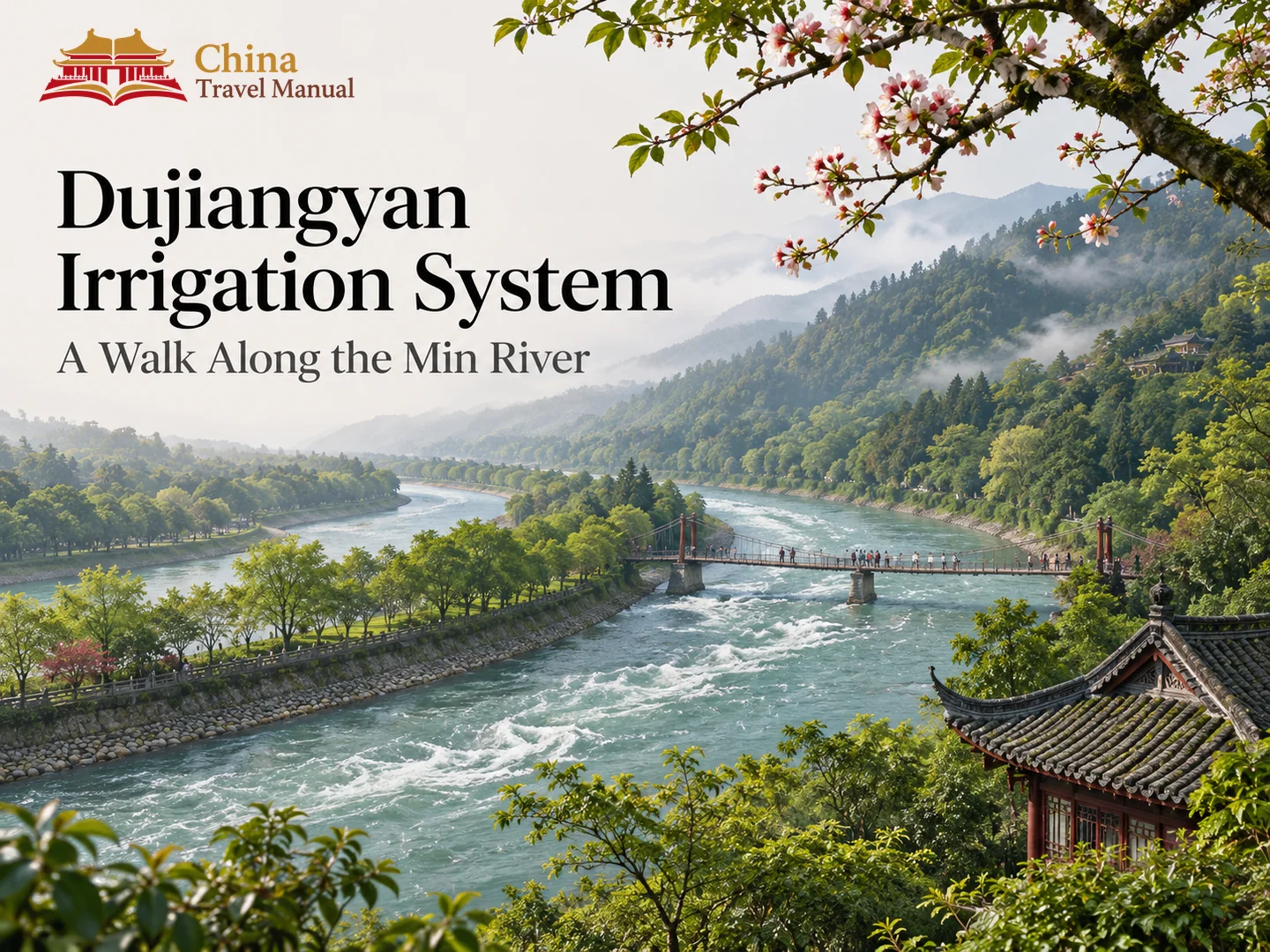
Quick Answer
Allow about three hours to see the main works at the Dujiangyan Irrigation System (都江堰水利工程, Dūjiāngyàn Shuǐlì Gōngchéng). The historic diversion still distributes water from the Min River.[1][2]
- City-side start: Enter beside Lidui Park (离堆公园, Líduī Gōngyuán) if you are coming from the rail station or old town.[3][4][7]
- Viewpoint start: Choose Qinyan Tower (秦堰楼, Qínyàn Lóu) at Gate 6 if you want to look across the channels before descending toward the river.[3][7]
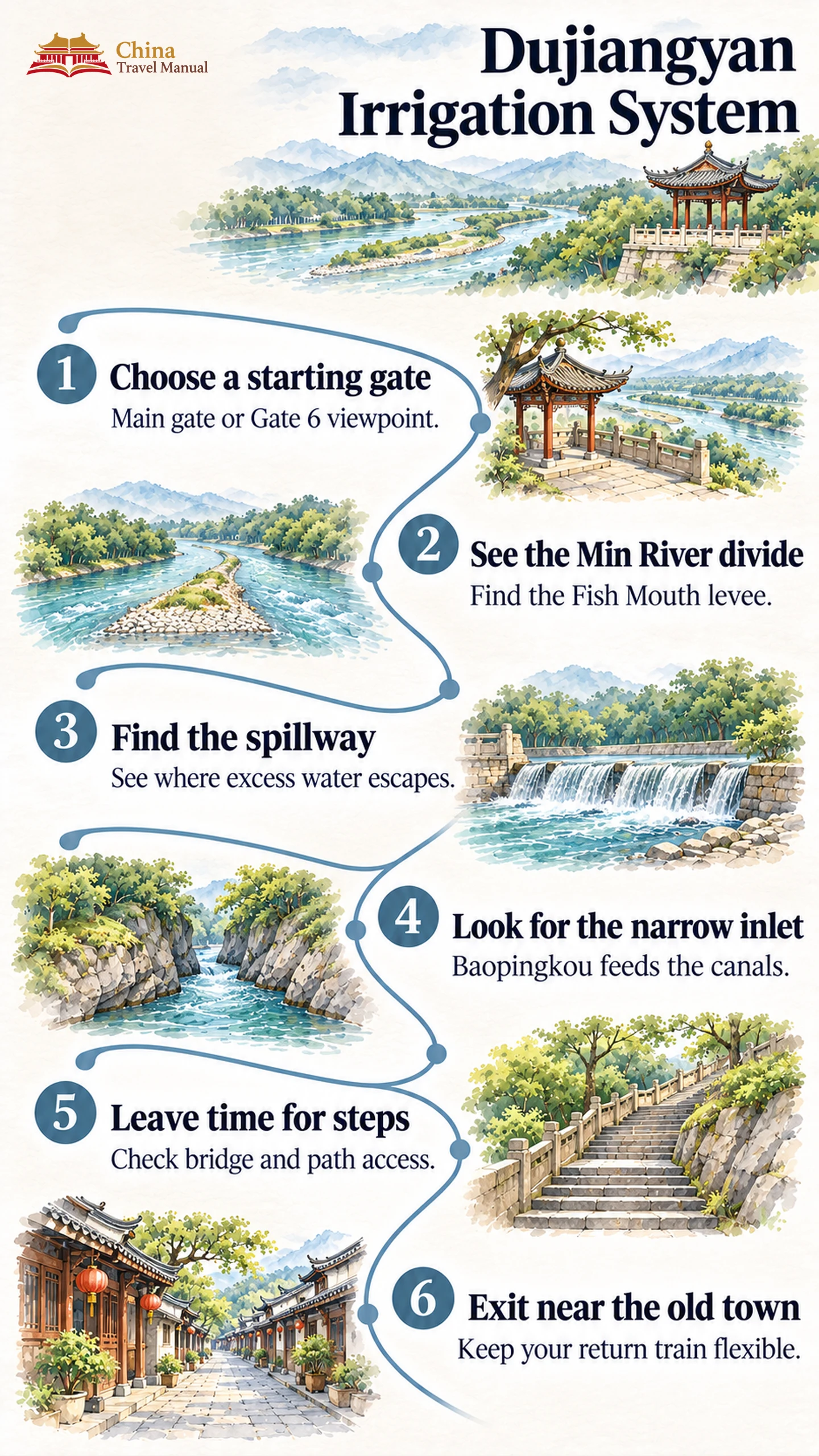
- What to see: Find the Fish Mouth (鱼嘴, Yúzuǐ) divider, Feishayan (飞沙堰, Fēishāyàn) spillway and Baopingkou (宝瓶口, Bǎopíngkǒu) intake.[1][5][6]
- Tickets: The official site lists a CNY 80 regular adult ticket. Check the date-specific hours and passport entry instructions.[2]
If you have limited time, concentrate on the waterworks. Add the hillside or the old town when your return allows.[2][3][7]
Start by deciding whether to look down on the water from a hillside or walk up to it from the city. Dujiangyan’s channels can look like ordinary river branches at first. Once you match each structure to a job, the visit explains how water reaches the Chengdu Plain.
Get to the Irrigation Scenic Area From Chengdu
From Chengdu, compare trains from Xipu (犀浦) to Lidui Park (离堆公园) with services to Dujiangyan Railway Station (都江堰站). Lidui Park is convenient for approaching the city-side gate on foot. If you arrive at Dujiangyan Railway Station, plan the onward ride from that station. Use Chengdu to Dujiangyan for more on making the rail connection.[4][7]
Use a separate map pin for your chosen entrance. Search for 都江堰景区离堆古园1号门 for the main city-side gate, or 都江堰景区秦堰楼6号门 for the hillside. If you take a ride-hail car to the hillside, allow time for pickup after you arrive by rail.[3][7]
Book the return around your intended exit. Gate 1 puts you near the old town. If you end on the hillside or leave by another gate, check how you will get to the station before adding other stops.[3][7]
Pick a Gate and Confirm Your Daytime Ticket
| Entry choice | How to use it | Who it suits |
|---|---|---|
| Lidui Park, Gate 1 | Walk from the city toward the intake and continue along the waterworks. | Visitors with a city-side arrival who want to focus on the engineering. |
| Qinyan Tower, Gate 6 | Start uphill, look across the channels and take the marked paths down. | Visitors who want an overview early and can manage steps. |
The official portal publishes visitor hours and a regular adult rate of CNY 80. Hours and sales cutoffs can move between seasons and dates. Check the date before you depart, especially if you will arrive in the afternoon or on a holiday. Bring your passport if you need help with entry or a purchase at the visitor center.[2][3]
A start by early afternoon gives you more room to stop and leave at a comfortable pace. Check for any closed bridge or viewpoint before choosing a route that depends on it. If you have limited mobility, ask the visitor center which signed riverside viewpoints are open and how much climbing is involved. Use the city-side gate if the hillside descent is unsuitable. Give everyone in your group a shared exit pin in case you take different detours.
Read the Irrigation System in Three Stops
UNESCO dates the start of the engineering work to the third century BCE. The system uses the terrain and flow of the Min River to divert water, move sediment and manage flood flows. The stops below follow the way water moves through the system. From the city-side gate you may encounter them in the reverse direction.[1][5][6]
- Find the Fish Mouth. Look for a tapered embankment where the river divides into an inner and an outer channel. The inner route brings water toward the irrigation intake. The streams remain visible from a suitable viewpoint.[1][5][6]
- Locate the Feishayan spillway. Notice the low opening that lets excess water go from the inner channel toward the outer river. It also helps remove sediment from the water heading toward the intake.[1][5][6]
- Look for the Baopingkou intake. The narrow passage through the rock limits the flow entering the canal system downstream. Follow the marked public paths to a view of the opening and compare its width with the wider river channels.[1][5][6]
The work was developed and maintained over many centuries. That history matters to its continued use: the present site shows how generations of maintenance have kept the river, levees and valley working together.[1]
Add the Bridge or Old Town With Spare Time
Consider the Anlan Bridge (安澜桥, Ānlán Qiáo) section for another angle on the river if it is open. You can also look for Erwang Temple (二王庙) when you have time for steps and hillside paths. Both sit within the larger scenic area of engineering works and historical places.[3][5]
If you leave near Lidui Park, continue to the South Bridge (南桥) area and the old town for a meal before the train. Check the Dujiangyan travel guide for more city stops.[3][7]
For a separate mountain visit, the Mount Qingcheng visitor guide helps you choose a side of the mountain before arranging transport. If you also want an old-town meal and an unhurried engineering walk, use the two-day Dujiangyan itinerary to give each area enough time.
FAQs About the Dujiangyan Irrigation System
How long does a Dujiangyan visit take?
Allow roughly three hours inside the scenic area for the main works. Add separate time for the approach, tickets, hillside stops and your trip back.[2][7]
What is the best starting gate for seeing the irrigation works?
Gate 1 suits a city-side approach. Choose Gate 6 if a high view comes first and you are comfortable with the descent.[3][7]
Is Dujiangyan Irrigation System still working?
Yes. UNESCO describes it as a system that still manages river flows and supplies the Chengdu Plain. The visitor area shows its upstream diversion works.[1]
Can you visit Dujiangyan and Mount Qingcheng in one day?
A long day can fit a shortened visit to each. Allow for a transfer, separate admission and time on the slopes. If you want to see all three waterworks and walk the mountain trails, give each its own day.[1][2][7]
Sources
[1] UNESCO World Heritage Centre. History and surviving functions of the waterworks
[2] Qingcheng Mountain and Dujiangyan Scenic Area. Official booking page and listed regular admission
[3] Sichuan Observer. Scenic-area gate numbering and visitor access
[4] Guangming Daily via Sichuan Online. Rail connection between Xipu and Lidui Park
[5] China Culture. Structures and heritage around the weir works
[6] State Council Information Office. Water management principles at Dujiangyan
[7] East China Trip. Relative walking access to the main gate and transfer to Qinyan Tower





