
Quick Answer: Using Chengdu Tianfu Airport
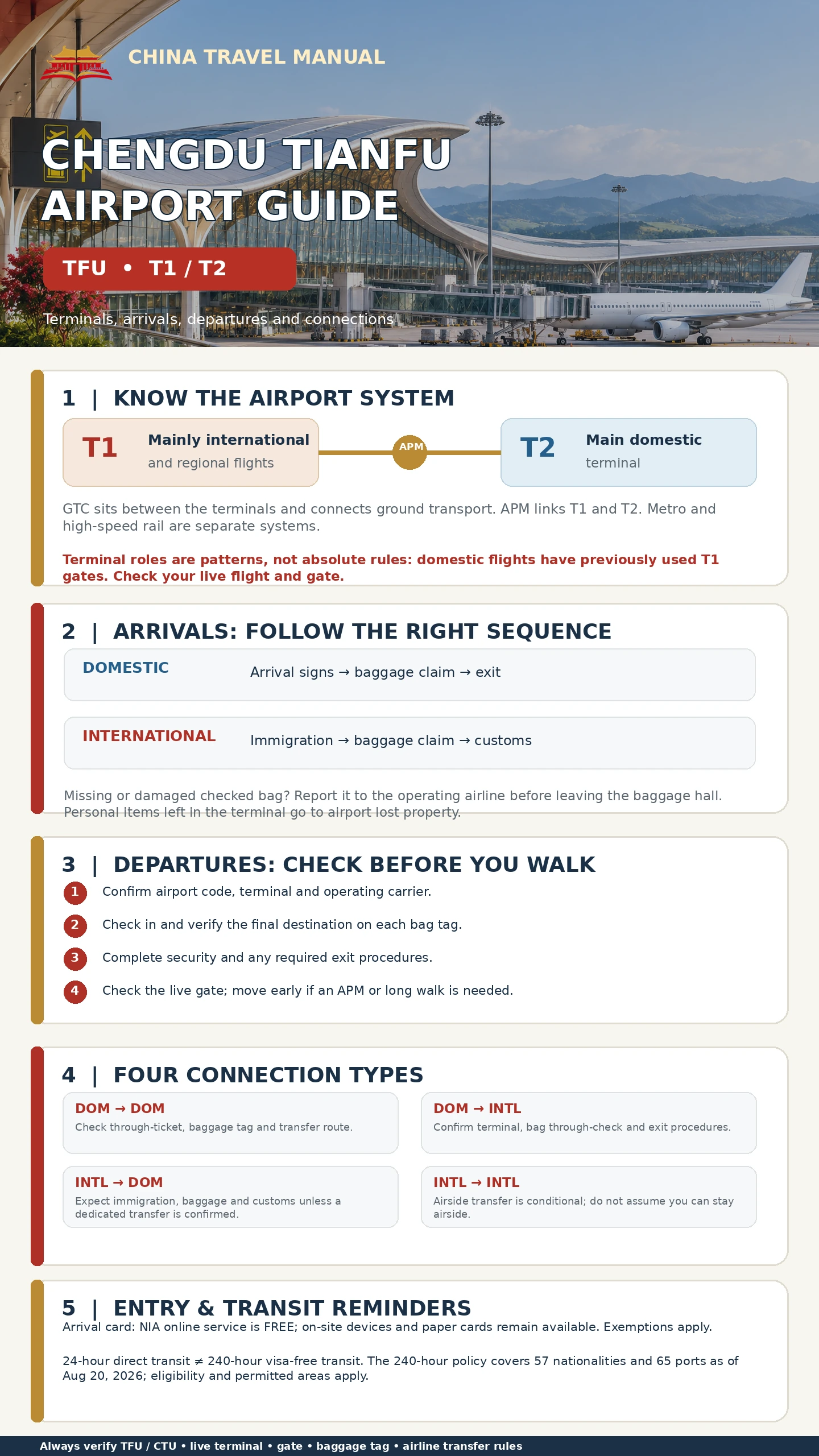
Chengdu Tianfu International Airport (TFU) has two passenger terminals. T1 mainly handles international and regional flights; T2 is the main domestic terminal. This is not an absolute split: domestic flights have previously used T1 gates, so check the terminal and gate for your flight.
- Check TFU on the ticket; CTU is the separate Shuangliu Airport.
- International arrivals normally follow immigration, baggage claim and customs; domestic arrivals go to baggage claim or the exit.
- Whether you collect baggage, clear immigration or repeat security on a connection depends on the ticket, bag tag and confirmed airline transfer.
- T1 and T2 are linked by an airport APM. GTC connects to separate ground-transport systems.
Use live airline and airport information before moving; do not rely on old terminal lists.
Chengdu Tianfu International Airport (成都天府国际机场, IATA code TFU) is Chengdu’s newer international hub, located in Jianyang about 50 km from the city center. First-time visitors should confirm the airport, find the right terminal, complete arrival or departure formalities and check whether a connection requires baggage collection, immigration or another security check. [1][2]
This guide focuses on the passenger journey inside Tianfu Airport. It does not repeat the detailed city-transfer routes. For broader trip planning, see the China Airports Guide and the Chengdu Travel Guide.
TFU or CTU? Confirm Your Chengdu Airport First
Chengdu Tianfu International Airport (TFU)
TFU is Chengdu Tianfu International Airport, southeast of central Chengdu in Jianyang. Its distance from downtown makes airport identification especially important: a ticket for TFU cannot be used at Shuangliu, and the two airports are not interchangeable. IATA lists Tianfu as TFU. [1][2]
Chengdu Shuangliu International Airport (CTU)
CTU is Chengdu Shuangliu International Airport, a separate airport with its own terminals and ground connections. A transfer between TFU and CTU is an inter-airport journey, not a terminal change. Allow time for the road or rail journey, then check in again at the airport shown on your next ticket.
From 6:00 a.m. on July 30, 2026, some Hong Kong, Macao and Taiwan passenger flights previously operated at T1 in Tianfu were transferred in phases to T1 at Shuangliu. After the change, both airports operate regional passenger flights. Do not use a regional destination or airline name to guess the airport. [3] See Tianfu vs Shuangliu Airport for a comparison, or the Chengdu Shuangliu Airport Guide if your ticket says CTU.
How to Check the Airport on Your Ticket
Read the three-letter code beside the departure and arrival airports on every flight segment. Match the flight number, date and operating carrier; a codeshare may display a marketing airline that is different from the airline operating the aircraft. Then check the operating carrier’s current flight information and the airport’s live display or official mini-program.
Recheck on the day of travel. Do not rely on a hotel booking, an old screenshot, the destination city or a static airline-terminal list. If your ticket and the live display disagree, ask the airline or airport information staff to confirm the flight number before entering a terminal.
Chengdu Tianfu Airport Terminals Explained
Terminal 1 (T1): Mainly International and Regional Flights
T1 is the main terminal for international and regional services. International check-in, immigration-related passenger flows, baggage services and airline transfer facilities are commonly associated with this terminal. However, “mainly” does not mean “only.” Terminal use can change, so the actual flight assignment takes priority over the general pattern.
Terminal 2 (T2): The Main Domestic Terminal
T2 is the main terminal for domestic passenger flights. China Eastern’s current page, for example, lists its domestic check-in counters on T2 L4 and international/regional counters on T1 L4; its baggage-query and transfer desks are listed in L2 arrival areas. These are carrier-specific locations, not a universal directory, and may change. [4]
Why T1 Is Not International-Only
Domestic flights have previously used gates in T1. A July 2024 public notice identified gates 27–45 and 119–128 as domestic-use gates at that time. It said some domestic passengers would check in and pass security at T2, then take the terminal APM to the T1 gate area. The notice also described a long walk and an APM ride. [5]
This is a historical example, not a current gate list. Do not assume those numbers are still assigned in the same way. If your live boarding information sends you to a T1 domestic gate, follow the current signs and move promptly after security. A domestic flight does not automatically mean T2.
GTC, APM, Metro and High-Speed Rail
The Ground Transportation Center (GTC) sits between T1 and T2 and brings together ground-transport modes such as metro, rail, taxis, private vehicles and buses. The Automated People Mover (APM) connects the terminal buildings. City metro and high-speed rail are separate systems with their own stations, tickets and access controls. [6]
“APM to T1” is different from “Metro Line 18” or “high-speed rail.” Your route also depends on whether you are landside or airside. Follow the relevant signs and ask staff before leaving a controlled area.
Confirm Your Terminal, Check-In Area and Gate
Check your ticket, operating carrier’s flight information and airport screens. Look for the flight number, not just the destination. Counters, transfer desks and gates can change, so an old online list cannot replace the live display.
Arriving at Chengdu Tianfu Airport
Domestic Arrivals and Baggage Claim
After a domestic flight, follow “Arrivals” and “Baggage Claim.” If your aircraft parks at a remote stand, follow the crew and ground staff to the terminal bus. Check the baggage screen for your flight number and carousel, collect your bag and compare the tag before leaving the hall.
If a checked bag is missing or damaged, report it to the operating airline’s baggage desk before exiting the baggage area. Keep the baggage tag and boarding pass, and ask for a written reference number. Checked-baggage problems belong with the airline; personal items left in a terminal belong with airport lost property.
International Arrivals: Immigration, Baggage and Customs
For an international arrival, follow “International Arrivals” and “Immigration.” Have your passport and entry documents ready. Complete any required arrival-card process, present your documents to immigration and follow the officer’s instructions. After immigration, check the baggage display, collect your checked luggage and proceed to customs.
At customs, use the declaration channel if you carry goods that must be declared. Travelers with nothing to declare may use the green or “Nothing to Declare” channel where permitted. Do not choose a channel simply because its queue is shorter; ask a customs officer if you are unsure. [7]
China Arrival Card for Foreign Visitors
Since November 20, 2025, foreign visitors have been able to submit China arrival-card information online through official National Immigration Administration (NIA) channels, including its website, government service platform, NIA 12367 app and official WeChat or Alipay mini-programs. The service is free. Beware of look-alike websites that charge a fee. [8]
If you cannot complete the form before travel, NIA says you can use the designated QR process or smart devices at the port; paper cards also remain available. Not every foreign traveler must submit a card: exemptions include certain permanent-residence holders, eligible group travelers, some fast-lane users and direct 24-hour transit passengers who remain in the restricted area. Check your own status. [9] For practical instructions, see How to Complete a China Arrival Card and Arriving in and Departing from China.
Missing or Damaged Baggage
For delayed, missing or damaged checked baggage, contact the operating airline before leaving the hall and provide the baggage tag. For a phone, passport or other item left in the terminal, contact airport lost property instead.
Departing from Chengdu Tianfu Airport
Domestic Check-In, Bag Drop and Security
Before leaving for the airport, confirm the airport code, terminal, flight number and operating carrier. At the terminal, use the current flight display to find the correct check-in area. Depending on the airline and ticket, you may use online check-in, a kiosk or a staffed counter. Travelers whose passports need manual verification should allow time for a staffed desk.
At bag drop, check the destination on the baggage tag. If you are connecting, ask whether the bag is checked through. After check-in, follow security instructions and keep your passport and boarding pass accessible. See Domestic Flights in China for wider domestic-flight rules.
International Check-In and Exit Procedures
International and regional departures commonly use T1, but verify the terminal for your flight. Keep your passport, destination visa or entry authorization if required, and onward itinerary ready. The airline may check your travel eligibility before issuing a boarding pass or accepting baggage.
After check-in, follow signs for any required customs declaration, exit immigration and security checks. The order can vary. Allow extra time if your passport or visa needs manual review. For the wider outbound process, see International Departure from China.
Boarding Gates, Long Walks and the APM
Passing security does not mean the gate is nearby. A 2024 public notice about T1 domestic gates described a maximum walk of about 720 m and an APM ride of roughly 6.5 minutes for the routes covered. These figures are historical examples, not a current promise about your gate or the APM timetable. [5]
Check the terminal, gate number and route as soon as they appear. Move early if an APM ride or long walk is required. Gate closure is earlier than scheduled departure, and the airline may not accept late passengers after the gate closes.
How Early Should You Arrive?
For a first visit, allow about two hours before domestic flights and three hours before international flights. These are planning buffers, not airport rules; add time for crowds, baggage, assistance or terminal changes.
Check-in closure, baggage-drop closure and gate closure are separate deadlines. China Eastern currently publishes Tianfu cutoffs of 40 minutes before departure for domestic check-in, 50 minutes for international/regional check-in and 15 minutes for gate closure. These figures apply to China Eastern, not every airline. [10] A July 2026 airport-group notice also listed special cutoffs for certain regional flights affected by the airport transfer; those values are not a general rule for TFU. [3]
Connecting Flights at Chengdu Tianfu Airport
Two questions determine your transfer: is it a protected through-ticket, and has the airline confirmed baggage is tagged to the final destination? These are not the same. One booking may still require baggage collection, and through-check does not automatically mean you can remain airside or skip immigration.
Domestic to Domestic
For a protected domestic connection, follow transfer signs and confirm both boarding passes. If the baggage tag shows the final airport and the carrier confirms through-check, you may not need to collect the bag. The route depends on the airline, terminal and open transfer channel.
With separate tickets, assume you may need to collect baggage, exit, check in again and pass security. A terminal change may also be required. Two domestic tickets showing TFU do not guarantee an automatic transfer.
Domestic to International
Before the first flight, confirm the international terminal, onward boarding pass and baggage arrangement. If you arrive at T2 and depart from T1, ask the airline which APM or transfer route applies.
You must complete the applicable outbound border and security procedures. A protected itinerary may simplify check-in, but it does not remove exit controls. Separate tickets may require baggage collection and a new check-in.
International to Domestic
After an international arrival, expect immigration, baggage claim and customs before a domestic flight unless the airline confirms a dedicated transfer. You may then need to recheck baggage and pass domestic security.
Some carriers offer dedicated international-to-domestic transfers. Use one only after the airline confirms eligibility; a domestic boarding pass alone does not bypass immigration or customs.
International to International
An international-to-international connection does not guarantee an airside transfer. Eligibility depends on the airlines, ticket, baggage, onward boarding pass, transfer channel and immigration rules. Confirm with the operating carrier.
If you must enter mainland China, collect baggage or leave the restricted area, you must meet the applicable entry or transit rules. Do not leave airside unless staff direct you.
Protected Through-Ticket vs. Self-Transfer
A protected through-ticket is recognized by the airline or ticketing arrangement as a connection. If a delay causes a missed flight, carrier conditions may provide rebooking assistance. Confirm the terms; an itinerary shown in one app is not necessarily protected.
A self-transfer usually means separate bookings. The next airline may not help after a delay; you may need to collect bags, clear border controls, check in again and pass security. Confirm China entry eligibility before booking.
How to Confirm Through-Checked Baggage
Ask the first check-in agent whether the bag is checked through, then read the tag. The destination should match your itinerary’s final airport. Keep the receipt; if the bag is tagged only to TFU, plan to collect and recheck it.
There is no universal minimum connection time. Use the carrier’s accepted time for a protected itinerary. For a self-transfer, allow several hours or consider an overnight stop.
Changing Between T1 and T2
Using the Airport APM
The airport APM links T1 and T2; it is not Chengdu Metro and does not go into the city. Follow current APM or terminal-transfer signs. [6]
Do not rely on an old timetable, entrance number or journey duration. Operating hours and access points can change; check the airport’s current instructions and follow staff directions.
Landside vs. Airside Connections
Landside passengers are in the public area; airside passengers have passed security. The transfer routes may differ, and a public-area APM route does not authorize an airside passenger to exit and re-enter.
Keep your boarding pass ready and ask the transfer counter which route applies. The APM, airline transfer service and restricted-area electric cart are different services; staff may need to verify your onward flight.
If Your Gate Is in the Other Terminal
Check the terminal and gate as soon as they appear. Move promptly and do not leave the restricted area unless staff instruct you to. If you have already exited security, you may need to enter the other terminal and pass security again.
If time is short, contact the operating airline and show both boarding passes. Arrange wheelchair, child or luggage assistance with the airline as early as possible.
Airport Facilities and Services for International Travelers
Facilities and hours can change. Use the current airport map; a service in T1 may not be accessible from T2 after security.
- Information: Ask for terminal, gate or transfer directions and show your flight number.
- Wi-Fi: Follow the current sign-in instructions; an overseas phone number may not always receive a verification code. Keep key bookings available offline.
- Cash and currency: Check the live map and opening hours for ATMs or exchange services. Do not assume every foreign card works at every machine.
- Food and shopping: Options vary by terminal and by whether you are before or after security.
- Lounges: Access may depend on cabin class, airline status, membership or a paid pass; it is not automatically free.
- Family facilities: Use the map or ask staff for restrooms, accessible toilets, drinking water and baby-care rooms.
- Medical and mobility help: Contact the airline in advance for a wheelchair or boarding assistance.
- Left luggage and lost property: Confirm the current location, price and hours before relying on storage. Airport lost property handles items left in the terminal; the airline handles checked-baggage claims.
China Eastern lists its own transfer desks in both terminals, baggage-query counters and special-passenger services at Tianfu. These are carrier-specific examples, not a promise that every service is open to every passenger. [4] Travelers with access needs can also consult Accessible Travel in China and request airline assistance before departure.
Transit, Visa and Customs Rules at TFU
24-Hour Direct Transit
China’s 24-hour visa-free direct-transit policy applies at open ports to eligible foreign nationals of all countries. Travelers need valid international documents and a confirmed onward ticket to a third country or region, must stay no more than 24 hours and remain in the port’s restricted area. Leaving it requires a temporary entry permit. [11]
TFU was named in the NIA’s 2024 list of nine airports offering border-inspection exemption for eligible 24-hour direct transit; a 2025 notice extended the measure to ten more airports. It applies to qualifying international interline passengers transiting to a third country or region within 24 hours without leaving the airport—not every connection. [9][12]
240-Hour Visa-Free Transit
As of August 20, 2026, the 240-hour policy covers nationals of 57 countries and 65 designated ports, including Tianfu. Eligible travelers generally need an ordinary passport, a confirmed onward itinerary to a third country or region, and must remain in the designated stay area for no more than 240 hours. [11]
This is not a general visa waiver for every visitor or round trip. Nationality, passport, onward route and permitted area matter; work, study and news reporting require approvals. Check the current NIA list or call 12367. A qualifying-looking ticket does not guarantee border approval.
Customs Declarations and Restricted Goods
Immigration and customs are separate. Declare goods covered by current rules and use the red channel when required. Travelers with nothing to declare may use the green channel where permitted. Ask customs staff if unsure. [7]
Rules may cover cash, commercial quantities, food, plants, animal products, medicines and other controlled items. Avoid old allowance tables. Read the China Customs Guide for Travelers and check current customs guidance.
Getting to and from Chengdu Tianfu Airport
The GTC between T1 and T2 connects the terminals with the wider ground-transport network, including Metro Line 18, rail services, airport buses, taxis and ride-hailing. These are separate systems with different entrances, tickets and operating hours. Once you reach the public area, follow the signs for your chosen mode and confirm the current departure point.
This page does not repeat route numbers, fares, schedules or pick-up zones. For the complete city journey, use Chengdu Tianfu Airport to the City. For a high-speed rail connection, see Chengdu Tianfu Airport to Chengdu East Railway Station and the Chengdu East Railway Station Guide.
Common Chengdu Tianfu Airport Mistakes to Avoid
- Confusing TFU and CTU: Check the code on every flight segment.
- Guessing by airline or destination: Codeshares and regional-flight changes make this unreliable.
- Assuming T1 is international-only: Domestic flights have previously used T1 gates.
- Using old regional-flight information: Some services moved between airports from July 30, 2026.
- Assuming every bag is through-checked: Read the baggage tag and ask the check-in agent.
- Treating separate tickets as protected: Self-transfers may require baggage collection and a new check-in.
- Assuming every international connection is airside: Confirm the route with the operating carrier.
- Underestimating the APM or gate walk: Check the live gate early and move promptly.
- Mixing up deadlines: Counter closure, bag-drop closure and gate closure are different.
- Paying an unofficial arrival-card site: The NIA online service is free.
- Assuming 240-hour transit applies to everyone: Nationality, route and permitted area matter.
- Leaving without reporting a missing bag: Contact the airline before exiting the baggage hall.
FAQs About Chengdu Tianfu Airport
Does Chengdu Tianfu Airport have two terminals?
Yes. T1 and T2 are linked by the airport APM, with the GTC between them. [6]
Which terminal handles international flights?
T1 is the main international and regional terminal. Always confirm the terminal for your exact flight.
Can domestic flights use T1?
Yes. Domestic flights have previously used T1 gates, including 119–128 in a 2024 notice. That is historical information, not a current gate list. [5]
How do I transfer between T1 and T2?
Follow current APM signs; routes differ for landside and airside passengers.
Can I connect without passing immigration?
Eligible 24-hour international direct-transit passengers may qualify for TFU’s border-inspection exemption. Other transfers depend on the airlines, baggage, boarding pass and immigration rules. [9][12]
Do I need a visa to transit at TFU?
Some travelers qualify for 24-hour or 240-hour transit. The conditions differ; check current NIA rules. [11]
Can I complete China’s arrival card online?
Yes. Official NIA online filling has been available since November 20, 2025, is free and has on-site and paper alternatives. Exemptions apply. [8][9]
How early should I arrive?
Use about two hours before domestic flights and three hours before international flights as planning buffers, then follow your airline’s actual deadlines.
Is Tianfu the same as Shuangliu Airport?
No. Tianfu is TFU and Shuangliu is CTU. They are separate airports.
How do I reach downtown Chengdu?
Follow GTC signs for metro, bus, taxi or ride-hailing. Use the city-transfer guide for route details.
Sources
- International Air Transport Association (IATA). Airline and Airport Code Search — TFU and CTU identifiers.
- Civil Aviation Administration of China (CAAC). Airport reference information — Tianfu location and terminal overview.
- Sichuan Airport Group / Chengdu Airport. Notice on the transfer of some Hong Kong, Macao and Taiwan passenger flights, July 15, 2026.
- China Eastern Airlines. Chengdu Tianfu Airport information — carrier-specific counter and transfer services.
- Chengdu Release, reposted by Sina Finance. Tianfu domestic boarding gates and APM guidance, July 31, 2024. Historical layout example only.
- China State Construction Engineering Corporation (CSCEC). Chengdu Tianfu International Airport officially launched — GTC and T1–T2 APM connection.
- General Administration of Customs of China. Customs declaration procedures for passengers.
- National Immigration Administration (NIA). Online arrival card filling and fraud warning, December 5, 2025.
- National Immigration Administration (NIA). Announcement on ten immigration measures, November 3, 2025 — arrival-card exemptions and direct-transit inspection exemptions.
- China Eastern Airlines. Check-in counter and boarding-gate closing times — carrier-specific Tianfu example.
- National Immigration Administration (NIA). Visa-Free Transit Policies, August 20, 2026 — 24-hour and 240-hour rules.
- National Immigration Administration (NIA). Measures to Facilitate Foreign Nationals’ Entry, January 11, 2024 — TFU included in the airport list for eligible 24-hour direct-transit border-inspection exemption.
- Chengdu Tianfu International Airport. Official airport website — check current flight information and airport notices.





