

Quick Answer: What Should You Eat in Chengdu?
If you have just two or three days, make room for one shared Sichuan meal, one noodle or dumpling stop, and either hot pot (火锅, huǒ guō) or a quicker skewer-style meal. Chengdu has plenty to offer beyond intense chili heat.
| Try this | Best for | What to expect |
|---|---|---|
| Hot pot (火锅, huǒ guō) | A leisurely dinner with friends | Cook ingredients in broth at your table; request a divided pot for a milder option. |
| Chuan chuan xiang (串串香, chuàn chuàn xiāng) | Sampling many small ingredients | Skewers served in several cooking styles; check how the shop charges. |
| Mapo tofu (麻婆豆腐, má pó dòu fu) | A classic rice dish | Soft tofu in a numbing-spicy sauce, usually with minced meat. |
| Dan dan noodles (担担面, dàn dàn miàn) | A quick solo meal | A modest bowl of noodles with a savory, often spicy topping. |
| Zhong dumplings (钟水饺, zhōng shuǐ jiǎo) | A distinctive local snack | Small pork dumplings in sweet, aromatic chili oil. |
| Bingfen (冰粉, bīng fěn) | A sweet break | Chilled jelly in syrup, often with fruit or crunchy toppings. |
| Gaiwan tea (盖碗茶, gài wǎn chá) | A relaxed afternoon | Tea served in a lidded bowl, often in a traditional teahouse. |
For a mild meal, seek out clear-broth wontons or other specifically non-chili dishes rather than assuming every restaurant can make its signature red-oil dish non-spicy.
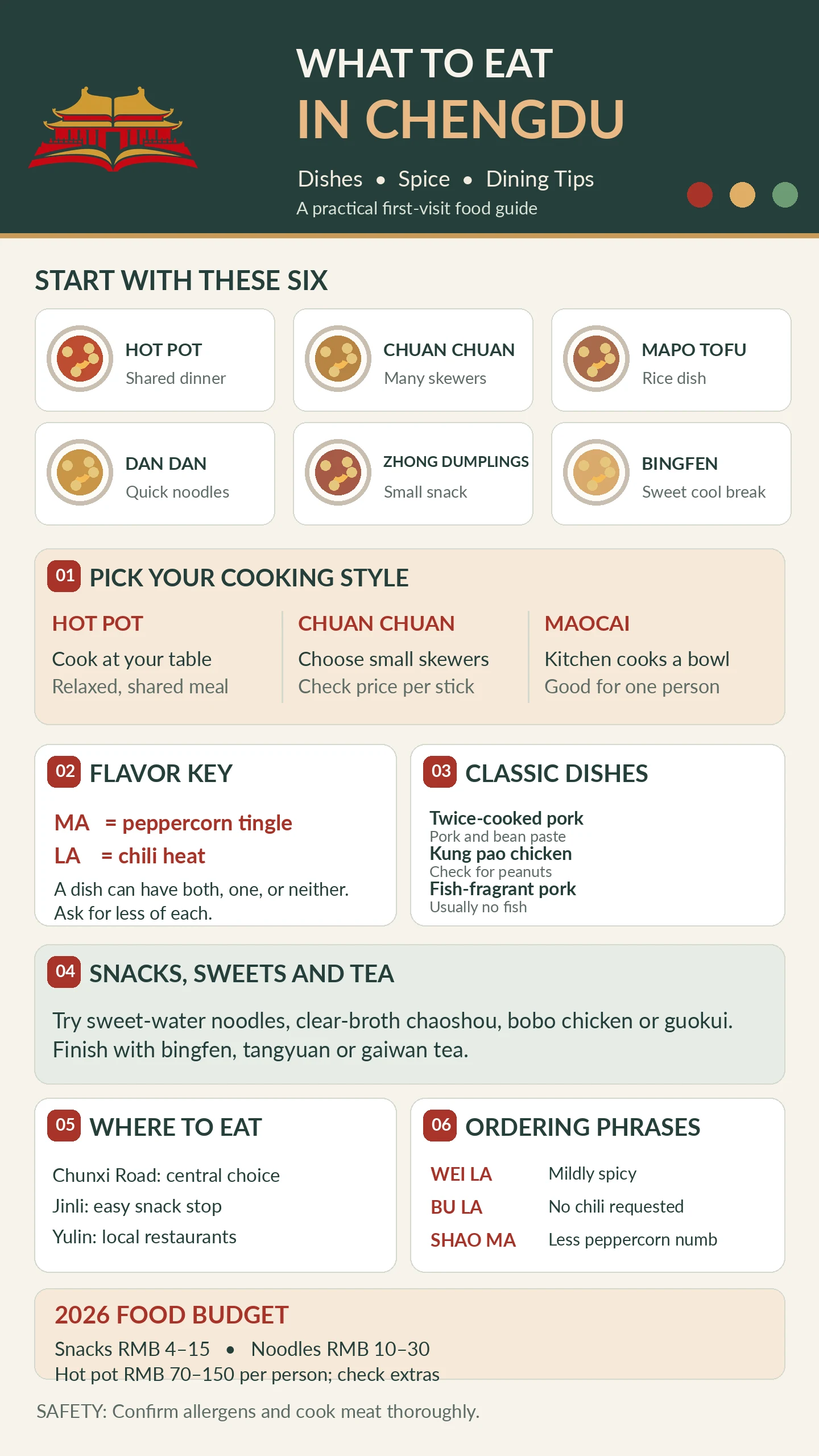
Chengdu is worth visiting hungry, but its food is not a contest to see who can eat the most chili. From shared hot pots and Sichuan stir-fries to tiny noodle shops, tea and sweet snacks, the city offers different ways to eat depending on your appetite, time and tolerance for heat. It has been part of UNESCO’s Creative Cities Network as a City of Gastronomy since 2010.[1]
This guide helps you choose the dishes that fit your trip and read common menu terms. For the broader journey, use the Chengdu travel guide and the nationwide food and drink guide.
What Does Chengdu Food Taste Like?
Sichuan cooking layers several flavors rather than treating spiciness as the entire point. The distinction to learn first is between má (麻), the tingling sensation associated with Sichuan peppercorns, and là (辣), the burning heat from chili peppers. A dish can have one, both, or neither. Chengdu’s UNESCO profile highlights precisely this range of sweet, sour, bitter, spicy and salty flavors.[1]
You will also see yú xiāng (鱼香, yú xiāng), or “fish-fragrant,” a garlic-forward balance of sweet, sour and savory notes that typically does not mean fish is included. Jiā cháng (家常, jiā cháng), or home-style, often involves fermented chili-bean paste, but its heat varies. If chili is a concern, see the practical Chinese food spice-level guide and ask how each dish is prepared. “Mild” is a request, not a standardized rating.
Hot Pot, Chuan Chuan or Maocai: Which Should You Choose?
These three meals share some Sichuan seasonings, but they differ in what happens at the table and how the bill is calculated.
| Style | How it works | Who should choose it | Check before ordering |
|---|---|---|---|
| Chengdu hot pot (成都火锅, chéng dū huǒ guō) | You cook ordered plates of meat, vegetables and tofu in simmering broth at your table. | Couples and groups wanting a long shared meal. | Broth, sauce, drinks and ingredients may be separate charges. |
| Chuan chuan xiang | Pick skewered ingredients. Depending on the shop, they cook in a table pot or arrive already prepared. | Solo diners and people who like trying many small items. | Per-stick, color-coded stick, plate or weight-based pricing. |
| Maocai (冒菜, mào cài) | Choose ingredients; the kitchen cooks and seasons them before serving in a bowl. | Travelers who want a faster, often one-person meal. | Weight-based selection versus a fixed-price combination. |
For hot pot, red broth is commonly chili-heavy; a split or yuān yāng guō (鸳鸯锅, yuān yāng guō) divides the pot into two broths. Check that the mild half has no chili if you need it. A red broth in Chengdu is not automatically the same recipe or dining tradition as a Chongqing-style hot pot. For more detail on choosing broth, sauces and ingredients, continue to the Chengdu hot pot guide; the Chongqing food guide covers the neighboring city’s food context.
The common trap is equating a low price per skewer with a low final bill. Ask the shop to explain its pricing method before you fill a tray. Some hot pot restaurants also charge for a dipping-sauce station or prepacked tableware. Cooking times and table arrangements vary, so follow the restaurant’s instructions rather than a universal online rule.
Classic Sichuan Dishes to Order in Chengdu
For a seated lunch or dinner, share two or three dishes with rice instead of buying a separate main for every person. These specialties are popular in Chengdu and elsewhere in Sichuan; being common in the city does not prove they all originated there. If you want the larger regional picture, see the Sichuan travel guide.
| Dish | What you are ordering | Important detail |
|---|---|---|
| Mapo tofu | Silky tofu in fermented chili-bean sauce, Sichuan pepper and usually minced beef or pork. | Not automatically vegetarian; ask about the meat and cooking fat. |
| Twice-cooked pork (回锅肉, huí guō ròu) | Pork cooked first, then sliced and stir-fried with chili-bean paste and vegetables, often garlic shoots. | Contains pork; a rich savory option with rice. |
| Kung pao chicken (宫保鸡丁, gōng bǎo jī dīng) | Diced chicken with dried chilies, aromatics and usually peanuts. | Nut allergy warning; balance of salty, tangy and lightly sweet flavors varies. |
| Fish-fragrant shredded pork (鱼香肉丝, yú xiāng ròu sī) | Strips of pork in a sweet-sour-garlicky sauce with vegetables. | Normally no fish, but do not assume the sauce meets an allergy requirement. |
| Mouthwatering chicken (口水鸡, kǒu shuǐ jī) | Sliced cooked chicken served cool under chili oil, Sichuan pepper and seasonings. | Often a cold starter; the sauce may be hot and may contain nuts or sesame. |
| Water-boiled fish (水煮鱼, shuǐ zhǔ yú) | Fish served in a large, fragrant chili-and-peppercorn oil broth. | Usually better shared; watch for bones and a generous amount of oil. |
Two diners might order one meat dish, one vegetable dish and rice, adding a soup or cold appetizer only if hungry. This avoids the very common mistake of ordering several large plates alongside a full hot pot. If someone in your group avoids pork, peanuts or other ingredients, point to the actual Chinese dish name and ask for the full ingredient list rather than trusting an abbreviated English translation.
Chengdu Noodles, Dumplings and Street Snacks
Noodles and Dumplings: Dandan, Sweet-Water Noodles, Zhong Dumplings and Chaoshou
A Chengdu snack-shop menu can look like a wall of near-identical noodle names. The texture, sauce and serving style are the useful differences.
- Dan dan noodles: Usually a small bowl of thin noodles dressed with chili oil, savory minced meat, preserved vegetables and sometimes sesame or peanut components. Recipes vary; ask before assuming a specific topping is absent. It works for a quick lunch or as one snack among several.
- Sweet-water noodles (甜水面, tián shuǐ miàn): Thick, chewy noodles in a sweet, savory and typically chili-rich sauce, often with sesame. Despite the name, this is not a dessert and is not usually served in sweet soup.
- Zhong dumplings: Small, generally pork-filled dumplings coated in an aromatic sweet chili-oil sauce, unlike plain boiled dumplings served with a separate dip. Order a portion as a snack rather than assuming it is a huge dinner.
- Long chaoshou (龙抄手, lóng chāo shǒu): Delicate Sichuan wontons with thin wrappers, often filled with pork. Clear broth is a useful option for those who want less chili; red-oil versions are a different choice. Make the broth request explicitly.
A tiny portion is not necessarily poor value: tasting two small snacks in one sitting can give you more range than ordering the largest noodle bowl. Where restaurants offer different portion sizes, ask which is suitable for one person.
Street Snacks: Bobo Chicken, Guokui and Adventurous Bites
- Bobo chicken (钵钵鸡, bō bō jī): Ready-cooked skewered items, commonly eaten cool in chili-oil or green-peppercorn seasoning. Despite the name, choices may include vegetables, quail eggs, tripe and chicken parts. Choose a shop that protects and properly chills ready-to-eat food; temperature control matters.[2]
- Guokui (锅盔, guō kuī): A baked or griddled wheat flatbread, sometimes plain and sometimes stuffed or filled with meat. It is a convenient portable snack, but the exact version changes by vendor.
- Egg pancake, danhonggao (蛋烘糕, dàn hōng gāo): A small folded pancake with sweet or savory fillings, from sesame to preserved vegetables. Ask about eggs, wheat and fillings if you have restrictions.
- Spicy rabbit head (麻辣兔头, má là tù tóu): A recognizable local specialty for curious eaters, usually more laborious to eat than a bowl of noodles. It is optional, not an initiation ritual everyone must complete.
Chengdu Desserts and Teahouse Treats
Dessert stalls and teahouses give you options between heavier, chili-forward meals. Do not rely on a dessert being allergy-safe: toppings are often mixed to order.
- Bingfen: Chilled jelly with syrup, commonly brown sugar, and optional fruit, nuts, raisins or sticky-rice additions. Ask what is on top; peanut toppings are possible.
- Lai tangyuan (赖汤圆, lài tāng yuán): Glutinous-rice balls with sweet fillings such as sesame or peanut, usually served warm. Texture is pleasantly chewy, but the fillings matter for allergies.
- Douhua (豆花, dòu huā): Soft tofu pudding served sweet or savory. Ask for tián dòu huā (甜豆花, tián dòu huā) when you want a sweet version; a savory one may arrive with chili oil.
- Gaiwan tea: Tea served in a covered bowl, with a slower pace than a snack stall. For choosing a neighborhood teahouse and understanding the full experience, use the Chengdu teahouse guide.
Bingfen can be a refreshing finish, but it does not medically neutralize spicy food. A tea break at People’s Park may fit naturally into a sightseeing day; specific venue availability should be checked locally.
Where to Eat in Chengdu
Choose an area that is convenient for your actual sightseeing route, not solely for a ranking online. A busy tourist street can be a sensible stop for several snack samples even if you would choose a neighborhood restaurant for a full meal.
| Area | Good use | Practical trade-off |
|---|---|---|
| Chunxi Road and Taikoo Li | Many dining formats close together; easy to combine with central sightseeing. | Busy commercial setting, and prices vary widely by restaurant. |
| Jinli | Try small snacks while exploring a lantern-lined historic-style street. | Tourist-oriented stalls and individual item prices can add up. |
| Kuanzhai Alleys | Combine light food or tea with an atmospheric walk. | More suited to a sightseeing-and-snack stop than a guaranteed bargain meal. |
| Yulin or Shuangnan neighborhoods | Explore everyday restaurants beyond the main visitor zones. | Less English signage and more need to check the precise location. |
| Jianshe Road / Jianshe Lane area | Casual snack-hopping with numerous small food outlets. | Vendor mix and opening hours change; verify before traveling specifically for one stall. |
If Jinli or Kuanzhai is already in your day, the Jinli visitor guide and Kuanzhai Alley guide help combine eating with the visit. For travel between neighborhoods, use the Chengdu transportation guide.
Chengdu also has a fine-dining scene, but this article is not a restaurant ranking. The MICHELIN Guide Chengdu 2027 edition, announced September 2, 2026, listed 84 establishments; the list includes restaurants serving several cuisines, not just Sichuan cooking.[3]
How to Order Food and Manage Spice in Chengdu
Pointing to a menu photo works for identifying a dish, but not for confirming hidden ingredients. If a menu is on a QR code, compare its photo, Chinese name and price; get the server to confirm anything that affects allergies or dietary rules. These expressions are practical starting points:
| Say or show this | Meaning or use |
|---|---|
| 微辣 (wēi là) | Mildly spicy; still may be too hot for some visitors. |
| 不辣 (bù là) | Not spicy; ask whether the dish can actually be made without chili. |
| 少麻 (shǎo má) | Less of the peppercorn numbing sensation. |
| 鸳鸯锅 (yuān yāng guō) | A divided hot pot with two broths. |
| 这是什么肉? (zhè shì shén me ròu?) | What kind of meat is this? |
| 打包 (dǎ bāo) | Pack leftover food to take away. |
For a strictly chili-free meal, say that you cannot eat chili, then ask about sauce, broth and shared utensils. Even a “clear soup” is not proof of vegetarian or allergy-safe preparation. For an overview of menu formats and common ordering steps, read how to order food in China.
At a shared restaurant, start with two dishes and rice for two people, then add food if needed; the right amount depends on portion size. Many restaurants support mobile ordering or payment, but do not assume an international card will work at every stall. Set up a supported payment option ahead of time using the visitor’s China payment guide and carry an appropriate backup.
How Much Does Food Cost in Chengdu?
Use these as approximate 2026 planning ranges in Chinese yuan (RMB), not current guaranteed menu prices. A snack in a busy visitor street, a neighborhood café and a premium hot pot restaurant may fall well outside one neat average.
| Meal type | Illustrative cost | Price unit |
|---|---|---|
| Simple street snack or small pastry | RMB 4–15 | Per item |
| Noodles, dumplings or a small prepared meal | RMB 10–30 | Per bowl or portion |
| Ordinary Sichuan restaurant | RMB 40–80 | Per person in a shared meal |
| Maocai or casual skewer meal | RMB 25–65 | Per person; varies with quantity |
| Mid-range hot pot | RMB 70–150 | Per person; extras may be charged separately |
| Fine dining | RMB 180 and upward | Per person; very wide range |
The biggest budget surprise is often what is not in the dish price: hot pot broth, sauces, beverages, tableware or an extra plate of meat. Check the total before approving the order. These ranges are synthesized from 2026 public menu-oriented estimates rather than a representative citywide price survey; check the menu for the restaurant you actually visit.[4] For whole-trip costs, use the Chengdu travel budget.
Food Safety and Dietary Needs
- Vegetarian and vegan: Tofu does not make mapo tofu vegetarian; mince, meat stock, lard and cooking sauces can be hidden ingredients. Ask separately about the dish, stock and cooking fat. Many kitchens cannot guarantee no animal ingredients or cross-contact.
- Allergies: Kung pao chicken commonly contains peanuts; sesame, soy, wheat, seafood and mixed sauces appear elsewhere. Carry a translated allergy card, ask what went into the actual order, and decline food if the kitchen cannot confirm safe preparation.[5]
- Hot pot: Keep raw and cooked utensils separate, and thoroughly cook meat, offal, seafood and eggs. A pot of hot broth is no guarantee if food is removed before it is fully cooked.[2]
- Street food: Prefer food cooked thoroughly and served hot. Ready-to-eat cool skewers or cut fruit require particular care with handling and safe temperature; high foot traffic alone does not make a stall safe.[2]
- Drinking water: Use sealed bottled water or adequately treated water when safety is uncertain. Freshly boiled tea is generally a safer choice than untreated tap water.[2]
For severe allergies, bring your prescribed emergency medication and an emergency plan as advised by your clinician. Further preparation is covered in food allergies and dining in China.
A One-Day Chengdu Food Plan
This is an eating sequence, not a route with promised transit times. Mix and match meals around the attractions already on your itinerary.
| When | A practical choice | Why it fits |
|---|---|---|
| Breakfast | Clear-broth chaoshou or a small bowl of dan dan noodles | A manageable first taste, with a mild option. |
| Lunch | One or two Sichuan shared dishes plus rice | Compare home-style and spicy flavors without ordering too much. |
| Afternoon | Bingfen, an egg pancake or a cup of gaiwan tea | Leave space and time for a pause. |
| Dinner | Hot pot for a group; maocai or chuan chuan for a quicker solo meal | Match the format to your company, budget and appetite. |
A three-day Chengdu itinerary can help place these food stops around sightseeing without zigzagging across the city. You do not need to eat every “must-try” dish in a single day to have a satisfying food trip.
FAQs About Eating in Chengdu
What food is Chengdu most famous for?
Chengdu is associated with hot pot, mapo tofu, dan dan noodles, chuan chuan and numerous local snacks. For a first visit, combine one shared meal with smaller bowls or snacks rather than trying to order everything together.
Can you eat non-spicy food in Chengdu?
Yes. Look for clear-broth chaoshou, sweet tangyuan, some egg pancakes and appropriately prepared sweet desserts. Always confirm toppings and broth; “mild” does not mean chili-free.
What should solo travelers eat in Chengdu?
Dan dan noodles, Zhong dumplings and a bowl of maocai are easy starting points. Some chuan chuan shops are also solo-friendly, though minimum orders and pricing policies vary.
Is street food safe to eat in Chengdu?
No stall can be guaranteed safe based on popularity. Choose hygienic handling and food cooked thoroughly and served hot; be more cautious with ready-to-eat cool foods and unverified ingredients.[2]
Sources
[1] UNESCO Creative Cities Network. Chengdu
[2] US Centers for Disease Control and Prevention. Food and Water Precautions for Travelers
[3] MICHELIN Guide. First Three-Star Restaurant Debuts in the MICHELIN Guide Chengdu 2027 Selection
[4] China Travel Food. Chengdu Food Streets
[5] US Centers for Disease Control and Prevention. Severely Allergic Travelers





