
Quick Answer: How Do You Use Chengdu East Railway Station?
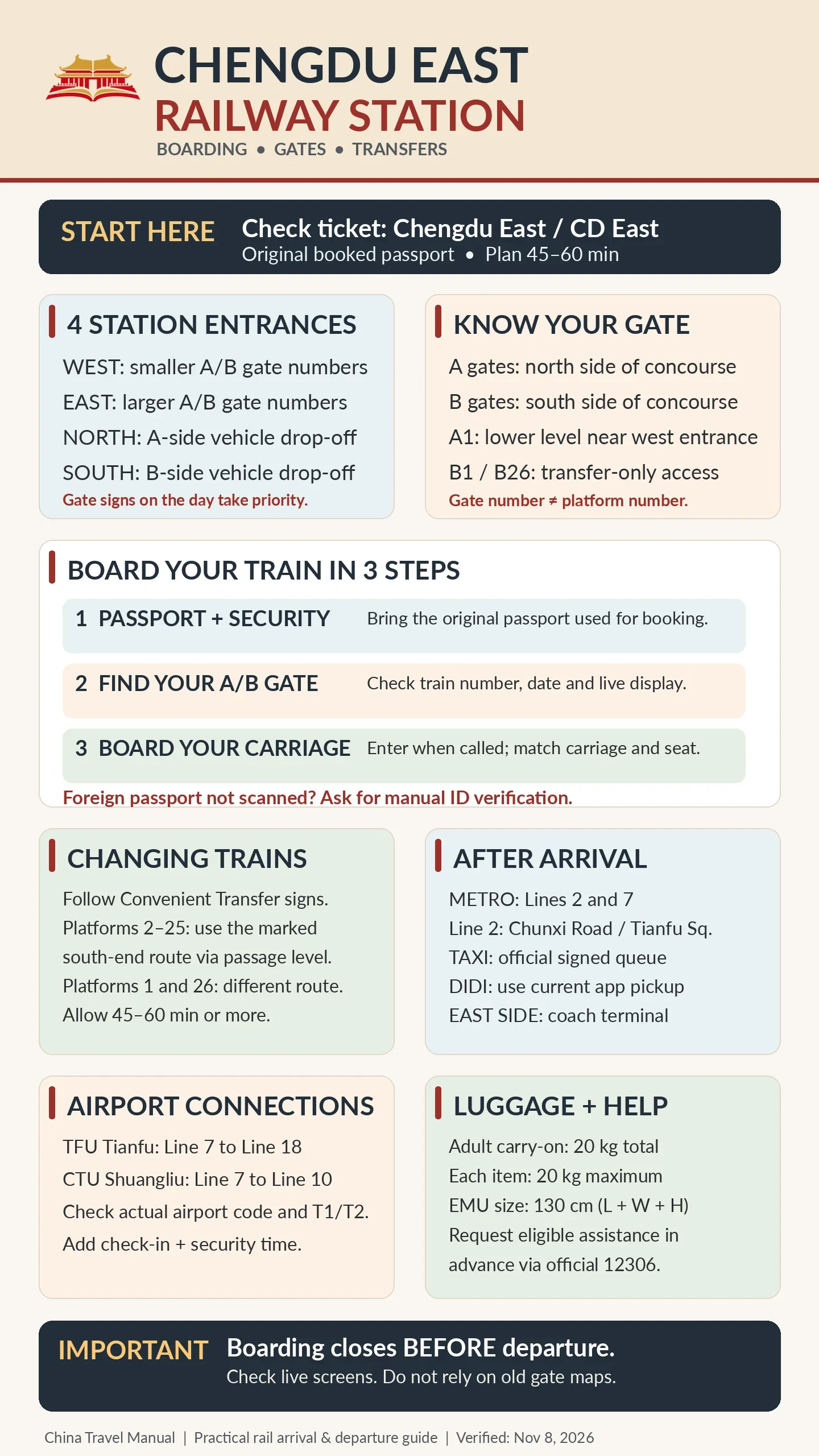
Check that your 12306 ticket says Chengdu East (成都东), and bring the original passport used for booking. Allow roughly 45–60 minutes before departure if this is your first Chinese train journey, especially with luggage; that is a planning recommendation, not a universal railway rule.
| Step | What to do |
|---|---|
| 1. Verify | Match the departure station, date, train number, and passenger name to your booking. |
| 2. Arrive | Take Metro Line 2 or 7 to Chengdu East Railway Station, or use an authorized drop-off point. |
| 3. Enter | Choose an entrance near your assigned A/B boarding gate when known. |
| 4. Security | Present the booked passport and complete baggage screening. |
| 5. Find gate | Check the live departure screen for your train and gate. |
| 6. Board | Enter when check-in opens; locate your carriage and seat. |
If an automatic passport gate does not recognize your document, ask for manual identity verification. You do not normally need a printed ticket merely because you have a foreign passport.[1]
Chengdu East Railway Station (成都东站) is a major high-speed rail hub for trips involving Chongqing, Xi’an, Leshan, and other Chinese cities. For first-time visitors, the difficult part is often not reaching the building: it is checking that the ticket names the right station, choosing an entrance, presenting a passport, finding an A/B boarding gate, and leaving enough time to board. This guide follows the journey from hotel to train, then explains how to transfer or leave the station after arrival. It focuses on Chengdu East itself, not the entire Chinese rail network.
Is Chengdu East the Right Railway Station for Your Train?
Chengdu has several separately named passenger railway stations. “Chengdu” on a ticket does not automatically mean Chengdu East. In the 12306 app or confirmation email, read the departure station field rather than relying on the destination city or the train’s general route.
| English name | Chinese station name | What it means |
|---|---|---|
| Chengdu East | 成都东 / 成都东站 | The station covered by this guide. |
| Chengdu South | 成都南 / 成都南站 | A different station; check its own departure arrangements. |
| Chengdu Railway Station | 成都 / 成都站 | Not another name for Chengdu East. |
| Chengdu West | 成都西 / 成都西站 | A separate departure point. |
Some trains to Chongqing, Xi’an, Leshan, or Emeishan use Chengdu East, but departures vary by service and date. Match the station name, train code (such as G or D followed by digits), and departure time in your order. When navigating, enter Chengdu East Railway Station, not simply “Chengdu Station.” The China railway-stations guide explains the naming conventions used elsewhere in the country.
Before You Arrive: Tickets, Passports and Timing
Before leaving your accommodation, check the travel date, train number, departure time, seat or carriage assignment, passenger name, and the exact station. Save the order details offline, but carry the original valid passport used to buy the ticket. China’s real-name railway rules require the traveler, document, and booking to match; an itinerary sheet or reimbursement receipt alone is not an admission document.[1][2]
If your passport information has not been verified in the booking system, allow additional time to speak with staff. An unreadable e-gate does not mean your electronic ticket is unusable; station staff may verify your identity manually. The full registration and booking steps belong in the 12306 guide for foreigners.
For an unfamiliar station, a 45–60-minute arrival buffer is sensible, with more for family groups, accessibility needs, or busy holidays. It must cover the walk from the square, entry checks, security, and reaching your gate. Chengdu East does not promise 24-hour public access; entrance opening depends on the day’s services and posted station notice.
Ordinary 12306 ticket sales generally follow a 15-day advance window. A separate 2026 early-request pilot, limited to specified Beijing–Shanghai services, is not a general 30-day sale of Chengdu East tickets.[9] Confirm the actual release date in 12306 before planning a connection.
How to Get to Chengdu East Railway Station
The rail hub is served by Chengdu East Railway Station metro stop (成都东客站) on Metro Lines 2 and 7. Line 2 reaches the central Chunxi Road and Tianfu Square areas; Line 7 is a loop that connects other districts and transport hubs, including the South Railway Station area. Follow the signs for the railway station once you exit the metro, not a similarly named bus stop.[3]
| Starting area or circumstance | Useful starting option |
|---|---|
| Chunxi Road or Tianfu Square | Metro Line 2 toward Chengdu East Railway Station. |
| Chengdu South or places along the ring line | Metro Line 7, checking the direction and interchange. |
| Several passengers or heavy suitcases | Taxi or DiDi to an authorized station drop-off. |
| Early departure or limited buffer | Compare the first metro departure with the entire door-to-gate journey. |
Road vehicles may reach the east or west approaches and designated north/south elevated drop-off platforms, subject to real-time traffic control. The north and south platforms are for dropping off, not a universal place to collect an arriving passenger. Ask your driver for the most practical railway entrance, particularly if your boarding-gate number is known. For citywide planning, see getting around Chengdu and the Chengdu metro guide.
Chengdu East Station Layout: Which Entrance and Gate Should You Use?
East, West, North and South Entrances
Chengdu East has four main approaches: east and west entrances connect to the respective public squares, while north and south entrances connect with road drop-off platforms. The waiting concourse is extensive, so entering near the likely gate saves walking with luggage.
| Boarding-gate area | Practical entrance guidance |
|---|---|
| Lower A/B gate numbers, roughly 1–11 | West Square is generally closer. |
| Higher A/B gate numbers, roughly 12–26 | East Square is generally closer. |
| A-side gate, arriving by car | North drop-off platform may be convenient. |
| B-side gate, arriving by car | South drop-off platform may be convenient. |
A 2024 railway-published station guide used the 1–11 versus 12–26 division, while some later public guidance uses a slightly different cutoff. Treat this as a walking-distance suggestion, not an entry restriction. Check current entrance signs and ask station staff if the assigned gate or route has changed.[4] If your gate is still unknown, prioritize a clearly signed open entrance over walking around the building in search of a theoretical shortcut.
Understanding A/B Boarding Gates and Station Levels
Gate labels at Chengdu East have both a letter and a number. The A-side gates occupy the northern portion of the waiting area, while the B-side gates occupy the southern portion. In published station layouts, most regular gates—A2–A26 and B2–B25—are on the upper waiting level. A1 is unusual: it sits at platform level near the west entrance escalators. B1 and B26 are used for transfer access rather than normal public boarding.[4]
A gate number is not a platform number. For example, a screen showing Gate A16 does not authorize walking directly to Platform 16. Wait for your service to be announced; staff may change the boarding gate or platform. If you enter on the wrong side, use the signed internal concourse rather than attempting to cross security barriers or approach a platform from outside the proper passenger route.
How to Board a High-Speed Train at Chengdu East
Step 1: Passport Verification and Security Check
At the entrance, join the real-name identity-check queue. Present the passport linked to the reservation when asked, then send your bag through the security scanner and pass the passenger screening point. These checks take place before you settle into the main waiting area.
Not every automated reader handles every foreign travel document. If the machine rejects your passport, use the manual identity-verification lane or ask an attendant to direct you there. Keep your 12306 booking number available if there is an issue with your name or identity status. The railway’s English FAQ recognizes valid foreign passports for real-name tickets and electronic check-in; there is no blanket requirement to collect a paper ticket.[1] For document exceptions, see passport checks on China trains.
Step 2: Find Your Train and Boarding Gate
Inside the concourse, look for an electronic departure board displaying your train number, scheduled departure, destination and gate. The train number is the most reliable identifier: different services can serve the same destination. Read changes or delay notices rather than assuming the gate in an earlier screenshot is final.
A gate may not appear immediately for a later train. That is a reason to wait in the public hall and keep checking screens—not to try to enter a platform early. If the display is difficult to understand, show staff the train number and date. You can say: “请问这趟车在哪个检票口?” (“Which boarding gate is this train using?”)
Step 3: Board the Correct Train and Carriage
Once the gate opens, follow the controlled route down to the designated platform. Your ticket or order shows a carriage (车厢) and seat (座位). Check carriage numbers on the train or platform signs, and stand clear of the platform edge while the train approaches.
The scheduled departure time is not when boarding begins. Gates close before the train departs, and the exact cutoff may differ by station or service. Do not rely on a universal “five minutes before departure is safe” rule. If staff have closed boarding, ask what ticket-change options apply rather than trying to pass through a closed gate.[2][5]
Changing Trains at Chengdu East Railway Station
How to Find the In-Station Transfer Route
If both rail services use Chengdu East, follow the signs for Convenient Transfer (便捷换乘) after your first train arrives. You should not simply stand on the platform and wait for your next train or assume that any staircase leads to the departure hall.
Published local instructions say passengers arriving at platforms 2–25 should move toward the south end of the platform and follow the transfer signage via the exit passage level to the waiting area. Platforms 1 and 26 have a different transfer arrangement.[6] The applicable route may change because of passenger-flow controls or construction, so the live signs and railway staff take priority. Keep the second train’s order and the original passport ready for any further verification.
If you find yourself approaching the public exit gates instead of the transfer corridor, ask for help before passing through. Depending on the current arrangement, leaving the controlled area may require you to repeat entry and security screening. For broader situations, consult the China train transfers guide.
How Much Time Should You Allow for a Connection?
A 30-minute connection appears in some station guidance, but it is not a guarantee of a successful transfer. Walking distance, arrival platform, a late first train, the second service’s gate-closing time, or a manual passport check may consume the buffer rapidly.
For a first-time foreign traveler, 45–60 minutes or more between trains is a safer planning choice, particularly with multiple bags or independently booked tickets. If either service has little flexibility, leave additional time. Confirm both departures name Chengdu East, rather than another Chengdu station; an itinerary with a station change is a different, longer journey.
Arriving at Chengdu East: Metro, Taxi and DiDi
How to Reach Metro Lines 2 and 7 After Arrival
After your train stops, follow the Exit (出站) signs through the designated passenger corridor. Once outside the railway-controlled area, follow Metro (地铁) signs toward Chengdu East Railway Station (成都东客站). Avoid assuming that an exit letter described in an old article is still the best route; nearby passages can be redirected during maintenance.
For hotels near Chunxi Road or Tianfu Square, Metro Line 2 is generally the most straightforward rail connection. Line 7 is useful for reaching transfer stations and the South Railway Station area. Check the platform direction and the time of the last connecting train before purchasing a ticket, especially after a late railway arrival.[3] A detailed Chengdu transport guide can help with onward city travel.
Where to Find the Taxi, Ride-Hailing and Coach Areas
Do not use “taxi,” “DiDi,” and “coach” interchangeably on the station signs. The official taxi rank has traditionally been associated with the west-square side; the intercity coach terminal is on the east-square side. Ride-hailing has separate managed pickup points rather than unrestricted collection on the arrival roadway.
A municipal response published in August 2026 reported improvement works at the west-square Perennial (鹏瑞利) ride-hailing facility and plans for additional east-side pickup capacity. That report did not confirm that every planned east-square pickup point was already in service.[7] On arrival, use your ride-hailing app’s active pickup instruction and compare it with the station’s current directional signs; if they disagree, seek help before wandering into the road lanes. The DiDi guide for tourists covers app setup and payment.
Chengdu East to Tianfu or Shuangliu Airport
Always check the airport code on the flight ticket before leaving the train station: TFU is Tianfu International Airport; CTU is Shuangliu International Airport. A transfer to the wrong airport can cost far more time than a small metro error.
| Destination | Typical rail approach | What to check |
|---|---|---|
| Tianfu Airport (TFU) | Metro Line 7 toward South Railway Station, then Line 18 toward Tianfu Airport. | Flight terminal, metro operation, long total connection. |
| Shuangliu Airport (CTU) | Metro Line 7 toward Taipingyuan, then Line 10 toward the airport terminals. | T1/T2, direction, and metro closing times. |
| Taxi / DiDi to either airport | Road transfer from the designated pickup area. | Congestion, pickup wait, and current app quote. |
These are route frameworks, not guaranteed fastest paths for every departure time. Airport check-in, baggage handling, security and terminal walking time must be added after the metro journey. Travelers arriving from TFU should use the separate Tianfu Airport–Chengdu East transfer guide in the reverse direction only after confirming current services; arrivals from CTU can consult the Shuangliu Airport transfer guide for airport-side information.
Luggage, Facilities and Accessibility at Chengdu East
Luggage Limits, Storage and Restricted Items
The current 12306 rule for an ordinary adult passenger is a 20 kg total free carry-on allowance; each individual piece also has a 20 kg weight limit. On high-speed EMU services, the sum of a piece’s length, width and height must generally be no more than 130 cm. Different exceptions apply to children, diplomats and certain mobility aids. These are not airline checked-baggage allowances.[2]
The rules also restrict dangerous or prohibited articles, and all carried bags remain subject to security screening. See the detailed China train luggage guide before bringing oversized cases, tools or special equipment.
Storage counters or third-party lockers may be available in or around the station, but locations, rates and operating hours are subject to change. Do not plan on unverified 24-hour luggage storage; ask at a staffed station information point or consult the railway-station lockers guide for the types of services to look for.
Waiting Areas, Food and Assistance
The main waiting level has public seating, restrooms and opportunities to purchase drinks or simple food. Facilities and tenants may move, so use current signs rather than assuming a named shop will still occupy a particular gate. Business-class lounge access depends on ticket and station arrangements.
Visitors who need a wheelchair, mobility assistance, or help boarding should request the railway’s special passenger assistance in advance when eligible. 12306’s current service instructions call for online requests at least six hours ahead; shorter-notice requests can be made at the station within the applicable cutoff.[8] Explain the assistance needed and have the ticket and passport information ready. See accessible train travel in China for further preparation.
What If Your Train Is Delayed or You Miss Boarding?
A disrupted train does not always mean you must buy a wholly new ticket, but the permitted remedy depends on current railway policy, available seats and your original booking. Check the station screen first, then ask staff or use 12306 before making assumptions.
| Problem | First action |
|---|---|
| Boarding gate changes | Match your train number with the updated screen; follow staff direction. |
| First train is late | Reassess any connecting train, airport or onward booking immediately. |
| Passport reader rejects your document | Request manual verification with the booked passport. |
| Boarding has already closed | Do not push past the barrier; ask about ticket-change options. |
| You missed the departure | Check eligibility, remaining seats and the current change fee or deadline. |
Under current 12306 rules, one ticket change may be permitted subject to capacity. A post-departure change to another train on the same date may be free if completed before midnight, but this does not guarantee a seat or remove all restrictions; changing to a later date may incur a fee.[5] For full procedures use missed train departure advice and refund and change rules.
FAQs About Chengdu East Railway Station
How early should I arrive at Chengdu East Railway Station?
Aim to reach the station 45–60 minutes before departure, and earlier if you need manual passport help, have heavy luggage or are traveling during a holiday. This is traveler advice, not a railway-mandated arrival time. Boarding closes before the scheduled train departure.
Can foreigners board trains at Chengdu East with a passport?
Yes. Bring the original valid passport used to book your electronic ticket. If an automated gate cannot scan it, request the staffed identity-check lane. You normally do not need to collect a paper ticket solely because you hold a foreign passport.[1]
Which metro lines serve Chengdu East Railway Station?
Metro Lines 2 and 7 serve the Chengdu East Railway Station metro stop. Line 2 reaches central destinations including Chunxi Road and Tianfu Square; Line 7 connects with other rail lines and the South Railway Station area. Check the correct platform direction.[3]
How do I transfer between trains at Chengdu East?
Follow Convenient Transfer (便捷换乘) signs after leaving your first carriage. The route depends on your arrival platform and may involve the exit-passage level. For a first visit, allow more than a bare 30-minute connection and confirm both services use this station.[6]
Is Chengdu East the same as Chengdu Railway Station?
No. Chengdu East (成都东) and Chengdu (成都站) are distinct stations. Always compare the name in your 12306 order against the station shown in your map and on the entrance signs before starting the trip.
Sources
[1] China Railway 12306. English FAQ: Real-name tickets and passports
[2] China Railway 12306. Railway Passenger Transport Rules and Carry-on Luggage
[3] China Railway Chengdu Bureau. Chengdu and Chongqing Transport Hub Connections
[4] Railway station public guidance. Chengdu East Entrance and Boarding Gate Layout
[5] China Railway 12306. Ticket Changes at Railway Stations
[6] Railway station transfer report. Chengdu East Entry and Transfer Routes
[7] Sichuan Online, reporting a municipal response. Chengdu East Ride-Hailing Pickup Improvements, August 2026
[8] China Railway 12306. Priority Passenger Assistance Reservations
[9] China Railway Academy. Advance Ticket Request Pilot Changes, September 2026





