

Quick Answer: Where Should You Stay in Beijing?
For a first Beijing trip focused on the Forbidden City, Tian’anmen Square, the Temple of Heaven and the hutongs, choose one well-connected base in central Dongcheng. Wangfujing, Dongdan and Dengshikou offer the easiest combination of metro access, conventional hotels and luggage-friendly arrivals. Chongwenmen is the practical alternative for families and travelers using Beijing South Railway Station.
- Best first-time base: Wangfujing, Dongdan or Dengshikou for balanced sightseeing and reliable hotel services.
- Best for the central axis: Qianmen for atmosphere and early Tian’anmen access; Chongwenmen for easier luggage and transport.
- Best for hutong character: Dongsi, Gulou or quiet Shichahai lanes, provided you accept stairs, weaker soundproofing and limited vehicle access.
- Best for nightlife or business: Sanlitun, Liangmaqiao or Guomao, with a longer trip to the historic core.
- Best for northwest Beijing: Xizhimen or Haidian for the Summer Palace, universities and Beijing North or Qinghe stations.
For a stay of three to five nights, use one base. Add a second only for a specific reason such as two Universal days, a Great Wall sunrise or a very early departure.
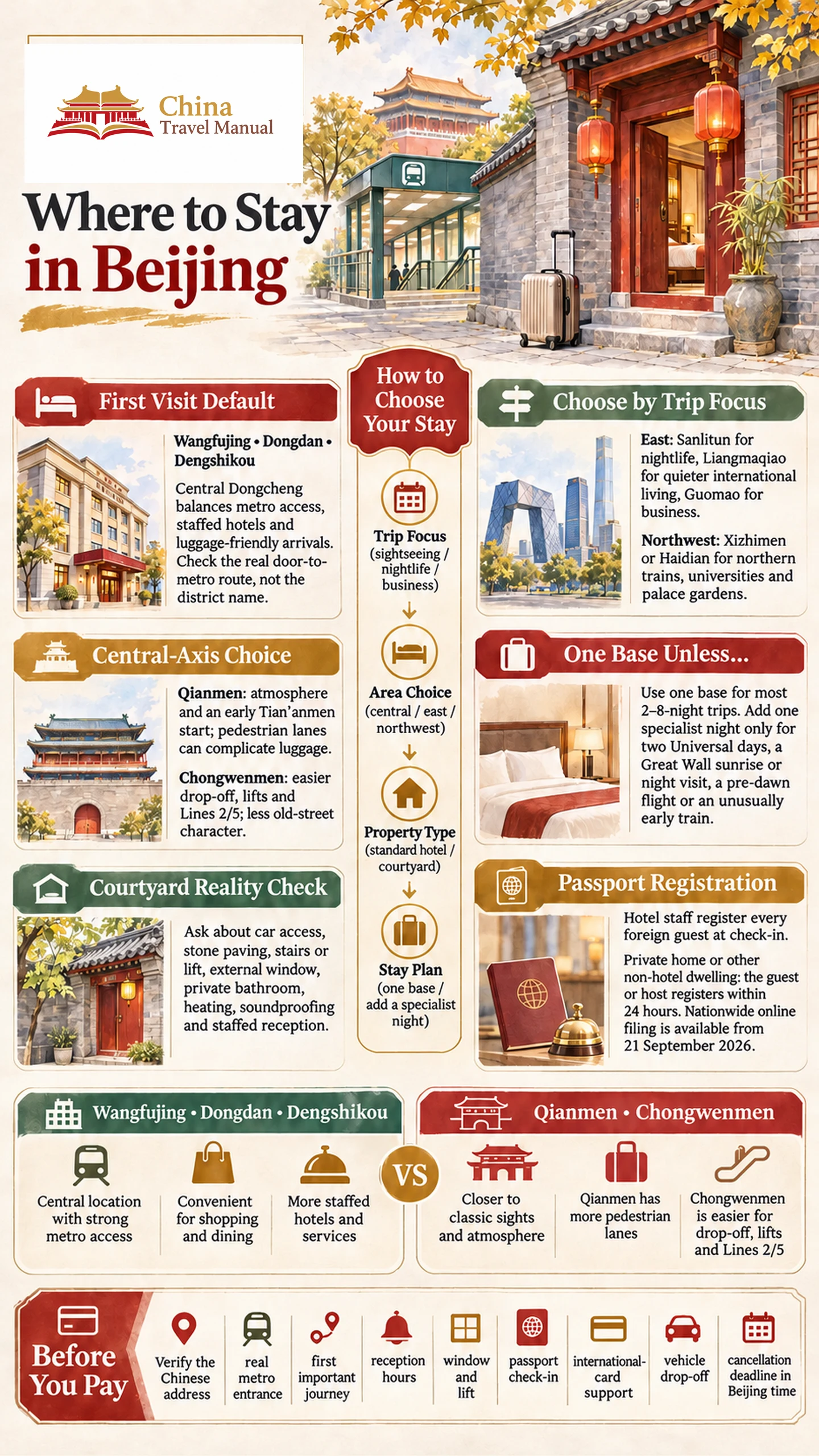
Beijing is too large for a hotel search based only on a famous district name. The practical question is whether the exact front door, metro exit and road access fit your itinerary. A property marketed as “Forbidden City” or “Sanlitun” may still require a long walk, an awkward underpass or several transfers.
This guide compares accommodation areas rather than ranking individual hotels. Use it with the broader Beijing travel guide and a realistic Beijing itinerary to choose one base, then verify the exact property before paying.
Best Areas to Stay in Beijing
The table gives the fast comparison. The sections below explain where each broad label stops being useful and what to check inside the neighborhood.
| Area | Best for | Main advantage | Common stay type | Main trade-off |
|---|---|---|---|---|
| Wangfujing, Dongdan, Dengshikou | First visits, families, late arrivals | Central location, several metro options, conventional hotels | Full-service and chain hotels | Premium prices near the main shopping street |
| Qianmen, Chongwenmen | Tian’anmen, Temple of Heaven, south-side arrivals | Strong central-axis access | Chain hotels, small courtyard stays | Qianmen pedestrian areas complicate luggage access |
| Dongsi, Gulou, Shichahai | Hutong atmosphere and evening walks | Historic street pattern and local dining | Courtyard and boutique hotels | Stairs, noise and vehicle-access limits |
| Sanlitun, Liangmaqiao, Guomao | Nightlife, embassies, business | International dining and modern services | Lifestyle and business hotels | Longer journeys to the historic core |
| Xidan, Xizhimen, Haidian | Northwest sights, universities, northern trains | Useful western and northern transport | Chain hotels and apartments | Daily cross-city travel for central sights |
Wangfujing, Dongdan and Dengshikou
This is the safest default cluster for a first independent visit. It combines central Dongcheng access with a large supply of staffed hotels, elevators, 24-hour reception and doors that cars can usually reach. It works especially well for travelers with children, older relatives, several suitcases or a late flight.
Wangfujing is the best-known name, but the main shopping street is not automatically the best hotel position. Rooms directly facing busy retail streets can be noisier and command a location premium. A hotel one or two streets away may offer a calmer night without sacrificing the area’s convenience. Check whether the room faces the street, an internal courtyard or a service lane.
Dongdan is a transport-first choice. Lines 1 and 5 meet here, and standard chain hotels are common. It suits travelers who care more about efficient transfers and easy ride-hailing than shopping outside the door. Dengshikou, north of Wangfujing on Line 5, has a more residential feel and is often the better compromise for quiet evenings and local restaurants.
Do not interpret “near the Forbidden City” literally. Visitors enter the Palace Museum through the southern Meridian Gate and normally leave through the north or east; the north Gate of Divine Prowess is not a morning visitor entrance.[4] A hotel near the north wall can therefore be poorly positioned for an early entry. Review the Forbidden City visitor guide, then map the route to Meridian Gate rather than to the center of the palace complex.
Qianmen and Chongwenmen
Choose Qianmen when the central axis is the experience you want outside sightseeing hours. Qianmen Street, Dashilar and the surrounding lanes are close to Tian’anmen Square approaches and convenient for an early start. The trade-off is access: pedestrian streets, barriers and narrow lanes can leave the taxi drop-off several hundred meters from a small hotel. That final walk matters with large cases, winter ice, a stroller or reduced mobility.
Chongwenmen exchanges old-street atmosphere for easier logistics. Lines 2 and 5 meet here, standard hotels are plentiful, and cars can usually stop at the entrance. It is a strong choice for the Temple of Heaven, Beijing Railway Station and arrivals through the south of the city. Families and late-arriving travelers often benefit more from this predictable access than from staying inside Qianmen’s pedestrian zone.
If your priority is a dawn visit to Tian’anmen, Qianmen may justify the inconvenience. If you want a central base with elevators, straightforward drop-off and easy transport, choose Chongwenmen. Neither removes the need to follow controlled pedestrian approaches and security checks around Tian’anmen and the Palace Museum.
Dongsi, Gulou and Shichahai
These areas are for travelers who want hutong streets and evening walks to be part of the stay. Dongsi is the most practical compromise: historic lanes sit close to useful main roads, and properties on the edges of the hutong network can combine courtyard character with better taxi and metro access. Read the Beijing hutongs guide before choosing a famous lane solely for its name.
Gulou has cafés, restaurants and the Drum and Bell Towers within an enjoyable walking area. Hotels beside major dining streets may be lively late at night; deeper lanes can be quieter but harder to reach. Shichahai adds lakeside scenery, yet the busiest bar sections around Houhai are a poor choice for light sleepers. A “lake-view” label also needs verification because trees and neighboring roofs may block the advertised view.
Treat a courtyard hotel as a building choice, not just a design theme. Ask these questions before booking:
- Access: Can a car stop at the door, and how far is the walk over stone paving?
- Mobility: Is there a lift, and are reception, breakfast and the room on the same level?
- Comfort: Does the room have an external window, private bathroom, reliable heating or air-conditioning, and adequate soundproofing?
- Service: Is reception staffed when you arrive, and can the property store luggage after checkout?
Small courtyard rooms can be memorable, but they are often less suitable for wheelchairs, heavy luggage, families needing connecting rooms or anyone who requires quiet, standardized facilities. For curated property types, use the Beijing boutique hotels guide rather than assuming every hutong guesthouse delivers the same experience.
Sanlitun, Liangmaqiao and Guomao
This eastern cluster works best when restaurants, nightlife, embassies or business meetings matter more than minimizing the journey to imperial sights. Sanlitun has the broadest range of bars, international dining and late-night activity. The label covers a large area, so a hotel described as “Sanlitun” may still be a substantial walk from the metro. Check the exact station entrance and late-night street noise.
Liangmaqiao is calmer and more residential, with embassy-area services, international supermarkets and restaurants along the Liangma River corridor. It is the strongest family or extended-stay option of the three when you prefer an international neighborhood but do not need to be beside nightlife.
Guomao is the business-first choice. Large hotels, office towers and standardized service make it suitable for meetings, premium facilities and predictable room quality. Its weakness is not comfort but sightseeing efficiency: reaching the Forbidden City, Qianmen or the Temple of Heaven still involves cross-city travel and security queues after arrival.
Choose this cluster for a repeat visit, business trip or food-and-nightlife stay. On a first three-day trip dominated by central historic sights, central Dongcheng or Chongwenmen will usually save more usable time.
Xidan, Xizhimen and Haidian
The western and northwestern districts make sense when your itinerary points that way. Xidan combines Lines 1 and 4 and gives reasonable access to Tian’anmen, the National Centre for the Performing Arts and western Beijing. It is a practical shopping and transport base, though it has less hutong atmosphere than Dongcheng.
Xizhimen is useful for Beijing North Railway Station and northbound rail trips. Lines 2, 4 and 13 meet here, but the road junction and station complex can make a short map distance feel much longer with luggage. Follow a walking route from the specific hotel entrance to the correct station hall, not just to the Xizhimen map pin.
Haidian is the right choice for the Summer Palace, Old Summer Palace, universities, technology campuses or Qinghe Railway Station. Comparable rooms may cost less than in the historic core, but the saving disappears if you spend every day crossing the city. For a first visit centered on the Forbidden City and Temple of Heaven, Haidian is usually a false economy. For a university visit or a northwest-focused second trip, it can be the most logical base.
Special-Purpose Stays: Universal, Airports, Stations and the Great Wall
These are one-night or task-specific bases, not default sightseeing neighborhoods.
- Universal Beijing Resort: Stay nearby if you want the first entry window or will spend two consecutive days in the parks. Line 7 and the Batong Line reach Universal Resort Station, so one park day does not automatically require a hotel move.[6] See the Universal Beijing guide before comparing the time saved with resort-hotel prices.
- Airport hotel: Use one for a flight departing before normal rail service, a middle-of-the-night arrival or an overnight connection. Otherwise, continue to your sightseeing base. Airport proximity is not useful for daily city touring.
- Railway-station hotel: Consider it for an exceptionally early departure or very late arrival. Beijing’s established major railway stations are connected to the subway network, so a normal daytime train rarely justifies moving hotels.[5]
- Great Wall stay: Add one night for a sunrise product, seasonal night visit or slow full-day hike. A standard Badaling or Mutianyu day trip is easier from the city; rural accommodation adds luggage movement and limited evening services. Start with the Great Wall near Beijing guide.
How to Check the Exact Hotel Before Booking
An area recommendation narrows the search. This eight-step check prevents the property itself from undermining the decision.
- Match the names and address. Compare the English listing, Chinese hotel name and full street address. Marketing names often borrow a landmark that is not close to the entrance.
- Map the real metro walk. Route from the hotel door to the appropriate station entrance, not to the station label. Underpasses, fenced compounds and wide roads can turn a short straight-line distance into a tiring walk.
- Test the first important journey. If your first morning is the Forbidden City, map the complete route to Meridian Gate. If you leave by train, map the correct station entrance with luggage and security time. The Beijing metro guide helps with the network; the hotel map confirms the last few hundred meters.
- Confirm reception and luggage service. Ask whether reception is staffed at your arrival time, how late check-in works and whether bags can be stored before check-in or after checkout.
- Verify the actual room. Check for an external window, private bathroom, lift access, usable heating or air-conditioning, bed dimensions and an accessible route if needed. “Courtyard room” can simply mean a room facing the common courtyard.
- Check every guest’s conditions. Confirm occupancy limits, children’s breakfast and extra-bed charges, connecting-room availability and whether all guests’ passport details can be registered at check-in.
- Confirm payment and cancellation. Ask whether the property accepts your international card, whether a deposit is required and when a free-cancellation deadline ends. Beijing time controls the deadline, not your home time zone.
- Ask about vehicle access. For hutongs and pedestrian streets, request the exact drop-off point and walking distance. A hotel that is attractive without luggage can be impractical on arrival day.
Take screenshots of the address, room conditions and written check-in confirmation. They are more useful at midnight than a broad promise that the hotel is “near the city center.”
Foreign-Guest Check-In and Accommodation Registration
The old idea that foreign visitors may stay only in a special class of “foreign-designated hotels” should not guide your search. National policy says local authorities and booking platforms should not use qualification requirements to restrict accommodation operators from receiving foreign guests, and operators should not improperly advertise that they reject foreign guests.[1]
That does not make every listing equally safe to book. A small property may have limited reception hours, an inexperienced clerk or an unclear registration process. Before paying for a self-service apartment, courtyard guesthouse or late-night arrival, ask in writing whether staff can check in every traveler using the original passport.
The registration responsibility depends on the stay:
- Hotels and licensed accommodation: Staff record and submit the foreign guest’s information during check-in. Bring the original passport for every guest; the traveler does not separately file the non-hotel online form.[3]
- A private home, a friend’s residence or another non-hotel dwelling: The foreign visitor or host must register with the local public security authority within 24 hours. Since September 21, 2026, nationwide online registration is available through the National Immigration Administration’s government service channels, while in-person registration remains available.[2]
Use a booking name that matches the passport. If a property appears uncertain, ask it to verify the process with the local public security authority before arrival rather than discovering the problem after a long flight. The nationwide accommodation article, Booking Hotels in China as a Foreign Visitor, covers the general process in more detail.
Match Your Hotel to Airports and Railway Stations
Your arrival point should influence the first or last night, not control the whole visit. Beijing’s subway network reaches both airports and the city’s major railway hubs, but security, platform walks, luggage and transfers still add substantial door-to-door time.[5]
| Arrival or departure node | Practical area logic | What to check |
|---|---|---|
| Beijing Capital International Airport (PEK) | Dongzhimen, Liangmaqiao and eastern Dongcheng are convenient for the airport side of the city | The Capital Airport Express runs through Sanyuanqiao to Dongzhimen; late arrivals may still require a taxi or hotel transfer.[7] |
| Beijing Daxing International Airport (PKX) | Qianmen, Chongwenmen and south-central areas reduce the cross-city journey | The airport express reaches Caoqiao, not the historic center; allow another transfer or road journey.[8] |
| Beijing South Railway Station | Chongwenmen, Qianmen or Line 4/14 connections | The station is large; include walking, security and platform time. See the Beijing South Station guide. |
| Beijing West Railway Station | Xidan or a western Line 7/9 base when the train time is awkward | Road traffic can be slow. The Beijing West Station guide explains entrances and transfers. |
| Beijing North Railway Station | Xizhimen for an early northbound train | The station is integrated with the Xizhimen complex; use the Beijing North Station guide. |
| Beijing Chaoyang Railway Station | Sanlitun, Liangmaqiao or Guomao can be practical | Confirm the latest metro route and the walking distance inside the station complex. |
| Qinghe Railway Station | Haidian for Jingzhang corridor departures | Choose this base only when northwest Beijing or the rail journey is central to the plan. Use the Qinghe Station guide. |
For a normal daytime flight, compare the complete route before paying extra for an airport-area hotel. The Capital Airport transfer guide and Daxing Airport transfer guide are better tools than choosing a district from airport distance alone.
How Many Hotel Bases Do You Need?
Use one base for almost every first visit.
- Two to three nights: Never move unless an overnight connection forces it.
- Four to five nights: One central base remains the best choice, even when sightseeing spans several districts.
- Six to eight nights: Still start with one base. Add one specialist night only for two Universal days, a Great Wall sunrise or night visit, a pre-dawn flight, or an unusually early train.
Changing hotels consumes more than the drive. Packing, checking out, storing bags, waiting for the next room and learning a new neighborhood can remove three to five usable hours. Moving from Wangfujing to Shichahai merely for atmosphere rarely repays that cost. A sensible split is central Beijing plus one Universal or Great Wall night.
If you want different neighborhood experiences without changing rooms, build them into an evening plan. The three-day Beijing itinerary shows how far a single central base can reach.
Costs, Booking Timing and Cancellation Checks
Hotel prices change by date, event and room type, so use relative patterns rather than a fixed nightly figure. Wangfujing’s main street, Guomao and central Sanlitun usually carry the highest location premium. Dengshikou, Chongwenmen and the edges of Dongsi often offer a better balance. Haidian, Fengtai and airport areas can look cheaper but may create large daily time costs.
A courtyard hotel is not automatically a budget option. A carefully restored property with few rooms may cost more than a conventional upscale hotel. Compare the real product: room size, external window, bathroom, heating, elevator, reception hours, vehicle access and cancellation terms. The Beijing travel budget guide can help place accommodation within the wider trip cost.
Book earlier for Chinese New Year, the May Day and National Day holidays, major exhibitions, family rooms, connecting rooms, accessible rooms and well-equipped courtyard properties. Prefer a refundable rate when flights, visas or attraction reservations are not yet secure. Review these less visible costs:
- breakfast and child supplements;
- extra beds and connecting-room premiums;
- deposits or card pre-authorizations;
- taxis created by a distant metro entrance;
- airport or station transfers outside normal rail hours;
- penalties calculated using Beijing time.
Families should use the Beijing family hotels guide for room-layout needs. Everyone should recheck the hotel’s current address, reception arrangements, accepted payment methods and cancellation clock immediately before the free-cancellation deadline.
FAQs About Staying in Beijing
What Is the Best Area to Stay in Beijing for a First Visit?
Choose Wangfujing, Dongdan, Dengshikou or Chongwenmen if your priorities are the Forbidden City, Tian’anmen and the Temple of Heaven. The exact hotel’s metro walk and vehicle access matter more than the district label. Dengshikou and Dongdan often provide a calmer, more practical base than a room directly on Wangfujing’s busiest retail street.
Should You Stay in Wangfujing or Qianmen?
Choose Wangfujing for conventional full-service hotels, shopping, late arrival and family convenience. Choose Qianmen for central-axis atmosphere and an early Tian’anmen start, provided you can manage pedestrian access and luggage. Chongwenmen is the middle option when you want south-central transport without Qianmen’s difficult drop-off.
Can Foreign Visitors Stay in Any Beijing Hotel?
There is no current “foreign-designated hotel” qualification list that travelers must use. However, a small or self-service property may still have weak reception or registration procedures. Confirm passport check-in in writing, bring each guest’s original passport and avoid an unattended listing when arriving late.
Is a Beijing Courtyard Hotel Worth It?
Yes, when hutong atmosphere is a priority and you can accept smaller rooms, stairs, imperfect soundproofing and a possible walk from the car. It is usually a poor fit for a wheelchair, several suitcases, light sleepers or families needing standardized connecting rooms. Verify the external window, bathroom, heating, lift and drop-off point before booking.
Should You Change Hotels During a Beijing Trip?
Not for a normal three- to five-night visit. One central base saves packing, check-in and luggage-storage time. Add a second stay only when it materially reduces a difficult journey, such as two Universal days, a Great Wall sunrise, a pre-dawn flight or an early train.
Sources
[1] Ministry of Commerce of the People’s Republic of China. Measures to Facilitate Accommodation for Foreign Visitors
[2] National Immigration Administration. Nationwide Online Accommodation Registration for Foreigners Staying Outside Hotels
[3] Beijing Municipal Government. Guide to Accommodation Registration for Foreigners in Beijing
[4] The Palace Museum. Visitor Guidelines
[5] Beijing Municipal Government. Beijing Subway Now Connects Seven Railway Stations and Two Airports
[6] Universal Beijing Resort. Getting Here
[7] Beijing Municipal Government. Beijing Capital International Airport
[8] Beijing Municipal Government. Daxing Airport





