

Quick Answer: A Self-Guided Beijing Hutong Walk
Walk from Nanluoguxiang to the Drum Tower, Yandai Xiejie and Shichahai for an easy-to-follow introduction to Beijing’s hutongs. The classic route is approximately 3–4 km depending on lakefront detours and takes about 2.5–4 hours with stops. Start at Nanluoguxiang Station (Subway Lines 6 and 8), and finish near Shichahai Station (Line 8).
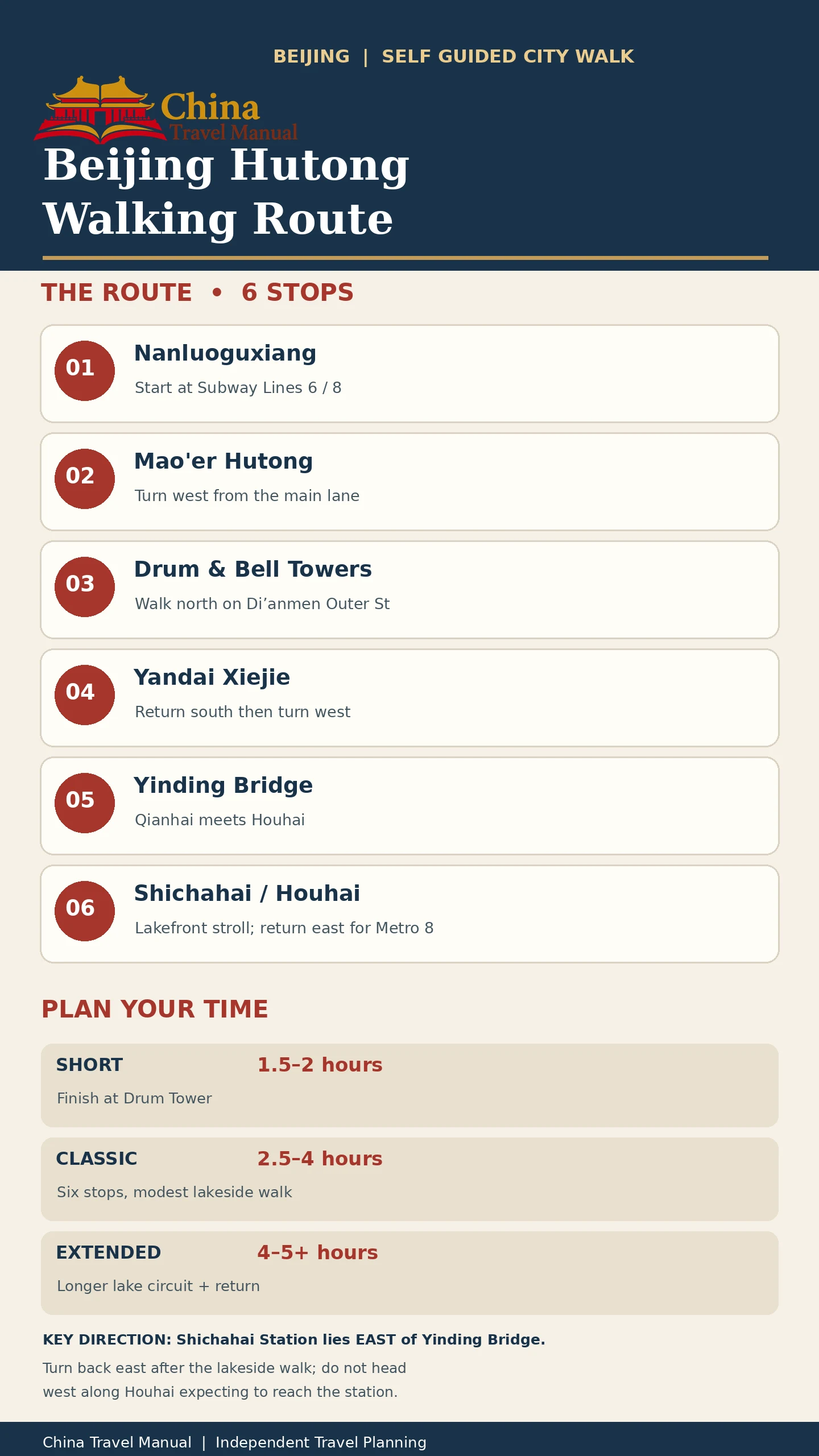
- Route: Nanluoguxiang → Mao’er Hutong → Drum and Bell Towers → Yandai Xiejie → Yinding Bridge → Houhai lakeside.
- Short version: Stop near the Drum Tower after about 1.5–2 hours.
- Extended version: Allow 4–5 hours for more of the Houhai waterfront, plus time to return to the metro.
- Cost: Public streets and the lakeside are free; tower interiors and museums are separately ticketed.
- Best time: Go in the morning for quieter lanes or late afternoon for lakeside light.
This is a proposed self-guided walk through places featured in Beijing’s official cultural routes, not an officially surveyed turn-by-turn trail. Check live walking directions and temporary access restrictions on the day.
Beijing’s hutongs are best experienced at walking pace, but finding a route between them can be harder than choosing which streets to see. This self-guided itinerary connects the busy Nanluoguxiang shopping lane, residential Mao’er Hutong, the Drum and Bell Towers, the short Yandai Xiejie commercial street and the lakeside paths of Shichahai. It is designed for first-time international visitors who want to explore independently without booking a guided tour.
The route follows publicly accessible streets, with optional stops rather than mandatory museum entries. Beijing’s tourism authorities have included Nanluoguxiang, the Drum Tower area, Yandai Xiejie and Houhai in their broader Central Axis walking and cultural-tourism route collections, but the precise six-stop sequence below is our own practical itinerary.[1][2] For hutong history and a comparison of other neighborhoods, use the separate Beijing Hutongs Visitor Guide.
Beijing Hutong Walking Route at a Glance
Begin near Nanluoguxiang Subway Station and head north along the main pedestrian street. Turn west into Mao’er Hutong before reaching Nanluoguxiang’s northern end, continue to Di’anmen Outer Street and head north to the Drum Tower. Then walk south on Di’anmen Outer Street to reach the eastern entrance of Yandai Xiejie, follow the street west to Yinding Bridge and continue onto the Houhai shore. After the lakefront stop, return east toward Shichahai Station or follow a longer lakeside loop if you have more time.
| Planning item | Recommended choice |
|---|---|
| Starting station | Nanluoguxiang, Subway Lines 6 and 8 |
| Finishing station | Shichahai, Subway Line 8, east of the Yinding Bridge area |
| Classic walking distance | About 3–4 km with selected side streets and lakeside walking; actual mapped distance varies |
| Classic visit time | 2.5–4 hours including photos, breaks and short stops |
| Route difficulty | Mostly level streets, but expect uneven paving, road crossings and crowds |
| Admission | Free on public lanes; separate entry fees apply to ticketed interiors |
Save the Chinese names of the stops before leaving your hotel. A local mapping app can help with the short turns, but the route descriptions below explain the overall direction. The main geographic trap is that Shichahai Station is east of the bridge, not west of Houhai: walking farther around the lake increases the return distance.
Step-by-Step Beijing Hutong Walking Route
Stop 1 — Nanluoguxiang
Take Subway Line 6 or 8 to Nanluoguxiang Station (南锣鼓巷站). Exit E is on the northern side of Di’anmen East Street near the southern entrance to Nanluoguxiang; confirm the posted exit signs in case of temporary changes. Enter the street at its southern end and walk north. Nanluoguxiang is an unusually clear example of a north–south main lane intersected by narrower east–west side hutongs.[3]
Allow 30–40 minutes to take in the gray-brick walls, courtyard gates, small stores and side-lane entrances. The main street has a high concentration of souvenir and snack businesses, so it is worth looking briefly into side streets such as Yu’er Hutong without making a lengthy diversion. Remain on public passages and avoid assuming that an attractive courtyard entrance is open to visitors.
To continue, watch the west side of Nanluoguxiang for the sign for Mao’er Hutong (帽儿胡同). Turn left, heading west into Mao’er Hutong before continuing all the way to Nanluoguxiang’s northern end. This avoids the common mistake of walking to the far northern end and then retracing your steps to find the turn.
Stop 2 — Mao’er Hutong and the Side Alleys
Follow Mao’er Hutong west toward Di’anmen Outer Street (地安门外大街). This section feels different from the main Nanluoguxiang lane: much of it is residential, with courtyard walls, gates, stone door bases and ordinary daily activity. Allow roughly 15–25 minutes to stroll and observe without disrupting residents.
Look at the architecture from the public lane only. Doorways, windows and open courtyard gates are not invitations to enter. Do not photograph people at close range without permission or point a camera into rooms. Give bicycles, delivery riders and residents space to pass.
At the western end of the hutong, you meet Di’anmen Outer Street, a larger north–south road. Turn right and follow it north toward the Drum Tower. Use marked crossings and the walking-navigation route rather than cutting across traffic. Shichahai Subway Station is also in this corridor, but do not finish here if you want the complete walk.
Stop 3 — Drum and Bell Towers
Continue north along Di’anmen Outer Street to the Drum Tower (鼓楼) and the adjacent Bell Tower area (钟楼). Allow 20–30 minutes for the exteriors and the square. The towers mark the northern end of Beijing’s historic central-axis zone and offer a useful contrast with the smaller residential streets you have just passed. This route does not require climbing either tower.
The surrounding public space can be enjoyed without buying a tower ticket, but interior visits have separate admission and operating hours. Adding a tower climb changes the schedule, especially during holidays or when access is temporarily restricted.
For the next stop, do not head west from the northwestern side of the tower square. Instead, return south along Di’anmen Outer Street. Find Yandai Xiejie’s (烟袋斜街) eastern entrance on the west side of the road, just south of the Drum Tower. Turning into this narrow street leads you toward the lake.[4]
Stop 4 — Yandai Xiejie
Enter Yandai Xiejie at its eastern end and follow the lane west and southwest. The historic commercial street is about 232 meters long, with closely spaced snack stalls, teahouses and small souvenir shops. Allow 20–30 minutes for an unhurried passage, perhaps with one short stop.[4]
The lanes here are narrow, and shop entrances can be crowded at lunchtime or on weekends. If you want a longer meal or a seated break, consider the Drum Tower neighborhood before entering the lane or a suitable restaurant once you reach the lake. Continue to the western end of Yandai Xiejie to reach the Yinding Bridge area.
Stop 5 — Yinding Bridge
Yinding Bridge (银锭桥) sits where Qianhai and Houhai meet. The small stone bridge is a memorable visual transition: dense hutong buildings give way to a broader waterside view. On a clear day the view can include the distant western hills. Allow about 10–15 minutes for the area rather than staying on the narrow bridge itself, where people need room to cross.[5]
From the bridge, follow the public path toward Houhai’s northern shore for the final scenic segment. Keep the return plan in mind: the metro station is back to the east near Di’anmen Outer Street, so a westward lakefront excursion is optional, not a direct walk toward the station.
Stop 6 — Shichahai and Houhai
Shichahai (什刹海) is a connected lake district; Houhai (后海) is the body of water immediately beyond Yinding Bridge. Walk a comfortable section of the waterfront for 30–45 minutes, watching the reflections, lakeside courtyards and activity around the cafés. Late afternoon is pleasant for photography, while the more commercial stretches become busier and louder after dark.
For the classic route, stop when you have had enough lakeside walking and navigate back toward Shichahai Subway Station (什刹海站), on Line 8 near Di’anmen Outer Street. The station is east of Yinding Bridge, and the return may require retracing part of your approach or using the Qianhai side streets; confirm the current pedestrian route on your phone. For the extended route, continue farther around Houhai and allow extra walking time to reach your chosen metro or taxi pickup point. A complete lake circuit is a separate extension, not part of the stated 3–4 km classic budget.
How to Choose the Right Hutong Walking Route
The six stops are designed as a flexible itinerary. Choose a shorter or longer version before starting so you can judge how much time to spend in shops and side lanes.
| Version | Where to walk | Approximate total time | Best for |
|---|---|---|---|
| Short walk | Nanluoguxiang → Mao’er Hutong → Drum Tower | 1.5–2 hours | Limited time, slower walkers and families |
| Classic half-day walk | All six stops, with a modest Houhai lakeside segment | 2.5–4 hours | First-time visitors wanting a mix of hutongs and water views |
| Extended lakeside walk | Classic route plus a longer Houhai waterfront circuit | 4–5 hours or more | Photographers and visitors staying for sunset or dinner |
The short walk ends near the Drum Tower. It does not end at Shichahai Station, though you can walk back toward that station or arrange a ride from a suitable main-road pickup point. The extended option may take longer if you stop for dinner or circle the full lake. Check the actual return route rather than assuming the lakefront takes you naturally to the same station.
How to Start and Finish the Walk by Subway
Nanluoguxiang Station is served by Lines 6 and 8, making it a convenient starting point from several parts of Beijing. Shichahai Station is on Line 8 near the Di’anmen Outer Street corridor. Both stations can be useful on the same trip, but the fact that they share Line 8 does not mean the walking route is a straight line between them.
Exit E at Nanluoguxiang is the convenient reference for the southern end of the shopping street. At the end of the lake segment, navigate toward Shichahai Station and confirm which entrance is accessible. Avoid choosing a taxi pickup pin inside a very narrow lane, where cars may not be able to stop. For fares, ticketing, transport codes and wider connections, see the Beijing Metro Guide and Getting Around Beijing.
What to Eat Along the Route
Nanluoguxiang and Yandai Xiejie offer easy access to food, but they are highly visited commercial streets and may not represent the best-value neighborhood dining. Treat snack stands as convenient stops rather than assuming that any famous-looking store is a long-established local institution.
Beijing dishes and snacks you may encounter include zhajiangmian (noodles with fermented soybean paste), tanghulu (candied fruit), aïwowo (sweet rice cakes), ludagun (rolled glutinous rice), wandouhuang (pea-flour sweets), chao gan (a savory liver-and-starch dish) and baodu (quick-cooked tripe). Not every dish is available on every street, and menus vary by restaurant. If you want a full meal, allow a separate stop around the Drum Tower or Shichahai rather than eating while trying to navigate the busiest lane.
For more background on dishes and ordering, see What to Eat in Beijing. The main value of this route is the streets themselves, so a single food stop is usually enough to keep the half-day walk comfortable.
Best Time to Walk Through Beijing’s Hutongs
Morning is generally the easiest time for a first walk. Starting around 8:30–9:00 a.m. means the lanes may be quieter before many visitors arrive, though not every shop will be open. Late afternoon offers appealing light and gives you the option to finish by the lake as evening approaches. Weekends, lunch hours and public holidays can be substantially busier, especially on Nanluoguxiang, Yandai Xiejie and Yinding Bridge.
Spring and autumn are comfortable for long walks in Beijing. In summer, start earlier, drink water and prepare for hot afternoons or brief storms. In winter, daylight ends sooner and the Houhai waterfront can be windy; bring a warm layer and avoid planning your entire walk after dark. Lunar New Year and National Day periods may bring temporary crowd-management measures. For citywide seasonal context, see the Best Time to Visit Beijing.
Practical Tips and Hutong Etiquette
- Respect homes: Hutongs are lived-in neighborhoods. Never enter a residential courtyard without permission, even if its gate is open.
- Ask before photographing people: Street and architectural views are generally straightforward, but give residents privacy and avoid shooting into windows or homes.
- Watch for bikes and scooters: Narrow lanes still serve daily traffic; step aside rather than stopping in the center to take photos.
- Use Chinese place names: Save 南锣鼓巷, 帽儿胡同, 鼓楼, 烟袋斜街, 银锭桥 and 什刹海 for navigation. Local map apps can be helpful where international maps have imprecise pedestrian directions.
- Budget for restrooms and water: Look for public toilets and shops in the busier areas rather than relying on facilities in quieter residential lanes.
- Separate free streets from paid buildings: Public lanes and lakefront paths do not require a ticket, while tower interiors, museums and some historic residences may charge admission or use reservations.
- Stay flexible: Construction, temporary crowd controls and road crossings may require minor changes to the street-level path.
Other Hutong Areas Worth Exploring
Qianmen, Dashilan and Yangmeizhu Xiejie form a separate southern Beijing walking area, rather than a natural continuation of this compact route. Wudaoying Hutong and the Lama Temple area also deserve their own outing. Prince Gong’s Mansion is a ticketed cultural site west of the Shichahai area; add it only if you have time and have checked its opening arrangements.
For other sightseeing choices, see Things to Do in Beijing. To fit this half-day walk into a wider schedule, consult 3 Days in Beijing and the Beijing Travel Guide. The Beijing at Night guide can help if you plan to stay around Houhai after sunset.
FAQs About Beijing Hutong Walking Routes
Can you explore Beijing’s hutongs without a guide?
Yes. The streets in this itinerary are publicly accessible and can be explored independently with a phone map and the route instructions above. You do not need a paid guide for the public lanes.
How long does a hutong walking tour take?
Allow 1.5–2 hours for the short version, 2.5–4 hours for the classic six-stop route, or at least 4–5 hours for a longer Houhai lakefront extension. Stops for food, museums and photography add time.
Is it free to walk through Beijing’s hutongs?
Yes. Public hutong streets and accessible lakefront paths are free. Entering ticketed tower interiors, museums or historic residences is a separate decision and may require payment or a reservation.
Which hutong area is best for first-time visitors?
Nanluoguxiang connected with Mao’er Hutong, the Drum Tower, Yandai Xiejie and Shichahai provides a useful introduction to both busy shopping lanes and quieter residential streets. It is a practical first walk, not a claim that it is the only worthwhile hutong district.
Can you walk from Nanluoguxiang to Shichahai?
Yes. They are linked by public streets and no bus or taxi is required for the core route. Take the westward turn into Mao’er Hutong, pass the Drum Tower, return south to Yandai Xiejie and continue to Yinding Bridge and the lake. Shichahai Subway Station is east of the bridge, so plan your return from the lake accordingly.
Sources
[1] Beijing Municipal Bureau of Culture and Tourism. Ten Themed Walks Along Beijing’s Central Axis
[2] Beijing Tourism. Walking Route from Nanluoguxiang to Drum Tower and Yandai Xiejie
[3] Beijing Tourism. Exploring Beijing Hutong Culture
[4] Beijing Tourism. Yandai Xiejie Scenic Area
[5] Xicheng District People’s Government. Yinding Bridge Historical Introduction





