
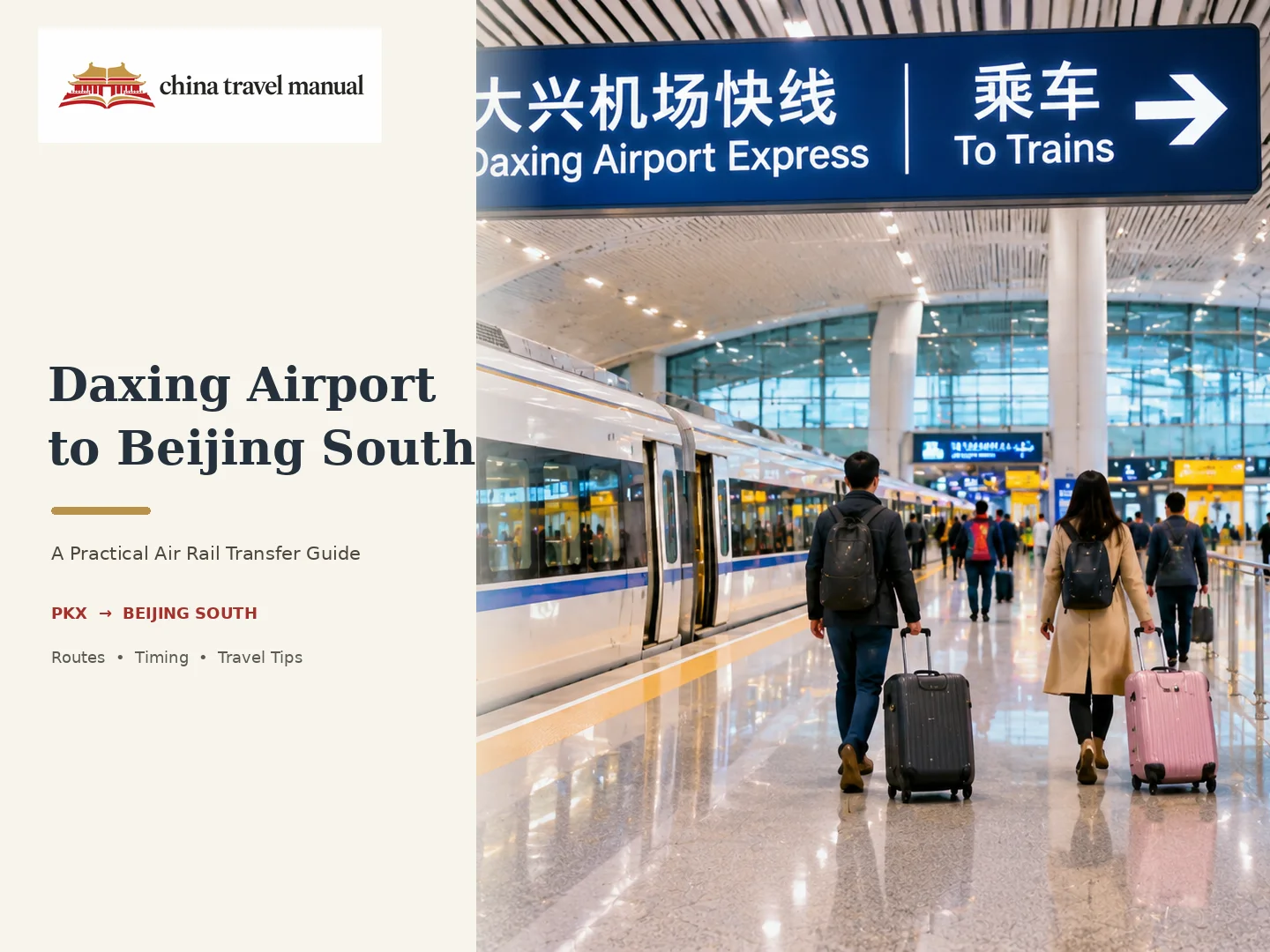
Quick Answer: How to Get from Daxing Airport to Beijing South Railway Station
For most visitors, the practical public-transport route from Beijing Daxing International Airport (PKX) to Beijing South Railway Station is the Daxing Airport Express to Caoqiao, followed by the Beijing Subway. Use Line 19 and Line 14 via Jingfengmen, or take Line 10 and Line 4 via Jiaomen West. The Airport Express ride to Caoqiao takes about 19 minutes, but that is train time only. [1]
- Main route: Airport Express to Caoqiao, then Line 19 and Line 14.
- Backup route: Airport Express to Caoqiao, then Line 10 and Line 4.
- Airport bus: The former Beijing South Night Line 2 was suspended on April 7, 2026. Confirm any daytime direct service at the airport counter. [2]
- Car options: Official taxis, DiDi and pre-booked transfers avoid subway changes but depend on road traffic.
- Connection buffer: Plan at least 120–150 minutes after a domestic arrival and 180–210 minutes after an international arrival, depending on checked luggage.
These time buffers are conservative recommendations, not guarantees. Include terminal walking, immigration, baggage, security, waiting and station transfers; never plan around the 19-minute train ride alone.

If you land in Beijing, the Beijing travel guide can help with the wider city plan. For the airport-to-rail transfer itself, if you need to catch a high-speed train at Beijing South Railway Station, the most practical public-transport option for many visitors is the Daxing Airport Express followed by the Beijing Subway. The main route uses Line 19 and Line 14 via Jingfengmen; a second route uses Line 10 and Line 4 via Jiaomen West. A taxi, DiDi ride or pre-booked private car is easier when you have several large suitcases, are traveling with children or older relatives, or arrive after rail services have stopped.
The Airport Express takes about 19 minutes from Daxing Airport Station to Caoqiao, but that is train running time only. It excludes terminal walking, security, ticketing, waiting, transfers, the subway ride and the walk into the railway departure hall. [1] This guide explains the route choices, flags an airport-bus service that has been suspended, and helps you plan a safer connection.
Where Are Daxing Airport and Beijing South Railway Station?
Beijing Daxing International Airport (PKX)
Beijing Daxing International Airport, code PKX, is in southern Beijing. For terminal layout and airport facilities, see the Beijing Daxing Airport guide. The terminal connects to the Daxing Airport Express station on B1. After arrival procedures and baggage collection, follow signs for “Rail Transit” or “Daxing Airport Express” to reach the station. The airport is not Beijing Capital International Airport (PEK): the two airports are in different parts of the metropolitan area and use separate transport connections. Check the three-letter code on your flight confirmation before choosing a route. If you need a broader overview of transport from PKX into the city, see getting from Daxing Airport to Beijing.
Beijing South Railway Station
Beijing South Railway Station (北京南站) is a major high-speed rail hub served by Beijing Subway Lines 4 and 14. The separate Beijing South Railway Station guide covers the station itself in more detail. The subway connects with the railway station’s underground transfer hall, but the subway platform is not the train departure hall. Follow signs for “Railway Station” or “Train Departures” after leaving the subway. [3]
Check the Airport and Station Names Before You Travel
A ticket for Beijing South is not valid for a train leaving from Beijing Railway Station, Beijing West Railway Station or Beijing Fengtai Railway Station. Likewise, a flight to PKX does not arrive at PEK. Save these Chinese names on your phone: 北京大兴国际机场 (Beijing Daxing International Airport) and 北京南站 (Beijing South Railway Station). Use the exact name when searching in a car app or asking staff for help.
Compare the Ways to Travel from Daxing Airport to Beijing South
Public transport is usually more economical and avoids road congestion, but the subway route requires two transfers. A car is direct and easier with luggage, but traffic can make the journey unpredictable. Treat the airport bus as an option to verify rather than a guaranteed direct connection.
| Option | Transfers | Best for | Main limitation |
|---|---|---|---|
| Airport Express + Line 19 + Line 14 | 2 | Most visitors seeking predictable public transport | Two station transfers and luggage handling |
| Airport Express + Line 10 + Line 4 | 2 | A backup if Line 19 is disrupted | Two transfers; follow live signs |
| Airport bus | To be confirmed | Travelers with a currently operating direct service | Direct service to Beijing South is not confirmed; former night route suspended |
| Official taxi or DiDi | 0 | Heavy luggage, families or limited mobility | Traffic and higher cost |
| Private transfer | 0 | Groups needing a planned pickup | Usually the most expensive option |
Choose the subway if you are traveling light, have enough time and are comfortable following station signs. Choose a car if you have several large suitcases, a stroller or mobility needs, or if you arrive after rail services stop. If you want a bus, confirm the destination and departure time with the airport operator on the day. A bus to Beijing Railway Station is not a bus to Beijing South.
Option 1: Take the Daxing Airport Express and Beijing Subway
Find the Airport Express at the Terminal
After immigration, baggage collection and customs where applicable, follow the rail-transit signs down to B1. The Airport Express station is connected to the terminal, so no road shuttle is needed. Allow time to walk from arrivals, buy or validate a ticket and pass the rail security check. If you need help, show staff “Daxing Airport Express” or “草桥站” (Caoqiao Station).
Step 1: Travel from Daxing Airport Station to Caoqiao
Board a train toward Caoqiao and remain on until the terminal station. Daxing Xincheng is the intermediate stop. The published airport-to-Caoqiao running time is about 19 minutes; it is not the full door-to-door transfer time. [1] At Caoqiao, follow the transfer signs for Line 19 or Line 10. Check the timetable for your travel date: Beijing announced a weekday timetable adjustment effective October 12, 2026, so do not rely on an old screenshot or fixed last-train time. [4]
Route A: Line 19 at Caoqiao, Then Line 14 at Jingfengmen
- At Caoqiao, transfer to Line 19 in the direction of Xingong.
- Get off at Jingfengmen and follow the signs to Line 14.
- Take Line 14 in the direction of Shan’gezhuang and get off at Beijing South Railway Station.
- Follow “Railway Station” or “Train Departures” signs from the subway concourse into the railway building.
This is the recommended route in this guide. For the wider city rail network and other lines, see the Beijing Metro guide. Beijing’s published Line 19 information identifies Caoqiao as an interchange with the Daxing Airport Express and Line 10, and Jingfengmen as an interchange with Line 14. [5] Transfer corridors, escalators and accessible lifts may require extra walking. Follow live signs rather than relying on a remembered exit number.
Route B: Line 10 at Caoqiao, Then Line 4 at Jiaomen West
- At Caoqiao, transfer to Line 10 and follow the platform signs for Jiaomen West.
- Get off at Jiaomen West and transfer to Line 4.
- Take Line 4 toward Anheqiao North and get off at Beijing South Railway Station.
- Follow the railway-station and train-departure signs.
Keep this as an alternative if Line 19 is disrupted, crowded or affected by maintenance. Check the destination displayed on the platform and train before boarding. Do not choose a Line 10 direction from an old map alone.
From the Subway into the Railway Departure Hall
The subway interchange at Beijing South is on B1. Follow signs for the railway station or departures and go up to the main station building. Check the large electronic departure board for your train number, departure time, check-in status and gate. Gate assignments can change, so use the live board rather than an old online guide. [3]
Option 2: Use an Airport Shuttle Bus Only After Checking Its Status
Where to Ask About Airport Buses
Follow the terminal’s “Airport Bus” or “Shuttle Bus” signs to the bus service area and ask the staffed counter whether a bus to Beijing South is operating that day. The Beijing government notice says tickets can be bought through the Airport Bus Official Platform mini-program or at on-site counters. It lists the Daxing Airport Shuttle 24-hour hotline as +86-10-81698565. [2]
Is There a Direct Bus to Beijing South?
The former Daxing Airport–Beijing South Railway Station Night Line 2 was suspended from April 7, 2026. The same notice also listed the Daxing Airport–Beijing Fengtai Railway Station route for suspension. [2] This is a confirmed service change, not simply a temporary late-night timetable adjustment.
The official route-change notice does not confirm a current daytime direct bus to Beijing South. This guide therefore does not present a daytime service, timetable or fare as confirmed. If the counter confirms a direct bus on your travel date, ask for its exact stop name, boarding point, departure time, ticketing method and arrival location before buying a ticket. If staff cannot confirm a direct service, use the Airport Express and subway or choose a licensed car service.
How to Check Current Bus Departures
Check the airport’s official bus channel or ask at the staffed counter after landing. Confirm the destination and direction: a route shown on an old timetable may have changed its stops or operating hours. Keep 北京南站 visible on your phone when asking for help.
Option 3: Take an Official Taxi or DiDi
Use the Official Taxi Queue
For a direct road transfer, follow airport signs to the official taxi queue on the ground-transport level and wait in the managed line. Avoid drivers who approach passengers inside the arrivals hall or offer an unmetered ride. For general advice on licensed cabs and ride-hailing in China, see the China taxi guide. Show the driver 北京南站 and confirm the destination is Beijing South Railway Station, not Beijing Railway Station or Beijing West.
A car avoids subway transfers, but traffic can change quickly. A 40–60-minute drive is only a rough estimate for favorable road conditions, not a guaranteed journey time. During weekday peaks, holidays, rain or road incidents, the trip can take substantially longer; allow for the possibility of 90 minutes or more. Check live navigation before deciding how much time to leave for your train.
Use DiDi or Another Ride-Hailing App
Install the app before landing, confirm that your account supports your chosen payment method, and make sure you will have mobile data. Enter “Beijing South Railway Station” as the destination and follow the pickup instructions assigned in the app. Do not ask a driver to stop at an arbitrary curb.
Daxing Airport’s ride-hailing pickup location changed on September 15, 2026. The Beijing Municipal Transportation Commission announced that the pickup area moved from the P1 parking building’s 1M level to a new area northeast of the terminal, at the former P2 parking building. Follow current airport signs and the location displayed in your app; do not follow older directions to P1 1M. [6]
Where to Get Dropped Off at Beijing South
Set the destination to the railway station’s passenger drop-off or departure area, not simply a generic map pin if the app offers several entrances. The driver must use the legal drop-off area and follow traffic-control directions. After getting out, enter the railway building and proceed through security. Do not confuse this drop-off point with the station’s taxi and ride-hailing pickup areas, which serve passengers leaving the station.
Option 4: Book a Private Airport Transfer
When a Private Transfer Makes Sense
A pre-booked car can suit families, groups, travelers with several large suitcases, visitors with mobility needs or passengers who arrive late. It provides a planned pickup and direct road journey, but usually costs more than public transport. Compare the full quoted price with the convenience it provides.
What to Confirm Before You Book
- Flight details: Give the flight number and arrival time, and confirm how delays are handled.
- Vehicle size: State the passenger count and number and size of suitcases.
- Fees: Ask whether tolls, parking, waiting time and late-night charges are included.
- Meeting point: Confirm the terminal and exact meeting instructions.
- Destination: Send 北京南站 and confirm the railway departure drop-off area.
Do not assume every quote includes unlimited waiting or flight monitoring. Read the conditions and keep the provider’s contact details available offline.
How to Enter Beijing South Railway Station After Arriving
Find the Railway Entrance
If you arrive by subway, follow “Railway Station” or “Train Departures” signs from the B1 transfer hall and go up to the main railway building. If you arrive by car, enter from the designated passenger drop-off area. Use current signs rather than a fixed entrance number from an older guide.
Check the Departure Board
Match the train number and departure time on your booking with the electronic departure board. Check the current check-in status and gate information. Gate assignments and check-in opening times can change with railway operations, so do not rely on a saved screenshot.
Prepare Your Passport and Ticket
Carry the original valid identification document used for your railway booking, normally your passport. Beijing’s foreign-traveler guidance says passengers can enter, exit and board with the original valid identification document used when buying the ticket, subject to the applicable verification process. [7] A passport photo or booking screenshot is not a substitute for the original. If an automatic gate cannot read your passport, ask staff for the manual verification gate.
Leave Time for Security and Boarding
Reaching the station building does not mean you are ready to board. You may still need to pass security, complete identity checks, find the waiting area and walk to the gate. Check-in closes before departure, and the exact timing depends on the service and station operation. Do not arrive only a few minutes before departure. If the board shows that check-in is closing or closed, contact staff immediately.
How Much Time Should You Allow Between Your Flight and Train?
An air-to-rail connection includes leaving the aircraft, immigration where applicable, baggage collection, customs, walking to the transport level, waiting, the ride to Beijing South, railway security and the walk to the gate. The buffers below are conservative planning recommendations based on those steps, not official minimum connection rules or a guarantee that every transfer will fit.
| Arrival type | No checked baggage | With checked baggage |
|---|---|---|
| Domestic flight | At least 120 minutes | At least 150 minutes |
| International flight | At least 180 minutes | At least 210 minutes |
Domestic Arrivals
A domestic arrival does not normally involve international immigration, but you still need to leave the aircraft, walk through the terminal and collect checked luggage if you have any. Use two hours as a conservative starting point if you have no checked baggage and two and a half hours if you do. Add time during busy periods, when traveling with children or when using a road transfer in rush hour.
International Arrivals
International arrivals add immigration and customs. Queue times vary by flight bank, season and passenger volume. Use at least three hours as a planning floor without checked baggage and three and a half hours if you need to collect luggage. Allow more if you arrive during a busy period or have a tight onward departure.
If Your Flight Is Delayed
If a delay leaves too little time, check whether your train ticket can be changed through the official railway channel before leaving the airport. Do not try to recover time by using an unlicensed driver, skipping security or running through the station. Congestion can also erase the time saved by switching from public transport to a car.
Avoid Tight Separate-Ticket Connections
A flight and a high-speed train are usually separate bookings, so a late flight does not automatically protect your onward train. For an important long-distance journey, choose a later departure or consider staying overnight if the flight is international, arrives late or is prone to delays.
Practical Tips for Foreign Travelers
Paying for the Subway and Airport Express
Beijing’s urban rail network supports contactless payments with five major card networks: China UnionPay, Mastercard, Visa, JCB and American Express. The municipal government says supported cards can be tapped at fare gates without buying a separate ticket or downloading an app first. [8] Your card must support contactless payments and overseas transactions; issuer controls may apply. If a tap fails, use a ticket machine or staffed counter and keep another payment method ready.
Do not assume that the same card will work in every ride-hailing app. Check payment settings before leaving the airport. For broader transport information, see getting around Beijing and mobile payments in China.
Internet, Navigation and Luggage
Prepare mobile data or roaming so you can check maps, train information and ride-hailing instructions. Save these names offline: 北京大兴国际机场, 草桥站, 景风门站, 角门西站 and 北京南站. Airport Express and subway transfers can involve long corridors, escalators and platform changes. Keep passports, phones and valuables in a small bag that stays with you. If you have several large suitcases, a stroller or mobility equipment, compare a car’s full door-to-door cost before choosing the subway.
Accessible Travel
If you use a wheelchair or need step-free access, check elevator availability at Caoqiao, Jingfengmen or Jiaomen West before traveling. An elevator may be some distance from the most direct transfer corridor, and equipment can be temporarily unavailable. Ask staff to direct you to the accessible route. If you need assistance throughout the journey, contact the airport, subway or railway service in advance.
Keep Your Passport and Train Details Together
Keep the passport used for the railway booking accessible for checks, and save your train number, departure time and booking details on your phone. For more information about buying rail tickets with a foreign passport, read using 12306 as a foreign traveler and the broader guide to train travel in China.
Common Mistakes to Avoid
- Confusing PKX with PEK: Check the airport code; the airports have different transport systems.
- Going to the wrong railway station: Confirm 北京南站 on the ticket and in the car app.
- Assuming the Airport Express reaches Beijing South: It ends at Caoqiao; you must transfer to the subway.
- Following an old bus timetable: The former Daxing Airport–Beijing South Night Line 2 was suspended in April 2026.
- Counting only train running time: The 19-minute ride excludes walking, security, waiting and transfers.
- Leaving too little connection time: Include immigration, baggage, traffic, security and the walk to the gate.
- Using an outdated ride-hailing pickup point: Daxing Airport’s pickup area moved in September 2026.
FAQs About Getting from Daxing Airport to Beijing South
How Far Is Beijing South Railway Station from Daxing Airport?
The road distance is roughly 46 kilometers, depending on the exact pickup and drop-off points. A car may take around 40–60 minutes in favorable traffic, but congestion can make it much longer. The subway journey includes the Airport Express, two transfers and the onward ride, so it takes much longer than 19 minutes.
What Is the Fastest Way to Get from Daxing Airport to Beijing South?
A taxi or ride-hailing car is usually the fastest door-to-door option when roads are clear. During rush hour, traffic can make the trip unpredictable. The Airport Express and subway are a more consistent alternative when roads are congested.
Is There a Direct Bus from Daxing Airport to Beijing South?
The former Daxing Airport–Beijing South Night Line 2 was suspended from April 7, 2026. The official notice does not confirm a current daytime direct service. Ask the airport bus counter or check the official platform before relying on a bus.
Can I Take the Daxing Airport Express Directly to Beijing South?
No. The Airport Express ends at Caoqiao. Transfer to Line 19 and Line 14 via Jingfengmen, or take Line 10 and Line 4 via Jiaomen West.
How Do I Transfer from the Airport Express to Line 4?
At Caoqiao, transfer to Line 10 and travel to Jiaomen West. Change to Line 4 there and continue to Beijing South. Check the platform signs for the correct direction.
How Much Time Should I Allow Between Landing and My Train?
As a conservative guide, allow at least 120 minutes after a domestic arrival without checked baggage, 150 minutes with checked baggage, 180 minutes after an international arrival without checked baggage and 210 minutes with checked baggage. Add more during busy periods or after a flight delay.
Can I Take a Taxi or DiDi from Daxing Airport to Beijing South?
Yes. Use the official taxi queue or the ride-hailing pickup point assigned in your app. The airport pickup area moved to the northeast side of the terminal at the former P2 parking building on September 15, 2026.
What If I Arrive After the Last Airport Express or Subway Train?
Use the official taxi queue, a ride-hailing service from its designated pickup point or a pre-booked private transfer. Do not assume the Airport Express or subway runs overnight, and do not accept rides from unlicensed drivers.
Sources
[1] Beijing Municipal Government. Daxing Airport
[2] Beijing Municipal Government. Starting on April 7: Update on Multiple Airport Bus Routes
[3] Beijing Municipal Government. Travel Tips for Beijing South Railway Station – Quick Exits
[4] Beijing Municipal Government. Airport Express Timetable Adjustment Effective October 12
[5] Beijing Municipal Government. Beijing Subway Line 19: Interchange Stations and Service Information
[6] Beijing Municipal Transportation Commission. New Ride-Hailing Pickup Area at Daxing Airport
[7] Beijing Municipal Government. Transportation
[8] Beijing Municipal Government. Beijing Subway Introduces Tap-and-Go Payments with Five Major Card Networks





