

Quick Answer: How to Use the Beijing Metro
The Beijing Metro is straightforward for international visitors, even without a Chinese mainland phone number or local bank account. The easiest option is usually to tap an eligible contactless physical bank card from Visa, Mastercard, American Express, JCB or UnionPay at the fare gate. Tap the same card when entering and leaving; the system calculates the fare automatically.
- Best payment option: Use your own contactless physical international bank card. Keep it available even if you plan to try a mobile wallet.
- Other payment methods: Use an activated Alipay Metro QR code, a BEIJING PASS or a single-journey ticket from a ticket machine.
- Regular fares: City metro fares start at CNY 3 and increase with journey distance.
- Airport express: Capital Airport Express and Daxing Airport Express have separate fares of CNY 25 and CNY 35 respectively.
- Before boarding: Check the line number, terminal direction, transfer signs and the best station exit for your destination.
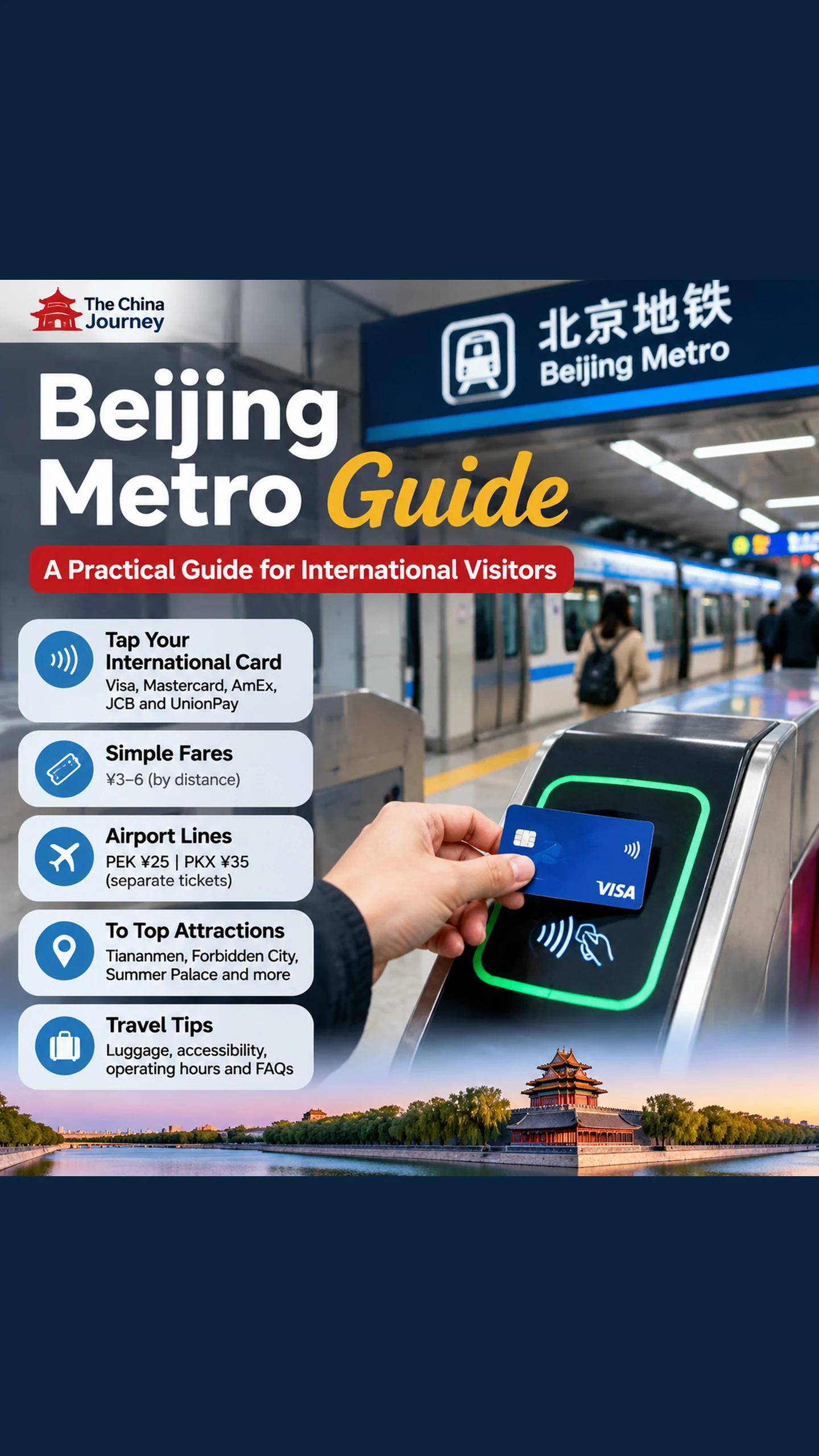
Beijing’s subway network is one of the most practical ways to reach the city’s major sights, railway stations and business districts. For visitors from the United States and other countries, the key is knowing how to pay without a mainland Chinese phone number, how ordinary metro fares differ from airport express fares, and which station exits lead closest to the places you want to visit. This guide focuses on completing a journey independently, without relying on Chinese-language apps or a mainland bank account. For broader trip planning, start with the Beijing Travel Guide and compare options in Getting Around Beijing.
What to Know About the Beijing Metro Network
Understanding Beijing Metro Lines and the Subway Map
Beijing’s urban rail network combines ordinary metro lines, suburban services and two dedicated airport express lines. The network had 29 passenger-operating lines and 523 stations when the international bank-card payment upgrade was announced in June 2025. The Xijiao Line and Yizhuang T1 Line are included in the broader operating network. The Capital Airport Express and Daxing Airport Express use separate fare arrangements, so do not calculate their prices using the ordinary city-metro distance table.
Line 22, also known as the Pinggu Line, entered no-passenger trial operation in August 2026. As of November 19, 2026, it has not opened to ordinary passengers.[6] Do not include it in a route until the operator announces passenger service.
On the English subway map, station names are generally shown in Pinyin. Lines are identified by numbers and colors, while interchange stations show the lines available for transfer. Check the latest official map before traveling because extensions, entrances and service arrangements can change.[3]
How to Read Station Names and Transfer Signs
Follow the English station name, line number and terminal destination displayed on signs. Exit directions use compass labels such as North, South, East and West, often alongside an exit letter or number. At interchange stations, blue signs marked “Transfer” direct passengers to connecting lines. Most transfers remain inside the paid area, but some involve long corridors or multiple levels. Follow the line number and destination rather than simply following the crowd.
Which Beijing Metro Lines and Stations Are Useful for Tourists?
Most first-time visitors can reach the main sightseeing districts using a handful of lines. Use the station and exit signs on the day of travel to confirm the best walking route; temporary closures or construction can change which exit is most convenient.
| Destination | Metro station | Line | Practical guidance |
|---|---|---|---|
| Tian’anmen Square | Tian’anmen East or Tian’anmen West | 1 | Both stations serve the square; choose the exit for the side you need. |
| Forbidden City | Tian’anmen East or Tian’anmen West | 1 | Walk toward the southern Meridian Gate entrance. Museum admission must be arranged separately. |
| Wangfujing | Wangfujing | 1 | Convenient for the pedestrian shopping district. |
| Qianmen and Dashilar | Qianmen | 2 and 8 | Exit C is a useful approach to Qianmen Pedestrian Street. |
| Temple of Heaven | Tiantandongmen | 5 | Serves the park’s East Gate area. |
| Summer Palace | Beigongmen | 4 | Use the signs for the North Palace Gate; check the current exit before leaving. |
| Nanluoguxiang | Nanluoguxiang | 6 and 8 | Exit E leads toward the southern end of the hutong. |
| Shichahai | Shichahai | 8 | Useful for the lake area and nearby historic streets. |
| Olympic Park | Aolinpike Gongyuan | 8 and 15 | Serves the National Stadium and National Aquatics Center area. |
| Universal Beijing Resort | Universal Resort | 1 and 7 | Provides access to the resort entrance area. |
The Forbidden City has a controlled visitor route: entry is through the south-side Meridian Gate, and visitors leave through designated exits. Reserve admission through the museum’s official channel. The Great Wall does not have a direct urban metro station; reaching Badaling or Mutianyu requires onward transport beyond the subway network.
How Much Does the Beijing Metro Cost?
Regular Metro Fares
Ordinary city-metro fares are based on the distance between the entry and exit stations. Transfers within the paid area do not normally trigger a separate base fare for each line.
| Journey distance | Standard fare |
|---|---|
| Up to 6 km | CNY 3 |
| Over 6 km to 12 km | CNY 4 |
| Over 12 km to 22 km | CNY 5 |
| Over 22 km to 32 km | CNY 6 |
| Over 32 km | Add CNY 1 for each additional 20 km |
The fare is settled when you exit. Keep the same card or travel credential for the entire journey.[2] The published passenger rules also impose a maximum time for remaining in the paid area; if you exceed it or a gate rejects your payment, ask station staff to check the trip and any adjustment due.
Airport Express Fares
The Capital Airport Express costs CNY 25 per one-way journey. The Daxing Airport Express costs CNY 35 for a one-way journey from Caoqiao to Daxing Airport. These services have separate ticketing and fare rules and are not included in the ordinary metro distance-based fare table.[2]
International card transactions are generally settled in the card’s billing currency. The exchange rate and any foreign-transaction fee depend on your card issuer, not the metro operator.
How to Pay for the Beijing Metro as a Foreign Visitor
Tap Your International Bank Card
For many overseas visitors, tapping a contactless physical bank card is the simplest payment method. From June 15, 2025, Beijing Metro enabled contactless payment across its operating network for five major card organizations: UnionPay, Visa, Mastercard, JCB and American Express. The official launch announcement covered 29 operating lines and 523 stations at that time, including the airport express services.[1]
- Look for a fare gate displaying the logo of your card organization.
- Hold your contactless card against the designated reader and wait for the gate to unlock.
- Keep the same card with you throughout the journey.
- At your destination, tap the same card again at the exit gate. The system calculates the fare automatically.
This process does not require a mainland Chinese phone number, a local bank account, a metro app or a separate ticket purchase. Make sure contactless payments and overseas transactions are enabled by your bank. A declined card may result from issuer restrictions, spending controls or card settings, so carry a backup payment method.
Treat one card as one passenger’s travel credential. Do not expect to tap the same card repeatedly to admit several passengers. Each traveler should have an individual card, QR code or ticket so entry and exit transactions can be matched.
Mobile wallets such as Apple Pay and Google Pay should not be assumed to work identically to a physical card. Acceptance can depend on the card token, wallet, device, issuing bank and reader compatibility. If you intend to use a phone, confirm compatibility with your issuer and keep the physical card as a backup. For the simplest first visit, carry the actual contactless bank card.
Use the Alipay Metro QR Code
Alipay offers a QR-code option for visitors who can register and activate the international version of the app. Register with an overseas phone number, complete the verification requested by the app, then find the transport or travel-services section and activate the Beijing Metro ride code. Scan the same activated code at entry and exit; an ordinary payment QR code is not necessarily a metro ride code.
Account verification, security checks and payment setup can vary. Alipay is useful as an alternative, but it depends on a working phone, an activated account and sufficient battery power. For setup help, see How to Pay in China as a Visitor.
Buy a BEIJING PASS
BEIJING PASS is a rechargeable physical transport card available at designated service points. The card has a CNY 20 issuance cost, which is non-refundable.[4] If the card is lost, its stored balance cannot be recovered because the card cannot be reported lost for a balance refund. Only eligible remaining stored value can be refunded at designated service locations under the applicable rules.
The card supports eligible public transport services and selected participating venues. It may suit visitors who prefer a dedicated transport card or plan to use supported services beyond Beijing. For a short three-to-five-day visit, direct payment with an international bank card is usually simpler because it avoids a separate card purchase and balance management.
Buy a Single-Journey Ticket
Self-service ticket machines at major stations provide English-language instructions. Select English, choose your destination, check the displayed fare, pay using an accepted method and collect the ticket. Follow the gate instructions to enter, then keep the ticket until you reach your destination. At the exit, insert it into the designated slot for collection. A single-journey ticket is for one passenger and one trip; groups may need to buy several tickets.
How to Use the Beijing Metro Step by Step
- Find the correct entrance: Check the station name and line number, then choose an entrance leading to your intended line.
- Pass security: Place bags and belongings on the screening equipment when requested. Prohibited items may be refused.
- Pay and enter: Tap an eligible bank card, scan an activated metro QR code or use a valid ticket.
- Check the platform direction: Read the electronic display and confirm the terminal destination before boarding.
- Transfer if needed: Follow the Transfer signs and confirm the next line number.
- Exit at your destination: Follow the correct exit signs and use the same card or QR credential used at entry.
If a gate does not open, do not force it or switch payment methods without checking the transaction. Ask a station employee to help identify whether the entry or exit record needs adjustment.
How to Transfer and Choose the Right Station Exit
Understanding Beijing Metro Transfers
Most interchange stations allow passengers to change lines inside the paid area. Follow the blue Transfer signs and check the line number and terminal direction. Some connections involve long corridors, stairs, escalators or multiple levels, so allow extra time at major hubs.
Leaving through a fare gate ends the current journey. If you exit and enter again, the second entry begins a new trip and may incur another fare. Do not leave the paid area simply to follow a street-level route between platforms unless the station signs direct you to do so.
Why Choosing the Right Exit Matters
Large stations can have several exits leading to different streets, attractions or railway entrances. Before leaving the paid area, check the exit number, compass direction and destination name. Qianmen Exit C is useful for Qianmen Pedestrian Street, while Nanluoguxiang Exit E leads toward the southern end of the hutong. At Beigongmen, follow the signs for the Summer Palace’s North Palace Gate and check the current exit arrangement on site.
Getting to Beijing Airports and Railway Stations by Metro
Getting to Beijing Capital International Airport
The Capital Airport Express connects the city with Beijing Capital International Airport. Dongzhimen is a key interchange with the urban metro network. The airport express fare is CNY 25 one way and is charged separately from ordinary metro fares. A regular city-metro train does not take passengers directly to the airport terminals; transfer to the dedicated airport service.
For terminal information and other city-transfer options, see Beijing Capital Airport to the City.
Getting to Beijing Daxing International Airport
The Daxing Airport Express connects Caoqiao Station with Daxing Airport Station. Caoqiao links with Lines 10 and 19. The one-way airport express fare is CNY 35, separate from the ordinary metro fare system. Caoqiao also offers city-terminal services for eligible airline passengers; check the airline, check-in conditions, baggage requirements and service hours before relying on them.
For terminal access and onward transport, see Beijing Daxing Airport to the City.
Connecting to Beijing’s Major Railway Stations
| Railway station | Metro connection | Planning note |
|---|---|---|
| Beijing South | Lines 4 and 14 | Follow signs for the railway departure hall. |
| Beijing West | Lines 7 and 9 | Allow time to walk from the metro concourse to the correct entrance. |
| Beijing Railway Station | Line 2 | Check the station name carefully; it is not Beijing North. |
| Beijing North | Xizhimen interchange: Lines 2, 4 and 13 | Follow railway signs from Xizhimen. |
| Qinghe | Line 13 and the Changping Line | Qinghe is a separate station from Beijing North. |
| Beijing Fengtai | Lines 10 and 16 | Check the correct station exit and railway entrance. |
For detailed station navigation, use the individual guides: Beijing South Railway Station Guide, Beijing West Railway Station Guide, Beijing Railway Station Guide, Beijing North Railway Station Guide, Qinghe Railway Station Guide and Beijing Fengtai Railway Station Guide.
Beijing Metro Operating Hours, Rush Hours and Service Changes
First and Last Train Times
There is no single opening or closing time for the entire network. First and last trains vary by line, station and direction. A train’s final departure from a terminal may differ from the last train passing through an intermediate station. Weekend and holiday schedules may also change.
Check the official Beijing Subway timetable for your exact starting station, destination and travel direction. If your metro journey is part of a short stopover, use the Beijing Layover Itinerary to plan the wider visit. Airport express services can have different operating hours from ordinary metro lines. If you have an early flight or arrive late at night, verify the specific airport line before setting out rather than relying on a general citywide time range.
Avoiding Rush Hour and Temporary Closures
Weekday morning and evening peaks are generally busiest, commonly around 7:30–9:00 a.m. and 5:30–7:00 p.m. Lines serving business districts and dense residential areas can become crowded. If you have large luggage, are traveling with children or need extra transfer time, avoid these periods when practical.
Temporary station closures and service changes may occur during major holidays, public events, maintenance or security operations. Check operator notices before traveling through central Beijing or near a large event venue.
Luggage, Security, Accessibility and Practical Services
Traveling with Luggage
Beijing Metro passenger rules limit the size and weight of carried items. The published limits include a maximum weight of 30 kg, a maximum length of 1.8 meters and maximum width and height of 0.5 meters each.[2] Oversized or prohibited items may be refused at security screening. Check the current rules if you are carrying sports equipment or unusually shaped luggage.
Luggage lockers are available at selected stations, not throughout the network. Locker availability, size, payment method and opening hours can vary. Confirm the current facility at the station before planning to leave a suitcase there; do not assume every airport or railway station metro stop has an available locker.
Accessibility and Wheelchair Assistance
Accessibility varies by station. Newer stations generally have more modern facilities, while some older stations still have stairs and limited step-free access. In November 2026, Beijing began an improvement project covering 15 older stations across Lines 1, 2, 10 and 13, with 33 escalators and seven elevators planned or being installed.[5] The work is being carried out mainly during nighttime service interruptions, so not all new equipment should be assumed to be operational.
Passengers with reduced mobility or heavy luggage should contact the operator in advance to confirm the accessible route and assistance arrangements at both ends of the journey. Ask station staff for help if an elevator is unavailable or a transfer route is difficult.
Other Useful Station Facilities
Depending on the station, facilities may include English-language ticket machines, passenger service counters, public toilets, vending machines, convenience stores, power-bank rental and selected luggage lockers. Foreign-currency exchange is not a standard service at ordinary metro stations, so arrange cash at an airport, bank or authorized exchange point rather than relying on a metro stop.
Common Beijing Metro Mistakes to Avoid
- Relying only on a phone wallet: Carry your physical international bank card as a backup.
- Using different cards at entry and exit: Use the same payment credential for the whole journey.
- Confusing airport express fares with city fares: The two airport express services have separate fare arrangements.
- Boarding in the wrong direction: Check the terminal destination on the platform screen.
- Choosing an inconvenient exit: Confirm the exit number and destination before leaving the paid area.
- Assuming every station has an elevator or locker: Check accessibility and storage at the specific station.
- Using an outdated map: Verify the current map and service notices.
- Planning to use Line 22: It is not open to passenger service as of November 19, 2026.
FAQs About the Beijing Metro
Can I use the Beijing Metro without a Chinese mainland phone number?
Yes. Eligible contactless international bank cards can be tapped directly at supported fare gates. This does not require a mainland phone number, local bank account or metro app.
Can I use my overseas Visa or Mastercard on the Beijing Metro?
Yes. Beijing supports contactless payment from Visa, Mastercard, American Express, JCB and UnionPay. Use an eligible card and tap the same credential at entry and exit.
Can I use Apple Pay or Google Pay instead of a physical card?
Mobile contactless acceptance can depend on the wallet, card token, device and issuing bank. Carry the physical contactless card as a reliable backup.
Can I use one bank card for several passengers?
Do not assume one card can be used for several passengers. Each traveler should have an individual payment method or ticket so entry and exit records can be matched.
How much does the Beijing Metro cost?
Regular fares start at CNY 3 for journeys up to 6 km and increase with distance. The Capital Airport Express and Daxing Airport Express are charged separately at CNY 25 and CNY 35 respectively.
Is Beijing Metro open 24 hours?
No. Operating hours vary by line, station, direction and day. Check the official timetable for your specific journey.
Can I take the metro to the Great Wall?
No direct urban metro service reaches the main Great Wall visitor entrances at Badaling or Mutianyu. You need onward transport beyond the subway network.
Can I travel with a large suitcase?
Yes, if it meets the published passenger limits and passes security screening. Check the current size and weight restrictions before traveling.
Does every Beijing Metro station have an elevator?
No. Accessibility differs between stations, and the older-station upgrade is not complete. Confirm step-free access and assistance arrangements before traveling if you use a wheelchair.
Can I ride Beijing Metro Line 22?
No. As of November 19, 2026, Line 22 remains in no-passenger trial operation and is not open to regular passengers.
Sources
[1] Beijing Municipal Government. Beijing Subway Supports Tap-and-Go with 5 Most Used Overseas Cards
[2] Beijing Municipal Government. About Subway Fares
[3] Beijing Subway. Official Website and Service Information
[4] Beijing Municipal Government. How Can Foreigners Obtain Public Transportation Card or Code?
[5] Beijing Municipal Government. 15 Old Beijing Subway Stations Are Getting Escalators and Elevators
[6] Beijing Tongzhou District Government. Beijing Subway Line 22 Begins No-Passenger Trial Operation





