

Quick Answer: Where Should You Stay in Hong Kong?
For most first-time visitors, Tsim Sha Tsui is the easiest all-round base for harbour sights, shopping, restaurants and transport. Choose Central or Sheung Wan for Hong Kong Island plans; Jordan or Yau Ma Tei for central Kowloon and local food; Causeway Bay for shopping; and Mong Kok for a busier, budget-oriented stay. Disneyland Resort, Tung Chung and airport hotels make more sense for dedicated park or flight plans than for a general city visit.
| Travel style | Recommended area | Main reason |
|---|---|---|
| First visit | Tsim Sha Tsui | Harbour, sightseeing and transport |
| Hong Kong Island focus | Central / Sheung Wan | Business, dining and island sights |
| Location and value | Jordan / Yau Ma Tei | Central Kowloon and local food |
| Shopping | Causeway Bay / Wan Chai | Malls and restaurants |
| Budget | Mong Kok | Economy accommodation to compare |
| Disneyland | Disneyland Resort / Tung Chung | Less travel on park days |
| Flight stopover | Airport / Tung Chung | Early or late flights |
These are starting points, not price rankings. Check the exact MTR exit, walk, room size and final bill before booking.
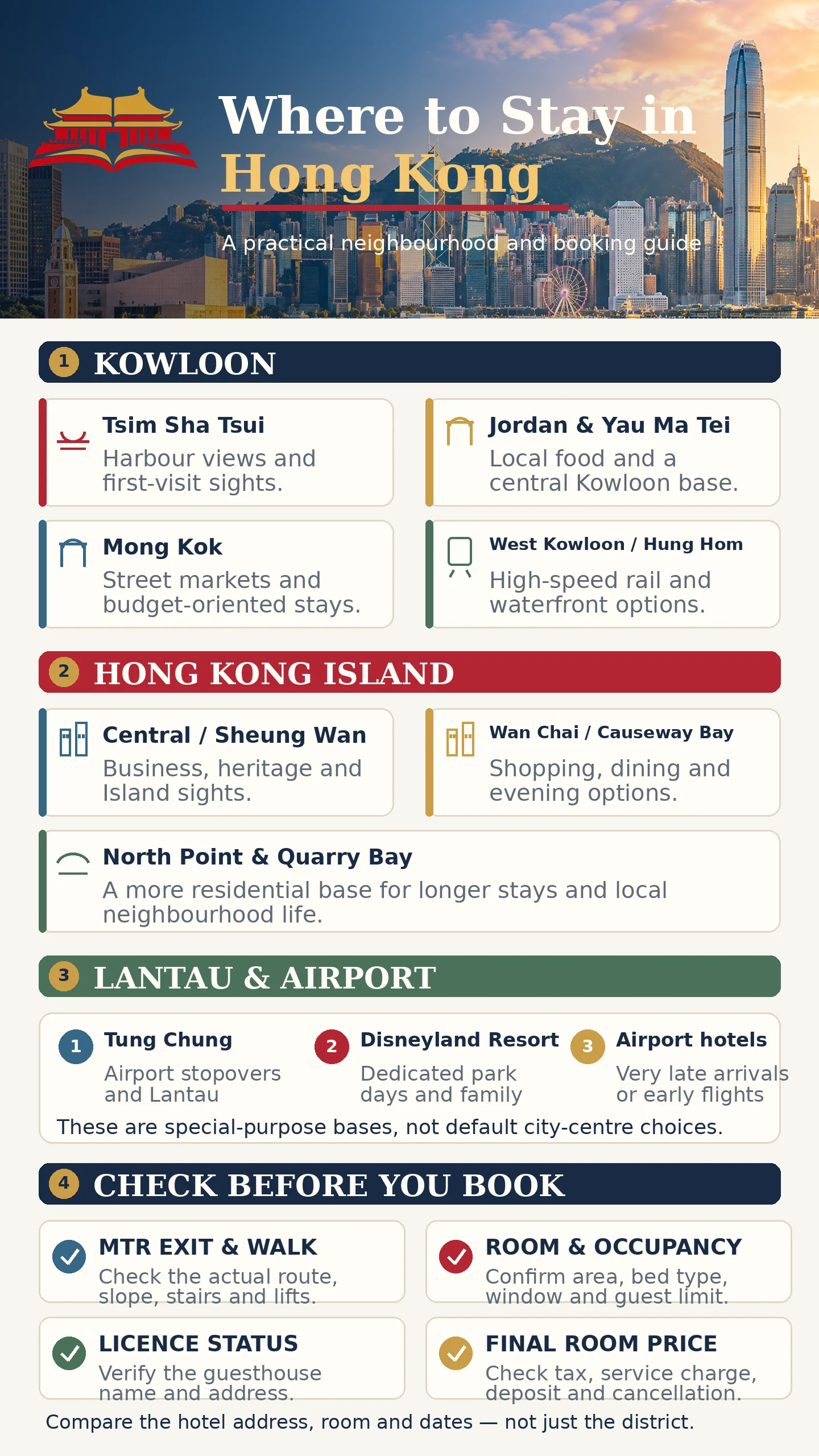
Where you stay in Hong Kong shapes how much time you spend travelling, how easily you reach the harbour and whether returning to your room feels simple or tiring. Two hotels in the same district can have very different walks to the MTR, noise levels and room layouts. Start by choosing the neighbourhood that fits your daily plans, then compare the exact hotel address, station exit and room category. For a wider overview, see the Hong Kong travel guide and the things to do in Hong Kong guide.
How to Choose the Right Area to Stay in Hong Kong
Kowloon vs Hong Kong Island: Which Side Is Better?
Kowloon suits plans centred on Tsim Sha Tsui, Jordan, Yau Ma Tei, Mong Kok, West Kowloon and the harbourfront. Hong Kong Island is often more convenient for Central, Sheung Wan, Wan Chai, Causeway Bay and business meetings. Neither side is automatically better: compare your most frequent destinations, evening plans and transfers.
The Star Ferry crossing takes about nine minutes between Central and Tsim Sha Tsui and about eight minutes between Wan Chai and Tsim Sha Tsui.[1] These are sailing times only; allow for walking, waiting and onward travel. The MTR also connects the two sides. If a day includes both, choose the ferry when the pier fits your route, but do not use sailing time alone to compare journeys; the walk to the pier and the final destination can change the result. Check the last ferry or train before relying on a late-night crossing. For the wider network, see Getting Around Hong Kong.
Why Your Hotel’s MTR Location Matters More Than Its District Name
Check the full address, nearest station and walking route from the exit you will actually use. A short map distance can hide stairs, a footbridge, a shopping-complex passage or a steep slope. MTR station location maps and layouts help identify exits and nearby buildings at many stations.[2] If you have luggage, a stroller or limited mobility, confirm lifts and step-free access. See the Hong Kong MTR guide.
Best Areas to Stay in Hong Kong
Tsim Sha Tsui: Best for First-Time Visitors
Tsim Sha Tsui is the most straightforward default for many first-time visitors. The harbourfront promenade, Avenue of Stars, Hong Kong Museum of Art, Star Ferry Pier, major shopping centres and a wide choice of restaurants are concentrated in or around the district. It is a practical base for a short trip when you want to explore both sides of Victoria Harbour. The Star Ferry guide explains the harbour crossing, while the Victoria Peak guide helps plan a popular Hong Kong Island excursion.
Tsim Sha Tsui is not one uniform hotel zone. A property near the waterfront feels different from one on Nathan Road or farther east around Tsim Sha Tsui East. Tsim Sha Tsui and East Tsim Sha Tsui are served by different MTR stations, so check the station that matches the hotel address rather than assuming the names mean the same entrance.
The trade-offs are crowds, traffic noise on busy roads and high demand on popular dates. Lower-priced rooms can be compact, and a hotel described as “near the harbour” may still require a walk through busy streets. Compare the exact room category and walking route, not just the district name.
Central and Sheung Wan: Best for Business and Island-Side Sightseeing
Central suits visitors whose plans focus on meetings, restaurants, nightlife or Hong Kong Island sights. It is close to the financial district, the Peak Tram area, the Mid-Levels Escalator, ferry piers, SoHo and Lan Kwai Fong. Sheung Wan has a more mixed neighbourhood feel, with older streets, cafés, galleries, antique shops and heritage buildings alongside newer hotels and offices. The Old Town Central area blends historic streets with modern businesses and cultural venues.[3]
Both areas can be expensive, and some accommodation is on sloping streets. A hotel may look close to an MTR station but still involve a steep approach with luggage. Central MTR station, Hong Kong Station and Sheung Wan station are separate nodes, even where pedestrian connections make transfers possible. Hong Kong Station is the Airport Express terminus, which can be useful for hotels nearby; however, the train’s station-to-airport time does not include the walk from your hotel or an onward transfer. Central and Sheung Wan are best when your itinerary actually uses the Island-side location, not simply because they sound central.
Wan Chai and Causeway Bay: Best for Shopping and Dining
Wan Chai and Causeway Bay are useful bases for shopping, restaurants and Hong Kong Island exploration. Causeway Bay has a dense concentration of department stores, malls, smaller shops, restaurants and Victoria Park. Wan Chai combines modern offices and hotels with older streets, markets, local restaurants and nightlife. It is also practical for events at the Hong Kong Convention and Exhibition Centre. Both areas have MTR stations on the Island Line, and the tram offers another way to move along the northern side of the island.
The drawbacks are busy pavements, road traffic and rates that can rise around major events. If most of your sightseeing is in Kowloon, daily cross-harbour travel may become repetitive. Wan Chai may suit travellers who want evening food and bars nearby; Causeway Bay is often the more direct choice for a shopping-led stay. For late-night planning, see Hong Kong at Night.
Jordan and Yau Ma Tei: Best for Local Food and Good Location Value
Jordan and Yau Ma Tei sit between Tsim Sha Tsui and Mong Kok, making them useful alternatives for visitors who want a central Kowloon location without paying specifically for a harbourfront address. Both have MTR access, restaurants, markets and traditional streets. Yau Ma Tei is associated with Temple Street and its evening market atmosphere; Jordan has a dense mix of eateries, small shops and accommodation around Nathan Road and nearby streets.
These districts are especially useful for food-focused travellers. Local cafés, noodle shops, dessert shops and cooked-food venues are part of the neighbourhood rather than a separate excursion. Our Hong Kong food guide covers the wider dining picture. The main compromise is the wide variation in accommodation quality. Check recent reviews for the exact room, the building entrance and the property’s licence status. Jordan and Yau Ma Tei are not simply cheaper versions of Tsim Sha Tsui; their street-level atmosphere is part of the appeal.
Mong Kok: Best for Budget Accommodation
Mong Kok suits travellers who value street life, markets, shopping and everyday restaurants. Ladies’ Market, the Sneaker Street area, shopping arcades and busy food streets make it one of Kowloon’s most energetic districts. Mong Kok and Prince Edward stations provide access to several MTR routes, although the best station depends on the hotel’s exact position.
A lower nightly rate does not automatically mean better value. Check whether the room has an external window, enough floor space for luggage, a private bathroom if required, reliable air conditioning and an elevator in the building. Noise can be an issue on busy streets, and some low-cost rooms are very compact. Travellers prioritising quiet or more space should compare the total cost of a larger room elsewhere. The Hong Kong travel budget guide can help compare accommodation with other trip expenses.
West Kowloon and Hung Hom: Best for Rail Access and Waterfront Stays
West Kowloon and Hung Hom are separate choices. West Kowloon is useful for visitors arriving or departing by high-speed rail and for travellers planning time at the West Kowloon Cultural District, including M+ and the Hong Kong Palace Museum.[4] However, Hong Kong West Kowloon Station, Austin MTR station and Kowloon Station are different transport nodes. Do not choose a hotel based on straight-line distance to “West Kowloon”; check the actual pedestrian route, station entrance, luggage access and the rail service you need. See the Hong Kong West Kowloon Station guide before booking around a train connection.
Hung Hom is farther east and has its own railway and MTR connections, with a more residential and waterfront feel. It may suit visitors who want to avoid the busiest tourist streets or have a specific reason to use Hung Hom station. It is less convenient if your daily plan is concentrated around Tsim Sha Tsui’s main attractions, so compare extra travel time with any room-rate difference.
North Point and Quarry Bay: Best for a Quieter Local Stay
North Point and Quarry Bay offer a more residential side of Hong Kong Island. They suit longer stays, business visits in the eastern part of the island and travellers who prefer neighbourhood restaurants and a less visitor-focused environment. North Point has a traditional market and ferry-pier atmosphere, while Quarry Bay and nearby Tai Koo combine residential towers, offices and shopping centres.
The Island Line provides access toward Central, Wan Chai and Causeway Bay, but journeys to Kowloon’s main tourist areas take longer than from Tsim Sha Tsui or Jordan. Do not assume that a less tourist-heavy neighbourhood will always be cheaper. Compare actual dates, room type and total travel cost; a lower room rate can be offset by extra commuting.
Tung Chung, Disneyland and Airport Hotels: Best for Special-Purpose Stays
These are three different accommodation choices, not one general “airport area.” Tung Chung is a town on Lantau Island with an MTR station and shopping at Citygate Outlets. It can work for an airport stopover, an early flight or a trip focused on parts of Lantau. Airport hotels are most useful when you arrive very late or need to leave very early. Check the exact transfer before booking: the Airport Express serves Hong Kong, Kowloon and Tsing Yi stations, not every hotel near the airport. Its published journey time is about 24 minutes between the airport and Hong Kong Station and about 22 minutes to Kowloon Station; these are train times only.[5] See the Hong Kong airport transfer guide and airport guide for the full arrival picture. For a very early departure or late arrival, compare the first and last train times with your flight schedule, and ask whether the hotel offers a transfer or luggage storage. Do not assume a nearby hotel has a 24-hour shuttle.
Disneyland Resort is practical for families spending one or more full days at the park, especially if they want to return to the hotel between visits. The resort has its own MTR station on the Disneyland Resort Line, reached by changing at Sunny Bay; resort hotels also operate complimentary shuttles between the hotels and the public transport interchange.[6] If you plan only one park day and the rest of your trip is in the city, a central hotel may be more convenient overall. Use the Hong Kong Disneyland visitor guide to plan the park day.
Mui Wo and Tai O are outlying-island choices for visitors who deliberately want a slower coastal or village stay. They are not efficient bases for a conventional first visit built around Central, Tsim Sha Tsui and Mong Kok. If you want island time, compare ferry and bus connections and see the Lantau Island guide and day trips from Hong Kong.
Which Hong Kong Area Is Best for Your Type of Trip?
Choose by daily plans, not by the label “tourist area.” Use this shortlist, then check the exact address and room category.
| Traveller type | Areas to compare | Main consideration |
|---|---|---|
| First-time visitors | Tsim Sha Tsui | Harbour and sightseeing |
| Families | Tsim Sha Tsui / Causeway Bay / Disneyland | Room capacity and lifts |
| Couples | Central / Sheung Wan / Tsim Sha Tsui | Dining and harbour atmosphere |
| Solo travellers | Jordan / Mong Kok / Sheung Wan | Budget and building access |
| Business travellers | Central / Wan Chai | Meeting location |
| Budget travellers | Jordan / Yau Ma Tei / Mong Kok | Room condition and MTR walk |
| Disneyland visitors | Disneyland Resort / Tung Chung | Park days and late return |
| Airport stopovers | Airport hotels / Tung Chung | Flight time and transfer |
Families should verify occupancy and bed configuration rather than relying on room photos. See the Hong Kong with kids guide and Ocean Park guide. If your route is not fixed, review the three-day Hong Kong itinerary before choosing a base.
What Types of Accommodation Can You Find in Hong Kong?
Full-Service Hotels and Business Hotels
Full-service hotels offer staffed reception, predictable check-in, luggage storage and a broader range of facilities. They suit families and travellers who prefer a clear service standard. Business hotels may be convenient for meetings but are not automatically best for sightseeing; compare the address with your daily plans.
Boutique Hotels, Guesthouses and Hostels
Boutique hotels offer smaller-scale accommodation, while guesthouses and hostels can reduce costs. Room size, bathrooms, shared facilities and building access vary. Some properties occupy only part of a mixed-use building, so check arrival instructions and reception hours. Hostels may offer dormitory beds as well as private rooms; confirm whether bathrooms are shared, whether linens are included and how late you can check in. A booking-platform listing does not prove that a property is licensed: the official search supports lookups by name, address, district and licence number.[7] Match the exact premises, not just a similar name in the same building.
Serviced Apartments and Longer Stays
Serviced apartments may suit longer visits, families needing more space or travellers who want cooking and laundry facilities. Confirm the minimum stay, cleaning, equipment, utility charges, deposit and cancellation terms. Do not assume every short-term apartment has the same legal or tax status as a conventional hotel; check the operator and premises before paying.
What to Check Before Booking a Hotel in Hong Kong
Room Size, Bed Types and Occupancy
Check the stated floor area, bed sizes, external window and maximum occupancy. Review photos of the exact room category, not only the hotel gallery. If you have large suitcases, confirm there is enough floor space to open them without blocking the door or bathroom. Families should ask whether children count toward the occupancy limit, whether cots or extra beds are available, and whether connecting rooms are guaranteed or only requested. Also check the bathroom layout, air conditioning, sound insulation, elevator and step-free access.
Check Whether Your Guesthouse Is Licensed
Before paying for a guesthouse, hostel-style room or small hotel, search the official Hong Kong hotel and guesthouse licence register. Check the property name, address, premises type and licence period. If the result does not match the listing, ask the operator for details and verify independently. A platform badge, review score or certificate photo is not a substitute for checking the official record.
Understand the Final Room Price
Hong Kong resumed its Hotel Accommodation Tax at 3% of the accommodation charge on 1 January 2025. Service charges are excluded from the calculation, and certain exemptions exist, including qualifying properties with fewer than ten rooms and qualifying non-profit operators.[8] Check whether the booking price includes the tax and whether the final bill shows the amount collected or states that it is included.
Compare the final amount, including service charges, deposits, cancellation penalties, breakfast, extra beds and late check-out. Check the cancellation deadline and payment currency too. Confirm whether the deposit is refundable, when the remaining balance is charged and whether a late arrival must be reported in advance. If you are comparing two room categories, make sure the quoted occupancy, bed type and cancellation conditions are the same. For seasonal context, see the best time to visit Hong Kong, but compare actual rates for your dates because holidays and major events affect demand.
FAQs About Where to Stay in Hong Kong
What Is the Best Area to Stay in Hong Kong for First-Time Visitors?
Tsim Sha Tsui is a practical default for harbour attractions, shopping, restaurants and transport. If most plans are on Hong Kong Island, Central or Sheung Wan may save daily travel.
Is It Better to Stay in Tsim Sha Tsui or Central?
Choose Tsim Sha Tsui for harbourfront and Kowloon sightseeing. Choose Central for Island-side plans, meetings, SoHo or the Peak. Compare the hotel-to-station walk and total price.
Where Should You Stay in Hong Kong on a Budget?
Compare Jordan, Yau Ma Tei and Mong Kok. The first two balance central Kowloon access with local food; Mong Kok is busier and budget-oriented. Check room size and licensing.
Is Kowloon or Hong Kong Island Better for Tourists?
Neither is universally better. Kowloon suits harbourfront and Kowloon plans; Hong Kong Island suits Central, Wan Chai and Causeway Bay. Ferries and cross-harbour MTR services connect them.
Should You Stay Near Hong Kong Disneyland?
Stay at the resort for multiple park days or a short journey after closing. For one park day within a wider city trip, a central hotel may be more practical.
Are Hong Kong Guesthouses Safe and Legal?
Do not infer legal status from a booking listing. Check the exact name and address in the government register, confirm the licence period and clarify any mismatch before paying.
Sources
[1] Hong Kong Transport Department. Franchised and Licensed Ferry Service Details
[2] MTR Corporation. System Map, Station Location Maps and Layouts
[3] Hong Kong Tourism Board. Neighbourhoods
[4] Hong Kong Tourism Board. West Kowloon
[5] MTR Corporation. Timetable and Airport Express Journey Times
[6] Hong Kong Disneyland Resort. Travel Information
[7] Office of the Licensing Authority. Hotels and Guesthouses Search
[8] Inland Revenue Department. Hotel Accommodation Tax FAQ





