

Quick Answer: What Is the Best Way to Get Around Hong Kong?
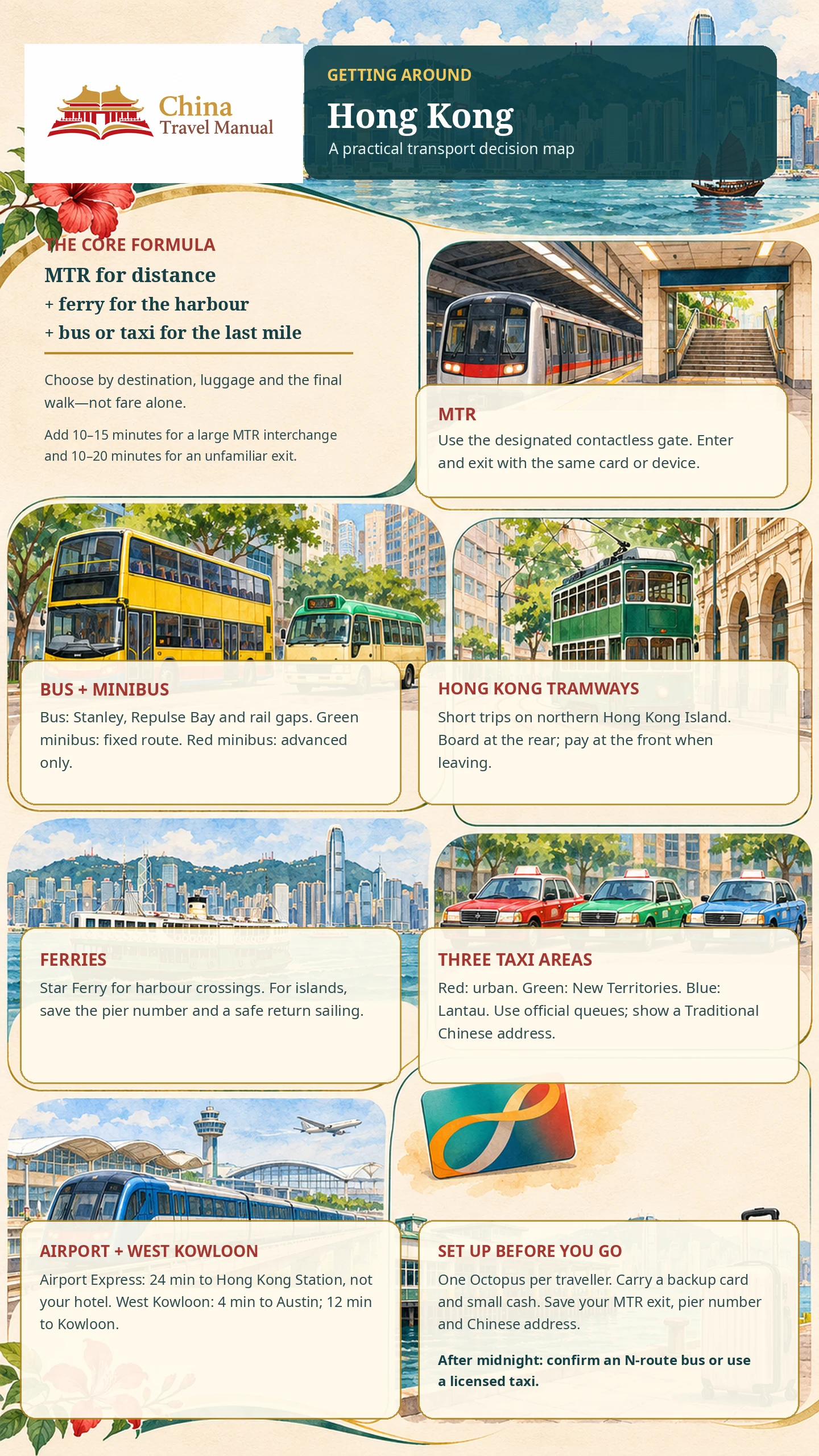
Use the MTR as the backbone of most sightseeing days, then add the transport mode that fits the final part of each trip. Hong Kong is easy to navigate in English, but station exits, steep streets, ferry timetables and payment coverage can add more time than the map suggests.
- Use the MTR: It is the most reliable choice for longer trips across Hong Kong Island, Kowloon and the New Territories.
- Use buses: Double-decker buses are often better for Stanley, Repulse Bay, southern Hong Kong Island and districts without direct rail service.
- Use ferries: The Star Ferry is a practical harbour crossing when both ends are near the piers; outlying-island ferries must be planned around the return sailing.
- Use trams: Hong Kong Tramways is inexpensive and atmospheric for short trips along northern Hong Kong Island, but too slow for a tight schedule.
- Use taxis: Choose a licensed taxi for luggage, late-night travel, steep last-mile trips or a family that would struggle with long station walks.
- Carry payment backups: An Octopus is the broadest everyday option. A supported contactless bank card works at designated MTR gates, but not across every transport mode.
For islands, airport departures and cross-boundary trains, check the operator’s current timetable shortly before travel rather than relying on an old screenshot.
Hong Kong has one of Asia’s most useful public transport networks, but a first-time visitor can still lose time by choosing the wrong station exit, pier or payment method. The city is vertical as well as dense: footbridges, shopping centres, hillside streets and long interchange corridors can turn a short map distance into a much longer door-to-door journey.
This guide is for an independent international visitor planning two to five days. It explains which mode to use, how to pay, what to allow at the airport and Hong Kong West Kowloon Station, and how to avoid late-night or luggage problems. For the wider trip structure, use the Hong Kong travel guide.
Choose the Right Transport by Situation
No single mode is best for every trip. Start with the destination and your luggage, then compare reliability, walking and the final kilometre rather than choosing only by fare.
| Mode | Best for | Time reliability | Luggage | Main limitation |
|---|---|---|---|---|
| MTR | Long urban trips and routine sightseeing | High | Moderate | Large stations, long transfers and the wrong exit can add substantial walking |
| Double-decker bus | Southern Hong Kong Island, hills and seeing the streets | Medium | Low to moderate | Road congestion and identifying the correct stop |
| Green or red minibus | Local rail gaps and short feeder routes | Medium | Low | Limited space and a higher navigation or communication burden |
| Tram | Short, unhurried trips along northern Hong Kong Island | Low to medium | Low | Slow and geographically limited |
| Ferry | Victoria Harbour crossings and outlying islands | Medium | Moderate | Fixed sailings and weather-related changes |
| Taxi | Luggage, families, late nights and steep last-mile journeys | Traffic-dependent | High | Higher cost, tunnel charges and different operating areas |
For most first trips, the practical combination is MTR plus walking during the day, one Star Ferry crossing when it fits the route, and a taxi only for work that rail does poorly. Avoid using a red minibus as your first transport experience unless you already understand its route and stopping pattern.
Set Up Octopus, Contactless Payment and Backup Cash
Choose the Right Octopus Option
An Octopus is not mandatory, but it is the most widely useful payment tool for visitors using several transport modes. It works across the MTR, most franchised buses, trams, ferries and many minibuses, as well as shops and casual dining. A physical card is usually simplest for a mixed-device group or anyone who does not want to depend on a phone battery.
The Tourist Octopus sold version costs HK$39 before stored value is added and requires no deposit. Its remaining value can be refunded, but the purchase cost is not refundable and the card is deactivated after the stored-value refund.[2] Purchase locations vary by arrival point and card version, so use the official channel list rather than assuming every MTR customer service counter stocks the tourist design.
Mobile Octopus can suit an individual with a compatible phone and supported payment card. Device, wallet and account-region requirements differ between iPhone, Apple Watch and Huawei products. Do not wait until a ticket gate to test compatibility; set it up in advance or buy a physical card after arrival.
Use Foreign Cards, Single Tickets and Cash as Backups
Designated MTR gates accept contactless Visa, Mastercard and UnionPay cards, including many cards issued overseas. The contactless fare is the adult Octopus fare, but concessions do not apply. Light Rail and MTR Bus are excluded. Use the same physical card or the same payment device to enter and exit; a plastic card and its phone-wallet version are treated as different media.[1]
One card or Octopus cannot move several people through the gate as a group. Give every traveller a separate card, device or ticket. A bank may also decline an overseas transit charge or add a foreign-transaction fee, so keep another payment route available.
- Best all-purpose setup: One Octopus per traveller plus a small amount of Hong Kong dollar cash.
- Short MTR-only visit: A supported contactless bank card can remove the need to buy an Octopus.
- Children and concession users: Use the correct Octopus or ticket instead of an adult bank-card fare.
- Cash backup: Carry small notes and coins for a vehicle, machine or small operator that does not accept your preferred card.
Use the MTR as Your Main Urban Network
The MTR is the default for trips between major districts because it is frequent, protected from road congestion and well signed in English. Its weakness is not the train ride but the space around it. Central, Admiralty, Tsim Sha Tsui and other large complexes can involve several corridors, escalators and underground shopping links before you reach the street.
Before boarding, save the destination’s exact exit letter rather than only the station name. Two exits from the same station can lead to opposite sides of a divided road, a different shopping complex or a steep uphill route. When a journey includes a large interchange, add about 10–15 minutes beyond the route-planner estimate. Add another 10–20 minutes when the final walk, hill or unfamiliar hotel entrance is involved.
Weekday commuter peaks are most noticeable around 8:00–9:30 a.m. and 5:30–7:00 p.m. Treat these as practical ranges, not universal system rules. A suitcase is manageable outside the peak, but two large cases, a stroller or a wheelchair can make a long interchange harder than a direct bus or taxi.
Check the last-train function for the entire route, including the last interchange. The last departure on one line does not guarantee that the connecting line is still available. Also remember that contactless bank-card travel between Tsim Sha Tsui and East Tsim Sha Tsui is charged as two journeys rather than receiving the Octopus interchange treatment.[1]
Use Buses, Minibuses and Trams Selectively
Double-Decker Buses and Minibuses
A franchised double-decker bus can be better than the MTR for Stanley, Repulse Bay, Aberdeen, parts of southern Hong Kong Island and routes where the rail alternative requires backtracking. It also shows the city rather than its tunnels. The trade-off is traffic: a coastal road or cross-harbour approach can slow sharply at commuter peaks, weekends or during an incident.
Use HKeMobility or the bus operator’s live information, save the stop name and follow your position on the map. Press the stop button early enough to signal that you want to get off. Keep luggage secure and out of the aisle; large cases are awkward on a crowded double-decker even when there is a luggage area downstairs.
Green minibuses are scheduled services on fixed routes. Red minibuses have more flexible stopping and operating arrangements.[3] Both have limited luggage space, and route information can be less intuitive than on the MTR or franchised buses. A first-time visitor should use a green minibus only when the route and stop are already saved, and treat red minibuses as an advanced option rather than an essential Hong Kong experience.
Hong Kong Tramways
The double-decker tram is useful for short journeys through Kennedy Town, Sheung Wan, Central, Wan Chai, Causeway Bay and North Point. Board at the rear, move forward and pay when leaving through the front. The fare is flat regardless of distance, so the tram works best when speed does not matter.
Current payment choices include Octopus, cash and several contactless or mobile methods. Cash passengers need the exact fare because no change is given.[4] The narrow interior and steps make a tram a poor choice with large luggage, and it is not a substitute for the MTR when you have a timed reservation.
Cross Victoria Harbour and Reach the Islands by Ferry
Use the Star Ferry for a Practical Harbour Crossing
The Star Ferry links Tsim Sha Tsui with Central and Wan Chai. It is both transport and a short harbour experience. Use it when your route naturally runs from a waterfront district to another waterfront district. If you start far inside Kowloon and need to reach inland Hong Kong Island, the MTR may be faster after the walks to and from both piers are included.
The Central–Tsim Sha Tsui crossing takes about nine minutes, but boarding, waiting and walking turn it into a longer door-to-door trip. Service normally runs frequently into the evening, with weekday and weekend fares differing; verify the current timetable and any special-event arrangements on the day.[5]
Plan Outlying-Island Ferries Around the Timetable
Outlying-island ferries are not turn-up-and-go services in the same way as an urban MTR line. Central Pier 5 serves Cheung Chau, while Central Pier 4 serves the Lamma Island routes to Yung Shue Wan and Sok Kwu Wan. Ordinary and fast ferries can have different journey times, fares, decks and accessibility.[6]
Check the exact destination, pier number and return sailing before leaving the hotel. A last ferry can differ by weekday, weekend and public holiday, and some routes have long gaps. On a hiking day, work backwards from a safe return sailing rather than assuming you can arrive at the pier whenever the walk ends.
High wind, a tropical cyclone, extreme rain or another operational problem may suspend or alter individual routes, but there is no safe universal rule that every ferry stops at one specific warning level. Follow the operator and Transport Department notices. If an island sailing is cancelled, do not replace it with another exposed sea trip; switch to an urban or indoor day.
Use Taxis and Ride-Hailing for Specific Jobs
Hong Kong taxis are metered and divided by operating area. Red urban taxis cover most of Hong Kong except closed roads on southern Lantau. Green taxis serve designated New Territories areas. Blue taxis operate on Lantau. All three types can serve Hong Kong International Airport and Hong Kong Disneyland, but the correct taxi for another origin and destination depends on the operating boundary.[3]
From April 1, 2026, taxis must offer at least two electronic payment methods: one QR option and one non-QR option. Cash remains accepted, but the exact card or wallet can vary by vehicle.[3] Ask for the meter and a printed receipt. The fare can also include luggage, telephone booking and road or tunnel charges; for example, a charge may apply to a suitcase placed in the boot, while a wheelchair carried for a passenger with a disability is exempt.[7]
Use an official taxi stand at the airport, railway station, hotel or busy attraction. Show the destination in Traditional Chinese as well as English. App-booked licensed taxis can reduce address problems, but the pickup point may be away from the building exit. Do not accept an unsolicited unmarked car at a port or station.
Plan Airport, West Kowloon and Border Connections Door to Door
Hong Kong International Airport
The Airport Express is the fastest rail link, taking about 24 minutes between the airport and Hong Kong Station and about 22 minutes to Kowloon Station. Trains from the airport to the city normally run from early morning until after midnight, but current first and last trains should be checked for the travel date.[8] These figures are train times, not hotel times.
| Airport option | Choose it when | Allow for |
|---|---|---|
| Airport Express | You travel light and your hotel connects easily from Hong Kong, Kowloon or Tsing Yi Station | Station walking plus a final MTR, taxi or hotel transfer |
| Airport bus | An A-route stop is close to the hotel and you want fewer transfers | Road congestion, many stops and handling luggage on the bus |
| Taxi | You have several travellers, large cases, children or a late arrival | Traffic, tunnel charges and the correct taxi queue |
| Night bus | Rail has stopped and the N-route serves your district | Longer waits and a possible final walk or taxi |
For an international departure, plan to reach the terminal with the buffer required by your airline, commonly around three hours before departure, then add the full trip from your hotel. From Central or Tsim Sha Tsui, that often means leaving roughly four hours before the flight rather than starting the Airport Express calculation at boarding time.
Hong Kong West Kowloon Station and Mainland Connections
Hong Kong West Kowloon Station is not Kowloon MTR Station and is not Hung Hom Station. It connects by pedestrian routes to Austin Station and Kowloon Station. The official guide estimates about four minutes to Austin and about 12 minutes to Kowloon under normal conditions, before allowance for luggage, navigation or crowds.[9]
A cross-boundary high-speed train requires identity verification, security and both Hong Kong and Mainland immigration procedures before boarding. The process can take 30–45 minutes in smooth conditions, and passport holders, holiday travellers and passengers using staffed counters should allow extra time. Real-name and ticket processing closes before departure, so arriving as if it were a local MTR ride is unsafe.
For step-by-step station planning, use the Hong Kong West Kowloon Station guide. For Lo Wu, Lok Ma Chau, the Hong Kong–Zhuhai–Macao Bridge port or another control point, verify the port’s operating hours and the exact city-side connection. A border closing time is not the same as the last practical MTR or bus connection.
Late-Night Travel, Luggage and Accessibility
| Situation | Best first choice | Main caution |
|---|---|---|
| MTR has stopped | Licensed taxi or a confirmed N-route night bus | Night buses are less frequent and may not stop near the hotel |
| Two large suitcases | Direct taxi, Airport Express plus short taxi, or direct airport bus | Long MTR interchanges and minibuses are tiring |
| Stroller or older traveller | MTR route with confirmed lifts or a direct taxi | The closest exit may not be the accessible exit |
| Wheelchair user | Pre-checked accessible route and operator assistance | A station lift does not guarantee a step-free pavement or pier at the other end |
| Missed island ferry | Ask the operator about the next sailing and safe alternatives | Some islands have no equivalent road route |
Night buses may arrive every 20–40 minutes rather than at daytime frequency. Confirm the stop direction and final walk before boarding. At the airport, a taxi is generally simpler than taking a night bus to a distant stop and then searching for another vehicle.
For an early flight, cross-boundary train or island sailing, check the first practical connection as well as the advertised first service. If that connection leaves no recovery time for a missed bus, long walk or lift outage, move closer the night before or use a prearranged licensed taxi.
Hong Kong has extensive accessible transport, including low-floor buses and station facilities, but the complete trip can still include steep streets, footbridges or an older pier. Check the accessible exit, not merely whether the station has a lift. When assistance is important, contact the operator in advance and keep a taxi fallback.
Download the Right Apps and Save Chinese Place Names
HKeMobility is the best broad official planner because it compares MTR, buses, minibuses, trams, ferries and other modes and includes fares, estimated times and real-time traffic information. MTR Mobile is stronger for rail routing, fares, interchange platforms and service updates.[3]
- Save the hotel: Keep its English name, Traditional Chinese name, full address and phone number.
- Save the last mile: Record the correct MTR exit, bus stop or pier number, not only the district.
- Take screenshots: Store the outbound and return routes before an island, hill or border trip.
- Use live position carefully: A map can show where you are but may not show the best level of a footbridge or shopping-centre passage.
Budget Time and Avoid Common Transport Mistakes
A route-planner estimate is a starting point. Add 10–15 minutes for a major MTR interchange, 10–20 minutes for an unfamiliar exit and final walk, and more when luggage, children, mobility needs or a fixed departure are involved. On busy weekends, public holidays or severe-weather days, protect another 15–30 minutes where a missed train or ferry would matter.
- Do not confuse the stations. Hong Kong Station, Kowloon Station, Hong Kong West Kowloon Station and Hung Hom are separate places.
- Do not treat Airport Express running time as hotel time. Add the city-end transfer and terminal walk.
- Do not assume one payment method works everywhere. Carry Octopus or a ticket and small cash even when your foreign card works on the MTR.
- Do not board an island ferry without the return plan. Save the correct pier and a safe earlier sailing.
- Do not drag large luggage through a complicated minibus or long interchange. A direct taxi can be better value than losing an hour and exhausting the group.
- Do not follow a normal timetable during severe weather. Check the operator and Transport Department notices before leaving shelter.
FAQs About Getting Around Hong Kong
Is Hong Kong Public Transport Easy for Foreign Visitors?
Yes. Major systems use English signs, and official apps cover route planning. The main challenges are choosing the right exit, allowing for hills and long station walks, and knowing where a payment method is accepted.
Do Tourists Need an Octopus Card?
No, but it is the easiest broad option for a visitor using several modes. A supported foreign card can cover MTR rides, while Octopus is more useful across buses, trams, ferries, minibuses and small everyday purchases.
Can You Use a Foreign Credit Card on Hong Kong Public Transport?
Supported contactless Visa, Mastercard and UnionPay cards work at designated MTR gates, and some other operators accept contactless cards. Coverage is not universal, so keep an Octopus, ticket or cash backup.
Is the Airport Express or a Taxi Better from the Airport?
Choose Airport Express when you travel light and the hotel is convenient from Hong Kong, Kowloon or Tsing Yi Station. Choose a taxi for several people, bulky luggage, a late arrival or a hotel that would otherwise require another difficult transfer.
Can You Get Around Hong Kong After Midnight?
Yes, mainly by licensed taxi and selected N-route night buses. The MTR, trams and most ferries are not all-night services, so check the actual last departure before an evening outside the urban core.
Sources
[1] MTR Corporation. Tap Contactless Bank Cards for MTR Rides
[2] Octopus Cards Limited. Tourist Octopus Sold Version
[3] Hong Kong Tourism Board. Travel Around Hong Kong
[4] Hong Kong Tramways. Schedules and Fares
[5] Star Ferry. Ferry Services, Schedules and Fares
[6] Hong Kong Transport Department. Franchised and Licensed Ferry Service Details
[7] Hong Kong Transport Department. Taxi Fares of Hong Kong
[8] MTR Corporation. Airport Express Timetable
[9] High Speed Rail. Hong Kong West Kowloon Station





