
Quick Answer: How to Spend 3 Days in Hong Kong
With three full sightseeing days, give one day each to Hong Kong Island, Kowloon and Lantau Island. This covers historic streets, Victoria Harbour, a museum or night market, and the Big Buddha area without repeated harbour crossings. There is not enough time to add every outlying island, Disneyland and a cross-border trip.
| Day | Main Area | Key Experiences | Evening Plan |
|---|---|---|---|
| Day 1 | Hong Kong Island | Central, Sheung Wan, Tai Kwun, Man Mo Temple and Victoria Peak | Dinner around Central or SoHo |
| Day 2 | Kowloon | Tsim Sha Tsui waterfront, West Kowloon, Jordan and Yau Ma Tei | Temple Street area |
| Day 3 | Lantau Island | Ngong Ping 360, Tian Tan Buddha, Po Lin Monastery and optional Tai O | Return to your hotel base |
For a theme park, replace the whole Lantau day with Hong Kong Disneyland. Do not combine the park with the Big Buddha and Tai O. These are full sightseeing days, not calendar days; keep arrival and departure separate.
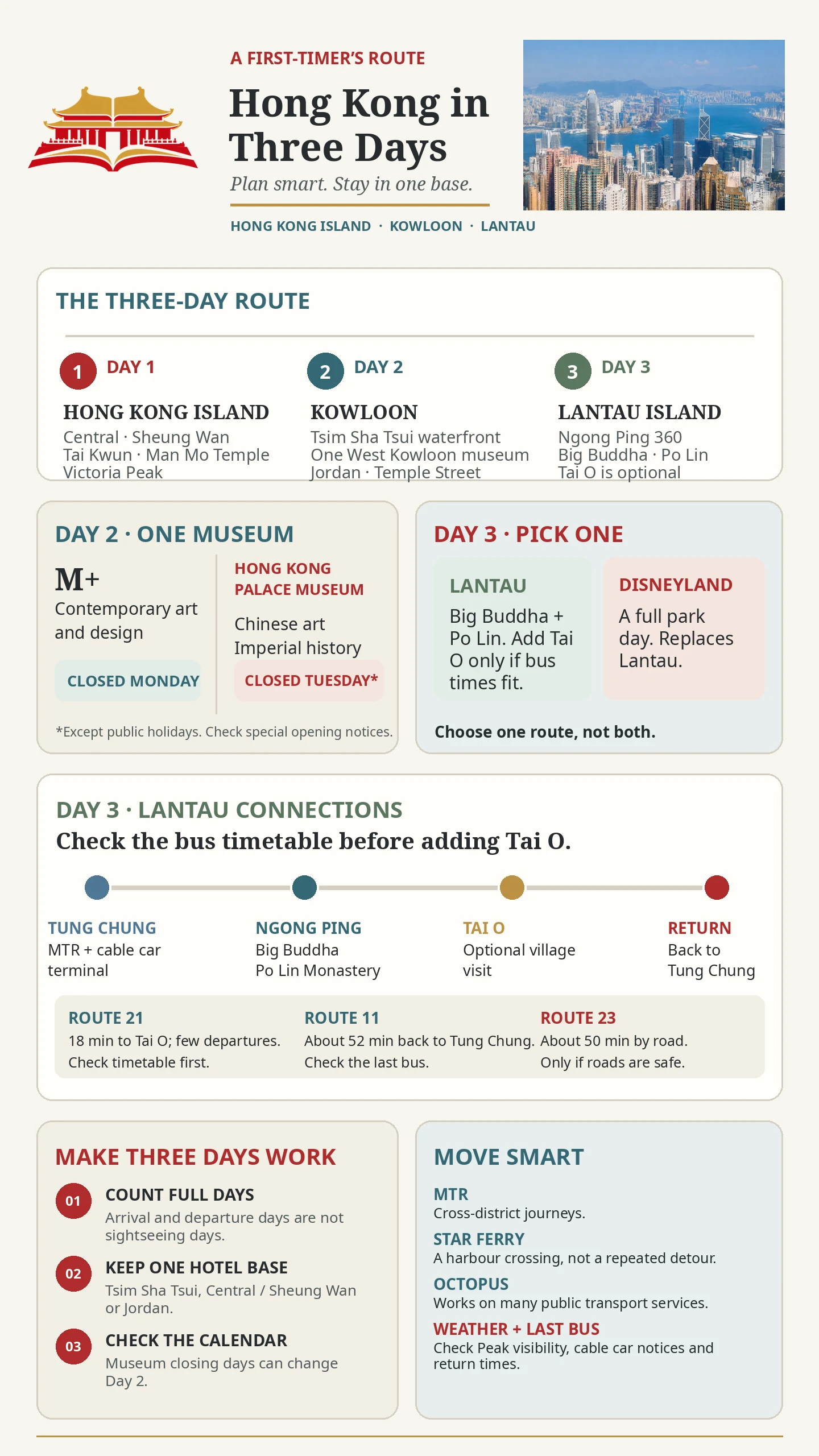
With 3 days in Hong Kong, first-time visitors can see more comfortably by grouping sights by area rather than chasing a long checklist. Hong Kong is compact on a map but divided by a harbour, steep hills and island transport links. This route gives Hong Kong Island, Kowloon and Lantau their own days, with one museum choice and a theme-park alternative. For a wider overview, start with the Hong Kong Travel Guide.
Before You Start: How to Use This 3-Day Hong Kong Itinerary
Three Full Sightseeing Days, Not Three Calendar Days
Count three days only when most daylight hours are available for sightseeing. A midday arrival, late check-in or early departure can reduce a three-day stay to fewer than two full days. Do not schedule Lantau on the morning of an international flight or high-speed train: its cable car and rural buses need flexibility.
With two full days, keep the Hong Kong Island and Kowloon routes and leave Lantau for another visit. With one day, use the one-day Hong Kong itinerary instead of compressing all three days. If you can stay longer, the five-day Hong Kong itinerary shows how to add another experience at a more relaxed pace. Check the entry conditions for your passport in the Hong Kong visitor entry guide. Hong Kong and mainland China have separate immigration systems.
Choose One Hotel Base for All Three Days
Use one hotel for all three days. Changing hotels to save a harbour crossing adds packing, check-out and check-in time. Tsim Sha Tsui suits the Kowloon waterfront and ferry; Central or Sheung Wan works for Day 1; Jordan gives access to local food streets and Yau Ma Tei. Compare areas in the Where to Stay in Hong Kong guide before choosing.
Plan airport transfers separately with the Hong Kong airport transfer guide; high-speed rail passengers should check exits and onward connections at Hong Kong West Kowloon Station; it is separate from Kowloon Station. Once the hotel is chosen, check which MTR exit is closest to the entrance and whether the final walk includes stairs or a steep slope. A hotel described as “near a station” may still involve a long underground passage or a difficult street-level approach.
Day 1: Explore Hong Kong Island — Central, Sheung Wan and Victoria Peak
Morning — Discover Central and Sheung Wan
Start near Central Market and Queen’s Road Central, then explore the Central–Mid-Levels Escalator and Walkway System, Tai Kwun, Hollywood Road and Man Mo Temple. The route moves from the business district into older lanes, galleries and historic buildings.
The escalator system combines separate escalators, travelators and covered walkways. It runs downhill during the morning commute and uphill later; the Transport Department lists the general change at 10:00 a.m. Follow local signs because individual sections may be under maintenance. It does not reach Victoria Peak, and some walking is still required. [1]
Central Market is a useful orientation point, but do not spend the whole morning shopping there if you want to see the older streets. Tai Kwun is worth allowing time for because its courtyards and restored buildings are part of the experience, not just a quick photo stop. The exact exhibition programme changes, so check what is open if a particular gallery or event matters to you.
Use the Hollywood Road or Old Bailey Street entrance for Tai Kwun, the former Central Police Station compound now used for heritage, exhibitions and public space. Continue west to Man Mo Temple, generally open from 8:00 a.m. to 6:00 p.m.; check special arrangements around religious dates. [2][3]
Expect hills, stairs and slopes; a short map distance can still be tiring. For a slower morning, spend longer at Tai Kwun and skip shopping detours.
Afternoon — Ride the Peak Tram to Victoria Peak
Walk to the Peak Tram Lower Terminus and ride up to Victoria Peak. The queue and boarding process can take longer than the ride, especially on busy dates. Check official notices and ticket options before setting out, and allow time for the return journey. [4]
At the top, choose between the paid Sky Terrace 428 and public viewpoints or walking paths. Lugard Road offers a broader panorama but requires more walking; you do not need an observation-deck ticket to enjoy the Peak. The Peak Tower area has cafés and shops if you need a break, but do not let them displace the return journey or your evening plans.
Visibility is decisive. Low cloud, haze or heavy rain can obscure the view, so a paid deck or sunset panorama is never guaranteed. If conditions are poor, return to Central for an indoor stop or an earlier dinner.
For a dedicated route, transport choices and viewpoint details, use the Victoria Peak visitor guide. The Peak Tram is a funicular railway, not a city tram, and its lower terminus is a separate walk from Central MTR exits. After your visit, use the tram or a local bus to return downhill; do not assume the Mid-Levels Escalator is a direct connection from the Peak.
Evening — Enjoy Dinner Around Central or SoHo
After descending, stay around Central and SoHo for dinner. The area offers local cafés, casual restaurants and international dining without another harbour crossing. Use the Hong Kong food guide to decide what to try; this itinerary does not depend on a particular restaurant booking.
If you still have energy, take a short Hong Kong Tramways ride along the north shore. Treat it as a scenic extra, not a fast connection. Wan Chai or Causeway Bay is optional; keep the evening on the island rather than crossing to Tsim Sha Tsui and back. This keeps the day’s route simple and leaves the harbour crossing for the next morning, when it fits naturally into the Kowloon plan.
Day 2: Explore Kowloon — Tsim Sha Tsui, West Kowloon and Temple Street
Morning — Start at the Tsim Sha Tsui Waterfront
Begin at the Tsim Sha Tsui waterfront and follow the promenade past the Clock Tower and Avenue of Stars. The view places Hong Kong Island’s skyline opposite Kowloon’s waterfront and cultural venues.
If your hotel is on Hong Kong Island, take the Star Ferry from Central to Tsim Sha Tsui if the crossing fits your route. Check the pier, timetable and service notices, especially during poor weather or special events. [5] Read the Star Ferry visitor guide if you want to plan the crossing itself.
If you are staying in Kowloon, start at the waterfront rather than crossing the harbour just to tick off the ferry. The Clock Tower is a remnant of the former Kowloon–Canton Railway terminus, while the Avenue of Stars gives you a promenade view of the island skyline. You can enjoy the waterfront without buying an attraction ticket; keep the morning flexible and move on when you have had enough time for photos.
Afternoon — Choose One Museum in West Kowloon
Choose one major museum in the West Kowloon Cultural District. M+ suits contemporary visual culture, design, architecture and moving image; the Hong Kong Palace Museum suits visitors interested in Chinese art, imperial history and changing exhibitions. Either can take several hours.
Check the weekday first: M+ is normally closed on Mondays, while the Hong Kong Palace Museum is normally closed on Tuesdays except public holidays. Special arrangements can override these patterns, and exhibitions and ticket conditions change. Confirm details before you travel. [6][7]
One museum is enough for this itinerary. If neither collection interests you, use the time for the West Kowloon waterfront and a relaxed lunch. The district is spread out, so allow for walks between transport stops, the waterfront and museum entrances. The Hong Kong Palace Museum visitor guide has more detail if you choose that museum. M+ is a broad contemporary-visual-culture museum, so visitors interested in design and architecture may prefer it; the Palace Museum is a more focused choice for Chinese imperial objects and art. Check the current exhibition list rather than choosing only by the building or its name. If your chosen museum is closed, do not automatically switch to the other without checking its hours and ticket availability; the Art Park and waterfront provide a useful open-air alternative.
Evening — Explore Jordan, Yau Ma Tei and Temple Street
From West Kowloon, use the MTR or a taxi to reach Jordan and Yau Ma Tei, then spend the evening around Temple Street. The area trades the waterfront skyline for smaller streets, market stalls and casual eateries. Browse at your own pace.
Treat Temple Street as an evening neighbourhood stop; stalls and business activity vary. If you continue towards Mong Kok, use the MTR when tired or when streets are crowded. For more night-time options, see Hong Kong at Night. Street food, casual seafood and local snacks are easy to find around this part of Kowloon, but opening hours and individual vendors change. Keep dinner flexible rather than building the evening around one stall that may not be operating.
As of 13 November 2026, A Symphony of Lights is scheduled for its final performance on 18 November 2026. Do not describe it as a permanent nightly show after that date; check current event listings for seasonal harbourfront displays instead. [14]
Day 3: Explore Lantau Island — Ngong Ping, Big Buddha and Tai O
Morning — Travel to Tung Chung and Take Ngong Ping 360
Take the MTR to Tung Chung and walk to the Ngong Ping 360 terminal beside the station. The cable car is the most direct sightseeing route to Ngong Ping Village. Hours vary by weekday, weekend and special date, so check the official calendar and allow for queues. [11]
Rainstorms or thunderstorms can suspend the cable car, and scheduled maintenance can close the service while the village remains open. Check the operator’s live notice rather than relying on an old timetable or ticket screenshot. [11][12]
Midday — Visit Tian Tan Buddha and Po Lin Monastery
At Ngong Ping, visit Tian Tan Buddha (the Big Buddha) and Po Lin Monastery. The village, monastery and Buddha platform are close enough to combine on foot. Reaching the Buddha platform requires a substantial climb of steps, so allow extra time if you prefer a slower pace or have limited mobility. If the stairs are not manageable, enjoy the monastery and village and skip the upper platform.
Have lunch near the monastery or in Ngong Ping Village. Vegetarian options are available, but check ingredients if you have dietary restrictions. Give the area time before heading to Tai O. The monastery is an active religious site as well as a visitor attraction: follow posted guidance, keep noise low in prayer areas and ask before photographing worshippers or ceremonies.
For the cultural and practical details of this part of the island, see the Lantau Island visitor guide.
Afternoon — Continue to Tai O Fishing Village
Tai O is optional. If the timetable fits, take New Lantao Bus Route 21 from Ngong Ping; the operator lists the ride at about 18 minutes, but departures are limited. Check the exact time before leaving the Buddha area. If the wait or return connection is awkward, skip Tai O and return to Tung Chung. [8]
In Tai O, explore the stilt houses, waterfront lanes and small shops. Route 11 returns to Tung Chung in an operator-listed journey of about 52 minutes. Check the last departure and allow for waiting and traffic before committing to the village. [9]
If the cable car is suspended, Route 23 is a road connection between Ngong Ping and Tung Chung; the operator lists about 50 minutes for the route. Use it only if the bus is running and roads are safe. Severe weather can disrupt both modes. [10][12]
Prioritize the Big Buddha and Po Lin Monastery. Add Tai O only when Routes 21 and 11 fit comfortably; do not risk the last useful connection to complete every stop.
Prefer Hong Kong Disneyland? Replace Day 3
Hong Kong Disneyland is a full-day alternative for families and theme-park fans. Take the MTR to Sunny Bay and transfer to the Disneyland Resort Line. Check the official calendar for date-specific hours, shows, attraction closures and admission arrangements before buying tickets. [15][16]
If you choose Disneyland, remove the entire Ngong Ping and Tai O route; the park is not a short stop to add after lunch. Families can use the Hong Kong with Kids guide for broader family planning and the Hong Kong Disneyland visitor guide for park-specific details. Plan to arrive near opening time and decide in advance which rides, shows or character experiences matter most. The entertainment schedule can change, so leave room to adjust rather than trying to follow an old online timetable.
Practical Planning: Transport, Tickets and Weather
Getting Around Hong Kong
Use the MTR for cross-district journeys, walking within neighbourhoods, the Star Ferry for a harbour crossing and buses on Lantau. The tram is scenic but slow; taxis help with luggage, steep last-mile trips or late returns. On the MTR, check the exit number before leaving the platform: Central, Tsim Sha Tsui and other large stations have long passages and multiple street exits. For Lantau, check the bus direction as well as the route number, since the same route may operate in opposite directions from different termini.
| Transport | Best Use on This Itinerary | Planning Note |
|---|---|---|
| MTR | Cross-district travel and reaching Tung Chung | Check the correct station exit and allow time for large interchanges. |
| Star Ferry | Central–Tsim Sha Tsui harbour crossing | Check the pier and sailing notices before departure. |
| Hong Kong Tramways | Slow sightseeing along the island’s north shore | Use for the experience, not for a tight connection. |
| Franchised buses | Lantau and local connections | Check the route, direction and last departure, especially on Lantau. |
| Taxi | Last-mile trips, luggage and late returns | Save the destination name and address in Traditional Chinese when useful. |
An Octopus card is a convenient option for many services, including the MTR, buses, ferries, public light buses and trams. Keep a backup payment method for services with different arrangements. For details, see the Hong Kong transport guide, Hong Kong MTR guide or Octopus card guide. [13] For route planning, use the MTR or operator’s own app alongside a general map. Large stations have multiple exits and long internal passages; choosing the wrong exit can add more walking than the train ride itself. Save your hotel’s address and the nearest station exit before leaving your accommodation.
What Should You Book in Advance?
- Peak Tram: Check current ticket options and consider advance purchase for busy dates, while keeping the weather forecast in mind.
- Ngong Ping 360: Check service notices and buy through the official website or an authorized channel; do not assume a ticket guarantees operation during bad weather.
- M+ or Hong Kong Palace Museum: Confirm the closing day, current exhibitions and ticket requirements before choosing your Day 2 museum.
- Hong Kong Disneyland: Check the operating calendar and admission conditions for your exact date before building the day around the park.
- Restaurants: Reserve only if you have a specific popular restaurant in mind; the route itself works with flexible meal choices.
For any prepaid attraction, read the date, entry window and cancellation terms before checkout. A ticket for a particular day does not guarantee that a weather-sensitive service will operate, and a museum exhibition may have separate admission conditions from the building’s general opening hours.
Weather and Route Flexibility
Humidity, cloud and rain can change the experience. Low cloud may hide the Peak, while rain or thunderstorms can suspend Ngong Ping 360. Check the Hong Kong Observatory’s warnings and the operators’ service notices on the morning of each outdoor day. [17] If the Peak forecast is poor, swap the city walk and viewpoint timing; Day 1 and Day 2 can trade places if museum closing days allow it.
For Lantau, check the cable car notice and New Lantao Bus timetable before leaving. If conditions or return connections are uncertain, shorten the route or choose a city-based alternative. The best time to visit Hong Kong guide explains the broader seasonal trade-offs; no season guarantees clear Peak views or uninterrupted outdoor transport. A day with a rainstorm or typhoon warning may require a complete change of plan, not just a different departure time. Keep one indoor option in reserve, and avoid making the final bus or ferry of the day the only way back to your hotel.
FAQs About Spending 3 Days in Hong Kong
Is Three Days Enough to Visit Hong Kong?
Yes, with three full sightseeing days focused on Hong Kong Island, Kowloon and one Lantau experience. There is not enough time to add every island, a theme park and a cross-border trip.
Can You Visit Hong Kong Disneyland and the Big Buddha in One Day?
No. Disneyland needs a full day, and the Ngong Ping–Big Buddha–Tai O route is a separate island day. Choose one.
Should You Visit M+ and the Hong Kong Palace Museum on the Same Day?
Choose one for a meaningful visit. M+ and the Hong Kong Palace Museum serve different interests and have different regular closing days: Monday and Tuesday respectively, subject to special arrangements.
Does a Three-Day Hong Kong Itinerary Include Arrival and Departure Days?
No. It assumes three days with most daylight hours available. Keep airport or rail transfers, check-in and luggage handling outside the sightseeing days.
What Should You Do If Ngong Ping 360 Is Closed?
Check whether Route 23 is operating and roads are safe. If the closure is weather-related or the bus is unreliable, shorten or cancel the Lantau route rather than assuming the road alternative is available.
Sources
[1] Hong Kong Transport Department. Central to Mid-Levels Escalator and Walkway System
[2] Tai Kwun. Visiting Information
[3] Tung Wah Group of Hospitals. Man Mo Temple Opening Hours and Address
[4] The Peak Hong Kong. The Peak Tram and Sky Terrace 428 Opening Hours
[5] The Star Ferry Company. Ferry Services and Timetables
[6] M+. Plan Your Visit
[7] Hong Kong Palace Museum. Plan Your Visit
[8] New Lantao Bus. Route 21: Ngong Ping to Tai O
[9] New Lantao Bus. Route 11: Tai O to Tung Chung
[10] New Lantao Bus. Route 23: Ngong Ping to Tung Chung
[11] Ngong Ping 360. Visitor Information and Opening Hours
[12] Ngong Ping 360. Cable Car Service and Bad Weather FAQs
[13] Octopus. Tourist Octopus
[14] Hong Kong Tourism Board. A Symphony of Lights to Stage Final Performance on 18 November 2026
[15] Hong Kong Disneyland Resort. Travel Information
[16] Hong Kong Disneyland Resort. Hours and Events Calendar
[17] Hong Kong Observatory. Weather Warnings and Signals





